

Key Takeaways
Measure progress by the behavior changed, not the feature shipped.
A costly lesson. In 2006, a Wall Street product team spent two years building a sophisticated trading app intended to help the business serve new kinds of trades. The app never shipped. The team had mistaken a promising product for progress, without first checking whether customers needed it or whether simpler options could work. Features can function exactly as designed and still fail to create value, like a website prompt that drives visitors away instead of attracting subscribers.
Name the result. Seiden defines an outcome as a change in human behavior that contributes to business results. A feature is something made; an outcome is what people do differently because of it. A well, for instance, is an output. Villagers spending less time hauling water is an outcome. Improved living standards are the wider impact.
The distinction is useful because software makes completion easy to count and value hard to see. A shipped feature is tangible, reportable, and often politically satisfying, even when customers ignore it. Behavioral measures pull attention closer to the people the product is meant to serve. Still, outputs are not the enemy: teams need to build things, and some work is necessary infrastructure whose value appears indirectly. The practical shift is to stop treating delivery as proof of benefit. A feature becomes evidence of progress only when its intended users adopt it or behave in a way that matters.
Translate executive ambitions into one observable customer action.
Separate the levels. A business impact, such as higher revenue or lower costs, is important but too broad to guide a team directly. An output is what the team makes. Between them sits the outcome: a specific behavior that can be observed and measured, such as customers returning more often or completing a purchase. In a village well project, building the well is the output, carrying water less often is the outcome, and a better standard of living is the impact.
Ask better questions. Seiden’s practical prompts are: Which human behaviors contribute to the result? How might the organization encourage those behaviors? What evidence would show the approach is working? The same principle improves OKRs, or Objectives and Key Results: define key results as measurable user or customer behavior, rather than as a list of features.
This middle layer solves a genuine coordination problem. Executives need to discuss broad organizational performance, while teams need a target close enough to their work to influence. A behavioral outcome can connect those levels without dictating the solution. It also makes a key assumption visible: that the behavior really contributes to the desired business result. That link should be examined rather than treated as self-evident. Otherwise, a team may optimize an easy-to-count action that looks promising but does not meaningfully improve revenue, cost, or customer value.
Treat each solution as a hypothesis until behavior shows its value.
Make uncertainty testable. Teams rarely know in advance whether a proposed feature will change customer behavior. Seiden recommends expressing the proposal as a hypothesis, then running an experiment to gather evidence. A minimum viable product, or MVP, means the smallest action or thing that can test an idea. It is not necessarily an early version of the finished product.
Learn before committing. To test whether a village well might improve daily life, a team could temporarily pump water to a central location and observe what villagers do with the time saved. That test is cheaper and faster than building the permanent well first. The Wall Street team could likewise have tried small services for traders before committing to a massive app. Small failures would have provided information without consuming two years.
This approach treats product development as applied science: state a belief, design a test, observe results, and revise. It is especially valuable when consequences are uncertain and expensive commitments are hard to reverse. The discipline lies in testing the causal claim, not merely launching something small. A test can show that people use a service without proving that it improves business performance. Some outcomes also take a long time to appear, and experiments involving customers or employees require care, clear expectations, and respect for privacy.
Choose leading behaviors that predict the business result you want.
Look upstream. A lagging indicator records a result after it has happened, such as how often customers visited a store last month. A leading indicator tracks a behavior that may predict that result and give a team something to influence. For an online T-shirt shop hoping to increase repeat visits, newsletter opens or customers sharing shirt images might be useful candidates.
Test the connection. Those actions count as outcomes only if they contribute to the business result. The shop might find that customers who share images return more often, but that pattern alone does not establish why they return. The team can check existing data or run a small experiment, then measure whether changing the behavior affects visits. The point is not to collect more metrics. It is to identify behaviors that are both actionable and meaningfully related to the result.
Leading indicators make management more actionable because they focus attention on something teams can try to change. But a proxy can become a trap when it is easier to improve than the underlying result. More email opens, for example, may not mean more purchases, and pushing for opens at any cost could annoy customers. The distinction between prediction and causation matters: a behavior can forecast a result without causing it. The strongest measures therefore pair an early signal with the business outcome it is meant to influence, and remain open to evidence that the link is weak.
Build roadmaps around customer problems, not guessed feature dates.
Map the lived experience. A customer journey map lays out, step by step, what customers and other participants do while using a service. It makes behavior visible across the whole experience, rather than focusing only on one screen or team. In a nonprofit marketplace that matched buyers and sellers, a team mapped both sides of the service and the organization’s role.
Find the leverage points. The team marked behaviors linked to successful experiences as boosters and behaviors linked to failure as blockers. It learned that buyers and sellers who met early tended to have better experiences, but distance made meeting difficult. The roadmap could therefore focus on questions and measurable outcomes, such as increasing early meetings, rather than promising a particular feature by a particular date. Proposed solutions remain hypotheses until tested.
A journey map helps teams see that customer experience is produced across handoffs, channels, and human interactions, not just by an individual feature. That wider view can reveal where an intervention might matter most. Yet a map is a model, not the customer’s complete reality. It can hide differences among customer groups or turn a few interviews into an overconfident account of everyone’s experience. Teams should use it to generate questions, then check those questions against observation and data. An outcome-focused roadmap preserves room to learn instead of presenting uncertain guesses as commitments.
Link user improvements to business results before choosing features.
Connect both sides. At HBR.org, a team reframed a subscription project around reducing the rate of people who began checkout but did not finish. Data showed that many left when they saw the price. Interviews with people who had abandoned the process suggested that the pricing display was confusing. The team made pricing visible earlier and showed prices relevant to each user’s region.
Make the reasoning explicit. Outcome-based work requires a clear connection between the change sought for users and the result sought for the business. In this case, less confusion should help more users complete a subscription purchase. The team can then test whether the changes reduce abandonment and improve purchases. Framing the effort this way leaves open the solution: the team can investigate and iterate rather than assume a redesign or a particular feature is the answer.
This case illustrates how user research and business measurement can reinforce each other. Data identified where people left; interviews helped explain why; the team then changed the experience in response. That combination is stronger than relying on either analytics or anecdotes alone. The proposed link still needs measurement, because a clearer price display might improve completion while affecting other parts of the business in unexpected ways. Linking user and business outcomes is not a guarantee that their interests always align. It is a way to state the intended exchange clearly and notice when the evidence contradicts it.
Replace feature queues with shared goals, honest learning, and trust.
Reset the work system. HBR.org faced a backlog containing more than two years of requests, including tickets submitted in 2014. The team and stakeholders recognized that the queue created false confidence: much of the work was unlikely to be done. They cleared the old backlog, set the three most important executive goals each quarter, and asked new requests to explain the problem, evidence, and intended result.
Organize around results. The group formed teams focused on helping readers buy and consume content, alongside an operations team for routine work. Moving away from promised feature lists unsettled some stakeholders, who worried about losing influence or being surprised. The team responded with more frequent check-ins and open retrospectives about what had and had not worked. Over time, stakeholder satisfaction improved, and the team felt more confident that its efforts mattered to the business.
The backlog story shows that planning practices can create their own demand. When people expect long waits, they bundle more requests together; larger requests take longer, which deepens the queue and encourages still more bundling. Clearing the list removed the comforting fiction that every request was a commitment. But a reset only works when paired with a credible way to choose new work and keep stakeholders involved. Outcome-based teams need discretion, while stakeholders hold important context. Regular communication and visible learning help reconcile those needs without pretending that either side has complete information.
Transform organizations by treating colleagues as customers and testing change.
Define internal behavior. A strategy team trying to align regional leaders asked what it would mean for those leaders to adopt the strategy. A useful sign would be that they could describe it consistently and use shared guidelines when considering changes. Those are observable behaviors, not vague hopes that people feel aligned. Treating colleagues as customers means understanding their needs and making the proposed change useful to them.
Run a small test. An innovation leader emailed 400 employees about training in a new technology and invited them to reply if interested. About one in three did. That response gave her evidence of demand before she built a larger program. The same pattern applies to organizational transformation: identify the behavior sought, try a low-risk intervention, observe what happens, and invest further when evidence supports it.
Internal change often fails because plans describe a desired future state without showing how people will experience the transition. Treating colleagues as customers encourages leaders to ask what would make a new process worthwhile, clear, and feasible for those expected to adopt it. Observable behaviors also make progress less dependent on slogans or self-reported enthusiasm. Still, uptake is not the same as durable adoption: employees may sign up for training and never use the technology. Good tests therefore distinguish initial interest from sustained practice, while avoiding the assumption that resistance is merely a communication problem.
Analysis
Seiden’s central argument is that organizations confuse production with progress. In software and service work, there is rarely a natural finish line: a feature can be complete while the customer problem remains. His answer is to manage through outcomes, defined as changes in human behavior that contribute to business results. This gives teams a target more concrete than executive aspirations and less prescriptive than a feature list. The book’s strongest contribution is not simply a new metric. It is a different relationship between planning and knowledge. Teams begin with a desired behavior, make their assumptions explicit, and test possible ways to influence it. Roadmaps become plans for reducing uncertainty, not polished forecasts of work whose value is unknown. The HBR.org case makes clear that this shift also changes organizational power. Product teams gain room to choose solutions, while stakeholders must share context and accept more frequent learning in place of fixed feature promises.
The approach works best when the behavior-to-business link is plausible, measurable, and within a team’s influence. Those conditions are not automatic. A metric may predict a result without causing it, and optimization can distort behavior if a proxy becomes a target. Customer benefit and business benefit may also conflict. The framework is therefore strongest when paired with explicit hypotheses, multiple forms of evidence, and attention to unintended effects.
The book also applies the method to transformation itself. Employees and stakeholders are not obstacles to be moved through a change plan; they are participants whose behavior determines whether a change takes hold. Small tests can reveal whether a proposed policy, message, or training effort is useful before it is scaled. Across products and organizations, the lasting discipline is to ask what people will do differently, why that change matters, and what evidence would justify continuing.
Review Summary
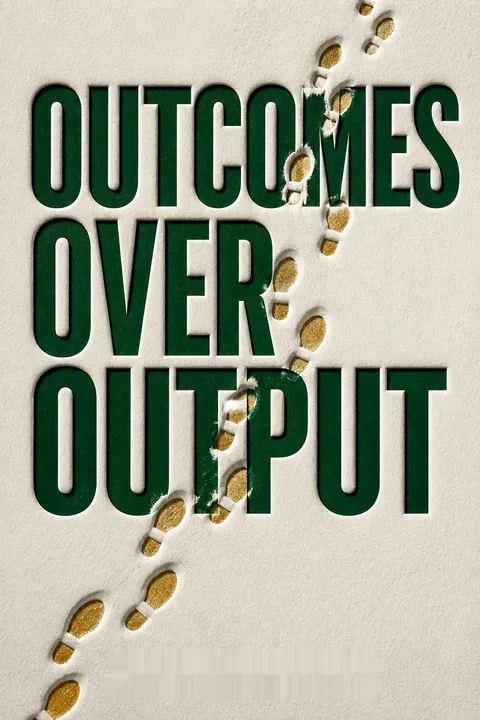
Outcomes Over Output receives high praise for its concise yet impactful message on focusing on behavioral changes that drive business results. Readers appreciate its practical approach to product management, emphasizing outcomes over features. Many found it transformative, offering a new perspective on goal-setting and strategy. The book's brevity and clarity are frequently highlighted as strengths. While some found it life-changing, a few readers felt it lacked depth in certain areas. Overall, it's widely recommended for product managers, leaders, and anyone involved in software development.
People Also Read







Glossary
Outcome
Behavior change tied to resultsIn Seiden’s usage, an outcome is a change in customer, user, employee, or other human behavior that contributes to business results. It is distinct from an output, which is what a team makes, and an impact, which is a broader organizational result. Outcomes give teams a specific, observable target without dictating the solution.
Output
A thing producedAn output is a product, feature, service, or other deliverable created by a team. Outputs can be completed and shipped, but completion does not prove that customers use them or that they create value. Seiden argues that outputs should be treated as possible means to an outcome, rather than as the primary measure of progress.
Impact
A broad organizational resultImpact is the larger result an organization ultimately wants, such as greater revenue, lower costs, or an improved standard of living. It usually depends on many contributing factors and is too broad to serve as a direct target for one team. Outcomes provide nearer-term behavioral measures that can contribute to the desired impact.
Program Logic Model
A chain from resources to impactA planning model that connects the resources used in a program to its activities, outputs, outcomes, and eventual impact. In the book’s well example, resources and construction activities produce a well; the well may reduce the time villagers spend carrying water; that behavioral change may contribute to improved living standards. The model clarifies what a project produces and what it hopes to change.
Minimum Viable Product (MVP)
Smallest useful experimentSeiden uses MVP to mean the smallest action or thing that can test a hypothesis. It does not have to be an early release of the eventual product. An MVP is useful when it generates evidence about whether an idea can produce the intended outcome, before a team commits to a larger or more expensive solution.
Leading vs. lagging indicators
Predictive and historical measuresA lagging indicator records a result that has already occurred, such as how often customers visited a site in the past. A leading indicator measures a behavior that may predict that result and can potentially be influenced, such as opening an email or sharing a product image. A proposed leading indicator must be checked against the business outcome it is supposed to predict.
Customer Journey Map
A map of service behaviorsA left-to-right view of the steps people take as they interact with a product or service. It can include customer, employee, and organizational actions, helping teams see behaviors across an entire experience rather than within one feature or channel. Teams use the map to identify behaviors associated with success, failure, satisfaction, or frustration.
OKR
Objectives and Key ResultsOKR stands for Objectives and Key Results, a planning approach intended to connect work to broader goals and track whether those goals are being achieved. Seiden recommends expressing key results as measurable user, customer, or stakeholder behavior. This keeps the result separate from the features or tactics a team chooses to produce it.
Net Promoter Score (NPS)
Likelihood of recommending a serviceNet Promoter Score is a measure used to assess how likely customers are to recommend a product or service to others. In the book’s example, improving NPS is treated as a broad impact rather than a direct instruction to a team. Mapping the service journey helps identify specific behaviors that may contribute to greater satisfaction.
Download PDF
Download EPUB
.epub digital book format is ideal for reading ebooks on phones, tablets, and e-readers.








