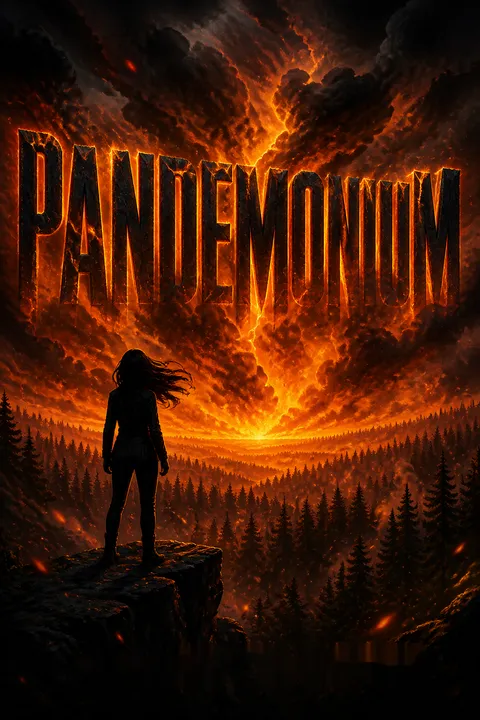


Plot Summary
The Fence Takes Alex
Lena escapes Portland with Alex, the boy she loves, but regulators and guards catch them at the border. She sees Alex left behind as she crosses alone, then staggers through the woods with a bullet wound, fever, and no idea where to go. After days of crawling and stumbling, she collapses.
Raven, a young Invalid living beyond the fence, finds her and nurses her through the fever. When Lena wakes in a cellar beneath a ruined church, Raven confirms she has reached a free zone. She also makes clear that Lena cannot keep living as the girl who crossed with Alex. Lena has survived the fence, but survival begins with the loss she cannot yet bear to name.
The escape is a physical crossing and a psychological amputation. Lena enters the Wilds believing Alex will share the danger, then must make decisions without him while grief and bodily weakness strip away her old certainties. Raven's care is practical rather than sentimental: water, bandages, food, and a demand that Lena orient herself to the present. This establishes a conflict that will recur throughout the novel. Lena needs attachment to survive, yet the people around her treat dependence on the past as a threat to survival.
Life Beneath the Church
Raven introduces Lena to a crowded homestead hidden below the bombed remains of a church. Sarah helps her eat and find clothes, while Blue, a quiet child Raven protects, watches from the edges of the room. Lena meets Hunter, a cheerful boy, Tack, a guarded young man, and Roach, the resourceful cook.
Their shared meals, makeshift supplies, and easy physical closeness unsettle Lena, who was taught to fear uncured people and contact between boys and girls. Aboveground, Sarah guides her through the ruined town, where school lockers and broken buildings expose the truth behind the government's sanitized account of the blitz. Lena is still grieving Alex, but the people she was taught to despise have carried her, fed her, and made room for her.
The homestead changes Lena's assumptions through material evidence rather than argument. The Invalids are not an abstraction or a cautionary tale: they ration water, share food, and make a bed for someone who cannot repay them. The bombed town extends this lesson into history, exposing how official language can erase human suffering by describing destruction as clean and swift. Lena's first steps toward belonging are therefore also steps toward recognizing that the state has trained her to misread both people and the past.
Water Becomes a Test
As supplies dwindle and Lena remains too weak to help, Raven tells her that staying means working. Lena chooses the daily trip to the river, where she struggles to carry water until her body begins to recover. She runs through the broken streets, using the thought that Alex might still be alive to force herself farther, even while knowing that running cannot bring him back.
Hunter teaches her how birds carry messages from sympathizers inside the cities: painted seed leaves the nests green for an expected delivery, yellow for delay, and red for danger. Lena also learns that Hana has undergone her procedure. The new work gives her a place in the homestead, but the news from home deepens the grief she has been trying to outrun.
Labor gives Lena a form of agency that neither denial nor mourning can provide. At first, she uses exercise as a bargain with the impossible, treating each mile as if it could restore Alex; gradually, training becomes a way to inhabit her own body again. The bird code offers a complementary lesson: survival depends on reading signs and trusting networks beyond one's immediate sight. Lena is learning the skills of the Wilds, but she still organizes her effort around loss.
Miyako's Unmarked Pyre
When Miyako falls ill, Raven insists she will recover, but the older woman grows weaker and dies. Frozen ground makes a grave nearly impossible, and Raven argues that the homestead must burn the body rather than spend strength it cannot spare. Lena challenges her, then helps carry Miyako to a gully where the group sets her alight.
The smoke and the smell of burning leave Lena furious at the conditions that have reduced their choices to this. She returns to the burrow, retrieves the old clothes she wore when she arrived, and buries them beneath a juniper bush. The gesture gives her a private farewell to the life she left behind, while Raven's decision exposes the brutal arithmetic that governs the community's care.
Miyako's death makes the moral cost of scarcity immediate. Raven's choice is not cruelty, but Lena experiences it as a refusal to honor a person whose life mattered. Their conflict reveals that survival can require decisions that resemble the violence the homesteaders oppose. By burying her old clothes, Lena creates a ritual where the group has none available. She does not resolve her grief; she gives it a physical place, marking a small distinction between adaptation and erasure.
Red Birds Over Rochester
With winter closing in, the homestead prepares to move south, and the scouts leave to cache food along the route. At the message nests, Lena finds birds coated in red paint, the warning that everyone must run. She races back as aircraft appear and bombs strike the settlement.
The survivors flee beside the river while helicopters spread chemicals over the burning woods; Squirrel and Grandma are missing, and most stored food and medical supplies are lost. Raven leads the group toward the first camp, though she must abandon hope that Tack and Hunter will return in time.
At the camp, Lena accepts the resistance's painful procedure, a false three-pronged scar behind her ear that lets her pass as cured. The mark prepares her for covert work, but it also disguises the identity she has chosen.
The painted birds turn a fragile communication system into the difference between escape and annihilation. Lena's ability to recognize the warning gives her a role in saving others, shifting her from a dependent patient into a participant. The false scar then complicates that new identity: she can move through the society that rejected her only by wearing its symbol. The resistance offers protection and purpose, but its methods already require Lena to submit her body and story to a cause whose boundaries she does not yet understand.
A Cure Made of Fire
During the southbound trek, Raven tests Lena's readiness by making her kill a trapped rabbit. When Lena resists, Raven reveals that she knows Alex's name and insists that life in the Wilds will keep demanding painful choices.
Lena finally drives the knife into the animal, then cries for the first time since Alex's loss. The journey grows colder, and Blue becomes feverish and confused. While Raven watches over the child, she tells Lena how she found Blue as an abandoned newborn and fled across the fence rather than let the authorities dispose of her.
Blue dies before dawn. Raven wraps her in her own sweater and buries her beside the river. Lena witnesses the grief beneath Raven's command, though neither woman can afford to stop moving for long.
Raven's lesson about the rabbit is an attempt to prepare Lena, but it also exposes the limits of her hard-edged philosophy. Lena can accept necessity and still mourn the creature; grief is not proof of weakness or a failure to adapt. Raven's story about Blue reveals that her authority began with an act of compassion and risk, not merely control. Blue's death tests that origin: Raven can protect a child from the state's judgment, but she cannot protect her from illness and exposure.
The Empty Hartford Cache
At the third planned camp, the travelers find no buried food and no sign that Tack and Hunter completed their route. Before the group can decide what to do, Scavengers disguised in the snowy woods spring an ambush. Lena and Raven run with Sarah, but the attackers corner them among rocks. Rifle shots break the attack: Tack and Hunter have survived and returned in time to save them.
The reunited group continues south, sheltering at a remote house whose residents share food, then crossing the icy Tappan Zee Bridge toward Salvage, a homestead near New York's landfill. Months later, Lena lives under a forged identity in Brooklyn, with Raven and Tack posing as her guardians. The escape from the north has become a new assignment inside the city.
The missing cache turns a planned migration into a test of whether the group can survive without its systems. The ambush confirms that danger is not an abstract possibility but an organized force that can exploit exhaustion and separation. Tack and Hunter's return restores the group without undoing its losses. Reaching Salvage marks a change in Lena's role: she is no longer simply fleeing the regulated world, but preparing to enter it under a false identity and act within its institutions.
The Girl Behind Glass
In Brooklyn, Lena attends school as Lena Morgan Jones, a supposedly cured orphan, while secretly observing the Deliria-Free America movement for Raven. At a rally, she watches its founder, Thomas Fineman, promote early treatment despite the risks to young patients.
His son Julian, the youth division's celebrated leader, supports the procedure scheduled for him on the day of a major demonstration, though earlier brain surgeries make it especially dangerous. After the meeting, Lena returns for a lost glove and finds Julian alone, projecting images of mountains, ocean, and forests onto the auditorium screen.
He claims the pictures are surveillance for Invalid camps, but Lena recognizes the lie. Their brief encounter gives her a glimpse of longing beneath his polished public role, even as she remains convinced that he represents everything she opposes.
Julian's public certainty and private images establish the novel's central contradiction: a person can serve an ideology while secretly imagining a world beyond it. Lena recognizes the longing because she has already crossed the border, yet she cannot translate that recognition into trust. Her own performance as a cured girl mirrors Julian's rehearsed public role. Both characters inhabit identities designed by institutions, and their first connection begins when one catches the other imagining beyond the approved script.
Times Square Turns Savage
At the enormous Times Square demonstration, Lena tries to keep Julian in sight as he prepares to appear with his father. Three small explosions trigger a violent assault by masked Scavengers, while police fire into the crowd.
Lena escapes a robber and sees Julian's bodyguards usher him through a concealed subway entrance. She follows, finds the guards killed, and hears Julian deeper in the tunnels. Before she can reach him, Scavengers seize her and knock her unconscious.
Lena wakes in a locked underground cell with Julian, who has also been captured. Their captors feed them just enough to keep them alive and question Julian about his family's security. Neither knows who arranged the attack or why they have been taken, and Lena has no way to contact Raven or Tack.
The demonstration converts political theater into actual bodily danger. The crowd's chants and the police's weapons make public order look indistinguishable from panic once violence begins. Lena's decision to follow Julian is both loyalty to her assignment and an emerging personal choice, though she cannot yet separate the two. In the cell, the pair lose the protections of status and ideology. Their survival will depend on what they can learn from one another rather than on the systems that have claimed to protect them.
Stories in the Cell
Lena and Julian initially treat each other as enemies, but stories loosen their distrust. Julian recounts finding forbidden books as a child and being beaten by his father; Lena shares memories of her mother and learns how lonely Julian has been.
In the dark, he touches her hair, and their small tenderness makes the division between them harder to maintain. When Scavengers take Julian away and return him badly beaten, Lena tends his injuries and admits her forged identity.
He accuses her of belonging to the people who captured them, so she stops trying to win his trust and searches for a way out. Marked pages in The Book of Shhh point her to Tack's knife, hidden inside the umbrella. Lena tricks a guard into opening the cell and frees Julian.
The cell makes intimacy possible without making it safe. Stories let Lena and Julian approach experiences their public roles suppress, including fear, childhood loneliness, and forbidden desire. Yet the disclosure of Lena's identity reactivates Julian's learned suspicion, showing how quickly state narratives reclaim the mind under pressure. Her decision to escape without waiting for his approval is important: she can care about him without surrendering her judgment. The hidden knife, planted by allies, turns trust in a network into a practical means of resistance.
The City Below
Lena and Julian break into the Scavengers' supply room, where weapons, stolen identification cards, and DFA badges suggest that the attackers have powerful connections. They fight two pursuers; Julian saves Lena by stabbing the man about to kill her.
Fleeing through the tunnels, they are intercepted by people living belowground, including Coin, a woman who protects children born with visible differences, and a pale guide who travels with rats. Coin's community treats their wounds and gives them food before the guide leads them to the surface near Manhattan's landfill.
Lena recognizes the route to Salvage. There, she and Julian share a bath, a meal, and their first kiss. Before they can decide what their closeness means, police raid the homestead and take them.
The underground community extends the novel's critique beyond the cure: a society obsessed with uniformity also casts out people whose bodies mark them as different. Coin's care contradicts the assumption that only the regulated world can provide safety. Lena and Julian's kiss arrives after they have acted for one another under mortal pressure, not as a sudden escape from politics. The raid interrupts that fragile possibility and reasserts how quickly private choice can be seized by institutions and factions.
The Resistance's Price
A masked freedom fighter extracts Lena from the police operation and takes her to a resistance warehouse, leaving Julian in custody. Raven and Tack explain that the resistance arranged for Scavengers to abduct both young people, hoping Julian would reject the DFA and draw its followers away.
The DFA had also paid Scavengers to stage the Times Square attack as propaganda, making the two factions' schemes collide. The resistance expected Lena to survive, but she and Julian were beaten and nearly killed.
When Lena learns that Julian is scheduled for execution, Raven insists he is expendable to the cause. Lena rejects that calculation, steals supplies, and slips away alone toward New York. Her loyalty to Julian has become a choice she makes against the very movement that recruited her.
The revelation exposes the resistance as an organization capable of reproducing the logic it opposes: individuals become instruments, and danger is justified by a projected collective benefit. Lena's anger is not simply romantic rebellion. She recognizes the moral resemblance between Raven's calculation and the DFA's language of sacrifice. Her choice to leave does not make her politically naïve; it marks a refusal to let membership dictate whom she is permitted to protect. The cause has given her skills, but it cannot own her conscience.
A Son on the Table
Lena enters the Fineman townhouse to find Julian, but he has already been moved. In Thomas's forbidden study, she finds a prison record for Annabel Haloway, her mother, and recognizes the number tattooed on the freedom fighter who rescued her.
She learns that her mother was the masked woman, though there is no time to find her. Following Thomas's plans, Lena reaches the clinic where Julian is about to be executed. Raven, disguised as a lab worker, shoots Thomas, creating the confusion Lena needs to reach Julian and unlock his handcuffs.
Raven, Lena, and Julian escape by the fire stairs and reunite with Tack outside. The rescue gives Julian his life back, but it also leaves Thomas dead and Lena with the knowledge that her mother was close enough to touch.
The townhouse sequence joins Lena's personal history to the political machinery of the present. Her mother's prison record is not a comforting reunion; it is evidence that the past has survived in altered, painful form. At the clinic, Raven's violence saves Julian while making the resistance's own methods impossible to ignore. Lena's rescue is therefore neither a clean victory nor a return to her former loyalties. She saves a person, learns a truth, and inherits new questions all at once.
A Voice from the Past
Back at the resistance warehouse, Lena learns that Annabel has already left with senior members of the movement; Raven cannot tell her where. Julian stays with Lena, and after they acknowledge their feelings, they kiss without the secrecy imposed by the cities. The group prepares to move north, and Lena believes she and Julian may begin a life in the Wilds together.
Then a voice warns her not to trust him. Alex stands behind them, alive but changed, with a scarred face and a number tattooed beside the mark Lena had taken for proof of his cure. The boy Lena mourned has returned at the exact moment she has begun to choose a future with someone else. Her reunion with the past leaves the story suspended between love, loyalty, and uncertainty.
The ending refuses the easy closure of replacing one love with another. Lena has acted on her desire for Julian, but Alex's return makes that choice newly complicated rather than invalid. His altered appearance also recalls the novel's repeated concern with manufactured identities: marks can disguise, certify, or betray, and none guarantees that a person is fully known. The final interruption restores emotional uncertainty after Lena has gained political and physical agency. She is free to choose, but freedom does not spare her from the consequences of choice.
Analysis
Pandemonium treats love not as a private escape from politics but as a capacity to notice and value particular people. The cure regime converts that capacity into pathology, while the resistance risks converting it into a resource to be spent for victory. Lena encounters both forms of instrumentalization: the DFA demands that Julian accept a dangerous procedure for the public good, and the resistance secretly places him in danger to weaken his father's movement. Her refusal to accept either calculation is the story's deepest act of rebellion.
The novel also links political control to the management of bodies and histories. A scar can certify obedience or conceal dissent; a prison record can erase a mother from a child's life; official accounts of the bombing campaign can render mass death tidy. Against that imposed order, the Wilds preserve knowledge through labor, shared memory, and fragile signals such as painted bird nests. Yet the Wilds are not romanticized as a perfect alternative. Hunger, illness, exposure, and Raven's painful decisions show that freedom without resources can become its own coercion.
Lena's development is therefore not a simple movement from fear to courage. She learns to act, but also to distrust any cause that claims the right to dictate what she must feel or whom she must abandon. Julian's transformation parallels hers: his public certainty begins to fracture as he experiences care, danger, and forbidden books outside the explanations supplied by his father. The ending with Alex interrupts the apparent resolution with Julian, refusing to make emotional freedom neat or exclusive. Lena has gained the power to choose, but the return of her past makes clear that choice will remain difficult, consequential, and alive.
Review Summary
Pandemonium received mostly positive reviews, with readers praising its fast-paced plot, character development, and emotional intensity. Many found it an improvement over Delirium, appreciating the dual timeline narrative and Lena's growth. The new characters, especially Julian, were well-received, though some readers expressed mixed feelings about the love triangle. The ending's cliffhanger shocked and excited fans, leaving them eager for the final book. Some criticism was directed at predictable plot elements and the alternating timeline structure, which some found confusing.
People Also Read






Characters
Lena
The border-crossing rebelLena begins as a young woman taught to fear love and trust the cure, then loses the person who helped her question that doctrine. Her time in the Wilds forces her to rebuild herself through physical work, observation, and relationships that contradict her old education. She is resourceful and stubborn, but grief can make her reckless, and she repeatedly has to decide whether survival means hardening herself or remaining responsive to other people. Her false identity allows her to move through the regulated world, yet her deepest conflicts cannot be solved by disguise. Lena's defining drive is not abstract rebellion; it is the insistence that individuals should not be sacrificed without their consent.
Julian Fineman
The DFA's reluctant symbolJulian is the son of Thomas Fineman, the public face of Deliria-Free America, and a celebrated advocate for a procedure that doctors fear may kill him. Years of illness, hospitals, and family pressure have taught him to perform composure and obedience. Beneath that discipline, he is curious, imaginative, and hungry for forms of experience his society forbids. Lena first sees him as an enemy, but their confinement reveals how little he knows about ordinary closeness and how much he has concealed from his public image. His central tension is between the security of a prescribed life and the frightening possibility that his own feelings might be worth trusting.
Raven
The survival-minded leaderRaven leads the northern homestead with practical authority, rationing supplies and making decisions that keep the group moving. She rescued Lena but does not offer comfort without expectations; she believes people must learn to work, endure, and act quickly. Her guardedness comes from a past she refuses to discuss and from the repeated losses that have taught her to treat attachment as a liability. Raven's care is real, though she often expresses it through commands rather than tenderness. She represents the strength and danger of a survival ethic: it protects the vulnerable, yet can also make sacrifice seem like the only available answer.
Tack
The wary resistance mentorTack is a capable, sharp-tempered member of Raven's circle who understands the practical risks of living outside the borders. He hunts, plans, gathers intelligence, and tends to show concern through action rather than reassurance. His relationship with Raven is close but argumentative, especially when he believes secrecy is costing the people they claim to protect. To Lena, he becomes a source of training and a model of vigilance. Tack's caution is not simple distrust; it comes from knowing that careless choices can expose an entire community. He values loyalty, but his disagreements with Raven reveal that loyalty does not always mean silence.
Alex
Lena's first great loveAlex is the boy whose love helped Lena see through the doctrine that emotion is a disease. His absence shapes her early life in the Wilds, where she preserves memories of him while trying to become strong enough to continue without him. He is associated with the books, tenderness, and imagined future that Lena lost at the border. Because her memories carry both comfort and pain, she often avoids speaking about him directly. Alex remains a powerful presence in Lena's choices, not merely as a romantic figure but as the person who first made another kind of life imaginable.
Thomas Fineman
The cure movement's patriarchThomas is the founder of Deliria-Free America and Julian's father. He presents early treatment as a necessary sacrifice for public safety, using his son's medical history to make the cause more persuasive. His polished public manner contrasts with the fear and control that shape his family life. Thomas sees social order as a moral good and treats dissent as a danger to be contained. His influence over Julian is both political and intimate, making him more than a distant spokesman for the system.
Annabel Haloway
Lena's imprisoned motherAnnabel is Lena's mother, taken to prison when Lena was a child and believed lost for most of her life. Lena's memories of her are fragmentary: a warm presence, a playful imagination, and moments of home that survived the official story of her disappearance. Annabel's absence has shaped Lena's longing to understand where she came from. The little Lena remembers suggests a woman who offered her daughter imaginative freedom in a society that restricts both feeling and thought.
Blue
Raven's fiercely protected childBlue is a shy, barefoot child raised in Raven's homestead. Her vivid eyes and small gestures make her difficult for Lena to approach at first, because they recall people Lena has left behind. She trusts Raven's rules and watches newcomers carefully. Blue's quietness is not emptiness; it reflects a young life shaped by communal hardship and the need to stay close to the adults who keep her safe.
Hunter
The homestead's openhearted scoutHunter is a friendly young man who helps Lena feel less like an intruder. He teaches her how the birds carry messages from sympathizers across the border and makes room for friendship without demanding that she explain her past. His ease with people offers Lena a lived counterexample to the warnings she learned in the cities. Hunter is also one of the group's scouts, accustomed to reading the land and sharing responsibility.
Sarah
The homestead's young helperSarah is a practical, lively child who helps Lena find food, clothes, and her first place at the communal table. She repeats Raven's lessons but also brings her own warmth and curiosity to them. Sarah knows the homestead's routines and treats ordinary work as part of belonging. Her openness gives Lena a gentler route into the community than Raven's stern tests do.
Miyako
A steady homestead caretakerMiyako is a strong, capable member of the homestead who helps feed and care for the group. She is particularly gentle with Sarah, offering comfort through touch and practical attention. Her presence shows Lena the ordinary tenderness that can survive in a place defined by hunger and labor. Miyako's care is quiet and communal, woven into meals and daily routines rather than announced.
Coin
The underground community's hostCoin lives among people pushed belowground because their bodies do not meet the regulated society's standard of normality. She is wary of outsiders but takes responsibility for those who arrive injured, offering food, water, and a place to recover. Her clear voice and careful questions challenge the assumption that bodily difference signals moral or intellectual inferiority. Coin's community has built a life from what the surface discards, and she insists that every person deserves a place.
The rat-man
The tunnel guideA pale, light-sensitive guide, he navigates the underground tunnels with the help of rats he feeds and understands. He avoids the surface and speaks sparingly, but leads Lena and Julian out when Coin asks him to. His private history reveals the cost of choosing life outside the cure.
Bram
The quiet homestead handBram is a quiet, capable member of Raven's homestead who helps with difficult tasks and joins the water runs. His steady presence and occasional humor make him one of the people Lena can begin to trust without a long explanation.
Hana
Lena's childhood best friendHana is Lena's closest friend from her life inside Portland. They shared school, running, and the unremarkable hours of adolescence, which Lena only recognizes as precious after leaving. Hana represents the relationships Lena lost to the cure system, as well as the life she once expected to live. Lena's memories of her are affectionate but increasingly difficult to approach.
Plot Devices
The cure and its scar
A body marked for belongingIn the cities, the procedure is presented as protection from love, and its scar signals that a person has been treated. The mark shapes Lena's fear and Julian's public role, while a convincing false version lets Lena pass as cured during covert work. The device makes ideology visible on the body: the same scar can be a medical sign, a badge of obedience, or a disguise.
Painted bird nests
Warnings carried across bordersSympathizers feed paint-mixed seeds to birds on the city side of the fence. When the birds return to their nests, their colors tell the homesteaders whether supplies are coming, delayed, or whether they must flee. The system joins human planning to animal behavior, giving Lena a skill that becomes crucial when the homestead is attacked.
The marked book and umbrella
A hidden route to escapeTack sends Lena to the rally with The Book of Shhh and an umbrella. Marked passages in the book point her toward a hidden weapon, while the umbrella conceals a knife. Together, the objects turn trusted preparation into a practical escape plan when Lena is imprisoned, and show how ordinary belongings can carry resistance knowledge through surveillance.
Forged identities
A mask for crossing systemsLena's invented identity, Lena Morgan Jones, lets her attend school and observe the DFA without exposing her history. The resistance equips her with papers and a false cure mark, while household documents and careful routines help conceal the people sheltering her. The cover story protects her, but it also forces her to keep separating her public self from the life she actually remembers.
The Scavenger operation
Two factions weaponize one attackScavengers attack the Times Square rally as part of a DFA-backed attempt to portray uncured people as a public menace. Separately, the resistance arranges for Scavengers to abduct Julian and Lena, hoping Julian's break with the movement will weaken the DFA. The overlapping schemes turn the captives into political instruments and reveal that both sides are willing to gamble with individual lives.
FAQ
Synopsis & Basic Details
What is Pandemonium about?
- Lena's Dual Journey: Pandemonium follows Lena Haloway's harrowing journey after escaping the controlled society of Portland, where love is deemed a disease. The narrative unfolds in a dual timeline, alternating between "Then" (her brutal survival in the Wilds and integration into the resistance) and "Now" (her undercover life in New York City, infiltrating the Deliria-Free America (DFA) movement).
- Survival and Resistance: "Then" chronicles Lena's physical and emotional transformation as she learns to survive in the untamed Wilds, finding a new family among the Invalids (uncured individuals) and joining the burgeoning resistance movement. "Now" sees her operating as Lena Morgan Jones, a seemingly cured citizen, tasked with observing and undermining the very system she once believed in.
- Unveiling Deeper Truths: The story delves into the complexities of freedom, identity, and the nature of love, as Lena grapples with her past, the loss of Alex, and the harsh realities of the resistance's fight. It explores the moral ambiguities of war, forcing Lena to confront difficult choices and the blurred lines between right and wrong in a world defined by fear and control.
Why should I read Pandemonium?
- Intense Emotional Depth: The novel offers a raw and unflinching portrayal of grief, trauma, and the struggle for identity, particularly through Lena's internal monologues and her attempts to reconcile her past with her present. Readers will connect with her profound emotional journey, making it a compelling read for those who appreciate character-driven narratives.
- Complex Moral Questions: Pandemonium challenges readers to consider the ethical dilemmas of a resistance movement, where "the greater good" can justify morally ambiguous actions. It forces a re-evaluation of what constitutes "good" and "evil" in a world where both sides commit atrocities, providing rich ground for discussion and thought.
- Masterful Dual Narrative: Lauren Oliver expertly weaves together two distinct timelines, building suspense and revealing Lena's transformation in a compelling way. The "Then" chapters provide crucial context and emotional weight to the "Now" chapters, creating a narrative tapestry that is both intricate and deeply satisfying.
What is the background of Pandemonium?
- Post-Blitz Dystopia: The world of Pandemonium is set after a catastrophic event known as "the blitz," a government-led bombing campaign aimed at eradicating "deliria" (love) and the "Invalids" (uncured individuals) who refused the cure. This event shaped the landscape, creating the Wilds – unregulated, dangerous territories – and the "sister cities" – highly controlled, bordered communities.
- Societal Control through Fear: The dominant political and cultural force is the Deliria-Free America (DFA) movement, which propagates the belief that love is a deadly disease. Society is structured around strict segregation (e.g., boys and girls, cured and uncured), constant surveillance, and mandatory "cures" (a lobotomy-like procedure) to suppress emotions, ensuring "Safety, Health, and Happiness."
- Underground Resistance: Opposing the DFA is a growing, decentralized resistance movement, comprised of Invalids and sympathizers. They operate from hidden homesteads in the Wilds and underground networks in the cities, fighting to dismantle the system and reclaim freedom, often resorting to violent tactics that mirror the government's own brutality.
What are the most memorable quotes in Pandemonium?
- "Love, it kills you. Both when you have it… And when you don't.": This quote, a recurring thought for Lena, encapsulates the central paradox of the novel's world. It highlights the devastating impact of love, whether through its presence (leading to the "disease" and persecution) or its absence (the emotional void of the cured society and Lena's grief for Alex). It underscores the pervasive suffering caused by the system's suppression of natural human emotion.
- "There is no before. There is only now, and what comes next.": Raven's mantra, repeated to Lena early in her time in the Wilds, serves as a stark philosophy for survival and adaptation. It emphasizes the necessity of shedding past identities and attachments to endure the harsh realities of their new world, reflecting the constant reinvention required of the resistance fighters.
- "You can't tell me what to feel.": Lena's defiant retort to Raven, particularly after the revelation of the resistance's manipulative tactics, marks a pivotal moment in her character arc. This statement signifies her reclaiming of emotional autonomy and her refusal to be controlled, whether by the oppressive government or the pragmatic, sometimes ruthless, resistance. It's a powerful declaration of individual freedom against all forms of ideological coercion.
What writing style, narrative choices, and literary techniques does Lauren Oliver use?
- Alternating Dual Narrative: Oliver employs a distinctive "Now" and "Then" chapter structure, creating a compelling sense of suspense and revealing Lena's character development in layers. This non-linear approach allows for thematic parallels and contrasts between Lena's past trauma and her present mission, enriching the reader's understanding of her internal state and the world's complexities.
- Sensory and Metaphorical Language: The prose is rich with vivid sensory details, particularly in descriptions of the Wilds ("fire in my legs and lungs," "air smells like winter already") and Lena's emotional states ("Grief is like sinking, like being buried"). Oliver frequently uses metaphors (e.g., hatred as a "high tower," the world as a "funhouse") to convey abstract concepts and Lena's internal landscape.
- First-Person Introspection and Foreshadowing: The story is told from Lena's first-person perspective, providing deep access to her thoughts, fears, and evolving understanding of the world. Subtle foreshadowing, often through dreams, recurring motifs (like the color red or the image of birds), and seemingly casual dialogue, builds tension and hints at future revelations, keeping the reader engaged and guessing.
Hidden Details & Subtle Connections
What are some minor details that add significant meaning?
- Ants on Rotten Fruit: Lena's opening dream of Alex and the picnic blanket features "half-rotten fruit, swarmed by tiny black ants." This seemingly minor detail subtly foreshadows Alex's perceived death and the decay of Lena's old life, hinting at the corruption and hidden dangers that will infest her new reality, much like the ants on the fruit.
- The "Store" in the Wilds: The description of the homestead's "store" filled with scavenged clothes, including a plastic plate with "ghostly silhouettes of animals," highlights the post-apocalyptic reality and the resourcefulness of the Invalids. It underscores their ability to create a functional society from the remnants of the old, symbolizing their resilience and rejection of the cured world's wastefulness.
- Julian's Brother's Room: The "unused, sterile" bedroom in the Fineman house, which Lena instinctively feels was Julian's brother's, is a poignant detail. It symbolizes the emotional void and suppressed grief within the cured society, where even the memory of a loved one is sanitized and locked away, reflecting the dehumanizing effects of the cure.
What are some subtle foreshadowing and callbacks?
- Julian's "Pretend" Games: Julian's childhood habit of "pretending" to be an explorer and imagining "other places" (like the mountains and ocean he views on the screen) subtly foreshadows his innate curiosity and yearning for a world beyond the controlled cities. This hidden desire makes his eventual defection from the DFA more believable and connects him thematically to Lena's own journey for freedom.
- Raven's "No Before" Mantra: Raven's insistence that "There is no before. There is only now, and what comes next" is a constant refrain. However, her later, reluctant revelation of her own past—finding Blue, her abusive father, her escape—serves as a powerful callback that subverts her own philosophy, demonstrating that the past, no matter how buried, always shapes the present.
- The "You Get Used to It" Refrain: The phrase "You get used to it" is repeated by Sarah (about the food), Hunter (about Tack's attitude/whiskey), and Lena herself (about the Wilds' hardships). This recurring callback highlights the pervasive theme of adaptation and resilience in the face of adversity, whether it's the physical discomfort of the Wilds or the emotional toll of a life on the run.
What are some unexpected character connections?
- Julian and Lena's Shared Trauma: Beyond their romantic connection, Julian and Lena are deeply connected by their shared experience of family loss and the system's brutality. Julian's story of his brother's death and his father's coldness ("He drove the whole way home without saying a word") mirrors Lena's own grief for Alex and her mother's imprisonment, forging a bond rooted in mutual understanding of profound suffering.
- The Rat-Man's Sacrifice: The unnamed "rat-man" who guides Lena and Julian through the tunnels reveals he chose to live underground because his loved one "was cured" and he "didn't want to lose her again." This unexpected connection highlights a parallel to Lena's own choice to remain uncured for Alex, showcasing that love, even in its absence, can drive profound acts of self-sacrifice and defiance against the system.
- Raven's Hidden Vulnerability: Raven, initially portrayed as a hardened, pragmatic leader, reveals a deep, unexpected connection to Blue, the child she rescued and named. Her story of finding Blue and her subsequent grief ("I have never seen Raven cry before") exposes a profound vulnerability that humanizes her and connects her to Lena's own capacity for love and loss, despite her tough exterior.
Who are the most significant supporting characters?
- Blue: More than just a child, Blue symbolizes the innocence and vulnerability of life in the Wilds, and the devastating cost of the government's attacks. Her eventual death, despite Raven's desperate efforts, serves as a profound emotional turning point for Raven, revealing her hidden depths of grief and driving her fierce protectiveness of the community.
- The Rat-Man (Unnamed Tunnel Dweller): This character, though unnamed, is crucial for revealing the diverse forms of resistance and the personal sacrifices made for love. His choice to live underground, away from his cured loved one, underscores the novel's central theme that love, even when forbidden, can lead to profound and enduring acts of defiance, offering a unique perspective on the consequences of the cure.
- Miyako: Her death from illness in the Wilds is a stark reminder of the harsh realities and constant dangers faced by the Invalids. Miyako's quiet strength and her simple act of comforting Sarah ("Miyako puts her arm around her and murmurs into Sarah's hair") highlight the deep bonds and compassion that exist within the resistance, contrasting with the coldness of the cured world.
Psychological, Emotional, & Relational Analysis
What are some unspoken motivations of the characters?
- Raven's Protective Instincts: While Raven presents as fiercely pragmatic and even ruthless, her unspoken motivation is a deep-seated, almost maternal, need to protect her community and prevent further loss. Her past trauma, particularly the story of her abusive father and her desperate attempt to save Blue, fuels her unwavering commitment to the resistance and her willingness to make hard choices, as she states, "I can try" to save everyone.
- Julian's Search for Authenticity: Julian's initial adherence to the DFA and his public persona mask a deeper, unspoken motivation: a yearning for authenticity and genuine connection. His secret "pretend" games and his confession about wanting the cure to kill him reveal a profound dissatisfaction with his controlled life, suggesting a subconscious desire to break free from the expectations and lies of his father's world.
- Lena's Need for Purpose: Beyond survival, Lena's unspoken motivation is a desperate need for purpose and meaning after Alex's perceived death. Her relentless running, her willingness to join the resistance, and her fierce protectiveness of Julian are all driven by a desire to find something to fight for, to fill the void left by her loss, and to prove that her sacrifices were not in vain.
What psychological complexities do the characters exhibit?
- Lena's Identity Fragmentation and Reintegration: Lena grapples with multiple identities: the "old Lena" (pre-Alex), the "new Lena" (hardened by the Wilds), and "Lena Morgan Jones" (her undercover persona). This fragmentation reflects her trauma and the constant need to adapt, but her journey is also about reintegrating these selves, particularly as she reclaims her capacity for love and defiance, as seen when she asserts, "You can't tell me what to feel."
- Julian's Conditioned Detachment vs. Innate Empathy: Julian embodies the psychological conflict of someone raised in a system that suppresses emotion. His initial "controlled detachment" and "perfection and practice" are deeply ingrained, yet his nightmares, his secret "forbidden" readings, and his growing empathy for Lena reveal an innate capacity for feeling that constantly battles his conditioning, leading to his eventual breakdown and rebellion.
- Raven's Pragmatic Hardness as a Defense Mechanism: Raven's "hardness" and "fierce" leadership are not inherent but a psychological defense mechanism developed from years of survival and loss. Her reluctance to speak of her past and her belief that "there is no before" indicate a deliberate suppression of painful memories, allowing her to function as a leader, even if it means appearing cold or ruthless to others.
What are the major emotional turning points?
- Lena's First Laughter with Julian: After days of grief and guardedness, Lena's spontaneous laughter with Julian over his childhood story of kissing ("At first I thought he was eating her") marks a significant emotional turning point. This shared moment of genuine humor breaks through her carefully constructed facade
Delirium Series

About the Author



Download PDF
Download EPUB
.epub digital book format is ideal for reading ebooks on phones, tablets, and e-readers.








