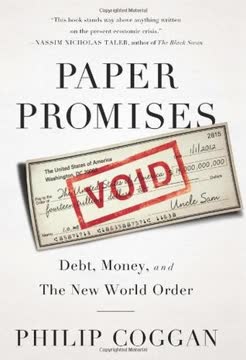
Key Takeaways
1. Money's Evolution: From Tangible Gold to Intangible Debt
Money is the belief that someone will pay you back.
Money's core functions. For millennia, money has served as a medium of exchange, a unit of account, and a store of value. Early forms ranged from precious metals like gold and silver to cowrie shells and even tobacco, each accepted based on collective belief and utility. The shift from tangible commodities to abstract representations like paper was driven by convenience and the need to overcome the limited supply of physical assets.
Paper money's rise. The Chinese introduced paper money over a thousand years ago, initially backed by copper, but its value often succumbed to government overprinting. In the West, goldsmiths' receipts for stored bullion evolved into banknotes, promising convertibility to precious metals. This promise, however, was a confidence trick, as banks rarely held enough gold to cover all notes, relying on the unlikelihood of a mass withdrawal.
Modern money is debt. Today, money is largely electronic data, created at will by central banks through mechanisms like quantitative easing (QE). This fiat money is no one's liability but a claim on someone else, whether a bank or a government. This fundamental shift means that modern money is debt, and debt is money, making their relationship inseparable and prone to expansion.
2. The Ancient War Between Creditors and Debtors
One can see all of economic history through this prism – a battle between those who lend money and those who borrow it.
Debt's ancient roots. Debt agreements predate coins by thousands of years, with early forms of interest tied to livestock or harvests. The concept of usury, or excessive interest, has been debated since Aristotle, with religious doctrines often condemning it, yet practical needs for credit always found ways around such injunctions. This tension highlights the inherent conflict between lenders seeking returns and borrowers seeking relief.
Monarchs and defaults. Throughout history, sovereigns frequently borrowed to finance wars and lavish courts, often resorting to arbitrary measures like debasing currency or outright default to escape their obligations. Philip IV of France ruined the Knights Templar, and Edward III of England defaulted during the Hundred Years War. The rise of parliamentary control in Britain and the Netherlands, however, created more stable financial systems by aligning state finances with the interests of the merchant and financier classes.
Moral and economic conflict. The debate over debt is deeply moral, pitting the creditor's demand for repayment against the debtor's plea for relief. While creditors emphasize responsibility and the need for interest to incentivize lending and investment, debtors often highlight predatory lending or the unfairness of repayment in times of hardship. This conflict shapes economic policy, as governments often face pressure to favor either the wealthy creditor minority or the more numerous debtor class.
3. The Gold Standard: Stability at the Cost of Flexibility
A sound currency is to the affairs of this life what a pure religion and a sound system of morals are to the affairs of a spiritual life.
The golden anchor. The gold standard, largely established by accident in Britain and adopted internationally in the late 19th century, fixed currency values to gold. This system provided exchange rate stability, low inflation, and fostered global trade and investment, creating a "golden age" of globalization. It reassured creditors that their money held "real" value, encouraging cross-border lending.
How it worked. In theory, trade imbalances under the gold standard would self-correct: a deficit country would lose gold, reducing its money supply, lowering prices, and making its exports more competitive. In practice, central banks managed this by adjusting interest rates to attract or repel capital flows, often requiring painful domestic economic adjustments. This rigidity, however, insulated politicians from public anger, as democratic accountability was limited.
Inherent weaknesses. Despite its perceived stability, the gold standard had flaws. Gold supply was lumpy and unrelated to economic activity, and the system relied on confidence and international cooperation among central bankers. The Barings crisis of 1890 exposed the need for central banks to act as lenders of last resort, a role that could conflict with maintaining gold convertibility. The outbreak of World War I, with its massive financing needs, ultimately forced its suspension, ending a 700-year era of gold coins in circulation.
4. Inter-War Failures: Hyperinflation, Depression, and the Rise of Keynes
The sound internal economic system of a nation is a greater factor in its well-being than the price of its currency.
Post-war disillusionment. After World War I, a desire to return to pre-war stability led to attempts to restore the gold standard, but the context had fundamentally changed. The US emerged as the dominant financial power, holding most of the world's gold, while Europe was burdened by war debts and reparations. This unequal distribution, coupled with new democratic pressures, made a robust return to gold nearly impossible.
German hyperinflation. Germany's post-war hyperinflation, fueled by excessive money printing to pay reparations and avoid tax increases, devastated the middle class and undermined faith in democracy. The Reichsmark's value plummeted from 4.2 to 630 billion per dollar in just nine years, a stark warning against unfettered fiat money. This trauma profoundly shaped Germany's enduring aversion to inflation.
Britain's costly return. Britain's decision in 1925 to return to the gold standard at its pre-war parity, championed by Winston Churchill and the financial establishment, proved disastrous. It overvalued sterling, making exports uncompetitive and requiring painful wage cuts, leading to high unemployment and the 1926 General Strike. This rigid adherence to sound money, despite Keynes's warnings, deepened economic hardship and contributed to the global deflationary spiral of the Great Depression.
5. Bretton Woods: The Dollar's Reign and Its Inherent Flaws
It’s our currency but your problem.
A new world order. Designed in 1944 to prevent inter-war economic mistakes, the Bretton Woods system established a new international monetary order. It aimed for stable exchange rates, encouraged trade, and created the IMF to assist countries with balance of payments issues. Crucially, it pegged global currencies to the US dollar, which was, in turn, convertible to gold for central banks, cementing the dollar's primacy.
Keynes vs. White. The system reflected a compromise between Keynes's vision of a large, multilateral clearing union with obligations for both debtors and creditors, and Harry Dexter White's more conservative, dollar-centric approach. While capital controls were implemented to allow independent monetary policy, the system's rigidity meant devaluations were rare and often seen as national humiliations, building long-term pressure.
The Triffin paradox. The dollar's role as the global reserve currency created an inherent dilemma: for the world to have enough dollars for trade and reserves, the US had to run persistent deficits. This "exorbitant privilege" allowed the US to print money for goods, but it also eroded confidence in the dollar's gold convertibility as US gold reserves dwindled. By the late 1960s, US spending on the Vietnam War and the Great Society reforms, coupled with rising inflation, made the system unsustainable, leading to Nixon's suspension of gold convertibility in 1971 and the collapse of Bretton Woods.
6. Post-1971: Unconstrained Paper Money Fuels Asset Bubbles
Stock market bubbles don’t grow out of thin air. They have a solid basis in reality, but reality as distorted by a misconception.
The era of fiat money. The collapse of Bretton Woods freed money from its gold anchor, ushering in an era of floating exchange rates and unconstrained money creation. This shift, a victory for debtors, led to an explosion in global debt and a new pattern of economic cycles driven by asset price bubbles rather than consumer price inflation. The ability to create money "out of thin air" removed a critical brake on speculative lending.
Debt-fueled asset booms. The link between increased debt and rising asset prices became self-reinforcing. Banks, eager for profit, relaxed lending standards, allowing more borrowers to enter markets like housing. This pushed prices to unprecedented highs, creating a "wealth effect" that encouraged further borrowing and spending, even though this "wealth" was often illusory and based on fictional valuations.
The Minsky effect. Economist Hyman Minsky described how financial stability breeds instability, leading to a progression from "hedge" (repaying principal and interest) to "speculative" (repaying only interest) to "Ponzi" (repaying neither) finance. These debt-fueled spirals, often driven by a "greater fool" theory, inevitably collapse when the supply of new buyers or credit dries up, revealing that much of the perceived wealth never truly existed.
7. The Financial Sector's Gravy Train: Risk, Leverage, and "Too Big to Fail"
The banking industry is a pollutant. Systemic risk is a noxious by-product.
Financial sector's explosive growth. The post-Bretton Woods era saw the financial sector's share of GDP and its employees' compensation skyrocket, particularly in Anglo-Saxon economies. This growth was fueled by the need to manage volatile floating exchange rates, the proliferation of complex derivatives, and the channeling of massive global capital flows, transforming banking from a staid profession into a highly lucrative, risk-taking industry.
Government backstop and moral hazard. The implicit government guarantee for "too big to fail" banks lowered their funding costs, effectively subsidizing their risk-taking and concentrating power in fewer, larger institutions. This moral hazard encouraged banks to take on excessive leverage and make riskier investments, knowing taxpayers would bear the ultimate cost of failure, as dramatically demonstrated in 2008.
Efficient market fallacy. Regulators, influenced by efficient-market theory and the perceived brilliance of financial "rocket scientists," adopted a light-touch approach, believing markets would self-correct. However, the complexity of new financial products, the "value-at-risk" models that underestimated extreme events, and the incentive structures for bankers to prioritize short-term gains over long-term stability proved this assumption catastrophically wrong, leading to systemic risk.
8. The 2008 Crisis: Private Debt Becomes Public Burden
The financial system had accumulated a series of claims on America’s housing stock. These claims were collectively worth far more than the houses themselves.
Sub-prime collapse. The 2007-08 crisis began with the bursting of the US sub-prime mortgage bubble, where lax lending standards allowed borrowers with poor credit to take on unsustainable debt. These risky loans were repackaged into complex mortgage-backed securities and collateralized debt obligations (CDOs), which were then widely distributed across the global financial system, obscuring the underlying risks.
Systemic contagion. When defaults surged, the value of these securities plummeted, freezing interbank lending and triggering a panic. Institutions like Bear Stearns and Lehman Brothers, heavily exposed to these assets and reliant on short-term funding, faced collapse. The crisis revealed that the financial system's claims on underlying assets far exceeded their real value, leading to a scramble to offload worthless paper.
Public debt surge. To prevent a complete economic meltdown, governments and central banks intervened massively, bailing out banks and injecting liquidity. This shifted trillions of dollars of private-sector debt onto public balance sheets, causing sovereign debt-to-GDP ratios to soar to levels unseen outside major wars. This unprecedented intervention, while averting a 1930s-style depression, merely transformed a private debt crisis into a public one, setting the stage for the Eurozone's struggles.
9. Demographic and Energy Headwinds Threaten Future Growth
For I, the Lord thy God am a jealous God, visiting the iniquity of the fathers upon the children unto the third and fourth generation of them that hate me.
Aging populations. Developed nations face a demographic time bomb: rapidly aging populations with declining birth rates and increasing longevity. This means fewer workers supporting more retirees, straining public finances through rising pension and healthcare costs. The worker-to-retiree ratio is projected to plummet, making it increasingly difficult to sustain existing social welfare systems without significant reforms.
Unfunded liabilities. Beyond explicit government debt, vast unfunded promises for public-sector pensions and healthcare (like US Medicare) represent hidden liabilities, often multiples of official GDP. These commitments, made by politicians for short-term gain, will fall on future generations of taxpayers. Attempts to address them through raising retirement ages, cutting benefits, or increasing contributions face fierce political opposition.
Energy efficiency decline. Compounding demographic challenges is the potential for declining energy efficiency. Economic growth has historically been fueled by cheap, easily accessible energy sources like coal and oil. However, new reserves are increasingly expensive and energy-intensive to extract, effectively raising the "tax" on economic activity. This could lead to higher energy prices, reduced productivity gains, and a lower standard of living, further hindering the ability to service mounting debts.
10. The Unholy Trinity: Inflation, Stagnation, or Default Await
The path pursued by fiscal authorities in a number of industrial countries is unsustainable.
The debt trap. Many developed nations are caught in a debt trap: high government debt, coupled with interest rates exceeding economic growth, necessitates painful primary budget surpluses. Attempts to achieve these surpluses through austerity often trigger recessions, further increasing debt-to-GDP ratios and alarming creditors. This vicious cycle, exemplified by Greece, makes debt repayment through growth alone increasingly implausible.
Three grim choices. With growth constrained by demographics and energy, and austerity proving politically and economically challenging, governments face an "unholy trinity" of outcomes:
- Inflation: Deliberately eroding the real value of debt through money printing, a "default in all but name" for creditors. This risks hyperinflation and investor flight.
- Stagnation: A prolonged period of low growth, high unemployment, and deleveraging, akin to Japan's "lost decades," where private sectors refuse to borrow despite low rates.
- Default: Outright repudiation of debt, either domestically or internationally, leading to financial turmoil, bank failures, and exclusion from capital markets.
Towards a new order. The current international monetary system, characterized by floating rates and massive capital flows, is unsustainable. The crisis will likely force a reordering, with China, as the world's largest creditor, playing a pivotal role in shaping the next regime. This could involve a managed currency system, capital controls, and a re-emergence of "financial repression" to coerce domestic savings into funding government debt, fundamentally altering global finance and the West's economic future.
Last updated:
Review Summary
Paper Promises by Philip Coggan examines the evolution of money from the gold standard to modern fiat currency, analyzing the ongoing struggle between creditors and debtors. Readers praise its accessible yet authoritative style, comparing it favorably to works by Niall Ferguson and Barry Eichengreen. The book traces monetary history through the Depression, Bretton Woods collapse, and 2008 financial crisis, explaining complex concepts without jargon. Coggan argues Western economies have accumulated unsustainable debt levels and predicts fundamental change, with China likely shaping the new financial order. Most reviewers found it enlightening and prescient.
Similar Books



 Immersive