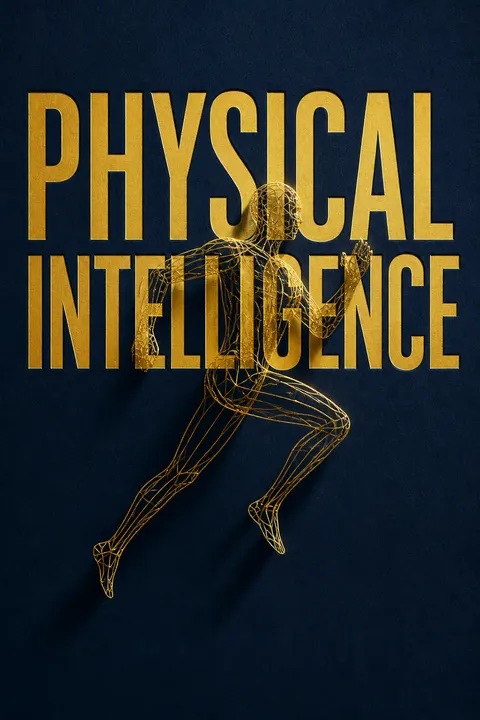


Key Takeaways
Treat bodily skill as intelligence, not as thought's lesser cousin
Intelligence in motion. Physical intelligence is the brain's capacity to learn through action, coordinate the body, and adapt to the world's demands. It is not housed in one brain module. It draws on many systems, most of which work without conscious narration. That hidden competence lets conscious thought focus elsewhere, while the brain keeps track of balance, movement, and immediate possibilities.
A self built by doing. Grafton opens with a farmer with Parkinson's disease who loses his driver's license and becomes depressed, then finds freedom again by driving his bulldozer around his land. His story shows that action can be central to identity, not merely a vehicle for thought. The ancient hunter Ötzi, equipped to travel and survive alone in the Alps, likewise depended on a repertoire of learned physical abilities that would have been ordinary in his world.
What's striking is how this view corrects a familiar bias: language is easy to report, so it can seem like the whole of intelligence. Research on embodied cognition similarly treats perception and thought as shaped by the body's capacities and actions. The idea does not make deliberate reasoning unimportant. Rather, it shows that reasoning often rests on skills that cannot be acquired by explanation alone. The farmer's story also cautions against treating mobility as a convenience: losing a valued action can mean losing a way of being oneself.
Train attention to widen before danger demands it
Space comes first. The brain builds an operational space, a usable mental layout in which it can notice events and direct action. After a stroke, some people lose awareness of the space on one side of their body. A visitor standing there may seem not merely unnoticed, but absent from the patient's working world. The example reveals that awareness and action depend on the brain being able to construct space.
Attention has no CEO. Grafton describes interacting networks that help focus attention, filter distractions, and decide what matters. In the wilderness, a cracking branch can become important; in a noisy campground, it may not. Gretzky's hockey awareness illustrates a trained alternative to staring at one target: brief glances update a broad sense of where players are. Mindfulness exercises can also train focused attention or open monitoring, where awareness stays receptive without fixing on one object.
This account fits a broader principle in cognitive science: attention is not simply a spotlight controlled by a single inner executive. It is a shifting coordination among goals, sensory events, and expectations. The distinction between focused attention and open monitoring is especially useful because different situations demand different settings. Yet vigilance has a cost. A soldier's trained scanning can help in danger and become hard to disengage from after trauma. Attention is not better when it is always wider; it is better when it can change with context.
Read surfaces as invitations and limits, not scenery
The world constrains action. Action perception is the largely unconscious sensing of features that matter for movement. A surface may be slippery, a gap passable, or a rock something to step over. Gibson's term affordance means an opportunity for action that depends on both the environment and the actor's abilities. A chair affords sitting to an adult, but not necessarily to a doll or a small child.
Experience teaches the match. In a campus eye-tracking study, walkers spent about 40 percent of their viewing time on the path and another 40 percent looking toward objects, often possible obstructions. Infants in Karen Adolph's experiments learned which slopes they could crawl down, but that knowledge did not transfer automatically to walking. Each action required its own experience. The lesson matters beyond childhood: a familiar-looking grassy patch may hide holes, and winter ice can defeat people who assume the surface is safe.
Affordances offer a practical way to think about design. A doorway is not simply wide or narrow; it is passable relative to a person's body, mobility, and carried objects. This perspective connects neuroscience to architecture and accessibility, where the same environment can enable one person and obstruct another. It also explains why fitness in a gym does not guarantee competence on uneven ground. A useful caution is that perception is fallible: practice calibrates judgments, but unfamiliar conditions can make a learned expectation dangerously wrong.
Practice varied movement to keep your internal body map calibrated
A body map for action. Proprioception is the sense of body position and movement supplied by signals from muscles, tendons, and joints. The brain combines these signals into a body schema, a continuously updated map used to guide action. In a tendon-vibration experiment, people felt their arm change position and even experienced their nose as stretching to reconcile conflicting sensory information. A rubber hand can also feel like one's own when sight and touch are coordinated.
Vision cannot replace it. Ian Waterman lost touch and proprioception below the neck after an illness. He relearned to sit, stand, and walk by watching his body, but movement remained effortful and fragile. He could not move quickly or make subtle adjustments without looking. The case shows why physical practice matters: the body schema is not just a conscious picture of the body, but an operational resource for coordinated movement.
The body schema is best understood as a working model, not a portrait stored in the head. Its flexibility helps people adapt to changing posture and sensory evidence, while also making body ownership vulnerable to illusions. This is a useful distinction in debates about selfhood: a person's felt body, named body parts, and ability to act are related but not identical. The rehabilitation story makes the cost of lost proprioception vivid, though a single remarkable case cannot specify how much practice is needed for every person or condition.
Let prediction guide fast movement before conscious deliberation intervenes
The hidden movement signal. An efference copy is an internal copy of a motor command that helps the brain predict the sensations a movement should produce. It can explain why self-tickling feels weaker than someone else's touch: the brain anticipates the self-produced sensation and discounts it. It also helps the brain distinguish self-generated motion from motion caused by the outside world.
Correction before awareness. A tennis return can allow only a fraction of a second to respond to a fast serve. Conscious reconsideration may be too slow, while an internal prediction of the unfolding swing helps the arm adjust in time. In lab studies, reaching movements changed direction within roughly 30 milliseconds of a target shifting. The parietal lobe helps relate the changing movement to its goal. This continual estimate of the body's current state relative to a goal is called state estimation.
Predictive control is a powerful solution to the delays built into biological systems. It resembles a skilled driver anticipating a curve rather than waiting to feel the car drift. The strongest account is not prediction instead of feedback, but prediction continually corrected by new sensory information. That balance explains both speed and flexibility. It also helps clarify why overthinking can disrupt a practiced action: conscious analysis may arrive too late to improve a movement already being adjusted by faster systems. Prediction remains fallible, especially when the situation is unfamiliar.
Build new skills by recombining movements, then refining them
Movement has building blocks. The brain does not need a separate instruction for every muscle in every action. A muscle synergy is a coordinated pattern of muscle activity that can be combined with other patterns to produce more complex movements. Research on frog legs found a small set of such patterns could reconstruct actions like jumping and scratching. In human hands, studies of everyday objects identified fourteen common grasp types, far fewer than the countless possible hand shapes.
Reuse, then specialize. A skilled person may learn a new action quickly by adapting familiar movement patterns. A novice may need to develop new coordination through much more practice. Grafton struggled to reassemble a camp stove because the task demanded unfamiliar finger combinations. Repetition can also become harmful: excessive identical movements may blur sensory distinctions and contribute to focal dystonia, a disorder involving involuntary stiffness or cramping. Skill needs both repetition and variety.
Movement building blocks help explain how practice can transfer across activities without implying that skills are interchangeable. A dancer's coordination may support balance on a beam, but a new task still has its own constraints. This resembles modular learning in other fields: reusable components speed up new work, while overly narrow practice can leave a person brittle. The account also makes a case for varied movement, particularly when a task requires fine control. The evidence does not yet provide a universal recipe for how much repetition or variation produces the best learning.
Treat problem-solving as learning, from bears to babies
Trying is part of thinking. Reinforcement learning is a process in which actions are tested and shaped by whether their outcomes improve or worsen. A hungry bear working at a food container may not begin with a plan; repeated attempts can teach it how a latch or handle works. Bears learned to open increasingly complex park food boxes, and one Adirondack bear, Yellow-Yellow, even opened a container by bracing it and manipulating its lid.
Sequences need structure. Babies learn ordered actions through thousands of attempts. To carry a spoon with food in the right orientation, an infant may first pass it to the other hand, then learn to choose the appropriate hand from the start. Simple trial and error becomes inefficient as a problem requires more steps. Hierarchical learning solves this by combining practiced subtasks into a larger plan. Model-based learning adds a mental representation of a solution, as in Köhler's chimpanzee stacking crates to reach a banana.
The bear examples make problem-solving tangible because success leaves visible traces: scratches, broken containers, and increasingly effective behavior. They also invite care in interpretation. A successful sequence does not by itself prove that an animal imagined the whole solution in advance; learning can emerge through exploration and feedback. The distinction between practiced routines and mental planning is useful well beyond animal cognition. Familiar subtasks free attention for coordinating a larger task, whether opening a jar or preparing several dishes at once.
Understand a tool's function, not merely its shape
Tools alter possibility. A stick can extend the arm, just as a rake lets a macaque pull distant food within reach. Experiments suggest that brief tool use can expand the brain's working map of the arm toward the tool's functional end. But a tool can also do more than lengthen the body. An ice axe's adze concentrates force to cut steps, while its pick provides a way to grip hard ice.
Function joins object and goal. A tool is useful because its properties fit an action and a problem. A climber who understands only that an ice axe can be swung like a hammer may fail to use it to stop a slide. Evidence from neurological patients with apraxia, who struggle to perform learned tool actions despite being able to move, suggests that knowledge of actions and tools is a distinct kind of knowledge, not just a list of object names.
Tool use shows cognition distributed across brain, body, object, and setting. The same stick becomes a walking aid, a lever, or a brake depending on what the situation requires. This connects naturally to human factors design: good tools make their useful actions legible, while poor design invites misuse. The distinction between incorporating a tool into the body's working map and recognizing it as separate from the self is also important. Flexible control does not require confusing the tool with one's body.
Use multiple maps; a GPS route is not spatial knowledge
Self-guidance drifts. In experiments, people asked to walk straight through a forest or desert often wandered into circles when clouds or darkness removed external cues. Small errors in sensing direction accumulate. The brain avoids this by combining reference frames, different coordinate systems for locating the body and objects. A person can use the sun, landmarks, the slope underfoot, or a mental map of the wider area.
A map beats a turn list. The hippocampus contains grid-like representations of location, while other brain cells track place, direction, and boundaries. In virtual navigation studies, people with a broader grid-like map maintained a better sense of overall direction than those relying only on the last landmark. GPS can make travel easier, but turn-by-turn instructions alone do not guarantee understanding of how places connect. Grafton warns that following directions without a wider map leaves hikers vulnerable when they miss a turn or start from the wrong trailhead.
Navigation illustrates a general principle of cognitive offloading: tools can extend memory, but the way they are used shapes what a person learns. A map that displays relationships may support spatial understanding; a stream of commands may only guide the next action. This is not an argument against GPS. It is a case for using aids that reveal context as well as provide directions. The age-related shift toward familiar landmarks also suggests that navigation strategy is not fixed, and individual differences should not be mistaken for a simple measure of intelligence.
Choose purposeful movement over exercise stripped of context
Movement has competing costs. Cost of transport is the energy needed to travel a given distance. The brain can adjust walking rhythm to reduce that cost, and treadmill experiments show that people adapt to unfamiliar resistance within minutes. The cerebellum helps refine movement for stability, accuracy, and efficiency; the basal ganglia help scale its vigor, or speed, force, and size. These systems balance what a task demands against what it costs.
Fatigue looks ahead. Grafton describes fatigue not only as a bodily signal, but as an emotion that can anticipate how long an effort must last and conserve reserves. A known finish line can change pacing because effort is judged against a goal. The book's closing argument is that demanding activities with real-world purpose, such as walking outdoors, dancing, or making things, engage body and mind together. Physical engagement may support cognitive health more broadly than exercise reduced to repetitive training.
This final idea connects motor control to decision theory: effort is not simply expended or withheld, but weighed against goals, risk, and expected reward. The distinction between purposeful engagement and repetition is compelling because meaningful tasks demand adaptation, not just exertion. Still, the claim should be read as an invitation, not a prescription that wilderness is necessary or that exercise lacks value. Access, disability, and safety shape which forms of engagement are available. The durable point is to seek movement that calls for attention, learning, and participation.
Analysis
Physical Intelligence makes a case for treating action as a central form of mind, not as a mechanical output of thought. Its structure mirrors that claim: a wilderness journey supplies the recurring problem, while clinical cases and laboratory experiments reveal the systems that make competent action possible. The narrative earns its scientific explanations by repeatedly returning to concrete tasks, crossing a talus field, estimating a cliff descent, fixing a stove, or navigating fog. These episodes turn concepts such as proprioception and state estimation into problems a reader can picture.
The book's most useful intellectual move is to replace a hierarchy, with abstract reasoning at the top and bodily skill beneath it, with a network of interacting capacities. Attention, spatial awareness, body maps, learned movement, prediction, and reward each contribute something different. The result is not a claim that all thought is bodily, but a reminder that action and reflection depend on systems that rarely appear in conscious experience. The distinction between body schema, body image, and conceptual knowledge of body parts is especially clarifying because it shows how apparently unified self-knowledge can come apart.
The narrative also gives learning a central role. Infants, athletes, patients, robots, and bears all demonstrate that knowing what can be done is often acquired through repeated contact with consequences. This makes the book more than a defense of physical activity. It is an account of how organisms build usable knowledge by testing their capacities against the world.
Some evolutionary interpretations are necessarily more speculative than the clinical observations and experiments that support them. Modern wilderness is not a direct reconstruction of ancestral life, and examples from elite sport do not automatically generalize to everyone. The book is strongest when it treats these settings as revealing tests of physical intelligence, not as proof that one lifestyle is universally ideal. Its lasting contribution is a sharper question for everyday life: what kinds of experience let the body and mind learn together?
Review Summary
Physical Intelligence receives mixed reviews, with an average rating of 3.64 out of 5. Some readers praise Grafton's exploration of the mind-body connection, his personal anecdotes, and the book's accessibility. They appreciate the insights into neurological processes and physical movement. However, others criticize the book for being overly simplistic, boring, or difficult to understand. Some reviewers found the hiking narrative distracting, while others enjoyed it. A few readers expressed disappointment with the book's handling of ADHD and its lack of practical applications.
People Also Read







Glossary
Physical intelligence
mind guiding physical actionThe capacities of the mind that let a person engage with and change the physical world. Physical intelligence includes sensing relevant features, coordinating movement, learning from direct experience, anticipating outcomes, and adapting actions to changing conditions. Much of it operates outside conscious awareness, supporting everyday skills as well as complex physical performance.
Umwelt
an organism's meaningful worldA term introduced by biologist Jakob von Uexküll for the meaningful world an organism perceives and acts within. The same environment can afford different actions to different creatures because their bodies and abilities differ. A person and a squirrel may encounter the same tree, yet experience different possibilities for moving through or using it.
Affordance
an opportunity for actionAn action possibility arising from the relationship between an environment and an actor's physical abilities. A surface may afford walking, climbing, or sitting to one body but not another. In Grafton's account, affordances are grounded in measurable properties of objects and surfaces, whether or not the actor consciously notices them.
Proprioception
sense of body positionThe sensory information from muscles, tendons, joints, and related receptors that helps the brain track body position, movement, and force. Proprioception makes it possible to move without constantly watching the limbs. When it is lost, a person may still use vision to guide movement, but actions become effortful, slow, and difficult to coordinate.
Body schema
working map of the bodyA continuously updated, mostly unconscious representation of the body's shape and posture used to guide movement. It combines information from proprioception, touch, vision, and other senses. The body schema is distinct from a person's conscious body image and from factual knowledge of body parts, and it can adapt through experience or become distorted.
Efference copy
predicted effects of movementAn internal copy of a motor command sent to brain systems that interpret sensation. It allows the brain to anticipate the sensory effects of its own movements, helping distinguish self-produced motion from external events and enabling rapid movement corrections. It can also reduce the apparent intensity of sensations caused by one's own actions.
State estimation
current body-to-goal estimateThe process of combining information about the body's movement and position with a desired goal to estimate where the body is in relation to that goal at a given moment. It draws on motor commands, sensory signals, and environmental information. This ongoing estimate supports corrections during movement and can be disrupted when body, action, and goal no longer align.
Muscle synergy
coordinated muscle patternA coordinated pattern of muscle recruitment that can function as a building block for movement. Complex actions may be produced by combining several synergies rather than controlling every muscle independently. Research on frogs, monkeys, and humans suggests that such patterns can simplify motor control, while training can change how they are recruited.
Reinforcement learning
learning through action outcomesA way of learning in which actions are adjusted according to whether their outcomes are better or worse than expected. The learner explores possible behaviors and receives feedback about results, without necessarily being told how to improve. In the brain, reward-related signals help shape behavior; the approach can support physical skills and problem-solving.
Reference frame
coordinate system for locationA system for representing where the body or an object is located. Reference frames may be centered on the self, the head, the eyes, a landmark, or a wider map of the environment. The brain can combine and shift among them, allowing it to navigate, reach, and move accurately as body and surroundings change.
Cost of transport
energy used per distanceThe energy required to move a given distance, commonly used to measure the efficiency of walking or other travel. The brain can adjust cadence and stride to lower this cost, while also considering other demands such as balance, speed, and accuracy. The best movement pattern depends on the task and its conditions.
Download PDF
Download EPUB
.epub digital book format is ideal for reading ebooks on phones, tablets, and e-readers.








