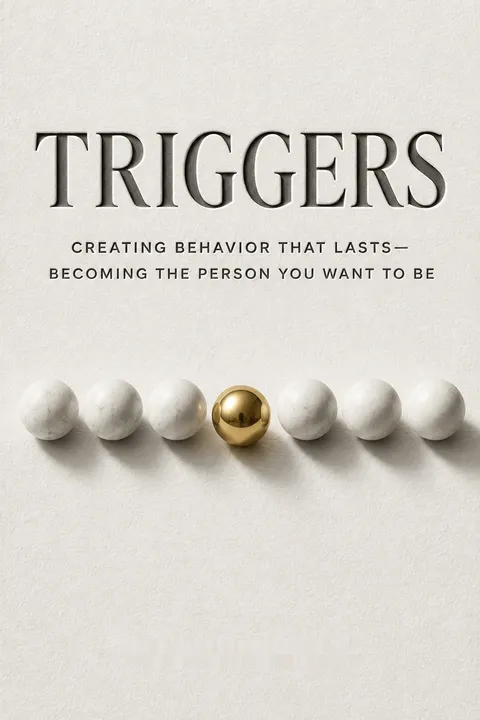


Key Takeaways
Change the situations that trigger the person you do not want to be
Triggers shape behavior. A behavioral trigger is any stimulus that changes what a person thinks or does. It might be a major shock, like Phil falling down the stairs and discovering he wanted to become a better neighbor, or an ordinary setting that brings out impatience or distraction. The same person can act differently at home, in a meeting, or around a particular colleague because each situation supplies different cues.
Sort the pressures. Goldsmith distinguishes triggers that feel encouraging from those that discourage, and those that move someone toward a goal from those that pull away. A compliment can inspire effort or invite complacency. Naming the situations that repeatedly derail a goal makes it easier to change the response, or change the setting itself.
The book makes behavior less mysterious by shifting attention from fixed personality to the interaction between person and situation. That move is useful because it replaces self-condemnation with diagnosis: when does the unwanted response appear, and what cues surround it? The same framing also discourages convenient blame. A situation can explain a reaction without excusing it. The practical balance is to recognize environmental influence while retaining responsibility for deciding whether to stay, leave, or respond differently.
Stop trusting the morning planner to manage the evening doer
Good intentions are incomplete. Goldsmith describes an inner Planner who sets goals and an inner Doer who has to carry them out amid interruptions, fatigue, and temptation. The Planner imagines a smooth day; the Doer inherits the actual one. This gap helps explain why knowing what to do rarely guarantees action. People also protect the gap with familiar beliefs: that understanding is enough, that tomorrow has endless room, or that an inspiring epiphany will make change permanent.
Commit to the change. The author argues that no coach or colleague can produce lasting change for someone who does not genuinely want it. His client Harry claimed openness to feedback but used every conversation to defend himself and diagnose others. Goldsmith ended the coaching rather than mistake talk about change for commitment to it.
The Planner and Doer distinction gives a practical name to a common failure of self-management: a plan is made under one set of conditions, then executed under another. It also clarifies why motivation alone is unreliable. A sincere intention can coexist with an unrealistic forecast of the day ahead. The caution is that the model can sound like two separate selves when behavior is more fluid. Its value is not literal psychology, but the reminder to design plans for the person who will face friction, not the person who wrote them.
Forecast your danger zones, then avoid or redesign them
Prepare for predictable trouble. Goldsmith's forecasting process has three moves: anticipate how a situation may affect behavior, avoid it when avoidance is sensible, and adjust when participation is unavoidable. A leader tempted to argue with a provocative colleague can plan for the encounter or limit unnecessary contact. Avoidance is not cowardice in this framework. It is a way to stop repeatedly testing self-control against a setting that has already proved difficult.
Read the room. Sachi, a successful technology executive, returned to her village in India and enthusiastically described her impressive work to old friends. Her closest friend later told her that the account sounded boastful. Sachi recognized that she had carried Silicon Valley expectations into a very different social setting. On a later visit she shared less about herself and showed more interest in her friends.
Forecasting extends personal change into situational judgment. It asks not only what behavior is desired, but what the setting is likely to reward, punish, or misunderstand. Sachi's story shows that good intentions do not guarantee good impact; social context changes the meaning of a remark. The strongest use of avoidance is selective, not global. Avoiding every uncomfortable conversation can shrink a life, while avoiding a known trap can preserve attention for choices that matter.
Use four change choices: create, preserve, eliminate, and accept
Choose the right kind. The Wheel of Change organizes decisions into four categories: create positive behavior, preserve what already works, eliminate harmful behavior, and accept what cannot be changed. Improvement is not always about adding something new. A successful person may need to protect a valuable habit, stop an unhelpful one, or face a limit honestly.
Make the choices concrete. Steve, a financial executive with a punishing commute, named a shorter commute as something to create and his family life as something to preserve. He identified the commute itself for elimination and accepted that he would not become a better golfer. Seeing the links among those answers helped him leave the suburbs for a home near work, reclaiming time with his family.
This framework counters the cultural bias toward visible reinvention. Preserving can be as deliberate as creating, and acceptance can release effort trapped in denial. Steve's example is especially useful because the answers form a system: accepting a diminished role for golf made a costly commute seem less necessary. The framework is a prompt, not a formula. Some realities that seem fixed are changeable, while some apparent choices are constrained by money, health, or obligations. Honest assessment matters more than fitting every problem into a neat category.
Measure effort daily, not just outcomes or good intentions
Ask an active question. A passive question asks about a condition, such as whether someone has clear goals. An active question asks what the person did to create that condition. Goldsmith recommends daily questions beginning with whether the person did their best to act on a chosen goal. The shift makes effort visible instead of letting every shortfall be assigned to circumstances.
Track what happens. In a study with his daughter, groups received training followed by either passive questions, active questions, or no follow-up. The active-question group reported twice the improvement of the passive-question group across four areas. In 79 further studies involving 2,537 participants, 89 percent improved on at least one of six daily engagement questions. Emily, who sought help with weight loss, used nightly scoring and follow-up to spot that she was making no effort to exercise, then changed her routine.
Self-monitoring turns an abstract aspiration into observable behavior. The useful measure here is effort, not simply the final result, since outcomes can depend on factors outside a person's control. Yet scores are not neutral: a person may learn to optimize the rating rather than the underlying goal, or feel shame instead of curiosity. The best use of a daily question is as information for the next choice. Emily's example also shows why tracking should support an adaptable plan, not certify an extreme regimen as suitable for everyone.
Borrow structure and a coach before willpower runs dry
Reduce the choices. Goldsmith argues that people improve more reliably when they build structure around the behavior they want. Alan Mulally's Ford meetings used a fixed agenda, shared progress reports, and rules against interruptions and side conversations. Repeating the format made problems visible and reduced opportunities to evade them. A daily medication organizer serves the same purpose on a smaller scale: the structure carries some of the remembering.
Account for depletion. Goldsmith uses the term ego depletion for the weakening of self-regulation after effortful decisions and restraint. He cites research on Israeli parole hearings in which approvals were much more common early in the day than late in the day. A coach can help bridge the Planner and Doer by checking progress, prompting action, and creating accountability. The support can be as simple as reporting a score to someone each evening.
Structure is powerful partly because it removes repeated decisions. That can protect attention and make a desired action more likely without demanding heroic self-control every time. A coach adds another useful function: an outside observer can remember an intention when the person is absorbed in the immediate situation. Still, structure should fit the task and the person. Rigid monitoring can become performative or controlling, especially when imposed without consent. The durable aim is a scaffold that supports agency, not a substitute for it.
Pause before reacting: ask whether this intervention will help
Create a pause. AIWATT is Goldsmith's name for a question that helps someone decide whether to engage: is there willingness, now, to invest the effort needed to make a positive difference on this issue? The point is not to win every exchange. It is to notice the impulse, consider the cost, and decide whether speaking or acting will help.
Do not personalize every collision. The book pairs this pause with the Buddhist story of a farmer whose boat is struck by an unmanned vessel. Anger assumes someone deliberately caused the problem; the empty boat suggests that many irritating actions are not aimed at the person affected. A colleague's interruption, a missed item at checkout, or a frustrating decision may not warrant a fight. If a disagreement matters, the question still allows deliberate engagement.
AIWATT combines emotional regulation with cost-benefit judgment. The empty-boat image can weaken the reflex to interpret inconvenience as an insult, leaving more room for proportionate responses. This is not a demand to tolerate mistreatment or abandon important disagreements. The decisive phrase is whether an intervention can make a positive difference. A boundary, complaint, or challenge may be necessary; a retaliatory remark usually is not. The pause helps distinguish those cases before pride chooses on someone's behalf.
Give your relationships professional effort, not amateur leftovers
Do not stop at good enough. Goldsmith distinguishes ordinary satisficing, which can be sensible when choosing a product, from the low standard people sometimes accept in how they treat loved ones and colleagues. He also warns against labeling interpersonal care as something that should come naturally. At work, people may monitor their behavior because feedback and consequences are visible; at home, they may assume familiarity excuses impatience.
Make the change legible. Nadeem, an executive who repeatedly clashed with Simon, apologized and asked colleagues to help him notice when he slipped. He initially aimed to make most of the effort toward repairing the relationship. After six months, he said he should have committed fully from the outset. The broader lesson is not perfection. Consistent visible effort gives others reason to trust that a new behavior is real.
The distinction between amateur and professional behavior challenges a familiar moral loophole: treating intimacy as permission to be less considerate. People closest to someone often bear the cost of the unedited response. At the same time, professional standards should not turn every relationship into a performance or erase legitimate needs. The target is not flawless self-presentation, but reliability, repair, and honest effort. Nadeem's apology mattered because it made the change observable to the people whose trust had been affected.
Make one small change that improves someone else's experience
Engagement is reciprocal. The Circle of Engagement describes how an attentive response can prompt a positive response in another person, which then sustains connection. Jim received a call from his wife, who needed someone to listen while he was having a difficult workday. His first impulse was to compare their problems. He paused, listened, and offered affection. She said the conversation helped.
Start before regret arrives. Goldsmith asks readers to choose a behavioral change they will not regret making, then act on it. It might be a call to a parent, a sincere thank-you, or withholding a cynical remark. His opening story about Phil's fall illustrates the larger possibility: a frightening event can reveal the kind of person someone wants to become, but ordinary moments offer chances to begin without waiting for a crisis.
The book's endpoint is not self-improvement as private achievement. It is a pattern of attention that changes the experience of other people and invites a better response in return. Jim's call shows how small the initiating act can be: listening rather than competing over whose day was worse. Reciprocity is not guaranteed, however, and care should not depend on getting an immediate return. The lasting value lies in choosing behavior aligned with one's own standards, even when another person cannot or does not reciprocate.
Analysis
The book's central contribution is its insistence that behavioral change is not primarily an information problem. People often know what patience, attention, or restraint would look like. The failure occurs at the point where intention meets a changing situation. Goldsmith therefore combines situational awareness with repeated measurement, external accountability, and deliberate pauses. This makes the work less a theory of personality than a practical method for managing the interval between impulse and action.
Its strongest feature is the shift from asking whether a person is good or bad to asking what conditions produce a particular response. That can reduce shame without dissolving responsibility. The examples also make an important distinction between outcomes and effort: a person cannot control whether a colleague forgives an apology, but can control whether the apology is made and whether the behavior changes.
Some claims need careful handling. The book presents ego depletion as a useful account of declining self-control, but the broader research literature has debated how robust and general that effect is. Its practical advice does not depend on accepting a single mechanism: fatigue, decision load, and stress can all make planned conduct harder. Similarly, a daily score can focus attention, but quantified self-assessment is vulnerable to gaming and oversimplification. A high rating may reflect honest effort, or a distorted standard.
The most useful synthesis is modest: choose a meaningful behavior, identify the situations that threaten it, create a reminder or accountability structure, and review what happened without confusing explanation with excuse. The method is especially compelling for interpersonal change because it asks whether the people affected can observe a difference. It is less sufficient where the environment is not merely distracting but materially coercive or unsafe. In such cases, redesigning the environment may require collective action, resources, or institutional change, not just better self-management. Goldsmith's tools are strongest when personal agency is real and the person is ready to exercise it.
Review Summary
Triggers by Marshall Goldsmith receives mostly positive reviews for its practical advice on behavior change. Readers appreciate the actionable steps, daily questions, and focus on personal accountability. Many find the book insightful and easy to read, with valuable lessons for both business and personal life. Some criticize the author's writing style and perceived smugness. The book's emphasis on structure, mindfulness, and understanding environmental triggers resonates with many readers. However, some feel the content is basic or too focused on executives.
People Also Read









Glossary
behavioral trigger
Stimulus that affects behaviorA behavioral trigger is any stimulus that influences a person's thoughts or actions. Triggers can come from people, events, surroundings, feelings, or memories. They may be conscious or unnoticed, anticipated or surprising, and helpful or harmful to a goal. Goldsmith emphasizes that the response to a trigger is not always automatic: awareness can create room to choose.
belief triggers
Beliefs that obstruct changeBelief triggers are assumptions people use to justify resisting behavioral change before they act. Examples include believing that understanding automatically leads to action, that willpower will always hold, or that a dramatic insight will make change permanent. These beliefs encourage overconfidence, postponement, and self-excuse by hiding the predictable obstacles between intention and follow-through.
Planner, Doer, and Coach
Intention, action, and supportThese roles describe three functions involved in personal change. The Planner sets intentions, the Doer acts amid real-world pressures, and the Coach reminds, measures, and supports follow-through. The roles may all exist within one person, but an external coach can help when daily conditions make the original plan easy to forget or abandon.
Wheel of Change
Four choices for changeThe Wheel of Change organizes personal or organizational decisions into four options: create positive elements, preserve what is already valuable, eliminate negative elements, and accept negative realities that cannot be changed. It broadens the idea of improvement beyond adding new behavior, encouraging people to protect strengths and stop wasting effort on denial.
Engaging Questions
Daily prompts for personal effortThe Engaging Questions are six active self-assessment prompts about setting clear goals, making progress, finding meaning, being happy, building positive relationships, and being engaged. Each asks whether the person did their best in that area. The phrasing directs attention toward personal effort and action rather than judging only the surrounding conditions.
Daily Questions
Nightly self-monitoring routineDaily Questions are a set of personal behavior goals reviewed and scored each day, often with a coach or accountability partner. They are phrased as effort questions and can be rated on a scale. The routine makes intentions visible, reveals where effort is missing, and provides regular feedback that can guide adjustments.
AIWATT
Pause before engagingAIWATT is Goldsmith's acronym for a self-question used before engaging in a potentially unproductive interaction. It asks whether the person is willing, at this moment, to invest the effort required to make a positive difference on the issue. The pause helps distinguish useful action from reactions driven by irritation, pride, or the urge to prove a point.
Hourly Questions
Short-term behavior check-insHourly Questions adapt the Daily Questions method for a defined, challenging event. A reminder prompts a person to assess effort during the event, such as whether they are engaging well with guests or remaining constructive in a difficult meeting. The repeated check-in restores awareness and offers opportunities to adjust before the event ends.
Circle of Engagement
Reciprocal positive interactionThe Circle of Engagement describes how attentive behavior can produce a positive response in another person, which in turn encourages further connection. Rather than reacting automatically to a trigger, a person chooses an engaged response that improves the interaction. The other person's response then becomes a new cue for constructive behavior.
ego depletion
Reduced self-regulation after effortEgo depletion is the term, associated in the book with psychologist Roy Baumeister, for reduced capacity to regulate impulses after sustained effortful control. Goldsmith applies the idea to decisions, restraint, and interpersonal demands, which can leave people more vulnerable to poor choices. He recommends tracking demanding situations and using structure to reduce repeated decisions.
FAQ
What's "Triggers: Creating Behavior That Lasts—Becoming the Person You Want to Be" about?
- Focus on Behavioral Change: The book explores why adults struggle with changing their behavior and how they can overcome these challenges to become the person they aspire to be.
- Role of Triggers: It emphasizes the impact of environmental triggers on our behavior and how they can either hinder or help us in achieving lasting change.
- Practical Frameworks: Marshall Goldsmith provides practical tools and frameworks, such as Daily Questions and the Wheel of Change, to help individuals manage their behavior effectively.
- Personal and Professional Growth: The book is not just about leadership but also about improving personal life, making it relevant for anyone seeking self-improvement.
Why should I read "Triggers: Creating Behavior That Lasts—Becoming the Person You Want to Be"?
- Expert Insights: Marshall Goldsmith is a renowned executive coach, and his insights are backed by years of experience working with top leaders.
- Actionable Advice: The book offers practical advice and tools that can be immediately applied to both personal and professional life.
- Holistic Approach: It addresses both internal and external factors affecting behavior, providing a comprehensive approach to change.
- Real-Life Examples: The book includes stories and testimonials from successful leaders who have applied these principles, making the advice relatable and credible.
What are the key takeaways of "Triggers: Creating Behavior That Lasts—Becoming the Person You Want to Be"?
- Environmental Influence: Our environment is a powerful trigger that can shape our behavior, often without our awareness.
- Active Questions: Asking active questions can significantly improve engagement and personal accountability.
- Daily Questions: Regular self-assessment through Daily Questions can help maintain focus and track progress in behavioral change.
- Structure and Support: Implementing structure and seeking support are crucial for sustaining long-term behavioral change.
What are the best quotes from "Triggers" and what do they mean?
- "We do not get better without structure." This highlights the importance of having a framework or routine to guide behavior change.
- "Am I willing, at this time, to make the investment required to make a positive difference on this topic?" This question encourages mindfulness and intentionality in our actions.
- "If I change my behavior, I change the people around me." It underscores the ripple effect of personal change on one's environment and relationships.
- "Triggers are not inherently 'good' or 'bad.' What matters is our response to them." This emphasizes personal responsibility in managing how we react to external stimuli.
How does Marshall Goldsmith define a "trigger" in the book?
- Stimulus Impact: A trigger is any stimulus that impacts our thoughts and actions, reshaping our behavior.
- Direct or Indirect: Triggers can be direct, with immediate impact, or indirect, influencing behavior through a series of thoughts.
- Internal or External: They can originate from within, like thoughts and feelings, or from external sources, like people and events.
- Conscious or Unconscious: Triggers can be within our awareness or operate unconsciously, affecting our behavior without us realizing it.
What is the "Wheel of Change" in "Triggers"?
- Four Options: The Wheel of Change consists of four options: Creating, Preserving, Eliminating, and Accepting.
- Creating: Focuses on adding new positive behaviors or elements to one's life.
- Preserving: Involves maintaining positive aspects that are already present.
- Eliminating and Accepting: Deals with removing negative elements and accepting those that cannot be changed.
How do "Daily Questions" work in "Triggers"?
- Self-Assessment Tool: Daily Questions are a self-assessment tool to track effort and progress in personal goals.
- Active Questions Format: They are phrased as "Did I do my best to..." to focus on effort rather than outcomes.
- Regular Reflection: Answering these questions daily helps maintain focus and accountability.
- Customization: The questions can be tailored to individual goals and priorities, making them versatile and personal.
What role does "structure" play in behavioral change according to "Triggers"?
- Essential for Improvement: Structure is crucial for achieving and sustaining behavioral change, as it provides a framework for action.
- Reduces Depletion: It helps manage decision fatigue and depletion by reducing the number of choices one has to make.
- Consistency and Discipline: Structure instills consistency and discipline, making it easier to follow through on commitments.
- Examples in Practice: The book provides examples, such as Alan Mulally's structured meetings at Ford, to illustrate the effectiveness of structure.
What are "Active Questions" and why are they important in "Triggers"?
- Focus on Effort: Active Questions focus on the effort made towards a goal, rather than the outcome, encouraging personal responsibility.
- Engagement and Accountability: They enhance engagement and accountability by prompting individuals to reflect on their daily actions.
- Twice as Effective: Studies in the book show that active questions are twice as effective as passive ones in improving engagement.
- Examples Provided: The book provides examples of active questions, such as "Did I do my best to be happy today?" to guide readers.
How does "Triggers" address the concept of "ego depletion"?
- Limited Resource: Ego depletion refers to the finite nature of self-control and decision-making resources, which get depleted throughout the day.
- Impact on Behavior: As depletion increases, individuals are more prone to making poor decisions and exhibiting undesirable behavior.
- Structure as a Solution: Implementing structure can help mitigate the effects of depletion by reducing the number of decisions one has to make.
- Awareness and Management: The book encourages awareness of depletion and suggests strategies to manage it effectively.
What is the significance of the "Circle of Engagement" in "Triggers"?
- Reciprocal Interaction: The Circle of Engagement represents the reciprocal interaction between an individual and their environment.
- Awareness and Engagement: It emphasizes the importance of being aware and engaged to positively influence one's environment.
- Trigger and Response: By recognizing triggers and responding appropriately, individuals can create a positive cycle of behavior.
- Example Provided: The book provides examples, such as Jim's interaction with his wife, to illustrate the concept in action.
How does "Triggers" suggest dealing with "good enough" behavior?
- Avoid Settling: The book warns against settling for "good enough" in areas that matter, as it can lead to mediocrity and missed opportunities.
- Identify Triggers: It encourages identifying environments and situations that trigger "good enough" behavior and addressing them.
- Commitment to Excellence: Readers are urged to commit to excellence, especially in interpersonal relationships and personal growth.
- Examples and Insights: The book provides examples and insights to help readers recognize and overcome the tendency to settle for less.
About the Author
Other books by Marshall Goldsmith




Download PDF
Download EPUB
.epub digital book format is ideal for reading ebooks on phones, tablets, and e-readers.








