

Key Takeaways
Judge a bluff by its expected value, not by whether it worked
Results can mislead. A bluff that gets called may still have been profitable, while a bluff that succeeds can still be a mistake. Poker decisions depend on hidden cards, future cards, and opponents’ choices, so one hand’s outcome cannot reveal whether the decision was sound. Equity estimates a hand’s share of the pot if betting stops. Expected value, or EV, estimates the average result after likely future actions are included.
Price the uncertainty. Suppose a player bets $100 into a $100 pot and gets a fold 40% of the time. If a call loses the $100 bet, the bluff’s EV is $100 × 0.40 minus $100 × 0.60, or negative $20. Winning the pot sometimes does not rescue a bet that loses money on average.
What's striking is how closely this resembles outcome bias in medicine, investing, and management: a decision is judged by what happened, even when the result was partly luck. EV offers a better standard because it evaluates a choice across plausible outcomes. Its weakness is that the calculation depends on estimates of an opponent’s behavior. A precise equation fed with a poor estimate can create false confidence. The practical discipline is to separate two questions: Was the decision reasonable given what was known, and did the outcome happen to be favorable?
Use equilibrium as your baseline, then exploit specific mistakes with evidence
Start with a neutral map. A Nash equilibrium is a set of strategies where no player can improve by changing strategy alone. It gives a useful baseline when the opponent’s tendencies are unknown, not a command to ignore reads. In poker, a strategy means a plan for every possible hand and situation, not merely a style such as “tight.”
Adapt in four steps. First picture the equilibrium strategy. Then identify a specific deviation, such as calling too often with bluff-catchers. Next find the actions that profit from that error. Finally, scale the adjustment to the size of the mistake and confidence in the read. A slight error can justify choosing one side of a close decision; a dramatic departure is needed to justify a large, risky change.
This equilibrium-first method resembles robust decision-making: establish a defensible policy before customizing it to uncertain conditions. That order protects against the habit of inventing a read to justify a preferred action. It also makes adaptation more precise. “Calls too much on rivers” points toward different adjustments than “does not raise bluffs.” The limitation is that a baseline is only as useful as its model. Real opponents change behavior, and solver strategies depend on assumed ranges and permitted bet sizes. Equilibrium is a compass, not a live feed of another player’s mind.
Pair value bets with bluffs, and keep medium-strength hands out
Separate the range. A polarized range contains strong hands that want calls and weak hands that can profit if stronger hands fold. A condensed range is made up mainly of medium-strength hands that beat bluffs but lose to strong value bets. In the book’s Clairvoyance Game, one player always held a middle card, a King, while the opponent held either the top card, an Ace, or the bottom card, a Queen. The Ace could bet for value, and the Queen could bluff. The King gained nothing by betting: better hands called, worse hands folded.
Let hands do their jobs. Medium hands usually check and bluff-catch, while strong and weak hands make up the bet. This gives the opponent difficult calls without exposing a medium hand to a raise or isolating it against stronger holdings.
The useful distinction is functional rather than emotional. A hand is not a “betting hand” because it feels strong; it belongs in a bet because it can earn calls from worse hands or folds from better ones. This is a form of portfolio construction: different holdings support different jobs, and the whole range matters more than any single card. The toy game makes the logic unusually clean, but real hands have draws, changing equity, and varied bet sizes. The principle is a starting point for judgment, not a rule that every medium hand must check.
Let bet size dictate your bluff ratio and your opponent's calling rate
Bigger bets need more bluffs. For a polarized bet of size B into a pot P, the equilibrium bluff-to-value ratio is B divided by B plus P. A half-pot bet therefore supports one bluff for every three value bets. A pot-sized bet supports one bluff for every two value bets. These are ratios of bluffs to value hands, not percentages of the entire betting range.
The caller’s price changes too. To make an opponent indifferent between calling and folding, the required calling frequency is P divided by B plus P. That is two-thirds against a half-pot bet and one-half against a pot-sized bet. Larger bets make bluff-catching more expensive and permit more bluffs, but enormous overbets are not automatically best: the toy game that favors them assumes a perfectly polarized range.
Bet sizing is a way to set the price of uncertainty. A large wager asks the opponent to risk more for the chance of catching a bluff, while its credibility depends on enough value hands being present. This is why bet size and range composition cannot be designed separately. The equations are valuable because they replace vague advice about “looking strong” with explicit relationships. Yet actual poker adds stack limits, future streets, and imperfect ranges. Treating a formula as universal without checking those conditions would turn a sound model into a brittle habit.
Position creates profit even when neither player gains new information
Acting last has structural value. In the Reciprocal Ranges and Ace-to-Five toy games, both players begin with the same range, but the in-position player can still earn more. The out-of-position player must decide whether to bet a polarized range or check and face a bet. The player acting last can check medium hands through to showdown, while retaining strong hands for value bets when the opponent checks.
The difference appears in the model’s returns. In the Ace-to-Five Game, the in-position player’s expected result is about $1.06 against $0.94 for the out-of-position player, from a $1 ante. The advantage persists even without a useful information reveal. Position is not only the chance to observe an opponent’s action; it is also the freedom to choose after that action.
Position behaves like an option: the player acting later retains more choices after seeing what the opponent does. That option value helps explain why position matters even when an opponent’s action reveals little. The example also warns against reducing poker advantages to hand strength or raw equity. However, the measured edge belongs to a particular toy game with specific actions and payoffs. In live play, the size of the positional advantage changes with stack depth, board texture, and opponent skill. The mechanism generalizes more safely than the numerical result.
Update hand ranges after every action, not just every card
Actions change what hands remain plausible. In one hold’em example, an under-the-gun raiser begins with a stronger range than a big blind caller. On an Ace-high flop, the raiser has about 57% equity. Yet after the raiser bets the flop, the big blind calls, and both players check the turn, the big blind reaches the river with about 61% equity in the solver scenario.
The sequence explains the reversal. The big blind folds many weak hands on the flop, while the raiser’s bet concentrates strong and weak hands in a polarized range. When the raiser checks the turn, many strong hands leave that range. The big blind’s calls and checks leave a denser set of medium-strength hands. The board has not suddenly favored the big blind; the players’ actions have reshaped their ranges.
This is Bayesian reasoning in practical form: each action is evidence that changes the relative plausibility of possible hands. A common error is to remember the original preflop advantage and carry it forward as if the later decisions added no information. The example shows why range analysis must be sequential. Its specific equity figures depend on the starting ranges and bet sizes chosen for the solver, so they should not be treated as universal. The robust lesson is to ask what each action makes more or less likely before deciding who now has the strategic advantage.
Use blockers to choose bluffs, not as a substitute for a reason
Your cards remove possibilities. A blocker is a card in a player’s hand that makes certain opponent holdings less likely. On a river with three spades on the board, holding the Ace of spades blocks the opponent’s possible ace-high flush. That can make a bluff more attractive because the strongest calling hands are less available.
Use blockers as selectors. First determine whether the situation supports a bluff and how many bluffs the range can contain. Then use blockers to choose among plausible candidates. A hand with a Jack may be a better bluff or bluff-catcher when it removes combinations such as top two pair or a set from the opponent’s range. Blockers also affect value bets by reducing the chance of running into stronger hands. They are probability clues, not proof that an opponent lacks a hand.
Blockers are a compact lesson in conditional probability: the unseen deck is not equally available once specific cards are known. Their strategic force comes from asymmetry, since the holder knows which combinations have been removed while the opponent may not know why the action was chosen. This makes blockers especially useful as tiebreakers between otherwise similar hands. The danger is fetishizing them. A card that blocks a strong hand may also block the opponent’s folding hands, weakening a bluff. The relevant question is always which parts of the opponent’s range the card removes.
Keep thin value bets in your range, even when raises hurt
Raises target the middle. When raising is possible, players bet less often and avoid some thin value bets because medium-strength hands fare poorly against a polarized raise. In the Ace-to-Five Game, allowing raises reduced the out-of-position player’s betting frequency from roughly 37% to 27%. A marginal hand such as a Jack became a less attractive bet because a raise could force it to surrender equity.
Do not solve discomfort by checking everything. Thin value bets can still earn calls from worse hands and make bluffs credible. If a player’s betting range contains only hands that call raises happily or fold easily, the opponent has little incentive to bluff-raise. A balanced range needs hands near the decision boundary. Against a passive opponent who rarely raises without a strong hand, betting and folding to a raise may be more profitable than avoiding thin bets altogether.
The deeper point is that a difficult response from an opponent is not automatically evidence of a bad decision. In strategic settings, a range can gain value by including marginal actions that prevent the other side from exploiting its extremes. This resembles credible deterrence: the threat of a bluff-raise matters because the opponent must account for it, not because it should occur constantly. The practical caveat is important. Against a player whose raises are almost always strong, the theoretical protection may be unnecessary, and an exploitative bet-fold strategy can be superior.
Analysis
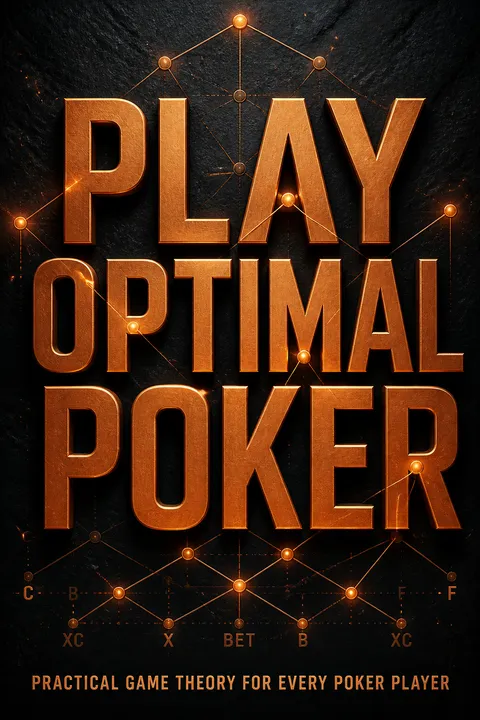
Play Optimal Poker is a practical strategy book built around a carefully escalating sequence: simple games establish equilibrium, more complex games reveal the roles of position and range construction, and hold’em examples test whether the lessons survive contact with real decisions. Its central argument is not that every player should imitate a solver. It is that a theoretical baseline makes both uncertainty and exploitation more manageable.
The strongest teaching move is the use of toy games. The Clairvoyance Game isolates the advantage of betting a polarized range against medium-strength bluff-catchers. Reciprocal Ranges shows that position can create value even when initial ranges match. The Ace-to-Five Game then adds enough intermediate hands to make thin value bets, blockers, and close calls visible. Each model removes distractions, allowing a reader to see why a strategy works before facing the complexity of hold’em.
The book also resists two seductive but incompatible shortcuts: deciding by results, and making unsupported claims about opponents. Equilibrium provides a defensible default; a specific read justifies a deliberate departure. The four-step exploitative process turns that distinction into a repeatable method. Its insight is especially practical because small opponent errors can change which side of a mixed decision is preferable, while large deviations require stronger evidence before a player risks a substantial counter-adjustment.
The main limitation is that exact strategy depends on assumptions. Solver outputs change with starting ranges, allowed bet sizes, and the modeled game. The author emphasizes these constraints, but readers can still overlearn the numerical outputs. A second boundary is the assumption that players maximize expected monetary value. Tournament payout structures, risk tolerance, or psychological goals can make that an incomplete description of a player’s preferences. The book’s durable contribution is therefore not a catalog of frequencies. It is a way to reason: model incentives, track how actions change ranges, and treat uncertainty as something to manage rather than wish away.
Review Summary
Play Optimal Poker receives mostly positive reviews, with readers praising its approach to game theory and poker strategy. Many find it an excellent introduction to GTO concepts, using simple examples to explain complex ideas. The book is appreciated for its effectiveness in teaching and quizzing readers. Some criticisms include the lack of practical applications and the need for more in-depth explanations. Overall, readers value the book for its innovative perspective on poker strategy, though some suggest it's best suited for intermediate players or those new to game theory concepts.
People Also Read






Glossary
Nash Equilibrium
No profitable unilateral changeA set of strategies for all players in a game where no player can improve their result by changing their own strategy while the others keep theirs fixed. In poker, an equilibrium strategy is a useful benchmark for play that is difficult to exploit, especially when an opponent’s specific tendencies are unknown.
Expected Value
Average value of a choiceThe average result of a decision across its possible outcomes, weighted by how likely each outcome is. In poker, EV accounts for future actions as well as cards. A bluff’s value, for example, depends on how often the opponent folds, calls, or raises, not simply on whether one particular attempt succeeds.
Equity
Share of the pot at showdownA poker hand’s or range’s expected share of the pot if no more betting occurs. Equity is commonly estimated by comparing hands across possible future boards. It does not capture all the value of a hand when additional betting, bluffing, folding, or value betting can still change the final result.
Polarized Range
Strong hands and bluffsA range made up primarily of strong hands that can bet for value and weak hands that can bet as bluffs, with relatively few medium-strength holdings. A polarized range can pressure bluff-catchers because a caller risks paying off strong hands or folding to bluffs. Larger bets tend to require more polarized ranges.
Condensed Range
Mostly medium-strength handsA range concentrated in hands that can beat bluffs but are unlikely to win when an opponent’s bet is called. Such hands often check and bluff-catch rather than bet, since a bet may fold weaker hands and receive action mainly from stronger ones. A condensed range can be vulnerable to pressure from polarized bets.
Indifference
Equal value across choicesA condition where two or more available actions have the same expected value. Equilibrium strategies often use mixed frequencies to create indifference in an opponent, such as making a bluff-catcher equally valuable to call or fold. When one action becomes more profitable, there is no strategic reason to keep mixing between the options.
Blocker
A card removing possible handsA card held by a player that reduces the number of combinations an opponent can hold. A blocker can improve a bluff by making strong calling hands less likely, or improve a call by making value hands less likely. It is a probability adjustment, not certainty about an opponent’s actual holding.
Nuts Advantage
More strongest hands availableA situation in which one player is more likely than an opponent to hold the strongest possible hands on a given board. The player with this advantage can often build a polarized betting range more credibly. It is distinct from overall equity, although the two advantages often overlap.
Four-Step Exploitative Process
A method for targeted adjustmentsA method for adapting to an opponent’s mistakes: envision the equilibrium strategy, identify a specific deviation, determine how to exploit it, and choose how far to depart from equilibrium. The size of the opponent’s likely error and confidence in the read guide the degree of adjustment.
Node locking
Fixing one modeled strategyA game-solver feature that constrains a player to a specified strategy at a particular decision point, such as never bluff-raising. The solver then calculates strategies for the other decisions under that constraint. It can help analyze how to exploit a known tendency, but its results depend on the accuracy of the modeled game.
Clairvoyance Game
A toy game about polarized rangesA simplified poker-like game using three cards, an Ace, a King, and a Queen. One player always holds the King, while the other holds either the Ace or Queen. A single betting round demonstrates how the player with a polarized range can value bet the Ace and bluff the Queen, while the King is a bluff-catcher.
FAQ
What's "Play Optimal Poker" about?
- Game Theory for Poker: "Play Optimal Poker" by Andrew Brokos is a guide to applying game theory principles to poker, helping players make better decisions under uncertainty.
- Strategic Framework: The book provides a framework for understanding poker strategy through the lens of game theory, focusing on equilibrium strategies and exploitative play.
- Practical Scenarios: It includes practical scenarios and toy games to illustrate complex concepts, making them accessible to players of all levels.
- Improving Decision-Making: The goal is to improve decision-making at the poker table by understanding the underlying mathematical principles.
Why should I read "Play Optimal Poker"?
- Enhance Poker Skills: The book is designed to enhance your poker skills by teaching you how to think strategically using game theory.
- Applicable to All Levels: Whether you're a beginner or an experienced player, the concepts are applicable and can improve your understanding of the game.
- Exploiting Opponents: It provides insights into how to exploit opponents' mistakes while minimizing your own vulnerabilities.
- Confidence in Play: By understanding game theory, you'll feel more confident and better prepared to handle any situation in poker.
What are the key takeaways of "Play Optimal Poker"?
- Equilibrium Strategies: Understanding and applying Nash Equilibrium in poker to make unexploitable plays.
- Polarized vs. Condensed Ranges: Recognizing when to use polarized ranges for betting and condensed ranges for calling.
- Exploiting Mistakes: Learning how to identify and exploit opponents' mistakes while maintaining a balanced strategy.
- Value of Position: Appreciating the strategic advantage of acting last and how it influences decision-making.
How does Andrew Brokos define a "strategy" in poker?
- Complete Algorithm: In game theory, a strategy is a complete algorithm for playing the game, detailing actions for every possible situation.
- Precision Required: It requires more precision than vague descriptions like "tight and aggressive," specifying actions for each hand in every scenario.
- Computer Assistance: Due to the complexity, computers are valuable tools for formulating and storing these strategies.
- Opponent's Strategy: Understanding your opponent's likely strategy is crucial for making informed decisions.
What is Nash Equilibrium according to "Play Optimal Poker"?
- No Incentive to Deviate: Nash Equilibrium is a set of strategies where no player has an incentive to unilaterally change their strategy.
- Perfect Information: Even with perfect information about the opponent's strategy, neither player would want to change their own.
- Example in Poker: In a heads-up game, both players could reveal their strategies, and neither would benefit from changing them.
- Application in Poker: It helps players make decisions that are unexploitable, regardless of the opponent's actions.
How does "Play Optimal Poker" explain polarized vs. condensed ranges?
- Polarized Ranges: Consist of strong and weak hands, used for betting and raising, often with larger bets.
- Condensed Ranges: Consist of medium-strength hands, used for calling and checking, often vulnerable to polarized bets.
- Strategic Use: Polarized ranges apply pressure, while condensed ranges aim to induce bluffs or value bets.
- Real-World Application: Understanding these concepts helps in constructing balanced betting and calling strategies.
What is the "Four-Step Exploitative Process" in "Play Optimal Poker"?
- Envision the Equilibrium: Consider how the hand would play out at equilibrium to understand potential deviations.
- Make a Read: Identify how your opponent deviates from equilibrium, being explicit and specific.
- Identify the Exploits: Determine how to exploit the opponent's mistakes, considering multiple options.
- Determine the Degree of Deviation: Decide how far to deviate from equilibrium based on the opponent's mistake magnitude and your confidence in the read.
How does "Play Optimal Poker" address the value of position?
- Strategic Advantage: Position provides a strategic advantage by allowing the player to act last, gaining more information.
- Double Use of Strong Hands: The in-position player can use strong hands for both value betting and bluff-catching.
- No Need to Split Range: Unlike the out-of-position player, the in-position player doesn't need to split strong hands between betting and checking.
- Informational Edge: Position offers an informational edge, even when the opponent's strategy is unknown.
What are the best quotes from "Play Optimal Poker" and what do they mean?
- "Poker is not about certainty; it is about learning to make good decisions under conditions of uncertainty." This emphasizes the importance of decision-making in poker, even when outcomes are uncertain.
- "The goal of a balanced betting range is to make an opponent indifferent between calling and folding with a bluff-catcher." This highlights the strategic aim of creating difficult decisions for opponents.
- "Game theory is not a panacea. It is not the only lens through which one should view poker, but it is an increasingly indispensable one." This acknowledges the limitations of game theory while stressing its growing importance in poker strategy.
- "Acting last is like taking a drink of water. We don’t have to understand why it’s good for us to know that it is." This underscores the inherent value of position in poker.
How does "Play Optimal Poker" suggest handling opponents who bluff too much?
- Call More Often: Increase your calling frequency with hands that are indifferent at equilibrium.
- Thin Value Raises: Consider making more thin value raises, as the opponent's range is likely weaker.
- Polarized Raising Range: Use a polarized raising range to exploit the opponent's marginal hands.
- Balance Bluffs and Value: Ensure your raising range is balanced with both bluffs and value hands.
How does "Play Optimal Poker" suggest handling opponents who fold too often?
- Bluff More Often: Increase your bluffing frequency, especially with hands that are indifferent at equilibrium.
- Fewer Thin Value Bets: Reduce thin value bets, as the opponent is less likely to call with weak hands.
- Trap with Strong Hands: Consider trapping with strong hands, as the opponent may not bet often.
- Look for Nutty Spots: Identify situations where the opponent is unlikely to have strong hands and exploit them.
What role do blockers play in "Play Optimal Poker"?
- Information Advantage: Blockers provide information about what is not in opponents' hands, offering a strategic edge.
- Bluffing Candidates: Blockers are often used as tiebreakers when choosing bluffing candidates.
- Value Betting Decisions: Blockers can influence thin value betting decisions by reducing the risk of running into stronger hands.
- Strategic Application: Understanding blockers helps in constructing balanced and effective betting and bluffing ranges.
Download PDF
Download EPUB
.epub digital book format is ideal for reading ebooks on phones, tablets, and e-readers.








