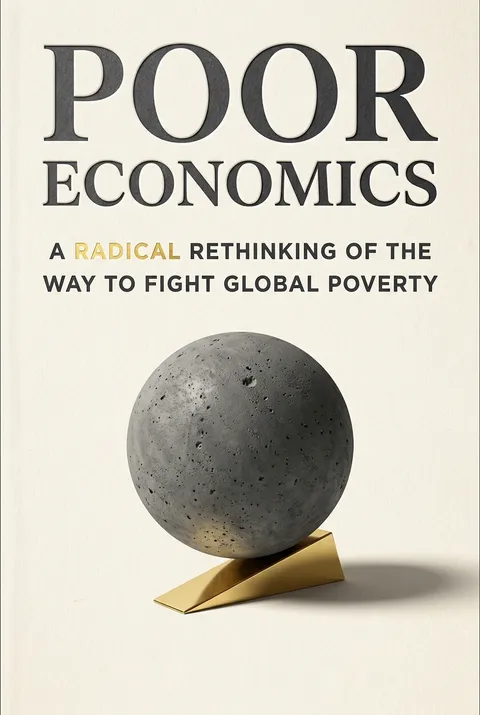


Key Takeaways
Replace poverty slogans with testable questions about specific bottlenecks
Start with the obstacle. The book rejects universal claims that aid either solves poverty or makes it worse. Instead, ask a narrower question: Does lowering the price of a bed net increase use, and does a free net reduce people’s willingness to buy one later? In Kenya, researchers randomly offered households nets at different prices, making their responses comparable. Randomized controlled trials, or RCTs, assign people or communities by chance to different programs so researchers can estimate a program’s effects.
Build knowledge stepwise. A trial cannot prove that an intervention works everywhere, and a result about bed nets cannot settle the whole aid debate. Repeated tests in different settings can reveal which details matter. The practical aim is not a grand theory that predicts every outcome, but evidence that helps identify and remove particular barriers.
What's striking is that this method treats humility as a tool, not a retreat. A narrowly framed test can improve a decision even when the larger causes of poverty remain disputed. The approach also makes failure informative: if a program misses its target, researchers can examine whether the obstacle was price, access, trust, or design. Its limit is equally important. A measured local effect is not a portable recipe, and a cluster of successful projects does not by itself explain national growth. The strongest use of experimentation is as disciplined learning, paired with attention to institutions and context.
Treat poor households as constrained decision-makers, not caricatures
Calories are not the whole story. Poor households do not automatically spend every extra rupee on food. In the authors’ data, food takes 45 to 77 percent of extremely poor rural households’ spending, yet families also pay for celebrations, television, tobacco, and food that tastes better rather than yielding the most calories. These choices can make sense in lives with little entertainment and few reliable routes to a better future.
Nutrition still shapes futures. The book argues that a simple calorie-driven poverty trap is uncommon for adults, but childhood nutrition is different. Stunting and micronutrient deficiencies can affect learning and adult productivity. In Kenya, children receiving deworming treatment for two years rather than one later earned about 20 percent more as adults. The policy implication is to improve nutrition directly, especially for pregnant women and young children, rather than assuming extra grain will solve the problem.
What's valuable here is the distinction between explaining a choice and endorsing every consequence of it. Spending on pleasure is not proof of ignorance; it reflects real preferences under constrained options. Yet the same household can make a reasonable purchase today while missing nutrition benefits that are delayed, hard to observe, and concentrated in a child’s future. That gap points toward better-designed food policy, not moral judgment. The evidence on adult calorie needs should also be applied carefully: local disease, workload, and food availability can change the picture, especially during crises.
Make prevention effortless, credible, and rewarding today
Good advice is not enough. Chlorine, oral rehydration solution, vaccines, and bed nets can prevent serious harm, yet people often do not use them. In Zambia, 98 percent of surveyed people could name the chlorine product used to purify water, but only 10 percent treated their water. In India, mothers often preferred injections or antibiotics for diarrhea, even though oral rehydration solution can prevent death from dehydration. Trust in providers and understandable evidence matter as much as technical availability.
Reduce the cost of acting. In rural Udaipur, offering lentils for immunization raised full immunization from 6 percent in comparison villages to 38 percent in incentive villages. Free bed nets were used at similar rates to purchased nets. The lesson is to make prevention convenient and immediate, with simple defaults, reliable delivery, or modest rewards, while regulating harmful treatment.
What's striking is how often prevention asks people to pay a small cost now for an uncertain benefit later. That is a difficult transaction even when the health science is clear. Incentives can compensate for time, travel, and uncertainty without implying that recipients lack concern for their children. The evidence also warns against treating information as a magic key: unreliable clinics and aggressive, poorly qualified providers can teach people to distrust the very system promoting prevention. Incentives and convenience should therefore accompany credible care, not substitute for it.
Measure what children learn, then teach the level they actually need
Attendance is not learning. School enrollment rose across many countries, but classroom results remained poor. In India, Pratham’s testing found that nearly 35 percent of children aged seven to fourteen could not read a simple first-grade paragraph, and about 60 percent could not read a second-grade story. Teacher absence and curricula aimed at high-performing students help explain the gap between time in school and skills acquired.
Teach the missing basics. Pratham’s remedial classes grouped children by what they could already do and focused on reading and arithmetic. Short-term community volunteers, after limited training, helped children make substantial gains. In Kenya, grouping pupils by prior achievement improved learning across levels. These examples suggest that schools should diagnose actual skill, teach foundational material at the learner’s level, and allow progress at different speeds instead of racing through an advanced syllabus.
The central distinction is between schooling as an institution and learning as an outcome. Enrollment figures are politically visible, while basic skills reveal whether the institution is doing its job. Targeted instruction also challenges the assumption that weak performance reflects fixed ability: a child who has missed foundations may need a different lesson, not a lower ceiling. Still, remedial programs can become a second track if they are not connected to mainstream schooling. Their deeper value is to show what ordinary classrooms could achieve when instruction responds to what students know.
Secure women’s choices and old-age support before prescribing smaller families
Fertility is chosen within constraints. The book questions the assumption that large families automatically leave each child less educated or less healthy. Studies using unexpected births and other sources of family-size variation found little consistent evidence that fewer siblings alone improved children’s schooling. But pregnancy timing can harm women’s health and education, and women do not always control fertility decisions equally with men.
Change the incentives, not bodily autonomy. Pak Sudarno valued his nine children partly because he expected some to support him in old age. The authors argue that pensions, health care, and access to savings could reduce the need to rely on many children, especially sons. In Zambia, women offered private access to contraception were more likely to seek it than women whose husbands were present. Coercive sterilization in India’s Emergency illustrates the profound damage done when population goals override consent.
This argument relocates family planning from population targets to security, bargaining power, and women’s agency. It also avoids a common analytical mistake: a correlation between family size and poverty does not establish that family size caused the poverty. Social protection may alter what families need children to provide, while private access to contraception can make stated preferences actionable. The unresolved issue is that formal services alone cannot quickly undo norms about gender, marriage, and care for elders. Policies should protect choice while addressing the economic dependence that narrows it.
Insure shocks so survival strategies stop destroying future growth
Risk is a daily condition. Poor households combine casual work, farming, and small businesses, often because no single income source is dependable. A shock can do more than reduce this month’s consumption. Ibu Tina’s garment business was set back by fraud and unsold inventory; after losing assets and separating from her husband, she struggled to restart. When a business needs a minimum scale to earn well, one loss can push a household onto a much poorer path.
Informal help has limits. Families diversify jobs, plots, and migration, and neighbors lend or share when someone has a bad spell. But health shocks are poorly covered, and households may still cut meals or borrow at high interest. Formal insurance is hard to design when claims are difficult to verify and contracts are not trusted. Subsidized, credible insurance can encourage productive investment by reducing the fear that one bad event will erase it.
The key insight is that risk changes decisions before a disaster occurs. A farmer who avoids improved seed or a business owner who refuses to expand may be responding rationally to the cost of failure, not lacking ambition. Insurance can therefore raise productivity by changing what people dare to attempt. But a policy is only useful if its terms match the risks people actually face and claims are trusted. Strict contracts that exclude common, devastating events can undermine confidence even when they are technically sound.
Build savings tools that protect goals from today’s temptations
Saving takes infrastructure and discipline. Poor households save through rotating groups, money guards, livestock, and unfinished houses, often because formal accounts charge fees or are distant. Jennifer Auma, a Kenyan market vendor, used six savings groups for different goals, alongside a village bank account and small cash reserves. Her complex system shows both financial skill and the lack of simple, affordable options.
Commitment can beat procrastination. Kenyan farmers often failed to buy fertilizer despite high returns, partly because cash disappeared before planting and fertilizer was unavailable when they had money. A program offering fertilizer vouchers after harvest increased use by at least 50 percent. This reflects time inconsistency: people value immediate spending more strongly than future benefits, even when they sincerely intend to save. Goal-based accounts, automatic deposits, and savings products that make withdrawal harder can help, but people must first choose to use them.
The chapter makes self-control look less like a fixed personal virtue and more like a design problem. A commitment device lets someone arrange a choice while calm, before immediate needs and temptations take over. Yet the fertilizer example also shows that behavior is not reducible to psychology: supply timing and travel costs mattered. Good savings policy must therefore combine commitment features with practical access. A product that protects money but is costly, inconvenient, or too restrictive may simply remain unused.
Keep microcredit useful without selling it as a poverty cure
Credit opens options, not miracles. Microfinance institutions make small loans possible by using regular meetings, repayment schedules, and social relationships to reduce the cost of lending. In a Hyderabad randomized evaluation, access to microcredit increased business starts from about 5 percent to just over 7 percent and raised purchases of durable goods. It did not clearly change spending on health or education, or women’s control over household decisions.
The contract shapes the business. Weekly repayments and pressure to avoid default make loans manageable for lenders, but they can deter risky ventures and projects that pay off slowly. In one Indian trial, allowing repayments to begin two months later encouraged larger and riskier businesses, but defaults rose. Microcredit is a useful financial service, especially where alternatives are costly, but its strict repayment model is poorly suited to financing firms that need room to fail and grow.
The book’s measured verdict is more useful than either celebration or denunciation. Access to credit can help a household make a planned purchase or start an enterprise, while modest average effects should not be mistaken for evidence of no value. The tension lies in the product itself: discipline lowers lender costs, but excessive discipline can suppress experimentation. That does not mean lenders should casually accept losses. It does mean that a financial tool designed for reliable repayment should not be judged as if it were venture capital or a complete anti-poverty program.
Stop mistaking a survival business for a scalable entrepreneurial engine
Many businesses are jobs of last resort. Poor households run shops, stalls, and farms in large numbers, but most enterprises remain tiny and earn little. In Hyderabad, the median small business made about 1,035 rupees a month before valuing the owner’s labor. Small grants can produce high marginal returns, meaning an extra dollar invested may pay well, while the business as a whole remains too unprofitable to support a family.
Scale requires a different path. Many ventures hit a ceiling because they lack capital, skills, equipment, or a larger market. The authors distinguish these necessity businesses from rare growth enterprises such as Xu Aihua’s garment firm, which expanded from a small start into an exporter. They argue that secure wage jobs matter too. Factory employment can stabilize income, support children’s education, and give households room to plan beyond the next day’s work.
The distinction between high marginal returns and low total earnings helps explain why giving small firms a little capital may help without transforming livelihoods. It also guards against romanticizing hardship as entrepreneurial genius. A shop can be a rational way to create a job when formal employment is unavailable, even if its owner has no wish to expand it. Development strategies that focus only on self-employment risk overlooking the need for productive firms and stable wages. The challenge is to support promising growth without assuming every small trader is a hidden industrialist.
Improve institutions through precise rules, public information, and real feedback
Small design changes can curb failure. In Uganda, schools initially received only 13 percent of the public funds allocated for them. After newspapers published monthly transfer information, schools were receiving about 80 percent by 2001. In Indonesia, audits reduced reported theft of wages and building materials by roughly one-third. These cases show that corruption can sometimes be limited without first replacing the whole political system.
Make participation workable. Community oversight often fails when people do not know their rights or are asked to take on vague, demanding tasks. Inviting villagers to meetings increased attendance and participation in Indonesia. In India, reserved local leadership positions gave women a chance to shape spending priorities, including water and roads. Policies also fail through the three I’s: ideology, ignorance, and inertia. Clear duties, transparent information, and feasible procedures can make accountability real.
This is neither a claim that institutions are irrelevant nor a promise that technical fixes defeat entrenched power. It is a case for looking below broad labels such as democracy or corruption to examine the rules people actually encounter. Public information worked in Uganda because officials could no longer assume nobody was watching; participation improved when invitations changed who showed up. The limits are political as well as administrative: powerful groups may resist reforms that threaten their advantage. Still, identifying room for marginal change is more actionable than treating institutional weakness as a reason to wait.
Analysis
Poor Economics is strongest as a method for seeing poverty clearly: begin with the decisions people face, identify the precise friction, and test whether a proposed intervention changes outcomes. Its stories resist two familiar simplifications. The poor are neither passive victims waiting for a grand rescue nor frictionless market actors whose choices automatically reveal what benefits them. They are capable decision-makers navigating poor information, unreliable services, thin markets, risk, and constant demands on attention.
The book’s central contribution is the connection between small constraints and large life trajectories. A missed vaccine, a child who never masters reading, or a business ruined by one shock may look isolated. Yet each can shape health, earnings, confidence, and future choices. That makes practical design consequential: a reminder, reliable delivery, a credible information source, or a workable savings instrument may matter more than a sweeping declaration of intent.
The experimental approach also has boundaries. A randomized trial can estimate what happened to a defined group in a particular setting, but scaling may change costs, markets, political incentives, and who benefits. A successful local program is evidence for a mechanism, not a guarantee of national transformation. Nor can small interventions substitute for employment, infrastructure, social protection, or political rights when those are the binding constraints. The book is most persuasive when it presents evidence as a way to improve judgment, not as a replacement for judgment.
Its deeper policy lesson is procedural: make claims specific, measure what people actually receive, and revise programs when results contradict assumptions. That approach rejects both fatalism and miracle thinking. Poverty is not one trap with one exit; it is a set of linked obstacles whose importance varies across households and places. Progress depends on finding the particular obstacle that matters, then building institutions capable of learning whether the fix worked.
Review Summary
Poor Economics offers a nuanced perspective on global poverty, challenging simplistic solutions. The authors use randomized controlled trials to examine the complexities of poverty and propose targeted interventions. Readers appreciate the book's data-driven approach, empathy for the poor, and practical insights. While some find it overly academic, many praise its fresh take on development economics. The book emphasizes the importance of understanding local contexts and avoiding one-size-fits-all policies. Overall, it's seen as a valuable contribution to the field, offering hope for effective poverty alleviation strategies.
People Also Read





Glossary
Randomized controlled trials (RCTs)
tests using random assignmentA research method in which individuals or communities are assigned by chance to different programs or versions of a program. Because the groups are comparable on average, differences in their outcomes can be attributed to the intervention more credibly than in a simple comparison. An RCT estimates effects in its tested setting, not universal effectiveness.
S-shape curve
growth with a thresholdA relationship between present resources and future resources that rises slowly at very low levels, then more quickly, and finally levels off. If the curve falls below the line where future resources equal current resources for the poorest, those households may become poorer over time while households above a threshold grow richer. This pattern can generate a poverty trap.
time inconsistency
future plans lose to present wantsA pattern in which people make plans for future behavior that they do not follow when the future arrives. Costs that feel distant during planning can feel immediate and unpleasant when action is due, while immediate rewards become especially tempting. The book uses this idea to explain postponed immunization, weak saving, and difficulty adopting preventive measures.
conditional cash transfer (CCT)
cash tied to required actionsA program that gives money to poor households on the condition that they complete specified actions, such as sending children to school or attending preventive health visits. Mexico’s PROGRESA program was an early example. Evaluations found that transfers could increase school attendance, while comparisons in some settings found that conditionality itself was not always necessary.
rotating savings and credit associations (ROSCAs)
rotating pooled savings groupsA group of members who meet regularly and contribute the same amount to a shared pot. At each meeting, one member receives the entire pot, with recipients rotating over time. ROSCAs help members save toward purchases or expenses and gain access to a larger sum sooner than saving alone, while group rules provide commitment and social accountability.
three I’s problem
ideology, ignorance, and inertiaA shorthand for three common sources of policy failure. Ideology can produce unrealistic assumptions about what workers or households should do. Ignorance means designers overlook conditions on the ground. Inertia allows flawed rules and programs to persist after their shortcomings become visible. The phrase emphasizes avoidable design failures, not simply bad intentions or corruption.
efficient household model
family decisions maximize joint welfareAn economic model that treats family members as able to bargain and allocate resources in ways that maximize the household’s total well-being. The book contrasts this assumption with evidence that family members may control separate income and resources, producing inefficient allocations. For example, men’s farm plots in Burkina Faso received more inputs than women’s plots, reducing total household production.
3-3-3 rule
brief visits, few questions, many medicinesA summary of observed medical consultations in India: the typical interaction lasted about three minutes, involved roughly three questions, and resulted in about three medicines. The pattern captures rushed care, limited diagnosis, and frequent medication. Public providers performed worse on several measures than private providers, while private care often involved unqualified practitioners and unnecessary treatment.
FAQ
What's Poor Economics about?
- Focus on Global Poverty: Poor Economics by Abhijit V. Banerjee and Esther Duflo delves into the complexities of global poverty, examining the multifaceted issues that contribute to it.
- Empirical Research: The authors use empirical research and randomized controlled trials (RCTs) to understand the lives of the poor and the effectiveness of various interventions.
- Rethinking Aid Strategies: The book challenges conventional aid strategies, advocating for targeted interventions that consider the specific needs and behaviors of the poor.
- Real-Life Examples: Through case studies and anecdotes, the authors illustrate how small, well-designed interventions can significantly improve the lives of the poor.
Why should I read Poor Economics?
- Evidence-Based Insights: The book is grounded in 15 years of rigorous research, providing data-driven insights into poverty and debunking common myths.
- Practical Solutions: Banerjee and Duflo offer practical, real-world solutions to combat poverty, based on actual experiments rather than theoretical models.
- Engaging Narrative: Written in an accessible style, the book makes complex economic concepts understandable and engaging for a general audience.
- Challenging Assumptions: It encourages readers to rethink their views on poverty and development, making it essential for those interested in social justice or economic policy.
What are the key takeaways of Poor Economics?
- Understanding Poverty Traps: The book discusses how individuals can become stuck in cycles of poverty due to various barriers, and how targeted interventions can help break these cycles.
- Importance of Local Context: Solutions to poverty must be tailored to local contexts and specific challenges faced by communities, as one-size-fits-all approaches are often ineffective.
- Role of Information: Access to information is crucial for decision-making among the poor, and lack of it can lead to poor choices that perpetuate poverty.
- Incremental Change: The authors advocate for small, well-designed interventions that can lead to significant improvements over time.
What are the best quotes from Poor Economics and what do they mean?
- “Poverty is not just a lack of money...”: This quote by Amartya Sen highlights that poverty extends beyond financial constraints to include social and personal limitations.
- “Success isn’t always as far away as it looks.”: Reflects the belief that with the right interventions, the poor can improve their circumstances, encouraging optimism in poverty alleviation.
- “The poor are no less rational than anyone else...”: Challenges stereotypes about the poor being irrational, emphasizing the complexity of their choices and the need for understanding their context.
- "Small changes can have big effects.": Emphasizes the power of targeted, incremental interventions in significantly improving the lives of the poor.
How do Banerjee and Duflo define a poverty trap in Poor Economics?
- S-Shaped Curve: The authors describe a poverty trap using an S-shaped curve, where current income influences future income, leading to a downward spiral for those trapped.
- Investment Limitations: Individuals in poverty traps cannot afford to invest in education, health, or business opportunities, crucial for breaking out of poverty.
- Need for Targeted Interventions: Understanding specific barriers that keep people in poverty is essential for designing effective interventions to break the cycle.
- Cycle of Poverty: The inability to invest perpetuates a cycle where the poor remain poor, highlighting the need for strategic support.
What role does health play in poverty according to Poor Economics?
- Health as a Poverty Trap: Poor health can trap individuals in poverty by limiting their ability to work and increasing medical expenses.
- Preventive Care Importance: Emphasizes the importance of preventive health measures, like vaccinations and clean water, in improving health outcomes for the poor.
- Behavioral Insights: Explores why low-cost health interventions are underutilized, highlighting the need for understanding health-seeking behavior and trust in health systems.
- Impact on Productivity: Health issues decrease productivity, further entrenching individuals in poverty.
How do the authors suggest improving education for the poor in Poor Economics?
- Focus on Basic Skills: Advocates for teaching basic skills to ensure every child masters foundational skills crucial for future success.
- Community Involvement: Emphasizes the role of community involvement, such as using local volunteers, to enhance accountability and improve educational outcomes.
- Conditional Cash Transfers: Discusses the effectiveness of programs that incentivize school attendance, alleviating financial burdens on families.
- Tailored Approaches: Highlights the need for education strategies that consider local contexts and challenges.
What are the limitations of microcredit as discussed in Poor Economics?
- Not a Miracle Solution: While microcredit can provide benefits, it is not a panacea for poverty, with many borrowers struggling to repay loans.
- Focus on Consumption: Often leads to increased consumption rather than investment in productive activities, perpetuating cycles of debt.
- Need for Comprehensive Support: Suggests microcredit should be part of a broader strategy including education, health, and market access.
- Limited Long-Term Impact: The impact on long-term poverty alleviation is limited without complementary supports.
What is the significance of randomized controlled trials (RCTs) in Poor Economics?
- Rigorous Evaluation: RCTs are used to evaluate the effectiveness of poverty alleviation interventions, allowing for clear comparisons between treatment and control groups.
- Evidence-Based Policy: Provides robust evidence to inform policy decisions, moving away from assumptions or ideologies.
- Learning from Failures: Helps identify ineffective strategies, allowing for iterative learning and improvement of development interventions.
- Highlighting Complexity: Reveals the complexity of poverty and the need for nuanced approaches.
Why do poor people often resist insurance, according to Poor Economics?
- Lack of Understanding: Many poor individuals do not fully understand insurance and its benefits, leading to skepticism.
- Adverse Selection: Only those likely to need insurance sign up, leading to unsustainable models and reluctance from insurers.
- Trust Issues: Distrust in insurance providers due to negative experiences with formal institutions.
- Perceived Irrelevance: Insurance may not seem immediately relevant to their pressing needs.
How do Banerjee and Duflo address the effectiveness of microfinance in Poor Economics?
- Mixed Results: Acknowledges both successes and limitations of microfinance, noting it does not universally improve income or well-being.
- Focus on Small Loans: Emphasizes that small loans may not drive substantial business growth, keeping micro-entrepreneurs in low-profit operations.
- Need for Complementary Support: Argues microfinance should be part of a broader strategy including education, health, and infrastructure improvements.
- Limited Impact: Without complementary supports, the impact of microfinance may be limited.
About the Author
Other books by Abhijit V. Banerjee
Download PDF
Download EPUB
.epub digital book format is ideal for reading ebooks on phones, tablets, and e-readers.








