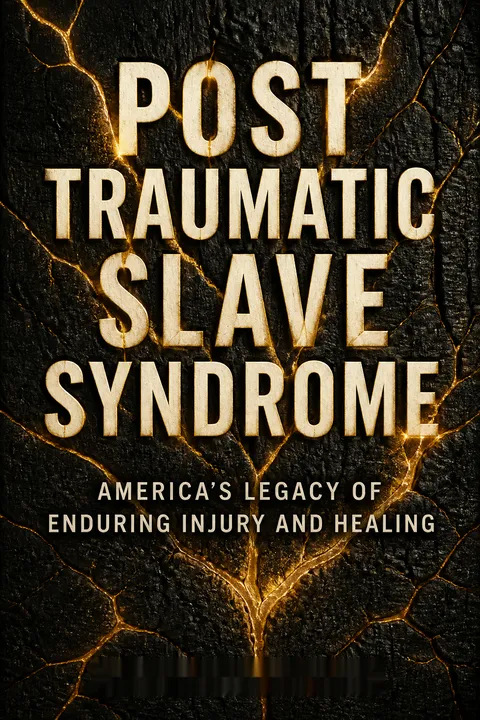


Key Takeaways
Read slavery as an unfinished history, not a closed chapter.
The past stays active. Joy DeGruy Leary argues that slavery’s end by law did not erase the injuries created by slavery and the oppression that followed. In her account, people adapted to survive danger, then passed some of those adaptations through family life, community expectations, and institutions. She calls the resulting pattern Post Traumatic Slave Syndrome, or PTSS: multigenerational trauma combined with continuing oppression and a perceived lack of access to society’s benefits.
History changes the question. In one opening story, a boy reacts angrily to another child’s gaze. DeGruy asks readers to consider how insecurity, threat, and learned vigilance may have historical roots, rather than treating the incident as an isolated flaw. The book’s central argument is not that every present problem comes from slavery, but that history belongs in any honest explanation of present-day experience.
The book’s force comes from treating history as a living context, not a museum exhibit. That move resembles work in family systems, where behavior can make sense as an adaptation to earlier conditions even when those conditions have changed. It also resists the comforting idea that legal reform automatically repairs social and psychological damage. The important qualification is that historical inheritance is not destiny: similar histories can produce different outcomes, and present conditions also matter. DeGruy’s framework is most useful as an invitation to investigate patterns, not as a shortcut that explains every individual.
Notice race as a structure of power, not a biological verdict.
Categories are not destiny. DeGruy distinguishes visible human variation from the idea that humanity falls into discrete biological races with fixed intellectual or moral traits. She recounts how influential European writers attached character judgments to physical categories, presenting opinion as scientific fact. Such claims helped make racial hierarchy appear natural rather than politically useful.
Racism has consequences. The book argues that prejudice alone is not the whole story: racialized beliefs become racism when backed by power that shapes access to housing, education, employment, health care, and justice. This is why “not noticing race” can conceal unequal treatment instead of ending it. DeGruy’s point is to notice race where institutions use it to distribute advantage and harm, while refusing to treat racial labels as measures of human worth.
This distinction usefully separates human variation from the political work performed by racial categories. Contemporary population genetics recognizes patterns of ancestry, but those patterns do not sort people into the familiar social races as clean, internally uniform biological groups. At the same time, a definition of racism centered on institutional power can leave interpersonal prejudice underexamined if used too rigidly. The strongest reading holds both levels together: individuals can harbor bias, while institutions determine whether bias compounds into durable differences in opportunity.
Ask what a survival behavior once protected before judging it today.
Adaptations have histories. DeGruy revisits everyday parenting through the dangers of slavery and Jim Crow. A mother who once spoke harshly about a child’s abilities might have been trying to keep an enslaver from noticing that child as valuable to exploit or sell. A parent who kept children close was responding to a world where wandering or challenging white authority could invite violence. These behaviors could protect children under one set of conditions and injure their confidence under another.
The context changes. The book also links competition and mistrust to systems that divided enslaved people and rewarded some for policing others. The lesson is not to excuse every harmful behavior, but to understand its possible function before deciding what should replace it. Survival strategies deserve both respect for their origins and scrutiny for their present effects.
This is a strong application of functional thinking: behavior is examined in relation to the environment that made it useful. It parallels trauma-informed practice, which asks what a response accomplishes before labeling it irrational. That perspective can reduce blame and reveal where a once-protective habit now carries costs. The caution is that historical explanation should not be assigned automatically to any person or family. Contextual inquiry works best when it invites people to interpret their own experiences, rather than imposing a single inherited story.
Follow emancipation's legal end into the institutions that carried exclusion forward.
Freedom was contested. DeGruy traces the aftermath of slavery through Black Codes, debt-based sharecropping, convict leasing, Jim Crow, racial terror, and discriminatory access to public life. These systems differed in form, but each constrained Black people’s freedom and economic security. Her account also includes medical abuse, such as the Tuskegee syphilis study, in which treatment was withheld from Black men who had been misled about their care.
Discrimination persisted in ordinary decisions. The book cites a resume experiment in which identical applications with white-associated names received 50 percent more callbacks than those with Black-associated names. The study illustrates how unequal treatment can operate without explicit declarations of prejudice. Together, these examples support DeGruy’s insistence that historical trauma cannot be understood apart from institutions that continued to restrict opportunity after emancipation.
The sequence of legal, economic, and social controls makes a useful case for path dependence: institutions can preserve unequal outcomes even after the original law changes. The resume experiment is particularly clarifying because it isolates one signal, a name, in a consequential gatekeeping decision. Still, the book’s statistics and examples are drawn from its historical moment and should not be mistaken for current measurements. The broader analytical task is to test where mechanisms persist, where they have changed, and how present-day evidence identifies their effects.
Use PTSS as a lens, not a diagnosis for an entire population.
A proposed framework. DeGruy presents PTSS as a theory for understanding the effects of multigenerational trauma, ongoing oppression, and the belief that society’s benefits are out of reach. She groups its possible behavioral patterns into three terms. Vacant Esteem means believing oneself to have little worth. Ever Present Anger describes anger that can build around blocked goals and repeated disrespect. Racist Socialization refers to absorbing beliefs that associate whiteness with superiority and blackness with inferiority.
A framework, not a verdict. DeGruy connects transmission to parenting, community norms, social institutions, and media, rather than claiming that descendants directly experienced slavery. She explicitly treats PTSS as a theory. It is not a formal clinical diagnosis established by the book, and its categories should not be used to label all African Americans or explain every individual’s behavior.
The framework’s value lies in connecting personal distress to historical and structural conditions, a connection that individual-focused models can miss. Its three patterns also give readers concrete questions to investigate, rather than reducing the argument to a general claim about inherited pain. Scientific usefulness, however, depends on distinguishing a compelling interpretation from a validated causal model. Each proposed pattern needs clear measures, attention to variation within communities, and comparison with other explanations, including poverty, contemporary discrimination, and individual experience.
Build self-worth through recognized contribution, without making dignity conditional on achievement.
Make value visible. DeGruy describes healthy esteem as a realistic sense of worth that grows through meaningful contribution and recognition. She recalls a friend’s father who had raised three decent sons and supported a long marriage, yet considered his life a failure until his son named those accomplishments in a letter. The story shows how valuable work can go unseen, even by the person doing it.
Recognition can be practiced. DeGruy suggests that families discuss what went well, notice acts of care and responsibility, and give children meaningful opportunities to help. This counters disparaging messages and gives people evidence of their capacities. The practice is not empty praise: the goal is to notice real contributions and help people understand their effect on others, rather than tying worth to status, possessions, or flawless performance.
The emphasis on specific recognition aligns with research on feedback and motivation: useful praise identifies an action and its effect, rather than assigning a fixed label such as “gifted.” The story also shows how family narratives shape self-assessment. A necessary nuance is that contribution cannot be the price of dignity. Infants, disabled people, and those in crisis have worth without measurable productivity. The most humane version of this idea treats contribution as evidence a person can recognize, not as a test they must pass to deserve respect.
Give children history, cultural pride, and tools to recognize racism.
Prepare, do not frighten. DeGruy calls deliberate teaching about Black history, culture, and racism positive racial socialization. In one example, a seven-year-old encounters a newspaper headline claiming that no intelligent Black men can be found locally. His family can explain why the claim is racist and unreliable, while affirming his abilities and helping him interpret what he sees.
Stories make inheritance tangible. DeGruy argues that children need family histories, living role models, and adults who model the behaviors they want passed on. Stories of hardship and achievement can link a child’s present to the people whose efforts made it possible. The aim is not to predict failure or burden children with every danger. It is to give them cultural knowledge and practical understanding, so racist messages do not become their only account of who they are.
This approach treats racial learning as preparation for interpreting the world, not as a lesson in suspicion. It has a close parallel in media literacy: children learn to ask who produced a message, what evidence supports it, and whose interests it serves. Historical and family stories can also strengthen identity by placing individuals inside a wider account of endurance and agency. The balance matters. Teaching discrimination without examples of belonging, pleasure, and possibility risks making threat the center of identity rather than one reality among many.
Let anger identify injustice, then choose a response that preserves agency.
Anger signals blocked goals. DeGruy describes anger as a normal response when people face frustration, fear, or repeated obstruction. In her research on 200 Black teenagers, half incarcerated and half not, she reports that perceived disrespect was a particularly strong antecedent of anger and violence. She argues that positive racial socialization can help young people withstand disrespect without answering it with violence.
Pause before acting. The book recommends separating the wrong from the response: calm down, identify what happened, gather evidence, seek an advocate, use grievance procedures, or decide that another priority matters more. Her example of a worker shorted on pay shows why shouting at the person delivering a check may not solve the problem. A deliberate response can protect both dignity and future options.
The distinction between a legitimate grievance and a useful response is central to preserving agency under pressure. Emotion regulation is not the same as accepting injustice; a pause can make documentation, negotiation, or collective action more effective. The reported survey gives disrespect a prominent role, though a sample of 200 teenagers cannot establish that it predicts violence across all settings or populations. The insight is best used to widen the response menu, not to imply that those harmed are responsible for preventing others’ misconduct.
Make relationships the infrastructure of learning and community repair.
Connection shapes learning. DeGruy draws on African and African American cultural traditions that emphasize relationship, greeting, and knowledge carried through stories. In one classroom lesson, she teaches the effects of drugs through a neighborhood story about a woman named Barbara; students remember the lesson because its information connects to a vivid human narrative. In another example, a Lesotho meeting pauses to welcome each late arrival, treating people’s presence as part of the gathering’s purpose.
Build durable networks. DeGruy argues that trust can support education, conflict resolution, and collective effort. She urges communities to strengthen organizations, mentors, faith communities, and accountable leaders, rather than waiting for inclusion to arrive on its own. Her examples point toward a practical principle: institutions work better when people feel seen, supported, and responsible to one another.
Relational teaching and community networks resemble social capital: trust and mutual obligation help people share knowledge and coordinate action. The Barbara story also illustrates narrative learning, where information becomes memorable because it is attached to a meaningful sequence of events. DeGruy’s cultural account is most persuasive when treated as a set of traditions and tendencies, not a rule for every Black learner or African society. Relationship-centered practice should expand choices, while respecting individuals who prefer direct instruction, punctual schedules, or greater independence.
Analysis
Post Traumatic Slave Syndrome is an ambitious bridge between historical narrative and psychological interpretation. DeGruy moves from encounters in family, school, and neighborhood life to the institutions that shaped Black experience, then returns to those encounters with a changed explanatory frame. This structure is the book’s chief strength: behaviors that might otherwise be dismissed as personal defects become legible as possible adaptations to coercion, danger, and restricted opportunity. Her examples make abstract transmission concrete, especially when she shows how parental warnings, community expectations, and media images can carry historical meanings into children’s lives.
The book also insists that slavery’s aftermath includes harms to the society that built and benefited from the institution. That expands the moral frame beyond injury to descendants of the enslaved, toward the corruption of relationships and public life by racial hierarchy. Its account of post-emancipation controls further challenges the assumption that a legal change necessarily transforms lived conditions.
The central caution concerns the status and scope of PTSS. DeGruy calls it a theory, not a demonstrated clinical diagnosis. The book’s categories are interpretive, and its historical examples do not alone establish that particular present-day behaviors were caused by slavery. A rigorous use of the framework would distinguish social transmission from biological inheritance, test mechanisms separately, and account for differences of class, gender, region, family, and individual experience. The book sometimes generalizes cultural patterns that are better understood as tendencies than universal traits. Its early-twenty-first-century statistics are historical evidence, not current measurements.
These qualifications do not erase the framework’s contribution. They clarify its best use: as a historically informed prompt for research, clinical humility, and institutional accountability. It asks readers to consider how trauma can travel through ordinary practices, while keeping open the question of which practices persist, why, and what forms of repair are effective. The book’s healing agenda joins personal recognition to collective memory, education, and community capacity, refusing both denial and fatalism.
Review Summary
Post Traumatic Slave Syndrome by Joy DeGruy explores the lasting impact of slavery on African Americans. Readers find it eye-opening, thought-provoking, and essential reading for understanding racial dynamics in America. The book examines how trauma from slavery affects behavior and self-perception across generations. While some criticized certain aspects, most praised DeGruy's clear writing, personal anecdotes, and historical context. Many readers felt the book offered valuable insights into healing and overcoming generational trauma, recommending it for both Black and White audiences seeking to understand and address racial issues.
People Also Read








Glossary
Post Traumatic Slave Syndrome
Multigenerational trauma frameworkDeGruy’s theory that multigenerational trauma from slavery, continuing oppression, and a real or perceived lack of access to society’s benefits can produce recurring patterns of thought and behavior. She identifies vacant esteem, ever present anger, and racist socialization as major patterns. The book presents PTSS as an explanatory framework, not as an established formal clinical diagnosis.
Vacant Esteem
Belief in little personal worthA term DeGruy uses for the belief that one has little or no value, reinforced by family, community, and societal messages of inferiority. She distinguishes this belief from a person’s actual worth. In her framework, it can appear in low expectations, self-sabotage, difficulty celebrating peers, or efforts to claim status through possessions or intimidation.
Ever Present Anger
Anger around blocked goalsOne of DeGruy’s proposed PTSS patterns. It describes anger understood in the context of repeated frustration, blocked goals, fear of failure, and experiences of disrespect. The term does not mean every African American is angry or that anger inevitably produces violence. DeGruy emphasizes that responses can be shaped by positive racial socialization and deliberate coping choices.
Racist Socialization
Absorbing racial hierarchyDeGruy’s term for learning and internalizing beliefs that associate whiteness with superiority, power, or beauty and blackness with inferiority or limitation. She describes these messages as coming through institutions, media, community practices, and family life. In her account, recognizing racist socialization makes it possible to question inherited assumptions rather than treating them as natural truths.
Positive Racial Socialization
Preparation through history and cultureA deliberate process of teaching children about their history, cultural strengths, and the realities of racism, while providing guidance for responding to discrimination. DeGruy emphasizes family communication, community support, role models, and examples of collective resilience. The aim is to help young people interpret racist messages without accepting them as measures of their own or their community’s worth.
Maafa
African catastrophe and disasterA Swahili term used in the book for the catastrophe associated with the transatlantic slave trade and the enslavement of Africans. DeGruy uses it to direct attention to capture, forced transport, death, and the sustained human suffering of the trade. The term frames this history as a major calamity rather than a minor episode in national development.
FAQ
What's Post Traumatic Slave Syndrome about?
- Exploration of Historical Trauma: The book examines the lasting psychological and social effects of slavery on African Americans, termed "Post Traumatic Slave Syndrome" (PTSS). It argues that the trauma experienced during slavery has been passed down through generations.
- Cultural Context: Dr. Joy DeGruy Leary emphasizes understanding the historical context of slavery to grasp its ongoing impact on African American identity and community dynamics.
- Call for Healing: The author advocates for a collective healing process, urging readers to confront and acknowledge the painful legacy of slavery to move towards a healthier future.
Why should I read Post Traumatic Slave Syndrome?
- Insightful Analysis: Dr. DeGruy provides a deep analysis of the psychological effects of slavery, essential for understanding racial dynamics in America.
- Cultural Competence: The book is a vital resource for mental health professionals and educators, emphasizing the need for cultural competence in addressing challenges faced by African Americans.
- Empowerment and Awareness: Reading this book can empower individuals to recognize and address the lingering effects of slavery, encouraging dialogue about race, trauma, and healing.
What are the key takeaways of Post Traumatic Slave Syndrome?
- Understanding PTSS: The concept of PTSS describes how the trauma of slavery has led to specific behavioral patterns and psychological issues in African Americans today.
- Historical Context Matters: Acknowledging the historical context of slavery is essential for understanding current racial tensions and disparities.
- Need for Healing: Dr. DeGruy emphasizes the importance of healing from historical trauma through education, awareness, and community support.
What is Post Traumatic Slave Syndrome (PTSS)?
- Definition of PTSS: PTSS is a condition arising from the historical trauma of slavery, characterized by psychological and behavioral adaptations passed down through generations.
- Symptoms and Behaviors: Symptoms include feelings of worthlessness, distrust, and internalized racism, affecting interpersonal relationships and community dynamics.
- Historical Roots: Dr. DeGruy connects PTSS to the historical context of slavery, explaining how brutal experiences have shaped the psychological landscape of descendants.
What are some examples of behaviors linked to PTSS?
- Self-Destructive Behaviors: Individuals with PTSS may engage in self-destructive behaviors, such as substance abuse or violence, as a means of coping with trauma.
- Distrust and Isolation: Many African Americans may struggle with distrust towards others, leading to isolation and hindering supportive relationships.
- Hyper-Vigilance: Affected individuals may exhibit hyper-vigilance, constantly feeling threatened or unsafe, a survival mechanism rooted in historical trauma.
What is Vacant Esteem as defined in Post Traumatic Slave Syndrome?
- Concept of Worth: Vacant Esteem refers to a state where individuals believe they have little or no worth, often due to societal messages that devalue their identity.
- Influence of Society and Community: This belief is shaped by societal norms, community standards, and family dynamics, perpetuating a cycle of low self-worth.
- Generational Transmission: Vacant Esteem is passed down through generations, affecting parenting styles and community interactions.
What does Ever Present Anger mean in Post Traumatic Slave Syndrome?
- Chronic State of Anger: Ever Present Anger is a pervasive emotional state among many African Americans, stemming from historical injustices and ongoing discrimination.
- Response to Blocked Goals: Anger arises when individuals face repeated obstacles in achieving goals, leading to frustration and hostility.
- Impact on Relationships: This anger can affect interpersonal relationships, leading to conflicts within families and communities.
How does Post Traumatic Slave Syndrome address Racist Socialization?
- Definition of Racist Socialization: It refers to the internalization of negative stereotypes and beliefs about one’s racial identity, influenced by societal messages.
- Consequences for Identity: Racist Socialization can undermine self-esteem and perpetuate feelings of inferiority among African Americans.
- Role of Education: Proactive racial socialization that educates children about their history and cultural strengths is essential for empowerment.
How does Dr. DeGruy suggest we begin healing from PTSS?
- Acknowledge the Past: Acknowledging the historical trauma of slavery is the first step towards healing, fostering understanding and empathy.
- Education and Awareness: Education about history and the effects of slavery can empower individuals to challenge negative narratives.
- Community Support: Building strong, supportive networks can help individuals cope with trauma and foster a sense of belonging.
What are some healing strategies suggested in Post Traumatic Slave Syndrome?
- Building Self-Esteem: Recognizing and affirming one’s worth is a foundational step in healing, involving individual reflection and community support.
- Community Engagement: Active participation in community-building efforts can provide support and resources necessary for overcoming PTSS.
- Racial Socialization: Educating children about their cultural heritage and the realities of racism can help mitigate the negative impacts of Racist Socialization.
What are the best quotes from Post Traumatic Slave Syndrome and what do they mean?
- "Let the healing begin.": This quote encapsulates the call to action for individuals and communities to confront historical trauma and begin healing.
- "I am not who I think that I am, and I am not who you think that I am. I am who I think that you think that I am.": Highlights the complex interplay of identity and perception within the African American experience.
- "We ignore our history at our own peril.": Serves as a reminder of the importance of understanding and acknowledging the historical context of slavery and its effects.
How does Post Traumatic Slave Syndrome relate to current racial issues in America?
- Ongoing Racial Tensions: The book connects historical trauma to contemporary racial tensions and disparities in America.
- Systemic Racism: Discusses how systemic racism continues to affect African Americans, perpetuating cycles of trauma and disadvantage.
- Call for Social Justice: Advocates for social justice and equity as part of the healing process, necessary for fostering a more just society.
Download PDF
Download EPUB
.epub digital book format is ideal for reading ebooks on phones, tablets, and e-readers.








