

Key Takeaways
Treat women's access to public space as a measure of equality
Watch who disappears. Hirsi Ali begins with a change she says is visible in some European neighborhoods: cafés, parks, and streets where men gather but women are scarce. Some women, she argues, leave after repeated harassment; others stay home or change their routes and routines. Her comparison is personal as well as political: arriving in the Netherlands in 1992, she was struck by women moving freely in public, a freedom she had not known growing up in Somalia.
The book's central claim. Ali argues that this freedom has weakened in some areas after increased migration from Muslim-majority countries, partly because some newcomers bring restrictive views of women. She explicitly rejects the idea that every Muslim man is dangerous, and notes that sexual violence exists in every society. Her focus is the safety and autonomy of women in particular places, not a claim about all migrants or all of Europe.
The book makes an important shift in the unit of analysis: safety is not only a count of recorded crimes, but also whether people feel able to use ordinary public spaces. That connects with urban planning research, where access to parks, transit, and shops is part of practical citizenship. Still, an empty café or a changed walking route cannot by itself establish why women are absent. Housing costs, local employment, age structure, and reporting practices may also shape the scene. The strongest version of the argument treats women's retreat as a signal worth investigating, not as proof of one cause.
Read crime statistics as warning signals, not proof of a single cause
The numbers are incomplete. The book cites the World Health Organization's estimate that 35 percent of women worldwide have experienced intimate-partner violence or non-partner sexual violence. Most of that violence is committed by partners or people known to the victim. The same chapter emphasizes that police data capture only a portion of sexual violence: the book cites estimates that 80 to 90 percent of offenses go unreported in some countries.
Comparisons are difficult. Countries define rape, assault, and harassment differently, and laws and reporting practices change. Some European countries recorded substantial increases in sexual offenses after 2014, while others showed smaller changes or declines. Ali argues that the pattern deserves attention, but also acknowledges that the data cannot settle causation on their own. A reported increase can reflect changed behavior, changed law, greater willingness to report, or some combination.
This is a useful lesson in measurement: the absence of clean data is not evidence that a problem is imaginary, but it does limit confident conclusions. Researchers should separate police reports, victim surveys, charges, and convictions rather than treating them as interchangeable. They should also distinguish migrant status from religion, culture, and individual belief. The book is right to resist using uncertainty as a reason for silence. The same uncertainty should also prevent strong causal claims from being presented as settled fact.
When authorities look away, victims lose faith and populists gain ground
Cologne became a test. On New Year's Eve 2015, large groups of men sexually harassed and assaulted women near Cologne's central station. The book reports that 661 women filed complaints involving sexual attacks. Police initially described the night as largely peaceful, then reversed course after complaints and public testimony surfaced. By 2019, only three men had been convicted of sex crimes connected to the night; other convictions were mainly for theft. That gap reflects serious investigative and evidentiary obstacles, not proof that every complaint was adjudicated as true.
Trust is part of safety. Ali argues that when officials fail to respond credibly, victims may stop reporting and residents may conclude that the law is not being applied equally. That creates political space for parties promising drastic action, even when their proposed remedies are simplistic or discriminatory.
Institutional trust depends on more than good intentions. People need to see that complaints are recorded, investigated, and judged through fair procedures. Cologne illustrates how an official response that minimizes events can compound harm, even before questions of criminal liability are resolved. The case also shows why transparent communication matters: accurate updates are better than premature reassurance. Yet policy should not infer group guilt from the background of suspects. Accountability must be individual, evidence-based, and paired with protection for victims.
Speak plainly about abuse before extremists monopolize the conversation
Silence has consequences. Ali identifies recurring forms of denial: dismissing incidents as isolated, shifting attention to the universality of male violence, obscuring relevant background, invoking weak or selective research, and avoiding discussion for fear of backlash. Her example from Britain is the grooming-gang scandals, in which groups of men sexually exploited vulnerable girls. A 2014 inquiry into Rotherham estimated that about 1,400 children had been exploited between 1997 and 2013. The book describes officials who hesitated to act because they feared being labeled racist or damaging community relations.
The political vacuum is real. Ali argues that when mainstream institutions refuse to discuss documented harm, anti-immigration populists can claim to be the only people willing to name it. She does not present their blanket hostility to immigration as a solution; she sees denial as helping their case.
The book's strongest institutional insight is that taboos can become politically self-defeating. Careful public language should distinguish a specific pattern from a whole population, rather than choosing between evasion and scapegoating. The Rotherham example also exposes a class dimension: victims described as troubled or unreliable may receive less protection than those with social power. Still, a single notorious case cannot establish how common the same pattern is elsewhere. Independent inquiries, consistent records, and protection for whistle-blowers are more useful than either silence or viral anecdotes.
Test cultural explanations without treating Muslim identity as evidence of guilt
Norms can shape behavior. Ali's term modesty doctrine describes a gender system in which women are expected to limit their dress and movement, while male relatives are treated as guardians. In her account, women who follow these rules are considered protected, while women who do not may be blamed for harassment or treated as sexually available. She also argues that polygyny, or a man having multiple wives, can reinforce women's treatment as scarce property and intensify control over their lives.
The claim is about influence, not destiny. The book links these norms to some forms of harassment and coercion, while insisting that many Muslim men reject them and that misogyny is not unique to Islam. The argument is a proposed cultural explanation, not a reliable way to predict an individual's conduct from religion or origin.
Culture is neither irrelevant nor a complete explanation. Social norms can shape what people learn about consent, gender, and public behavior, but they interact with age, poverty, trauma, peer groups, and enforcement. The book's account is most persuasive when it asks whether particular beliefs are present and how institutions respond to them. It is least persuasive when broad religious or regional categories stand in for individual evidence. A rigorous approach measures attitudes directly and avoids turning an explanation of some behavior into a presumption against an entire community.
Account for age, sex ratios, and social conditions before blaming one factor
Demography matters. The book reports that asylum applicants in Europe in 2015 included about 2.6 men for every woman. The imbalance was much higher in some destinations, including a reported ratio of seven to one in Italy and ten to one in Sweden. Young men commit a disproportionate share of violent crime in many societies, so a population with many young men can affect local risk even without a distinctive cultural explanation.
Context changes the picture. Ali also describes overcrowded reception centers, unemployment, bureaucratic limbo, and limited social ties as factors that may contribute to offending. Evidence is mixed: some country-level statistics show migrants overrepresented among suspects, while a German study cited in the book found no statistically significant increase in native victimization from refugee inflows in the period it examined. Its time frame, however, did not fully cover the later years of rising crime reports.
This section benefits from treating demographic composition as a plausible mechanism rather than a moral verdict. Social science often finds that age, sex, economic exclusion, and opportunity jointly affect crime, which makes one-variable explanations fragile. The book also usefully notes that studies can disagree because they measure different outcomes and periods. A stronger evidence base would compare similar people and places over time, account for reporting and enforcement changes, and distinguish suspects from convictions. That approach can identify risk without making identity itself the risk factor.
Make women's autonomy a central measure of immigrant integration
Integration has several paths. Ali offers four categories as a way to describe outcomes, not as a validated scientific classification. Adapters adopt liberal norms and participate in society. Menaces engage in disruptive or criminal behavior. Fanatics seek to replace liberal rules with religious authority. Coasters rely on welfare and may remain socially separate, sometimes creating environments where their children move toward the other categories.
Look beyond employment. The book argues that language skills and a job do not alone demonstrate integration if women remain confined, controlled, or unable to make their own choices. It describes parallel societies as neighborhoods where people share language and institutions largely within one community, with limited interaction across groups. Women may face family surveillance, restrictions on school or work, forced marriage, or honor violence. Their education and freedom, Ali argues, are central to whether families connect with the wider society.
The book's emphasis on women's autonomy adds a valuable test to measures of integration that focus mainly on employment and language. Access to education and freedom to choose work can shape children's opportunities across generations. Its categories, however, simplify lives that can change over time and combine very different behaviors under broad labels. The useful question is not which box a community belongs in, but whether individuals have equal rights and meaningful routes into public life. Policy should support women directly rather than treating them only as instruments for integrating others.
Enforce equal laws without turning women's freedom into the safety plan
Do not make victims adapt. The book recounts officials advising women to change their clothing, avoid walking alone, or stay away from public places after attacks. Ali sees these responses as a reversal of responsibility: instead of restraining offenders, institutions limit the movement of potential victims. She also describes women-only transit carriages, segregated swimming times, and security measures that arise when women report harassment in public settings.
Apply the law consistently. Ali argues that weak responses to early offenses can signal that harassment is tolerated and may allow repeat behavior. She cites the concept of broken windows policing, the idea that visible tolerance of minor disorder can encourage further violations. Her point is not that every offense deserves the harshest sentence, but that women should not have to surrender public space because authorities fail to investigate or enforce basic protections.
The distinction between protecting people and restricting them is fundamental to equal citizenship. A safety measure that excludes women may reduce immediate exposure while normalizing the very loss of freedom it is meant to manage. The broken-windows analogy is more contested: evidence that aggressive enforcement of minor offenses reliably prevents serious crime is mixed, and disproportionate policing can create new harms. The durable principle is narrower and stronger: define offenses clearly, investigate them fairly, support victims, and make public spaces usable without shifting the burden onto women.
Teach consent and shared civic norms before conflict hardens
Make expectations explicit. Ali argues that newcomers, especially young people, need more than housing and food while they wait for decisions. They need language instruction and clear teaching about consent, relationships, women's equal rights, and the consequences of violating the law. The former Afghan-Swedish police officer Mustafa Panshiri told her that some teenagers he met did not know what a condom was. The book also describes men who were confused about how to approach women in a society where public interaction is less restricted.
Fix incentives, not just courses. Ali criticizes what she calls the integration industry, a network of public agencies and contractors whose programs can continue without clear evidence of success. She favors listening to successfully integrated immigrants and tying practical support to participation in language and civic education, while ensuring that courses teach enforceable rights rather than vague slogans.
This proposal treats integration as a learnable civic practice, not a quality people either possess or lack. Consent education can help all young people, while language and employment pathways create everyday contact across groups. But teaching cannot substitute for fair access to jobs, housing, and legal status, and welfare conditions can punish people facing barriers they cannot control. Program evaluation should therefore track outcomes such as language proficiency, employment, school participation, and women's safety, while allowing recipients to challenge decisions and retain basic protections.
Choose accountable integration over silence or indiscriminate exclusion
Reform the system. Ali rejects both the denial of integration problems and populist promises of mass expulsion. She argues that most newcomers are likely to remain, so policy should focus on making integration work. Her proposals include replacing the asylum framework she sees as outdated, addressing the conflicts and economic pressures that drive migration, improving border and deportation systems, and linking some welfare benefits to language learning and civic participation.
Protect liberal rules. She also calls for stronger law enforcement, mandatory sex and relationship education, and a larger role for immigrants who support liberal values. One controversial proposal is to assess applicants partly by their likelihood of adapting to the host society. The book's more durable principle is that public institutions should protect individual rights consistently while making the expectations of membership clear.
The book's refusal of a simple open-versus-closed choice is a strength: integration requires both credible rights and credible obligations. Some recommendations, especially predicting who is likely to adapt, raise serious questions about fairness, bias, and the purpose of refugee protection. A person's capacity to assimilate is difficult to measure in advance, and political or religious identity should not replace individualized due process. Policies are more defensible when they specify common laws, provide realistic routes to participation, enforce rules consistently, and evaluate results rather than promising easy control.
Analysis
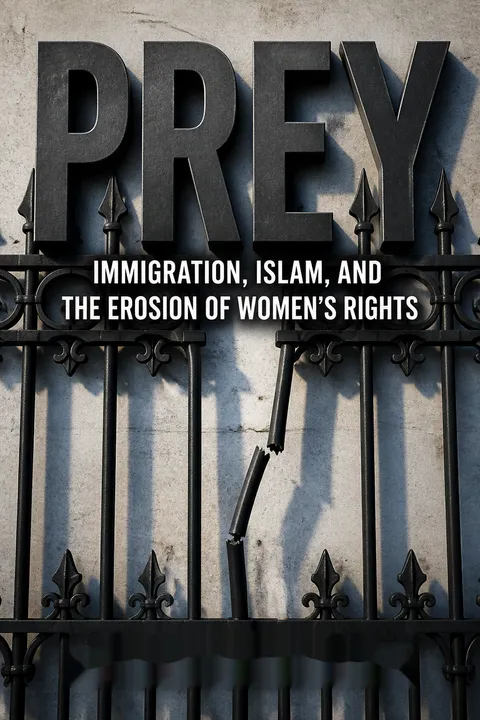
Prey is an advocacy-driven political argument built around a vivid social observation: in some neighborhoods, women alter their routes, routines, and use of public space because they feel exposed to harassment. The book then moves outward, connecting those accounts to post-2015 migration, sexual-violence statistics, police and court failures, debates about cultural norms, and proposals for integration reform. Its narrative force comes from combining the author's own migration history with case reports and interviews. That form helps make overlooked experiences legible, especially where ordinary harassment rarely appears in official records.
The evidentiary challenge is also central to assessing the book. The text repeatedly notes that definitions differ, sexual offenses are underreported, and national datasets are incomplete. It presents evidence of migrant overrepresentation in some places, but overrepresentation among suspects does not by itself establish religious or cultural causation. Citizenship is not a measure of belief; suspect counts are not conviction counts; and age, sex, poverty, trauma, and enforcement practices can all affect observed rates. The cited German study that finds no significant increase in native victimization further shows that results depend on the period and outcome being measured. The book's case studies make a compelling case for investigation, not a substitute for comparable, carefully controlled data.
Its most consequential contribution is the insistence that women's autonomy belongs at the center of immigration and integration policy. Safety is not meaningful if it is secured by narrowing women's lives. The strongest policy implications are therefore universal: record relevant information transparently with safeguards, investigate abuse consistently, teach consent, support women's education and work, and assess integration programs by outcomes. The book is most useful when its claims about particular norms are tested openly and individually. It is least useful when broad categories threaten to flatten differences among migrants. Its argument deserves neither automatic acceptance nor reflexive dismissal, but serious evidence, clear law, and equal protection.
Review Summary
Prey receives mixed reviews, with some praising its controversial premise and thorough research on the impact of Muslim immigration on women's rights in Europe. Critics commend Ali's bravery in addressing sensitive topics and providing data-driven insights. However, others criticize the book for cherry-picking arguments, promoting Islamophobia, and oversimplifying complex issues. Many readers find the statistics overwhelming but appreciate Ali's suggestions for addressing integration challenges. The book provokes strong emotional responses, with some viewing it as essential reading and others dismissing it as prejudiced.
People Also Read






Glossary
modesty doctrine
gendered sexual codeHirsi Ali's term for norms that require women to dress modestly, limit their public movement, and rely on male guardianship. In her account, women who observe these rules are treated as protected, while women judged to violate them may be blamed for harassment or treated as sexually available. The term describes the author's proposed framework, not a uniform belief held by all Muslims.
taharrush gamea
group sexual assaultAn Arabic phrase the book uses for coordinated sexual harassment or assault by groups of men, sometimes involving the encircling of a woman to isolate her from help. Hirsi Ali connects reports of this behavior in parts of North Africa with the mass assaults reported in Cologne on New Year's Eve 2015. The phrase should not be used to imply that group assault is unique to one region or religion.
dawa
Islamist ideological outreachA term used in the book for outreach that transmits a political interpretation of Islam. Hirsi Ali describes Islamists using institutions such as mosques, schools, and community organizations to promote religious norms and political goals. The word has broader meanings in Muslim contexts, including ordinary religious invitation, so the book's specialized use refers particularly to political Islamism.
parallel societies
socially separate communitiesThe book's term for neighborhoods or networks where immigrant communities maintain much of their social life, language, schooling, and religious practice apart from the wider society. Hirsi Ali argues that limited interaction can weaken language learning and civic participation, and can reinforce restrictions on women. The concept describes a degree of social separation, not a claim that every close-knit immigrant community rejects integration.
integration industry
self-perpetuating service sectorHirsi Ali's critical label for the public agencies, nonprofits, contractors, and specialists funded to help integrate migrants. She argues that fragmented programs may spend large sums without clear measures of success, and that providers can have weak incentives to solve the problems that sustain their work. The term is an argument about institutional incentives, not a formal name for a single organization.
adaptation deficit
gap in social integrationThe book's phrase for the failure of some immigrant communities or individuals to adopt the language, civic norms, and equal-rights practices of their host society. Hirsi Ali links the gap to religious and cultural beliefs, social isolation, and gender relations. It is a broad diagnosis rather than a single measurable variable, and the book's proposed explanations require separate evaluation.
adapters
liberal civic participantsOne category in Hirsi Ali's four-part account of immigrant integration. Adapters are people who use opportunities in their new country, learn, work, educate their children, and participate in civic life while accepting core liberal norms. The author presents the category as a descriptive heuristic, not as a standardized social-science classification or a fixed identity.
menaces
disruptive or criminal participantsA category in Hirsi Ali's integration typology for people, mainly young men in her account, who engage in criminal or antisocial behavior and may become dangerous to others. She associates this group with school disengagement, unemployment, and sometimes substance use. The label is the author's broad shorthand and should not be mistaken for a clinical, legal, or independently validated category.
fanatics
anti-liberal religious activistsHirsi Ali's term for religiously committed people who may speak the host country's language and understand its institutions but reject liberal norms and seek a greater role for religious authority. She describes both violent and nonviolent political methods. The category concerns political commitments and actions, not religious observance alone.
coasters
socially separate welfare recipientsA category in Hirsi Ali's integration typology for people who accept available benefits, have limited formal education or employment, and remain socially close to their community of origin. The author argues that concentrated settlement can reduce interaction with the wider society and affect children's opportunities. The term is her evaluative shorthand, not a neutral or established demographic label.

Download PDF
Download EPUB
.epub digital book format is ideal for reading ebooks on phones, tablets, and e-readers.








