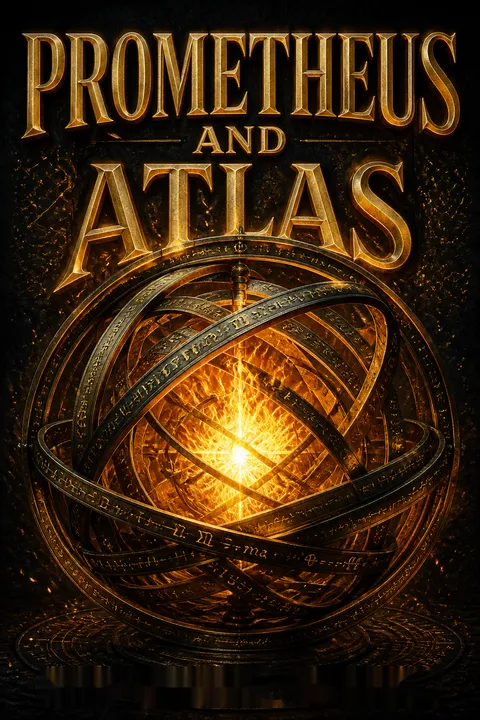


Key Takeaways
Take paranormal claims seriously without mistaking possibility for proof
The central provocation. Jorjani argues that phenomena dismissed as paranormal may expose what a culture has excluded from its picture of nature. He calls the proposed upheaval the “spectral revolution”: not simply a new scientific theory, but a change in how people recognize the assumptions and social forces shaping scientific inquiry. His larger thesis links three ideas: psychic agencies may influence scientific frameworks, living beings struggle to inhabit worlds shaped around their concerns, and technology gives one way of life unusual power to absorb others.
A demanding distinction. The book treats these claims as a challenge to investigate, not a settled account of reality. Its title figures, Prometheus and Atlas, stand for anticipatory invention and world-building, respectively. The argument asks readers to notice what standard explanations may leave out, while also raising questions about privacy, power, and social order.
The strongest version of this challenge is methodological: a field should not rule out a class of observations merely because its current theories cannot explain them. That principle has helped science investigate anomalies before. But openness is not confirmation. Reports, striking coincidences, and statistical deviations need controls capable of separating an unusual effect from expectation, selective reporting, and ordinary error. The book is most productive when it asks what a discovery would mean for society, rather than treating the possibility of a discovery as evidence that its boldest metaphysical claims are true.
Treat scientific facts as model-shaped, not view-from-nowhere truths
Observation has a history. Drawing on Thomas Kuhn, Paul Feyerabend, and Michel Foucault, Jorjani argues that scientific observations are interpreted through theories, language, institutions, and accepted methods. A paradigm is the shared framework that helps researchers decide what counts as a problem, an explanation, and credible evidence. Foucault’s “episteme” names a broader historical structure that shapes what a culture can recognize as knowledge.
Alternatives can reveal. Feyerabend’s case for competing theories matters here: a theory can make some observations visible while leaving others unnoticed. Jorjani uses this argument to defend inquiry into subjects such as telepathy and astrology, which he says have been excluded too quickly. He does not claim every alternative is true; he argues that testing more than one framework can expose assumptions that a single framework hides.
This is a useful correction to the fantasy that data arrive without interpretation. In practice, instruments, categories, and research questions help determine what can be observed. Yet model-dependence does not make all accounts equally credible. A thermometer’s readings depend on calibration, but calibration can be checked against other instruments and reproducible procedures. The productive lesson is not to abandon standards, but to make them explicit, compare rival explanations, and keep the possibility of correction open. Otherwise, criticism of orthodoxy can become its own orthodoxy.
Test psychic claims with open methods and tougher controls
The book’s evidence. Jorjani surveys research on telepathy, remote viewing, psychokinesis, and memories suggestive of reincarnation. He cites Rupert Sheldrake’s telephone experiments: in 854 trials, participants identified the caller at a reported 42 percent rate, compared with a 25 percent chance rate in a four-caller setup. He also describes Princeton Engineering Anomalies Research experiments in which participants attempted to influence random number generators, and Stanford Research Institute remote-viewing trials funded by US agencies.
A vivid historical case. The book recounts chemist William Crookes’s investigations of medium Daniel Dunglas Home, including reports of an accordion playing inside a restricted cage. Jorjani presents these cases as evidence that the paranormal deserves serious study. The claims remain contested; the book’s examples establish what its sources report, not that every proposed explanation has been independently confirmed.
The emphasis on testing rather than reflexive dismissal is valuable, and the examples give readers a concrete sense of what researchers have claimed to observe. The harder question is how to distinguish an anomalous result from bias in selection, analysis, or reporting. Stronger safeguards include preregistered methods, independent replication, complete publication of results, and clear handling of failed trials. These standards do not prejudge the outcome. They protect unusual claims from being accepted too easily and protect serious inquiry from being dismissed because some studies are weak.
See technology as worldmaking, not neutral equipment
Two mythic functions. Jorjani recasts Prometheus as the force of foresight and technical invention, and Atlas as the force that measures, maps, and organizes a world. Together, they represent what he calls the spectral ideals behind technoscience: technology and science understood as a practical activity that shapes the world, not just a theory that describes it. A map, measurement system, or laboratory apparatus does not merely copy nature. It helps determine what can be compared, controlled, and built.
The atomic emblem. The book treats the atomic bomb as a Promethean image: a human technology that breaks apart what was once imagined to be indivisible. A photograph of Earth from space becomes an Atlas image, framing the planet as something that can be surveyed and managed. Jorjani argues that technical practice often comes before the theories used to explain it.
This account draws attention to a real feature of engineering: tools reorganize behavior and institutions, not just matter. A map changes navigation, a metric standard enables coordination, and an experimental device defines which properties can be measured. The mythic vocabulary makes that process memorable. Its risk is suggesting that technology has one unified will or destiny. Technologies are designed, funded, regulated, and used by particular people. Examining those choices keeps the analysis of world-making grounded in accountability rather than in a grand force that seems to act on its own.
Let art and imagination question science’s inherited categories
Ideas before definitions. In Jorjani’s reading of Immanuel Kant, “aesthetic ideas” are images or imaginative presentations that provoke more thought than a precise concept can contain. Kant argues that artistic genius can produce work without following a formula; Friedrich Schelling extends this idea, proposing that creative activity joins conscious intention with processes beyond conscious control. Jorjani suggests that scientific concepts may also grow from such imaginative starting points.
A warning in fiction. Mary Shelley’s Frankenstein is presented as a story about the peril and promise of creation, not merely a tale about a monster. Victor Frankenstein’s attempt to create life shows how discovery can outrun ethical judgment and social responsibility. For Jorjani, artistic imagination can help expose the assumptions beneath scientific models and picture alternatives that established methods have not yet named.
Imagination is indispensable to hypothesis formation. Scientific advances often begin with a model, analogy, or question that cannot yet be expressed as a finished theory. Shelley’s story sharpens the ethical side: technical possibility does not settle whether an intervention is wise, or who bears its consequences. Still, an evocative image is not evidence for the reality it suggests. The most useful relationship is reciprocal: art helps science ask new questions, while empirical tests prevent powerful stories from being mistaken for demonstrations.
Remember that revolutions can replace one orthodoxy with another
Reason became a ritual. During the French Revolution, the Cult of Reason attempted to displace Catholic worship with a secular civic faith. Its leaders staged a Festival of Reason at Notre Dame in 1793. Maximilien Robespierre opposed the atheistic movement, promoted a Cult of the Supreme Being, and helped drive its leading figures toward execution. Napoleon later restored monarchy and reached an accommodation with the Church. Jorjani uses this sequence to show that anti-religious politics can become coercive rather than liberating.
A philosophy under suspicion. He also argues that René Descartes and Kant helped build modern philosophy by excluding psychic phenomena and separating mind from matter. His account of their motives, including claims about Descartes’s ties to religious intelligence work and Kant’s fear of Swedenborgian ideas, is interpretive and disputed. The larger point is that theories of knowledge can carry political and moral consequences.
The Revolution’s history makes the book’s warning tangible: replacing a religious authority with a new official creed does not eliminate dogmatism. Its account of Descartes and Kant also invites readers to examine the institutions and incentives surrounding intellectual life. However, biographical speculation cannot by itself establish why a philosopher adopted a position. The stronger argument concerns consequences: when a theory defines certain experiences as impossible before examining them, it can close inquiry. That criticism should be assessed separately from claims about an individual thinker’s hidden motives.
Read Atlantis as a warning about scientific utopias becoming empires
A civilization in miniature. Plato’s Atlantis is a powerful island society that attempts to conquer surrounding lands. Francis Bacon’s New Atlantis reimagines the island as a secret scientific community, collecting knowledge from across the world and pursuing new inventions. Rudolf Steiner’s version emphasizes the inhabitants’ alleged psychic abilities. Jorjani treats these stories as myths about the promise and danger of a society organized around extraordinary technical power.
The cost of one standard. The book argues that global systems of measurement and technical organization can displace local practices, as European colonial rule displaced Indigenous systems. It presents this as an example of Atlas’s world-building power. Jorjani’s proposed alternative is a cosmopolitan society able to use different maps for different purposes without treating any one model as reality itself.
The Atlantis sequence makes a strong connection between utopian ambition and imperial reach. A society that claims to improve the whole world can still impose its own standards and erase the knowledge of those it governs. At the same time, shared measurement systems can support trade, science, and public coordination; their use is not automatically colonial. The important questions are who sets the standards, whose practices are displaced, and whether affected communities can shape the system. Pluralism needs institutional safeguards, not just an open-minded attitude.
Track how Japanese art turned atomic trauma into psychic power
From monster to pilot. Jorjani reads postwar Japanese popular culture as a record of the psychic afterlife of Hiroshima and Nagasaki. In Godzilla, nuclear testing creates a destructive sea monster. In Akira, an apparent atomic blast is revealed as an uncontrolled release of psychic power by a boy with extraordinary abilities. Neon Genesis Evangelion shifts the emphasis again: adolescents pilot giant engineered beings in a struggle involving angels, technology, and human identity.
A cultural argument. Jorjani links these stories to Japanese Zen, its historical association with military culture, and the country’s encounter with Western technology. He argues that the atomic bombings helped reshape the Japanese imagination around Promethean invention and Atlas-like world-building. The sequence is an interpretation of cultural symbols, not proof that a whole nation underwent one uniform psychological transformation.
Reading popular art as a way of processing historical trauma can illuminate why a society returns to particular images. The movement from an external monster to a child’s psychic power, and then to human pilots inside giant machines, gives the interpretation a persuasive narrative shape. But national cultures are internally diverse, and a handful of influential works cannot stand for every Japanese experience. The reading is most convincing as an account of recurring artistic concerns, not as a comprehensive claim about the psychology or political destiny of an entire population.
Choose an unfinished world where human choices can change outcomes
James’s alternative. William James contrasts a predetermined universe, where every event is already part of a completed whole, with a pluralistic universe that remains open to change. His “meliorism” is the view that improvement is possible but not guaranteed; outcomes depend partly on what people do. Jorjani connects this to the risks and responsibilities of treating intentions as causally significant.
Revelation under examination. The book applies radical empiricism to religious miracles and UFO reports, reading some scriptural events as possible encounters with advanced beings or technologies. Jacques Vallée’s work is central to this move, as is the case of Ted Owens, who claimed psychic powers and contact with UFO occupants. These interpretations challenge established religious and scientific accounts, but the book’s readings are hypotheses, not verified explanations.
An unfinished universe makes moral agency more consequential: no ultimate guarantee erases the cost of harmful choices or ensures that justice arrives by itself. That is a powerful reason to prefer James’s meliorism to fatalism. But openness to unexplained events can also invite confident claims about hidden beings, especially when a story carries religious or political authority. Any proposed revelation should therefore face both evidential scrutiny and ethical scrutiny. A remarkable experience may deserve investigation without granting its interpreter the right to command others.
Analysis
Prometheus and Atlas is a sweeping work of speculative philosophy that moves from theories of knowledge to paranormal research, classical myth, religious history, and popular culture. Its central strategy is to treat these subjects as parts of one argument: scientific models do not simply describe a ready-made world; practical technologies, social institutions, and cultural imaginaries help make the world people inhabit. The mythic pairing gives that argument a memorable structure. Prometheus represents foresight and invention, while Atlas represents measurement and the organization of space. The book’s most valuable contribution is its insistence that scientific categories have histories and consequences. It asks readers to consider not only whether a method works, but what it excludes and what forms of life its success enables.
The case becomes less secure when this critique of scientific certainty is used to support specific paranormal explanations. The cited studies and historical cases are not all equally strong, and reports of anomalous events do not establish that psychic forces, extraterrestrials, or ancient technologies caused them. The book sometimes moves quickly from the possibility of an interpretation to a broad account of history, religion, or national character. Its readings of Descartes, Kant, the Bible, Atlantis, and postwar Japan are best approached as provocative interpretations rather than settled findings.
That tension is central to the book’s appeal and its limitation. It is an imaginative challenge to both mechanistic reductionism and unexamined religious authority, but its own alternative worldview can become just as totalizing if its claims escape scrutiny. The most durable lesson is therefore not to accept its cosmology wholesale. It is to hold inquiry open, distinguish observation from explanation, examine who benefits when a model becomes dominant, and keep the ethical stakes of discovery in view.
Review Summary
Prometheus and Atlas receives mixed reviews, with ratings ranging from 1 to 5 stars. Positive reviews praise its revolutionary analysis of paranormal suppression, philosophical depth, and ambitious scope. Critics argue it lacks coherence, relies on pseudoscience, and contains verbose jargon. Some readers find it enlightening and thought-provoking, while others dismiss it as nonsensical. The book's exploration of metaphysics, technology, and parapsychology generates both enthusiasm and skepticism. Overall, it appears to be a polarizing work that challenges conventional thinking and sparks debate among readers.
People Also Read





Glossary
Spectral Revolution
Radical rethink of knowledgeJorjani’s name for a proposed transformation in science and society prompted by serious engagement with phenomena excluded as paranormal. It means more than replacing one scientific paradigm with another. It would require people to examine how cultural assumptions shape research, and to reconsider the limits placed on agency, nature, and experience.
Supernature
Nature beyond current modelsJorjani’s term for aspects of nature that mechanistic scientific models obscure or exclude. He distinguishes this from a separate supernatural realm: what seems supernatural may instead reveal dimensions of nature that standard methods do not capture. The term frames paranormal reports as possible clues to an incomplete account of the natural world.
Technoscience
Science joined to technologyThe book’s term for scientific knowledge understood as inseparable from practical tools, experimentation, and technological development. In this account, technology is not merely an application added after theory. Instruments and technical practices shape what can be observed and how nature is made to appear, while scientific ideas guide further technological work.
aesthetic ideas
Images that exceed conceptsA Kantian term that Jorjani uses for imaginative presentations that generate thought without being fully captured by a precise concept. Artistic genius can express such ideas through images or works that invite multiple interpretations. Jorjani extends the notion to suggest that foundational scientific concepts may also arise from imaginative, non-formulaic insight.
Atlas
Archetype of world-buildingJorjani’s specialized use of the mythic Titan who bears the heavens. Atlas represents the construction of maps, measurements, models, and systems that organize a world for calculation and action. The figure also signals the expansive, sometimes colonizing power of technological systems that impose a common framework across different cultures.
Prometheus
Archetype of technical foresightJorjani’s specialized use of the Titan who gives fire and craft to humanity. Prometheus represents anticipatory knowledge, invention, and the drive to reshape nature rather than submit to an existing order. The figure also embodies the danger of discovery: new powers can liberate people, but they can bring consequences their creators cannot control.
meliorism
Improvement is possible, uncertainWilliam James’s term for the position between pessimism and guaranteed optimism. A better world is possible, but its arrival is not assured by a divine plan or by historical necessity. Whether conditions improve depends partly on human action, making choices consequential and leaving open the possibility of failure.
FAQ
1. What is Prometheus and Atlas by Jason Reza Jorjani about?
- Exploration of Myth and Technology: The book investigates the mythic figures of Prometheus and Atlas as archetypes symbolizing the spirit of technoscience, human creativity, and the burden of knowledge, tracing their influence from ancient mythology to modern science and culture.
- Spectral and Paranormal Dimensions: Jorjani argues that suppressed "spectral" or paranormal phenomena are fundamental to reality and have been systematically excluded from mainstream science, yet are essential for understanding human potential and technological progress.
- Philosophical and Cultural Critique: The work critiques Cartesian dualism, Enlightenment rationalism, and religious dogmatism, proposing a new paradigm that integrates the paranormal and mythic into scientific and cultural evolution.
2. Why should I read Prometheus and Atlas by Jason Reza Jorjani?
- Visionary and Interdisciplinary Approach: The book offers a unique synthesis of philosophy, mythology, parapsychology, and cultural history, providing a fresh perspective on the forces shaping modern civilization.
- Challenge to Conventional Science: Jorjani invites readers to reconsider the foundations of scientific knowledge, encouraging openness to phenomena marginalized by mainstream science, which could revolutionize our understanding of reality.
- Engagement with Contemporary Debates: The book situates itself within ongoing philosophical discussions about reason, freedom, and the nature of reality, making it valuable for those interested in philosophy, science, and cultural studies.
3. What are the key takeaways from Prometheus and Atlas by Jason Reza Jorjani?
- Promethean and Atlantean Archetypes: These mythic figures represent human creativity, rebellion, and the burden of knowledge, framing the tension between aspiration and responsibility in a godless, technological world.
- Spectral Revolution: Jorjani predicts a coming scientific and cultural upheaval that will integrate the paranormal into mainstream knowledge, transforming science, ethics, and society.
- Critique of Rationalism and Religion: The book challenges both religious dogmatism and universalist rationalism, advocating for a pragmatic, pluralistic philosophy that embraces cultural diversity and the provisional nature of truth.
4. How does Jason Reza Jorjani define the "spectral" and the concept of a "spectral revolution" in Prometheus and Atlas?
- Spectral as De-structuring Force: The spectral transcends binary oppositions (life/death, mind/matter), haunting and unsettling fixed scientific and social constructs.
- Spectral Revolution Explained: Inspired by Derrida, Jorjani envisions a future where the paranormal is recognized as normal, collapsing barriers between conscious and unconscious, and transforming scientific practice.
- Implications for Knowledge and Power: This revolution demands a pluralistic, self-conscious approach to knowledge, challenging the Cartesian mechanistic paradigm and acknowledging the role of personal, spectral agencies in shaping reality.
5. How are the mythological figures Prometheus and Atlas interpreted in Prometheus and Atlas by Jason Reza Jorjani?
- Prometheus as Foresight and Rebellion: Prometheus symbolizes forethought, technological mastery, and the rebellious spirit that brings forbidden knowledge (the "fire") to humanity, embodying both creative potential and existential risk.
- Atlas as World-Bearing Sovereignty: Atlas represents the burden and power of modeling, measuring, and colonizing the world, symbolizing the foundational conditions of existence and the calculative order imposed by science.
- Archetypes Guiding Science: Both figures are presented as unconscious archetypes or aesthetic ideas that shape the anticipatory projection and world-building spirit of technological science and human destiny.
6. What is Jason Reza Jorjani’s critique of Cartesian and Kantian philosophy in Prometheus and Atlas?
- Suppression of the Spectral: Jorjani argues that Descartes’ mind-body dualism and Kant’s limits on experience were motivated by a fear of the spectral, leading to a mechanistic worldview that excludes paranormal phenomena.
- Philosophical Consequences: Both philosophers contributed to a science that alienates mind from matter and suppresses the revolutionary potential of the paranormal, reinforcing a divide that limits human understanding.
- Institutional and Social Impact: Kant’s advocacy for institutionalizing those with paranormal abilities and Descartes’ rejection of the occult are seen as efforts to protect social order and religious faith at the expense of genuine inquiry.
7. How does Prometheus and Atlas by Jason Reza Jorjani address parapsychological phenomena like telepathy and psychokinesis?
- Empirical Evidence and Significance: The book surveys replicated research on telepathy, clairvoyance, precognition, and psychokinesis, emphasizing their deep roots in organic life and transformative potential for human experience.
- Ethical and Social Challenges: Recognition of these abilities threatens privacy, legal systems, and economic structures, raising questions about thought privacy, crime prevention, and property rights.
- Psi-Inhibitor Effect: Widespread skepticism acts as a dam on psychic abilities; mainstream scientific validation could amplify these phenomena and lead to protocols for enhancing latent human potential.
8. What is the significance of Atlantis and Bacon’s New Atlantis in Prometheus and Atlas by Jason Reza Jorjani?
- Atlantis as Technological Power: Plato’s Atlantis is interpreted as a metaphor for a civilization with god-like technological and psychic powers, serving as a cautionary tale about hubris and downfall.
- Bacon’s New Atlantis and Scientific Secrecy: Bacon’s vision is depicted as a secretive, cosmopolitan scientific foundation that accumulates and controls knowledge, anticipating modern research institutions and raising ethical questions about openness and power.
- Symbolism in Modernity: Both myths are used to illustrate the enduring influence of Atlantean archetypes on Western civilization’s technological and cultural evolution.
9. How does Prometheus and Atlas by Jason Reza Jorjani relate to the occult, alchemy, and the concept of "Supernature"?
- Hidden Dimensions of Nature: The book argues for a "Supernature" that is occulted by modern scientific rationalism but accessible through aesthetic intuition and genius, revealing a deeper, non-dual reality.
- Alchemy as Spiritual Science: Alchemy is reinterpreted as a spiritual science capable of transforming matter and consciousness, bridging the natural and spirit worlds in a future science of life.
- Paranormal as Natural: Phenomena like extrasensory perception and mesmeric sleep are discussed as natural expressions of the soul’s capacities, challenging Cartesian dualism.
10. What role do philosophers like Heidegger, Bergson, Schelling, and William James play in Prometheus and Atlas by Jason Reza Jorjani?
- Heidegger’s Ontological Critique: Heidegger’s analysis of technology as a force with ontological priority over science is used to reveal the spectral essence of technoscience and the need for poetic engagement with technology.
- Bergson’s Intuition and Evolution: Bergson’s view that intuition can be redeveloped to transcend rational knowledge supports the idea that spectral phenomena reveal a hidden Supernature.
- Schelling’s Archetypes and Genius: Schelling’s concept of aesthetic ideas as archetypes and the creative genius as a mediator between unconscious and conscious realms underpins the book’s framework for understanding the spectral.
- William James’ Radical Empiricism: James’ pluralistic universe and openness to psychic phenomena provide a foundation for integrating personal forces into scientific inquiry.
11. How does Prometheus and Atlas by Jason Reza Jorjani address the relationship between Eastern and Western thought?
- Heidegger and East Asian Philosophy: The book highlights Heidegger’s engagement with Taoism and Zen Buddhism, showing how Eastern thought influenced his concept of "being in the world."
- Comparison of Heraclitus and Taoism: Jorjani draws parallels and contrasts between Heraclitus and Taoist sages, illuminating different philosophical responses to nature and society.
- Japanese Zen and Promethean Ethos: The evolution of Zen Buddhism in Japan, its role in militarism, and its postwar transformation are explored as examples of the hybridization of Eastern spirituality with Atlantic civilization.
12. What are the ethical and political implications of embracing the spectral and paranormal in Prometheus and Atlas by Jason Reza Jorjani?
- Challenge to Social Order: Acknowledging paranormal abilities threatens privacy, national security, legal systems, and economic structures, potentially leading to radical social transformations or crises.
- Revaluation of Religious Revelation: The book calls for a hermeneutics that sees oppressive religious dictates as manipulations by mercurial, possibly deceptive intelligences, advocating liberation from slavish ideologies.
- Vision for a New Civilization: Jorjani envisions an Atlantic civilization that consciously integrates the Promethean and Atlantean ethos, building a scientific society on the ruins of traditional religious and political orders, with ethical engagement at its core.
Download PDF
Download EPUB
.epub digital book format is ideal for reading ebooks on phones, tablets, and e-readers.








