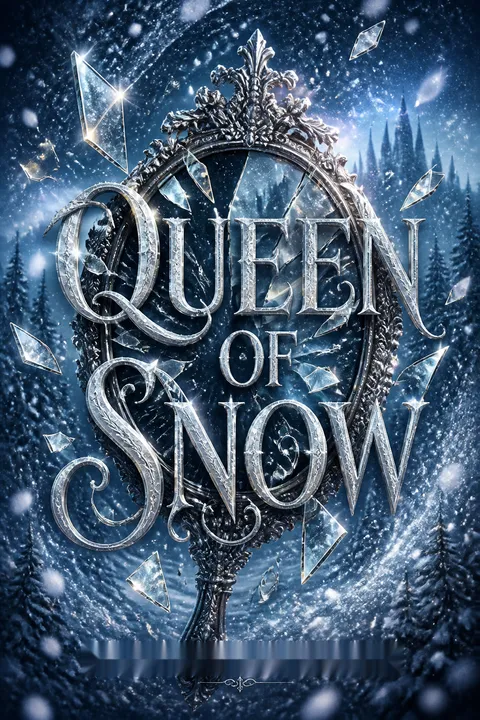


Plot Summary
The Mirror at the Funeral
At seventeen, Jack Smith stands at his grandfather Arthur’s funeral, grieving the only family he has known and unsure what to do with the manor left to him. Across the cemetery, he notices a veiled young woman in white; their eyes meet, and an unfamiliar jolt breaks through his numbness. She disappears before he can approach.
Later, a flash from Arthur’s forbidden study draws Jack inside, where an old oval mirror shows the same woman. A gust drives him through the glass and into a snowy forest beneath a strange castle. The woman meets him there, now with brown hair, knows his name, and urges him to flee. When Jack demands an explanation, she knocks him unconscious.
Jack’s passage begins at a moment when his old life has already lost its center. Arthur’s death seems to free him from the role of dutiful grandson, but the inheritance offers only a vast house and no sense of direction. The woman’s appearance gives that emptiness a face: she is at once an impossible image in the mirror and the first person to act decisively toward him. The portal makes grief literal, turning the forbidden room and the unreadable parts of Arthur’s life into a threshold. Jack crosses not because he is prepared, but because curiosity briefly outweighs the habits of a sheltered boy.
A Princess Sells Her Guide
The woman is Aria, a fugitive princess hiding her identity and dyeing her blonde hair brown. She has arranged to exchange Jack for a shard of the Mirror of Reason with Ryke, a pirate who deals in stolen goods. While the transaction is underway, an elf confirms Jack is the person Ryke expected; Aria takes the shard, then learns its label means a complete mirror.
Realizing Jack may know how to reach the mirror, she turns back. Jack wakes imprisoned in a carriage bound for a pirate ship, still unsure whether the portal was real. Aria attacks his captors in the forest, frees him, and offers her horse. Jack distrusts the rescuer who sold him, but the pair ride together because he has nowhere else to go.
Aria’s first choice is shaped by a survival ethic that has hardened into transaction: she treats Jack as payment because the mirror seems to offer an exit from a kingdom suffering under the Queen. Her reversal does not erase the betrayal; it complicates it. She has to admit, through action rather than apology, that Jack is not merely a means to her freedom. Jack, meanwhile, cannot afford the luxury of moral certainty. The horse and the shared ride create an alliance before trust exists, making dependence the first bond between them. Their relationship begins not with idealized recognition, but with a debt neither can yet define.
Belle’s Library Burns
At a burned village, Aria tells Jack that the northern Queen has been destroying settlements while searching for a missing princess. She admits she wants the Mirror of Reason so they can both leave the Chanted Forest.
They visit Belle, a scholar who explains that Jack’s mirror remains intact in his own world, though a cracked mirror can be used only once every seven years. Belle also reveals that an outsider called the Intruder has altered fairy-tale destinies, including her own.
Before they can study further, the Queen’s guards seize Belle and Jack. Aria’s ice powers erupt as she fights through the castle, confirming to the guards that she is the princess. With Belle’s help, Jack and Aria escape, but the chase drives them into the woods as wolves approach.
Belle’s library converts Jack’s bewilderment into rules, but each answer sharpens the dilemma. The intact mirror offers a route home, while the seven-year interval makes escape costly rather than simple. The Intruder’s influence introduces a second kind of danger: stories here are not just familiar plots but lives already disrupted by someone’s attempts to improve them. Aria’s exposure changes the partnership’s balance. Jack is no longer traveling beside an anonymous thief; he is beside the person whose capture has become the Queen’s public obsession. Belle’s aid also models a form of resistance grounded in knowledge, while Aria’s rescue depends on a power she cannot reliably contain.
Robin’s Arrow Breaks the Bracelet
Aria and Jack sneak into an ogre’s cave to find a mirror shard. Jack’s fall wakes the giant, and Aria blinds it with her knife and an arrow. Jack stalls the ogre by offering the false name No One, giving them time to hide from its brothers and escape. Outside, a net catches them, but Robin Hood and his band rescue them.
Robin mistakes Jack for the Intruder and threatens him, then accuses Aria of running from the Queen while villages burn. He shoots the hinge of Aria’s power-suppressing bracelet. Her stored ice explodes into a blizzard, nearly burying Jack as well as the village. Jack calms her by removing her mother’s necklace. Robin yields the real shard he had hidden and reveals that Marian has been taken by a wolf.
The ogre episode gives Jack a first chance to contribute through invention rather than inherited skill: his literary knowledge becomes a practical tool, and Aria’s willingness to spare the blinded creature contrasts with her earlier readiness to use violence. Robin’s accusation then exposes the moral cost of her flight. He is right that the kingdom needs her, but wrong to treat Jack as guilty by association. The broken bracelet makes Aria’s power physical and political at once: suppression has kept danger contained, yet it has also left her cold and dependent. Jack’s intervention does not master her power for her; it helps her regain enough trust in herself to choose restraint.
The Secret Beneath Aria’s Hair
In Aria’s hidden burrow, Jack sees that the repaired pieces of the Mirror of Reason can reveal a truer reflection: Aria’s hair is naturally blonde, and she has been disguising herself to evade the Queen. Pressed about George, she explains that he was her childhood friend and the Queen’s son.
When he kissed her, Aria’s uncontrolled ice killed him; the Queen blamed her, and the ensuing conflict cost Aria her parents and younger sister. Aria believes leaving is the only way to stop more people dying.
Jack does not condemn her, and she lets him comfort her. The mirror then points them toward Pirate Cove, where the final shard may be. Aria’s mother’s mermaid-stone necklace, which strengthens her powers, becomes the price of a bargain with a mermaid named Lexa.
The mirror’s truer image is not simply a disguise reveal. It gives Aria a brief chance to be seen without the camouflage she has made necessary, and Jack’s acceptance makes intimacy possible without absolving her guilt. Her account of George separates intention from consequence: she did not mean to kill him, but she cannot deny what her power did. That distinction is central to her fear of using it again. The necklace carries grief as well as strength, so trading it away is not a practical exchange alone. Aria gives up a piece of her mother’s memory because escape still seems more bearable than remaining responsible for a kingdom.
The Shard Goes Underwater
At Pirate Cove, Jack and Aria find pirates fighting mermaids, then swim through an underwater passage to search for the shard. Lexa captures Jack and reveals that her father, Poseidon, has it beneath the sea. She agrees to retrieve it in exchange for Aria’s necklace, but the pirates net her before she can return. Aria and Jack board the ship to free her.
During the fight, Jack refuses to abandon Lexa after Aria has recovered the shard, and Aria joins him. The captain, working for the King of the Shores and seeking the Queen’s bounty, wounds Aria and locks her below deck. As the ships sink in a storm, Jack risks drowning to break into her cabin. Lexa frees Aria, then carries both of them to an island where healers can help.
This sequence tests the difference between a bargain and a relationship. Aria initially treats Lexa as a necessary exchange, while Jack insists that receiving help creates obligations beyond the terms of a deal. His refusal changes Aria’s choice: she returns to the fight even though the shard is already within reach. The shipwreck makes that ethical shift costly. Jack’s effort to reach Aria is not a display of power but a refusal to save himself alone, and Lexa’s rescue repays the same principle. The necklace’s loss strips Aria of an amplifier, not her underlying abilities, leaving her to discover whether she can act without relying on inherited strength.
The Intruder Hands Jack Over
On the island, Jack recognizes the healer as Arthur, his supposedly dead grandfather. Arthur explains that he entered this realm when Jack was a baby and that time moves differently across the mirror. He is the Intruder, whose attempts to spare storybook characters pain have disrupted their lives.
Arthur asks Aria to keep Jack from returning to England, then sends Jack away and delivers him to the Queen. Aria completes the Mirror of Reason and sees Jack imprisoned, so she chooses rescue over escape despite the seven-year cost of crossing its cracked glass.
At the Queen’s castle, she disguises herself as a guard, discovers her sister Snow is alive and hidden there, and helps Snow and George escape toward Robin Hood. Aria turns back alone to find Jack.
Arthur’s revelation recasts Jack’s childhood without making its loneliness harmless. The grandfather’s preparation may have served a purpose, but Jack was still a child who experienced distance as rejection. Arthur’s decision to surrender him repeats that pattern under the language of necessity. Aria’s choice marks the opposite movement: she accepts a severe cost without certainty that Jack can be saved. Finding Snow alters the meaning of the escape she once pursued. Her family is not wholly gone, and her return to the castle is no longer a flight from loss but a deliberate confrontation with the power that produced it. She acts from attachment, not from a promised happy ending.
The Queen Becomes a Dragon
The Queen holds Jack at court and asks him to advise her on how fairy-tale heroes might defeat her. He agrees only after she promises to spare Aria and stop burning villages. When Aria reaches the castle, she confronts the Queen, who transforms into a dragon and attacks.
Guards restrain Jack as Aria fights with her remaining strength, her injured shoulder bleeding and her ice faltering. Jack finally recognizes the snow and wind he has unconsciously summoned in earlier crises as his own powers.
He breaks free, builds a sword from ice, and pins the dragon in a blizzard. Knowing the Queen’s death will also kill whoever strikes the fatal blow, he still drives the weapon into her heart. The dragon falls, the storm clears, and Jack collapses beside Aria, dead.
The court scene offers Jack the role he has long wanted: someone whose knowledge matters. Yet he accepts it as a bargain made to protect Aria, not as loyalty to the Queen. The dragon’s transformation turns the Queen’s violence into its literal source, while Jack’s winter reveals that he belongs to this world more deeply than he understood. His choice to kill her is not a clean heroic triumph. The protection attached to the Queen’s life makes victory demand a sacrifice, and Jack chooses it with full knowledge of the risk. His death leaves Aria facing the consequence she has spent the story trying to avoid: someone she loves has paid for the kingdom’s survival.
A Kiss Changes the Ending
Aria mourns Jack as Snow and the gathered villagers celebrate the Queen’s defeat. Snow urges her to try a true love’s kiss, and Aria does, though she fears their story has no such magic. Ice first seals Jack’s body; then it breaks apart in a surge of snow, and he wakes transformed, with white hair and a new connection to winter.
Arthur explains that Jack’s grandmother came from this kingdom and that Jack’s new identity is Jack Frost. He also tells Aria that the Queen’s death leaves a role to fill: she must become the feared Snow Queen so that others can have stories to overcome. Aria accepts the burden, freezes Arthur’s heart at his request, and watches him return to his own time. She and Jack choose to face what comes together.
The kiss does not erase the cost of Jack’s sacrifice; it answers it through a relationship that has become mutual rather than merely protective. His transformation gives form to a belonging he had not been able to name, while Aria’s survival of the Queen’s regime brings no uncomplicated freedom. Arthur’s explanation turns the apparent happy ending into a new ethical trap: the kingdom’s story depends on someone embodying the threat. Aria accepts that role, but the choice echoes her earlier fear that she will be reduced to a weapon. Freezing Arthur’s heart repeats the very emotional deprivation that shaped Jack’s childhood, making her victory inseparable from a fresh wound.
Epilogue
At Aria’s coronation, Ryding Hood watches the princess take the crown while Jack stands beside her, changed and white-haired. The new queen’s solemn manner unsettles Red, but the crowd cheers as Aria promises her people a better future. On the balcony, Aria suddenly pushes George into the lake.
Snow screams as Aria freezes the water over him. Then Aria announces that the kingdom’s next ruler will be the Snow Queen. The coronation’s promise of peace fractures in public, leaving Red and the court to face a ruler who has chosen the role Arthur said the stories required.
The epilogue converts the resolution into a threat without canceling its emotional truth. Jack and Aria are reunited, and Aria has accepted the crown, but the ceremonial setting makes her violence more disturbing: she commits it before the people she has just promised to protect. George’s fall also reaches backward to the guilt that has defined her, suggesting that the old wound may be becoming a political instrument. By letting Red witness the act, the book replaces private intimacy with public uncertainty. The final declaration makes the Snow Queen identity a chosen performance, or perhaps a surrender to the role Arthur described. Either way, the kingdom’s restored order is already unstable.
Analysis
Queen of Snow turns a familiar fairy-tale structure into a dispute about who has the right to decide how a story should end. Arthur’s interference begins with benevolent intent: he wants to spare characters the suffering he has read about. But the damaged fates around him expose the limits of treating lives as narratives to edit. His mistake is not simply changing events; it is assuming that he can calculate other people’s good without their participation. Jack inherits the consequences of that impulse through a childhood shaped by secrecy, while Aria inherits them through a kingdom pushed toward violence.
The mirror makes this conflict tangible. It promises escape, reflects hidden identities, and offers knowledge, yet it never supplies an uncomplicated answer. Its seven-year restriction turns departure into a moral cost, and its ability to show truth cannot decide what someone should do with that truth. Jack and Aria approach the mirror differently: he wants to return to a life he has barely begun, while she wants to leave a place that has made her feel responsible for every loss. Their changing bond does not erase those motives. Instead, each gradually chooses not to treat the other as a tool for getting away.
Power in the novel is most dangerous when separated from emotional accountability. Aria fears becoming a weapon because her magic once caused a death she never intended. Jack’s winter abilities emerge through protection and sacrifice, but they too culminate in a lethal choice. The story’s romantic resolution therefore remains uneasy. Love can restore Jack, yet it does not simply restore the kingdom to innocence. Aria accepts the role of Snow Queen because Arthur claims the stories need an antagonist, and the epilogue immediately tests whether that role can be inhabited without repeating the Queen’s cruelty. The ending’s sharpest question is whether a person can preserve a community by performing the evil it expects, or whether that performance becomes another form of fate imposed from outside.
Review Summary
Queen of Snow is a fairytale retelling with mixed reviews. Readers appreciate the creative reimagining of classic tales and the fast-paced adventure, but some find the writing and character development lacking. The story follows Jack, who falls into a magical world, and Aria, a princess on the run. While some enjoy the romance and plot twists, others criticize the instalove and rushed pacing. The ending, which sets up future books in the series, is particularly divisive, with some finding it intriguing and others unsatisfying.
People Also Read
Characters
Jack Smith
The stranded bookwormJack is a seventeen-year-old orphan raised in the shadow of his scholar grandfather, with a head crowded by fairy tales, languages, and questions about who he might become. His sheltered life has left him inexperienced, but not passive: he observes patterns, remembers stories, and often finds a solution by thinking rather than overpowering an opponent. He is drawn to Aria’s courage and troubled by the loneliness beneath it. Jack’s instinct is to protect people, even when the risk is personal, and that generosity sometimes leads him into danger. His developing sense of purpose grows out of action and attachment, not a wish to inherit someone else’s authority.
Aria
The runaway ice princessAria is a fugitive princess with ice magic, a thief’s survival skills, and a practiced habit of hiding what she feels. She dyes her blonde hair brown and keeps strangers at a distance because discovery could endanger both her and the people sheltering her. Her powers are tied to emotion and difficult to control, making restraint a daily discipline rather than a simple virtue. Aria’s guilt over past harm feeds her desire to flee, while her loyalty to the family and friends she has lost pulls her toward danger. Jack unsettles her defenses by treating compassion as strength, but she resists needing anyone until circumstances make dependence unavoidable.
Arthur Smith
The distant scholarArthur is Jack’s learned, exacting grandfather, a celebrated author whose manor and library shape Jack’s childhood. His passion for books, travel, and preparation gives him the manner of a man who believes knowledge can prevent disaster. Yet his reserve leaves Jack struggling to distinguish care from control. Arthur’s decisions are guided by a powerful commitment to what he believes must happen, even when that certainty places emotional burdens on others. He is connected to the mirror and to the tangled fates of the Chanted Forest, but his deepest conflict is personal: how to protect the people he loves without changing the course he believes they must follow.
The Queen
The kingdom’s feared rulerThe Queen rules through surveillance, threats, and spectacular destruction. Her hunt for the missing princess reaches beyond the palace, giving frightened villages a reason to fear what she may do next. She is intelligent enough to recognize that knowledge of stories can become political leverage, and she tries to turn Jack’s familiarity with them into an advantage. Her authority depends on making other people feel powerless, but her fixation on controlling what comes next suggests that fear also governs her. She is not merely an obstacle at the edge of Aria’s journey; her methods shape the choices and losses that define the kingdom.
Belle
The bookish allyBelle maintains the library in a manor and has built a life around reading, collecting knowledge, and understanding the stories that govern her world. She helps Jack and Aria interpret the mirror’s rules and recognizes that the Intruder has altered people’s fates. Her own experience has made her wary of anyone who treats a person’s future as a page to revise. Belle is warm toward Aria and curious about Jack, but she is no sheltered scholar: when danger reaches her library, she helps the pair escape.
Robin Hood
The suspicious outlawRobin is an archer and leader of a band rebuilding after the Queen’s violence. He takes Aria in, trains her, and treats her as a younger sister, but grief has sharpened his suspicion. When Jack arrives through a mirror like the Intruder, Robin sees a possible threat before he sees an individual. His loyalty to his people can make him ruthless, while his skill at reading danger makes him difficult to dismiss. The missing Marian complicates his certainty and reveals how his own practical choices can hurt someone he loves.
Ryding Hood
Robin’s hopeful cousinRyding Hood, commonly called Red, is Robin’s cousin and a friend to Aria. More willing than Robin to believe that desperate situations can still change, she brings a counterweight to his suspicion. Red’s courage is quieter than Aria’s or Robin’s, but her loyalty keeps her close to the people whose choices reshape the kingdom. In the epilogue, she witnesses the coronation and becomes the reader’s view into the public uncertainty surrounding Aria’s rule.
Snow
Aria’s sheltered sisterSnow is Aria’s younger sister, gentle and compassionate, with little experience of life beyond the palace. Her instinct to trust and care for others contrasts with Aria’s guardedness, though both sisters carry the same family losses. Snow’s survival depends on allies who protect her, but she is not simply a symbol of innocence: she makes choices about where she can live and whom she loves. Her bond with Aria is an emotional anchor in a story where the princess has spent a year believing her family is gone.
George
The childhood princeGeorge is the Queen’s son and Aria’s childhood companion, raised alongside her before political conflict divided their families. He is remembered as kind and loyal, yet his position gives him an uneasy place between the Queen’s power and the people harmed by it. His relationship with Aria is shaped by affection, duty, and the kingdom’s expectations. George also matters to Snow, whose guarded life at the castle is closely connected to his choices. His presence links Aria’s private guilt with the broader political struggle.
Lexa
The mermaid with a bargainLexa is a mermaid who protects her sisters and guards the underwater world around Pirate Cove. Her beauty and enchanting song make her dangerous to those who underestimate her, while her dealings are governed by direct exchanges. She wants Aria’s necklace and knows the shard’s location, so cooperation begins as a trade rather than friendship. Jack’s willingness to help her when the bargain is complete complicates that arrangement. Lexa is capable of cruelty toward pirates she believes have harmed her people, but she can also repay a debt.
Ryke
The opportunistic pirateRyke is a pirate who sells stolen objects to whoever can pay and treats danger with easy confidence. He arranges Aria’s exchange with an elf and later becomes a source of information when she needs to learn where the captured mermaid has been taken. Ryke is not guided by the same loyalties as Aria or Jack, so he often demands something in return before helping. His charm is practical rather than trustworthy, and his willingness to make deals keeps him useful even when his motives remain uncertain.
Marian
Robin’s missing belovedMarian is Robin Hood’s beloved, whose capture by a wolf becomes a painful measure of what his choices have cost him. Though she appears only through others’ accounts in this story, her absence pushes Robin toward action and complicates his insistence that Jack is the true danger.
Manny, Monty, and Mougel
The ogre brothersThe ogre brothers are enormous, greedy collectors who live in a swamp and threaten anyone who enters their cave. Their bickering over food and possessions gives Jack and Aria an opening to survive, even when their physical strength makes direct confrontation nearly impossible.
The pirate captain
The Queen’s bounty hunterThe unnamed captain disguises his crew as ordinary pirates while pursuing a mermaid for the King of the Shores. He sees Aria as valuable because of the Queen’s reward and uses violence to keep control of his ship, making him a hired threat rather than a personal rival.
Plot Devices
The Mirror of Reason
A portal and searching glassThe elven mirror links Jack’s England with the Chanted Forest and can also reveal information through its reflections. It breaks into scattered pieces when Jack passes through, so Aria must seek shards before she can use it herself. A completed mirror can show the location of a missing shard or reveal a person when asked. If cracked, however, it can be used only once every seven years, turning escape into a decision with lasting consequences. Its shifting reflections also distinguish a disguise from a person’s truer appearance. The mirror is both a route between worlds and a device that forces characters to look at what they would rather avoid.
The Mirror Shards
A quest with a costAria collects pieces of the Mirror of Reason because she wants to leave the Chanted Forest. The fragments pass through pirates, ogres, and mermaids, so the search repeatedly forces her to negotiate with people she distrusts. Jack’s arrival changes the purpose of the quest: he needs a route home, while Aria initially hopes to escape alone. The final shard can only be reached through a chain of bargains and risks, and completing the mirror creates a choice rather than an easy solution. The shard hunt gives the traveling pair a concrete goal while testing whether either will put another person ahead of escape.
The Necklace and Bracelet
Power restrained and amplifiedAria’s mother’s mermaid-stone necklace recharges and strengthens her ice magic, while a genie bracelet suppresses her ability to release it. The objects make her powers visible as a problem of regulation, not simply strength: too much restraint leaves her vulnerable, but removing the bracelet after her power has built up can unleash a dangerous storm. Jack’s choice to remove the necklace during her first uncontrolled surge helps her regain composure, though it does not erase her responsibility for what her magic does. Later, losing the necklace forces Aria to rely on her own energy and discover that the stone supports her powers rather than creating them.
The Intruder’s Story Pages
Fates revised, then contestedThe Intruder has entered the Chanted Forest’s stories and changed the expected course of characters’ lives. A page associated with Robin tells him about a future that makes him fear Jack, whose arrival through a mirror resembles the Intruder’s. Jack’s knowledge of familiar fairy tales gives him clues, but the stories do not match the lives unfolding around him exactly. This device makes foreknowledge unreliable: knowing a plot does not mean understanding a person, and an attempt to prevent suffering can produce new harm. Arthur’s interventions become the source of that disruption, and the story asks whether anyone can repair a damaged fate without repeating the same controlling impulse.
Winter Powers
Emotion made elementalAria’s ice magic responds to the force of her emotions and is shaped by the necklace and bracelet. Jack’s own connection to snow and wind appears gradually through moments of danger, initially mistaken for weather or Aria’s influence. His eventual recognition of these abilities reframes his earlier rescues and gives him a way to confront the Queen’s dragon form. Winter is therefore both a practical means of survival and an external expression of what the characters struggle to contain. The powers do not remove the need for judgment; they intensify the consequences of fear, guilt, trust, and sacrifice.
Fairy Tales Reimagined Series
About the Author

Download PDF
Download EPUB
.epub digital book format is ideal for reading ebooks on phones, tablets, and e-readers.








