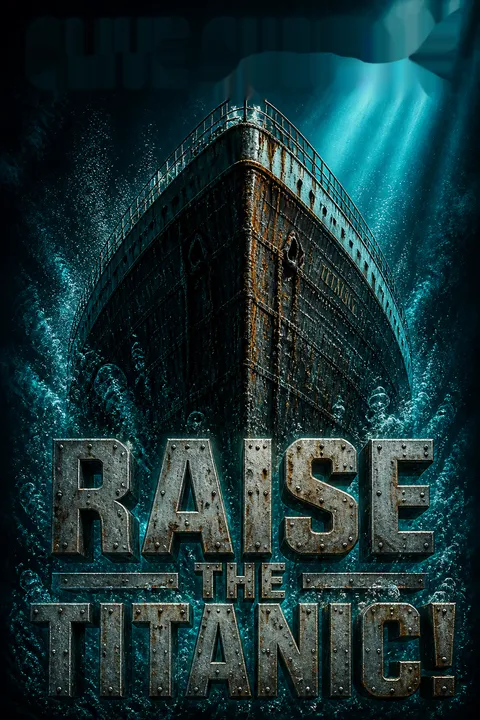


Plot Summary
Prologue
In April 1912, as the Titanic sinks, a terrified passenger forces an officer named Bigalow to lead him below deck toward a steel vault. The passenger unlocks it with a key he has guarded throughout the voyage, then refuses to leave, confessing that he cannot live with the deaths he believes he caused.
Bigalow escapes moments before the ship disappears, and in the freezing water he grabs a red pennant from the sinking liner. For decades, he remembers the stranger, the vault, and the passenger’s claim that eight men had died because of him. The ship takes its secrets to the seabed, but Bigalow carries the questions ashore.
The opening makes the Titanic more than a famous wreck: it is a sealed crime scene whose lone witness cannot identify the crime. The passenger’s choice to remain in the vault converts guilt into physical confinement, while Bigalow’s survival preserves a human link to the mystery. The pennant becomes a small, tactile remnant of a disaster that otherwise erases its evidence. By withholding the stranger’s identity and motive, the prologue gives the later investigation a double task: recovering an object and revisiting a moral catastrophe.
A Mission Beneath the Ice
In 1987, President Warren authorizes Meta Section, a secret scientific unit, to pursue the Sicilian Project, a proposed sonic barrier against incoming missiles. Its essential element, byzanium, is nearly impossible to manufacture, so mineralogist Sid Koplin is sent to Novaya Zemlya to find a natural deposit.
Dirk Pitt, a NUMA officer, rescues Koplin from a Soviet patrol in a blizzard and gets him home badly wounded. In hospital, Koplin reports that he found traces of byzanium, but the mine appears to have been worked long ago by miners from Colorado.
Gene Seagram, Meta Section’s driven director, learns there may be enough ore somewhere to save the project. His wife, Dana, meanwhile, is asking him to choose their marriage over his work, and he refuses.
The science begins as a national-security gamble, but the first cost is private: Gene treats commitment to the project as a duty that outranks his marriage. Koplin’s discovery changes the problem from finding a mineral to reconstructing a human disappearance. Pitt’s rescue also establishes the practical ethic that will govern the expedition: rules and plans matter, but a person in immediate danger matters more. The Arctic mine is thus both a geological site and an archive, where objects can outlast the people who made them.
The Little Angel Disappears
Mel Donner, Seagram’s colleague, follows Koplin’s clues to Denver. A newspaper clipping identifies nine men supposedly killed in the 1911 Little Angel Mine disaster, including Jason Hobart. Donner traces mining equipment to a Colorado manufacturer and confirms that its predecessor supplied tools to the United States government.
The paperwork looks like a dead end until historian Harry Young explains that his uncle, mining engineer Joshua Brewster, had reopened the unprofitable Little Angel.
Young’s records show no convincing evidence that the trapped men died there: no bodies were recovered, and the disaster’s supposed warning arrived in an oddly indirect way. He believes the accident concealed a planned disappearance. Donner returns to Washington with a sharper question: why would a respected engineer make nine men vanish?
The investigation advances through mismatched records rather than a single revelation. Official paperwork, a newspaper account, and a family archive each preserve a different version of the same event, and their contradictions become more informative than their claims. Young’s theory is not proof, but it gives Donner a way to read absence as evidence. The chapter also makes historical research active: the past does not simply explain the present; investigators have to challenge the categories, such as death and disaster, that earlier authorities imposed on it.
Adeline’s Three Postcards
Seagram visits Adeline Austin, once the wife of miner Jake Hobart, expecting an old widow with little to add. Instead, she remembers Jake as a red-haired explosives expert who hid their marriage from mine employers.
Before the Little Angel disaster, he told her not to believe reports of his death and left her money. Three postcards then arrived from France, Le Havre, and Scotland, each confirming that Jake and the other miners were alive and travelling toward the Arctic.
A government officer later ordered her to keep silent and delivered an unusually large payment. Her account turns Young’s suspicion into a clear conclusion: the mine disaster was staged, and the men were recruited for a secret operation. Seagram now has a personal witness, not just a trail of paper.
Adeline’s domestic keepsakes disrupt the public record. The postcards are modest objects, but their dates and routes expose a hidden itinerary that official documents had obscured. Her silence was not simple passivity: a government official used secrecy and money to make her grief part of the cover story. Seagram’s willingness to listen also marks a shift from institutional problem-solving toward human testimony. The truth begins to emerge when private memory is treated as evidence rather than as an emotional distraction.
The Ore Aboard Titanic
A Defense Department archive gives Seagram and Donner Joshua Brewster’s journal and the missing government files. They learn that Brewster discovered byzanium on Novaya Zemlya, then secretly arranged for Colorado miners to extract it for the United States.
French financiers, who wanted the ore for themselves, arranged the Little Angel hoax and attacked the miners as they fled across Britain. Brewster and Vernon Hall reached Southampton with the ore, but French agents killed Hall and pursued Brewster.
Brewster boarded a White Star liner, leaving a journal that said the mineral was secured in a ship’s vault. The only matching vessel was the Titanic. Since the Sicilian Project cannot function without byzanium, Seagram concludes there is no alternative: the government must raise the wreck.
The recovered journal recasts patriotism as a morally compromised chain of decisions. Brewster’s effort to secure a strategic resource brought laborers into danger, while rival governments treated their lives as costs in a contest over possession. The false mine disaster shows how bureaucracy can manufacture a durable public truth. The Titanic now concentrates these consequences in one inaccessible place. Seagram’s decision to salvage it is both rational and haunted: the project depends on the same secret operation whose human price has remained unacknowledged.
Pitt Takes the Impossible Job
Seagram recruits Pitt to command the salvage, despite their hostile first meeting over Pitt’s unauthorized rescue of Koplin. Before the expedition can settle its target, NUMA’s Sappho I retrieves a cornet from the Atlantic floor.
Curator John Vogel restores the instrument and reads its presentation engraving, linking it to a musician aboard the Titanic. The discovery confirms that the liner sank nearby and survived the deep with more of its structure intact than expected.
Pitt accepts leadership, while Admiral Sandecker secures Navy support and hidden financing. The cornet turns an abstract search zone into a recoverable location, and its preservation offers the first reason to believe the Titanic might be raised rather than merely surveyed.
Pitt’s appointment joins expertise to a task no résumé can make safe. His conflict with Seagram is personal, but the operation forces cooperation before trust has been repaired. The cornet functions as evidence with a human history: it belonged to a working musician, not a cargo manifest, and its survival demonstrates that the seabed may preserve more than wreckage. The novel’s great engineering scheme therefore begins with a small instrument, whose clear inscription makes an immense, lost ship imaginable as a physical object again.
The Titanic Appears
Conflicting reports place the Titanic’s sinking position several miles apart, so Pitt asks NUMA’s scientists to calculate where the ship would have travelled as it fell. Their model incorporates its steep descent, shifting boilers, and the cornet’s resting place.
Pitt and Rudi Gunn then take the Navy’s Sea Slug down through miles of black water, following the computer’s predicted track. Sonar first detects scattered wreckage, including a boiler and a fallen funnel.
The submersible then reaches the liner itself, upright on the seabed and in unexpectedly sound condition. Pitt leaves a tracking beacon on its deck. The discovery gives the salvage teams a precise target, but the massive ship must still be sealed, freed from the mud, and lifted.
The search depends on accepting uncertainty without surrendering to guesswork. Pitt’s choice to model the sinking path rather than sweep a vast area reflects a methodical form of courage: he narrows risk through inference, then commits people to the descent. The wreck’s condition changes the mission from speculative recovery to technical possibility. Yet finding the Titanic does not solve the central problem. The ship is visible, but its most important cargo remains inaccessible, and the difference between discovery and possession becomes the story’s next source of danger.
A Death in Sappho II
During the months of preparation, the salvage crew seals the Titanic with a new compound, installs pressure valves, and prepares to lift it with compressed air. Then photographer Omar Woodson reports that instrument specialist Henry Munk has been found dead inside the Sappho II.
A towel had covered the cabin camera, and Woodson suspects the fatal head injury was arranged to resemble an accident. Pitt keeps the sub submerged until the storm above eases, then examines the body and equipment.
Munk’s death turns routine salvage into a security crisis: someone among the crews has reason to prevent scrutiny. Meanwhile, Dana leaves Gene and moves in with colleague Marie Sheldon. Sandecker later asks her to serve as the public face of an operation whose most important purpose remains secret.
The murder punctures the salvagers’ assumption that technical competence and shared danger produce solidarity. A sealed submersible, designed to protect its occupants from the ocean, also traps a killer with them. Pitt’s refusal to let fear dictate an unsafe ascent shows leadership as management of competing vulnerabilities. Dana’s departure gives the parallel marriage plot its own consequence: when secrecy has made intimacy feel like exclusion, she chooses distance. Her public role will put her back near Gene’s world without repairing their private bond.
Explosives Free the Liner
A falling cargo crane pins the Deep Fathom against the Titanic and floods the submersible through a cracked seam. Its three crew members have only hours before rising water and failing life support kill them.
The Sea Slug’s manipulator is broken, leaving the salvage team without a way to move the wreckage. Pitt proposes detonating carefully spaced charges around the Titanic, using successive shock waves to loosen its suction from the seabed. The other submarines must abandon their positions beside the trapped men to place the explosives.
After the final blasts, the sonar initially shows no movement. Then the aftershocks release the liner. The Titanic surges toward the surface, and rescuers reach the Deep Fathom in time to find all three men alive.
Pitt’s rescue depends on risking the larger mission to save three people whose predicament is partly an accident of the work itself. The plan makes the Titanic’s immense mass serve as both danger and instrument: the ship must be shaken free, though the same force might destroy it. The delayed movement after apparent failure gives the climax its emotional rhythm, shifting the crew from helpless watching to sudden action. Practical ingenuity here is not triumph over nature so much as a narrow negotiation with forces no one fully controls.
The Storm Breaks the Tow
After the Titanic rises, salvage crews begin pumping out water and preparing her for the tow to New York. A record-strength hurricane bears down before the hull is stable. Two Navy tugs take the liner in tow, while a cruiser stands guard. Dana, assigned to accompany reporters, sneaks back toward the helicopter to retrieve her makeup kit.
A hidden man strikes her with a hammer and leaves her unconscious. The towing cable is cut, the Titanic swings dangerously broadside to the seas, and the helicopter carrying Pitt is swept off the deck. The storm’s eye briefly calms the waters, creating the opening an unseen enemy needs. The crew faces both a failing ship and a threat aboard it.
The storm strips away the protective systems the salvage operation has built: towlines, communication, visibility, and the assumption that the crew can identify every person aboard. Dana’s apparently trivial errand places her in the path of a hidden saboteur, while the severed cable converts a controlled tow into an exposed struggle. The hurricane is not simply spectacle; it creates a tactical window. Human deception and natural violence now reinforce one another, leaving the Titanic vulnerable at precisely the moment its rescuers are least able to coordinate.
Prevlov Claims the Deck
During the hurricane’s lull, Soviet intelligence captain Andre Prevlov boards with armed men and takes control of the Titanic. Their assault kills Woodson and injures several salvagers; Dana is held with the others. Prevlov says he will use the crew to keep the sinking liner afloat, then claim it as an abandoned vessel once they are forced to leave.
The Americans have no radio, no clear route to the tugs, and no sign of Pitt, who is presumed lost with the helicopter. On the surface, Gene hears that Dana is missing and believes she may have died. Already convinced that the President’s order to leak Sicilian Project information means betrayal, he reaches the edge of suicide before learning that the Titanic has risen.
Prevlov weaponizes legal ambiguity as well as firearms. His plan depends on making coercion resemble salvage procedure, then turning the crew’s forced departure into a claim of legitimate possession. The attack also fractures the story’s emotional geography: Dana is captive at sea while Gene’s guilt and fear isolate him on land. His near-suicide shows how secrecy has narrowed his interpretation of events until every setback appears conclusive. News that the Titanic surfaced interrupts that fatal certainty, though it cannot yet restore the marriage or the project.
A Dead Man Returns
Pitt survives the helicopter’s fall, climbs back onto the Titanic, and finds Navy SEALs waiting in hiding. In the dining saloon, he returns just as Prevlov threatens Dana to force the salvage crew back to the pumps. Pitt identifies Ben Drummer and Sam Merker as the Soviet agents known as Gold and Silver.
He explains that one killed Munk after Munk discovered a coded communications device, while the other sabotaged the Titanic and cut the tow cable. Pitt had delayed confronting them until the SEALs could reach the ship. The commandos attack, overpower the guards, and secure the liner. Prevlov is captured; later, the CIA reveals that its planted evidence has trapped him into seeking American protection.
Pitt’s apparent death buys the minutes needed to assemble a counterattack, but his return is not a solitary rescue. His account connects clues that seemed unrelated: the covered camera, the sonar pings, Munk’s injury, and the damage to the ship. The reveal makes betrayal a matter of sustained behavior rather than a single confession. Meanwhile, the CIA’s manipulation of Prevlov echoes the novel’s larger contest over truth: both sides manufacture appearances, and victory depends on knowing which story an opponent believes.
The Vault Contains Gravel
The Navy tugs recover the Titanic from the hurricane and tow her to New York, where crews move her into dry dock. Seagram, who has survived his despair after hearing the liner was raised, joins the team opening the armored vault. They tear away its door and find Joshua Brewster’s preserved body beside ten boxes of ordinary gravel. There is no byzanium.
The discovery destroys the premise behind the entire salvage: the miners’ ore was never aboard. Dana refuses to resume her marriage, and Seagram’s hope collapses into a violent breakdown; he attacks the mineralogist testing the boxes and damages Brewster’s remains. The ship is safe in port, but the national project and Gene’s sense of purpose seem to have failed together.
The empty vault is not merely a failed search; it is the material form of a mistaken interpretation. Brewster’s journal was true in spirit but misleading in location, and the investigators trusted the most literal reading because the Titanic offered a compelling destination. Seagram’s breakdown follows the same pattern: he has made achievement the structure holding his identity together, so evidence of failure leaves him without a stable self. The body in the vault finally gives the opening’s mystery a face, while leaving the ore’s fate unresolved.
Southby Gives Up Its Secret
Pitt retraces the miners’ route across Britain, searching for the meaning of Brewster’s repeated references to Southby. A weathered roadside sign leads him to the small village and its churchyard, where Vernon Hall is buried.
Pitt realizes that Brewster’s final references to a vault may mean Hall’s burial vault, not the Titanic’s. With Seagram, Donner, Koplin, and Sandecker present, workers remove the grave’s stone cover. Koplin tests the surrounding fill and detects high-grade byzanium.
Brewster had hidden the real ore in the grave, then filled the Titanic’s boxes with worthless stones to misdirect anyone searching the ship. The discovery supplies more than enough material for the Sicilian Project. Pitt leaves the graveyard exhausted, having solved the clue that the first investigation misread.
Southby resolves the mystery through a change in scale: the investigators stop looking for a treasure hidden in a spectacular wreck and attend to a small village grave. Brewster’s misdirection worked because it exploited the assumptions of later readers, including their faith in the obvious container. The burial ground also makes concealment inseparable from mourning. The ore is recoverable, but its hiding place preserves the story of the men who died protecting it, so success arrives with a human cost rather than erasing one.
Epilogue
In August, the British cruiser Troy commits Commodore Bigalow’s remains to the sea near the Titanic’s sinking position, honoring his wish to rejoin his old shipmates. Elsewhere, a submarine launches four ballistic missiles toward American targets.
The Sicilian Project activates its sonic defense system, and all four missiles break apart far short of their destinations. The final test proves the barrier works. After a long chain of secrecy, failed assumptions, and recovered evidence, the byzanium has become the missing component of a defense system capable of stopping the attack it was built to prevent.
Bigalow’s burial closes the human frame opened by his escape from the Titanic: the survivor who carried its unexplained secrets returns to the sea after the wreck has been found and raised. The missile test then gives the salvage its practical answer. The project succeeds, but its victory is deliberately quieter than the ship’s spectacular arrival in New York. A defensive technology proves itself by preventing destruction, making the ending hinge on an event that does not happen. The wreck’s recovered past becomes the means of averting a future catastrophe.
Analysis
The novel turns historical recovery into a problem of interpretation. Every major institution has records, but no record is sufficient: the newspaper declares the miners dead, the Army classifies one as a soldier, the journal points toward a ship’s vault, and the physical evidence eventually contradicts the most plausible reading. Truth emerges only when investigators compare forms of evidence that were never meant to meet. The story’s central object, byzanium, is therefore also a test of epistemology: what people know depends on what they are willing to question.
The Titanic intensifies this problem because its scale encourages certainty. It seems the obvious container for the ore, the obvious center of the mystery, and the obvious prize. Yet the real deposit lies in an obscure English grave. Cussler uses spectacular engineering to dramatize how easily magnitude can distract from precision. The salvage is a triumph of planning and invention, but it is not the same as understanding. Pitt’s final insight depends on noticing a minor place-name after the largest possible search has failed.
The parallel stories of Gene and Dana give secrecy an intimate cost. Gene believes that protecting the nation requires withholding his work from his wife; Dana experiences that withholding as abandonment and leaves. Their conflict is not solved by discovering the mineral, because the marriage has been damaged by choices made before the mystery’s answer arrives. Gene’s collapse after the empty vault shows how a public mission can become a private identity, leaving a person unable to survive the loss of its promised meaning.
The ending is cautiously affirmative. The Sicilian Project works, but only after its creators endure false certainty, political manipulation, and real casualties. The defense system’s success offers protection rather than conquest, yet it does not cleanse the means used to secure it. The novel’s lasting tension is that responsible action sometimes requires secrecy and risk, while those same tools can distort judgment and injure the people they are supposed to serve.
Review Summary
Raise the Titanic! is a thrilling adventure novel that captivated readers with its unique premise of salvaging the famous shipwreck. Many praised Cussler's technical descriptions and action scenes, though some found the characterization lacking, particularly regarding female characters. The book's pre-discovery speculation about the Titanic's condition added intrigue. While some readers found the plot implausible, many enjoyed the fast-paced storytelling and Cold War espionage elements. Overall, it's considered one of Cussler's better early works, despite dated elements.
People Also Read



Characters
Dirk Pitt
NUMA’s daring salvage chiefPitt is NUMA’s special projects director, a skilled pilot, diver, and organizer who can move from technical calculation to physical danger without losing his composure. His easy humor helps steady crews, while his capacity for solitary action can make him seem remote. He values judgment over rigid procedure, as his rescue of Koplin shows, but he also accepts responsibility for the risks his choices impose on others. The Titanic operation draws together his maritime knowledge, appetite for difficult work, and instinct for reading people. He is most effective when those abilities serve a team rather than his own legend.
Gene Seagram
A scientist under strainSeagram is the physicist who created and directs Meta Section, a secret research group pursuing technologies beyond ordinary government programs. He believes national service requires an almost absolute commitment, and he takes pride in carrying a project from conception to completion. That discipline has hardened into a weakness: he treats personal needs as interruptions and struggles to share uncertainty with Dana. His intelligence makes him a powerful planner, but his identity is so closely bound to the Sicilian Project that setbacks threaten more than his professional confidence. He embodies the emotional price of confusing responsibility with self-erasure.
Dana Seagram
A marine archaeologist seeking roomDana is a NUMA marine archaeologist whose work links shipwrecks to human history. She is confident, sharp-witted, and unwilling to let Gene’s career define her own. Her difficult childhood informs her guardedness about family and parenthood, though she resists being reduced to that history. Dana wants both professional recognition and a marriage in which she is treated as a partner, not as an audience for Gene’s sacrifice. Her independence is genuine, but it is also a defense against rejection; she often chooses distance before another person can decide her worth for her.
James Sandecker
NUMA’s stubborn admiralSandecker directs NUMA with blunt humor, political instinct, and a deep loyalty to the people who work for him. He dislikes being used by intelligence agencies, yet he understands that his oceanographic teams operate within larger national pressures. His authority comes less from ceremony than from knowing when to push and when to trust his specialists. He can be gruff enough to hide his concern, but he does not confuse toughness with indifference. The salvage operation tests his ability to protect his crew while allowing Pitt to make decisions that Sandecker himself might not choose.
Andre Prevlov
A polished Soviet strategistPrevlov is a captain in Soviet naval intelligence, cultivated, observant, and unusually attentive to the habits of his adversaries. He studies Western culture not from admiration alone but because he believes understanding an opponent creates advantage. His confidence is carefully maintained through control of information, presentation, and timing. Unlike a blunt military antagonist, Prevlov prefers plans that can be defended as lawful or inevitable. He sees himself as a professional serving his country, and his composure makes him formidable even when the situation around him becomes violent.
Mel Donner
Meta Section’s steady partnerDonner is Seagram’s physicist colleague and the practical investigator who follows the trail from Colorado records to witnesses. His quick mind is paired with a more socially flexible temperament than Seagram’s, making him a useful intermediary between the project and the people it affects. He recognizes that Gene’s commitment is becoming destructive, but he cannot simply replace his friend’s judgment. Donner’s persistence turns scattered archival clues into a coherent history.
Sid Koplin
The wounded mineralogistKoplin is a mineralogist whose scientific training takes him into a dangerous Arctic field mission. He is neither a spy by temperament nor physically prepared for combat, but he perseveres because the discovery could matter to the country. His careful observations of the concealed mine, its tools, and its traces provide the investigation with its first concrete evidence. Koplin’s mixture of expertise, candor, and vulnerability keeps the project grounded in actual geological work.
Albert Giordino
Pitt’s closest technical allyGiordino is NUMA’s assistant projects director, a compact, capable engineer who pilots the Sappho and works comfortably under extreme pressure. His jokes puncture tension, especially during long dives, but they also help him manage fear and confinement. He has known Pitt since school and can recognize the difference between Pitt’s sociable manner and his colder, intensely focused mode. Their trust is old, practical, and tested by shared risk.
Rudi Gunn
A trusted submersible commanderGunn is a NUMA commander whose quiet warmth earns the confidence of the crews under him. Though physically unassuming, he is experienced in ships, instruments, and expedition logistics. He does not need to dominate a room to lead it, and his steadiness complements Pitt’s more forceful decisiveness. Gunn’s judgment helps turn a technically complex mission into coordinated work.
Pavel Marganin
Prevlov’s ambitious lieutenantMarganin serves under Prevlov in Soviet naval intelligence. He is cautious about the captain’s indulgent Western tastes but ambitious enough to pursue information beyond his official assignments. His insecurity is visible in the way he measures himself against his superior, though he is capable of patience and independent judgment. Marganin’s position places him at the intersection of hierarchy, loyalty, and career advancement.
John Bigalow
The Titanic’s surviving officerBigalow is the young officer who survives the Titanic’s sinking and becomes a witness to an incident he cannot explain. In old age, his seafaring manner remains firm, and his memories retain both the ship’s physical detail and the terror of its last hours. He represents the thin human thread connecting the 1912 disaster to the modern salvage effort.
Warren
A president backing secret scienceThe President created Meta Section and supports its risky research while managing a hostile Congress and a troubled administration. His irreverent manner conceals a serious calculation about national defense, political exposure, and the limited time left in office. He can authorize extraordinary schemes, but he cannot control how their secrets affect the people carrying them out.
Henry Munk
NUMA’s instrument specialistMunk is a quiet, capable technician on the Sappho crew, responsible for monitoring the instruments that measure the deep sea. His attention to small changes in readings reflects the patient concentration the expedition requires. He is not a political operator; he belongs to the practical world of equipment, data, and careful observation.
Harry Young
A mining historian with doubtsYoung is a retired geologist and the nephew of Joshua Brewster. He has spent years studying Colorado mining history and trusts the evidence in his uncle’s notebooks, even when it leads him toward an implausible theory. His combination of scholarly exactness and family loyalty makes him willing to preserve a suspicion that others might dismiss.
Marie Sheldon
Dana’s candid confidanteMarie is a NUMA marine geologist and Dana’s friend and temporary housemate. She offers practical care without indulging Dana’s self-deceptions, and her bluntness gives Dana space to speak honestly about her marriage and fears.
Plot Devices
Byzanium and the Sicilian Project
The missing defense ingredientByzanium is an exceptionally rare mineral whose properties are needed to complete Meta Section’s proposed sonic barrier against ballistic missiles. Its scarcity drives Koplin to Novaya Zemlya, turns the old miners’ disappearance into a national mystery, and leads the government to authorize the Titanic salvage. The project gives the search its urgency while also creating a reason for Soviet intelligence to intervene. Because the mineral’s value is strategic rather than merely financial, the characters disagree over who has a right to possess it and whether a defensive technology can justify secrecy, deception, and loss of life.
The Cornet
A wreck’s pinpoint clueThe cornet recovered by the Sappho I carries an engraved presentation identifying its White Star Line connection and its owner, a Titanic musician. Its discovery anchors the wreck search to an object with a documented human history. Restored by curator John Vogel, it also suggests that metal objects on the deep seabed may remain in unusually good condition. The instrument therefore performs two jobs: it helps establish where the Titanic lies and supports the salvage team’s belief that the ship may still be recoverable.
The Little Angel Hoax
A false death recordThe staged Colorado mine disaster makes Brewster and his crew appear dead before they travel to the Arctic. Newspaper accounts, military records, mining equipment, and Adeline’s postcards expose the gap between public story and private fact. The hoax enables the secret extraction, but it also misdirects investigators for decades by making a false event look complete. Its details eventually teach Pitt to question literal readings of Brewster’s journal and to search for the ore in an unexpected kind of vault.
The Coded Pinger
A spy’s underwater signalA small battery-powered pinger sends coded messages from the salvage area to the Soviet research vessel. Its intermittent sounds are first mistaken for loose debris, allowing the agents to communicate without ordinary radio traffic. Munk recognizes the device and is killed before he can expose its purpose. Pitt later uses the pinger, the camera cover, the murder evidence, and a controlled rotation of crew assignments to identify the compromised salvagers. It links espionage to the very instruments intended to map the ocean floor.
Dirk Pitt® Series

About the Author
Other books by Clive Cussler

Download PDF
Download EPUB
.epub digital book format is ideal for reading ebooks on phones, tablets, and e-readers.








