

Key Takeaways
Read Scripture from lived experience, then let Scripture challenge your conclusions.
A fourth interpretive voice. Esau McCaulley grew up between his mother's gospel music and Southern hip hop, two traditions that spoke differently about Black life, despair, and hope. Later, white progressive classrooms seemed to discard the Bible, while some evangelical settings treated Black history and justice as distractions. Black progressive theology offered another home, but did not always share his traditional beliefs. He names the approach he seeks to articulate Black ecclesial interpretation: reading Scripture from the particular experience, worship, preaching, and convictions of Black church communities.
Dialogue, not a shortcut. This method brings Black questions to the Bible, but also lets the Bible answer back. Readers interpret from somewhere, McCaulley argues, so acknowledging one’s location is more honest than pretending to be neutral. Careful attention to context, grammar, and the whole biblical story keeps experience from becoming the only authority.
What's compelling is the refusal to choose between cultural particularity and shared theological conversation. This resembles standpoint theory, the idea that social position can reveal features of power that more privileged observers overlook. Yet situated knowledge is not automatically correct knowledge. Communities can inherit blind spots as well as insight. The method is strongest when it treats experience as a source of urgent questions, then invites evidence, textual care, and disagreement to refine the answers. That balance makes the approach relevant beyond Black Christian communities without flattening the history that gives it its force.
Make public authority answer for whether innocent people can live without fear.
A personal encounter. As a teenager, McCaulley was stopped with friends at a gas station, searched, and accused of a drug deal. Officers found nothing, but gave no explanation or apology. He recalls several such stops, despite his efforts to avoid trouble. The story grounds his reading of Romans 13, a passage often used to demand obedience to government.
Limits on the state. McCaulley argues that Roman soldiers also performed public-order roles resembling policing. Paul describes government as responsible for protecting good conduct, not terrorizing the innocent. His emphasis falls on how rulers direct state power, so reform cannot rest only on individual officers. Luke’s John the Baptist addresses soldiers directly, condemning extortion and false accusations. Together, these texts place duties on both institutions and their agents.
The shift from individual misconduct to institutional responsibility is important: rules, incentives, and leadership shape what frontline agents can do and what behavior gets rewarded. Contemporary procedural-justice research likewise finds that people judge authorities partly by whether they are treated with dignity, heard, and given understandable reasons. That connection helps explain why a search that finds nothing can still damage trust. The analogy between Roman soldiers and modern police is illuminating, but not exact. Differences in legal systems and civic roles matter, so the comparison works best as a theological lens, not a claim that the institutions are identical.
Do not let prayer and submission become excuses for political silence.
More than compliance. In 1963, eight Alabama religious leaders urged moderation and criticized Martin Luther King Jr.'s Birmingham campaign. King answered that injustice itself compelled his presence. McCaulley argues that Christian duties to pray for rulers and submit to government do not exhaust the church’s public responsibilities. In the same letter that urges prayer for leaders, 1 Timothy condemns slave trading as contrary to sound teaching.
A wider witness. Jesus publicly rebukes Herod, Paul calls the present social order evil, and Revelation portrays imperial Rome as an exploitative power facing judgment. These examples support protest, though McCaulley distinguishes protest from claiming divine approval for violent revolution. Christian peacemaking is not automatic neutrality between opposing sides. It requires naming injustice truthfully and working toward repaired relationships and a more just social order.
The distinction between peacemaking and mere quiet is crucial. Conflict can be suppressed without being resolved, especially when the cost of calm falls on those already harmed. In conflict-resolution practice, a durable settlement usually requires acknowledging the injury and addressing its causes, not simply asking the injured party to lower their voice. Still, religious criticism gains credibility when it applies standards consistently, including to allies and to the church itself. The chapter’s biblical examples support public moral judgment, but they do not settle every tactical question. Christians still have to weigh consequences, evidence, and the risks borne by those they represent.
Pursue justice that repairs material conditions and honors spiritual agency.
Luke’s vision of justice. McCaulley reads Luke as a Gospel that speaks directly to people facing domination and deprivation. Its opening story begins with an elderly couple living under Roman rule and carrying personal grief. Mary’s song celebrates God’s attention to the lowly and hungry. At the start of his ministry, Jesus reads Isaiah’s promise of good news for the poor and release for the oppressed.
Bodies and souls. The message is neither a purely spiritual comfort nor a political program. Jesus treats poor people as full moral agents who can repent and grow, while Isaiah’s call to break oppressive bonds insists that faith must also change material conditions. McCaulley draws a double warning: do not reduce the poor to bodies needing aid, and do not treat their present suffering as irrelevant because they have souls.
This refusal to split material wellbeing from moral and spiritual life offers a useful corrective to approaches that treat poverty only as a policy problem or only as a matter of personal virtue. Public health and social work similarly emphasize that agency is shaped by conditions: people make choices, but their options are not equally available. The theological framework adds a claim about human worth that is not reducible to economic productivity. At the same time, a biblical vision of justice does not specify a single modern policy package. Readers must distinguish the moral direction of the text from the practical debates about how best to realize it.
Treat Black identity as a gift, not a problem Christianity must erase.
A story with African roots. McCaulley challenges the idea that Christianity is simply a European religion imposed on Black people through slavery. He points to early Christian centers in North Africa and to African figures in the biblical story, including Simon of Cyrene, who carried Jesus’s cross, and the Ethiopian official baptized in Acts. He also reads the inclusion of Joseph’s Egyptian sons, Ephraim and Manasseh, as an early sign of Israel’s mixed ancestry.
Unity without erasure. Against colorblind readings of Christian unity, McCaulley argues that Galatians 3:28 concerns equal standing in Christ, not the disappearance of ethnic identity. Revelation’s final vision gathers worshipers from every nation, tribe, people, and language. Their differences remain meaningful within a shared community. The point is not that every cultural practice is beyond criticism, but that Blackness need not be shed to belong to God’s people.
The argument separates equality from sameness, a distinction that matters in debates about inclusion across many fields. A group can share rights and obligations without requiring members to abandon their histories or cultural forms. That said, the historical examples establish African presence and participation, not a simple modern racial classification for every ancient figure. The book’s larger theological point does not depend on making every person fit a present-day category. Its most durable claim is that Christian belonging need not require cultural assimilation, while cultures themselves remain open to moral scrutiny and change.
Name rage truthfully before it hardens into despair or retaliation.
Anger needs an address. As a child, McCaulley heard a stranger use a racial slur over the phone. He remembers the anger and helplessness arriving together. He connects that experience to a longer history of racial violence and to the everyday indignities that can accumulate across a life. The Psalms of lament, especially Psalm 137, give traumatized people language to remember what happened and bring even their desire for vengeance before God.
Memory without revenge as destiny. These prayers do not authorize people to enact revenge; they entrust judgment to God and preserve the victims’ testimony in the community’s sacred memory. The prophets add a harder horizon: a future beyond the destruction of enemies. McCaulley presents lament as honest speech, not a final moral destination. Communities can acknowledge pain without pretending it is small or allowing it to dictate every future relationship.
The psychological value of naming injury is well recognized: putting painful experience into language can help people organize memory and seek support, though it does not by itself resolve trauma. The Psalms offer something more communal than private venting. They preserve testimony and make listeners responsible for remembering. That matters when societies pressure victims to move on without acknowledging harm. A necessary nuance is that calls to imagine a future beyond grievance should not become demands for premature forgiveness. The order matters: truth and safety cannot be replaced by a performance of reconciliation.
Forgive through the cross without asking victims to remain in danger.
God enters suffering. McCaulley presents the cross as God's identification with people harmed by unjust power, not as an explanation that makes slavery or racial oppression acceptable. Jesus suffers under state violence, and the cross gives Black Christians a reason to trust that God knows injustice from within human life. The resurrection is essential to this account: without it, forgiveness could look like a demand to accept defeat.
Forgiveness is not surrender. The cross can interrupt revenge, McCaulley argues, because Christians believe they have received mercy and that injustice will face judgment. But forgiveness does not require remaining in an abusive situation. The biblical call to liberation and the duty to help people in distress support separation from danger and practical intervention. The hope is not that victims should absorb further harm, but that revenge need not be the only imaginable response.
The distinction between forgiveness and access is vital. In therapeutic and restorative approaches, releasing a desire for retaliation does not require restoring trust, resuming contact, or abandoning accountability. The book’s combination of cross, resurrection, and judgment holds together compassion for wrongdoers and seriousness about victims’ claims. That combination is difficult, and it should not be used to impose emotional obligations on survivors. Its ethical force depends on preserving protection and justice alongside mercy. Without those safeguards, language of forgiveness can serve the powerful more than the wounded.
Read slavery texts through creation, exodus, and the Bible's whole moral direction.
Do not isolate a verse. James W. C. Pennington, an abolitionist and formerly enslaved pastor, asked whether the God of the Bible sanctioned slavery. McCaulley answers by reading difficult passages in light of broader biblical claims about God's character and purposes. Jesus’s discussion of divorce offers his model: some laws manage damage in a broken world rather than express the ideal. The exodus presents God as hearing enslaved people and delivering them.
Pressure toward freedom. The Old Testament includes limits and protections, though not a complete abolition of slavery. Israelite slaves were to be freed after six years with resources, and runaway slaves were not to be returned. In the New Testament, Paul tells enslaved believers to seek freedom if possible and urges Philemon to receive Onesimus as family. McCaulley argues that these themes make slavery incompatible with the Bible’s larger moral direction.
Reading a text within a larger canon is a form of moral reasoning, not a way to make every difficult passage disappear. The method asks which passages describe an ideal, which constrain harm, and how the whole tradition bears on a contested practice. That can prevent proof-texting, but it also requires interpreters to explain why some texts carry greater weight than others. The chapter acknowledges that biblical law did not free every enslaved person and that Paul did not directly abolish the Roman institution. Its conclusion is therefore a trajectory argument: powerful and consequential, but still an interpretation that deserves careful debate.
Keep interpreting, because patient engagement with a wounded text can sustain hope.
Hope has a history. McCaulley’s mother filled their home with gospel music and brought her children to church, while a family Bible stood as a constant presence. His own faith later met hard questions about racism, slavery, and passages used to justify oppression. He turns to the Black church’s long practice of reading Scripture amid those contradictions, including enslaved believers who found hope in the exodus and in a God who heard their suffering.
A practice, not a guarantee. McCaulley calls this patience a hermeneutic of trust: the willingness to wrestle seriously with Scripture while expecting that careful reading can yield blessing rather than harm. That does not mean denying the church’s failures or assuming every question has an easy answer. The practice itself becomes an exercise in hope because readers keep seeking truth, justice, and a faithful future without pretending the past was clean.
The book’s personal narrative gives its argument emotional credibility without making personal experience the sole evidence. It also shows how traditions transmit more than doctrines: music, worship, family habits, and shared memories teach people what kinds of futures they can imagine. Such practices can preserve resilience, although inherited hope can also become fragile if institutions fail to address present harm. The most compelling version of trust is therefore neither unquestioning loyalty nor quick rejection. It is durable attention, willing to remember injury, test interpretations, and keep open the possibility of repair.
Analysis
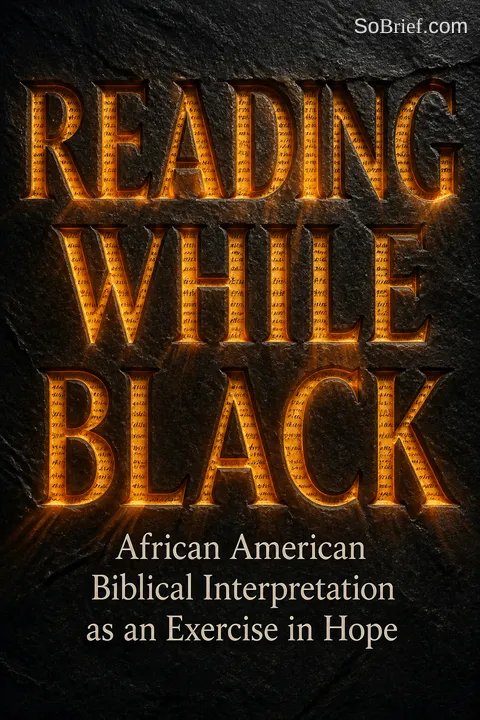
Reading While Black is both a work of biblical interpretation and an argument about who is allowed to interpret. Its central intervention is methodological: Black experience is not an embarrassing bias to remove before reading, nor a final authority that makes the text unnecessary. It is a historically formed vantage point that identifies questions often overlooked by dominant interpretive communities. The book then demonstrates that method across concrete controversies: policing, protest, economic justice, racial identity, anger, and slavery.
The structure is deliberately cumulative. McCaulley begins with his formation in a Black church and the alienation he encounters in academic and evangelical settings. He then moves from public institutions to identity and interior life, before confronting slavery as the question that tests whether the Bible can remain trustworthy after its use as an instrument of oppression. The personal stories keep exegesis attached to lived consequences, while the biblical argument resists reducing faith to either private consolation or political program.
The book’s strongest contribution is its refusal of false choices: orthodoxy versus justice, ethnic belonging versus Christian unity, forgiveness versus resistance, and spiritual salvation versus material freedom. Its account of interpretation as dialogue also offers a model for plural communities. Readers need not share its theological commitments to recognize the intellectual importance of naming one’s standpoint and taking marginalized testimony seriously.
Some arguments are necessarily compressed. The proposed analogies between ancient soldiers and modern police, the reading of particular texts, and the claim that Scripture’s broad trajectory condemns slavery remain contestable. McCaulley often signals that these are arguments rather than neutral facts, but readers should distinguish his theological synthesis from settled historical description. The book is a beginning for debate, not a policy manual or exhaustive history. Its lasting challenge is to test interpretations by asking what kind of God they portray, whose suffering they notice, and whether they permit a community to imagine justice without erasing either faith or memory.
Review Summary
People Also Read


Glossary
Black ecclesial interpretation
Black church-rooted biblical readingA way of interpreting Scripture shaped by the histories, worship, preaching, theological commitments, and present concerns of Black Christian communities. It brings Black experience into conversation with the biblical text, while allowing Scripture to challenge and redirect those experiences. It emphasizes careful reading of individual passages within the wider biblical story.
Black ecclesial theology
Black church-rooted theological traditionMcCaulley's name for a stream of Black Christian thought that combines historic Christian beliefs with the Black church's concern for justice, dignity, and communal life. It is not presented as a new denomination or a single uniform position, but as a tradition whose convictions and practices have often been transmitted through churches and sermons rather than academic writing.
hermeneutic of trust
Patient, hopeful biblical interpretationA posture of reading Scripture that takes difficult questions seriously without assuming in advance that the text must be discarded or that every troubling passage has an easy answer. Readers study historical context and textual details, interpret passages in relation to the whole Bible, and remain open to the possibility that careful reading can produce wisdom and hope.
imago Dei
Humanity made in God's imageA Christian theological term, drawn from the biblical account of creation, for the belief that human beings are made in the image of God. McCaulley uses it to ground the dignity of people whom social and political systems dehumanize. A person's worth does not depend on race, status, wealth, or whether authorities judge that person innocent.
Download PDF
Download EPUB
.epub digital book format is ideal for reading ebooks on phones, tablets, and e-readers.








