

Key Takeaways
Stop treating the next moment as the place where life begins
Now is not a goal. Tolle argues that people often experience life as a problem-filled story, with happiness postponed until the next achievement, relationship, or resolution. But the future exists in the mind as an expectation; whatever actually happens arrives as the present moment. He calls the deeper quality of this moment presence: alert awareness that is not swallowed by thoughts about what came before or what should come next.
Return without striving. A small pause to notice a sound, a breath, or the quiet between someone’s words can reveal this awareness. The point is not to manufacture a special state or collect a spiritual experience. It is to recognize what is already here, even when circumstances remain difficult.
The practical force of this idea lies in shifting attention, not winning an argument with the mind. Contemporary approaches to mindfulness and cognitive defusion similarly teach people to notice thoughts as mental events rather than facts that must dictate the present. Tolle’s claim that awareness is the deeper ground of existence is a spiritual interpretation, not something this exercise proves. The distinction matters: a reader can test whether attention changes their experience without having to adopt a metaphysical theory about consciousness.
Notice the space around thoughts before obeying their stories
Thought is not the whole field. Tolle compares consciousness to a night sky: there are visible objects, but also the space in which they appear. Inwardly, thoughts, emotions, and events are the objects; awareness is the space that lets them be noticed. He calls these dimensions object consciousness and space consciousness. Object consciousness is attention absorbed by mental content, often fused with a story about “me.” Space consciousness is awareness of that content without being entirely defined by it.
Keep thought in its place. This is not a command to stop thinking. Tolle says thought can become more useful when it no longer dominates identity. A judgment such as “this person is awful” can be seen as one perspective, rather than the complete truth about a person.
This distinction resembles metacognition, the capacity to observe one’s own thinking, and cognitive defusion, a method used in acceptance-based therapy to loosen the grip of thoughts. The sky image makes an abstract practice easy to grasp: content can be vivid without being all that exists. Its useful test is behavioral. Does noticing a thought create room for a more considered response? The spiritual language adds meaning for some readers, but the attentional skill remains available without assuming that awareness is a universal substance.
Use ordinary perception to interrupt the mind’s running commentary
See before naming. Tolle asks readers to notice the instant a flower, tree, or other object enters view. For a brief moment, perception can occur before the mind supplies a label, memory, or judgment. The object is not better understood by refusing its name. Rather, the pause reveals how quickly interpretation can replace direct attention.
Practice in everyday motion. Walking a familiar trail, listening to a bell fade, or noticing the silence between spoken phrases can bring attention back to immediate experience. Tolle calls such periods of awareness openings into space consciousness. He also recommends “noble silence,” silence joined with alert attention, rather than merely not speaking. These exercises do not require special surroundings; they use ordinary sensory moments that usually pass unnoticed.
The exercise points toward a useful balance between perception and categorization. Human beings rely on labels to recognize hazards, communicate, and act efficiently, so naming is not itself a problem. The problem is mistaking a label for exhaustive knowledge. Research traditions in attention and perception often distinguish immediate sensory processing from later interpretation, though the boundary is not as clean as the retreat’s language may imply. The practice is most persuasive as a way to refresh attention, not as a demand to abandon concepts.
Accept what has happened before deciding what to do
Acceptance starts with facts. For Tolle, allowing the present means dropping the inner insistence that what is happening must already be different. It does not mean approving of harm, giving up, or refusing practical action. A person can acknowledge a missed ferry, for example, without adding the second injury of rehearsing how the day was supposed to unfold. From that clearer state, the person can decide whether to wait, make another plan, or act.
Separate response from resistance. Tolle suggests that fighting reality internally often produces repetitive thought rather than effective change. The event may still need to be addressed, but accepting its presence stops denial from taking over the response. His emphasis is on meeting the moment first, then seeing what action, if any, is appropriate.
This account is strongest when acceptance is understood as accurate contact with reality, not endorsement. In psychology, acceptance-based approaches distinguish willingness to experience a feeling from resignation about the conditions causing it. That distinction also matters ethically: a person can acknowledge an unjust situation while organizing to change it. Tolle’s language about the totality of events can sound as if every outcome is necessary or good. The more defensible practical claim is narrower: resistance to the fact of an event can consume attention needed to respond.
Meet emotional pain as sensation, not as a biography
Notice the pain body. Tolle uses this term for accumulated emotional pain that can be activated by present events and then shape thoughts and reactions. When anger or sadness rises, the mind may quickly build a story about who caused it, what it proves, and how the future will go. He recommends feeling the emotional energy directly, without denying it or immediately turning it into that story.
Allow without feeding. In the retreat, a craving is treated as an opportunity to observe an urgent pull without acting on it for a moment. This is not the same as forcibly suppressing desire. Tolle says that acceptance can create enough distance to keep a feeling from controlling behavior. He describes intense anger sometimes shifting into aliveness when it is fully felt, though he presents this as a possibility, not a guaranteed result.
This practice has a close cousin in emotion regulation: naming or sensing an emotion can create a pause between feeling and action. It also resembles the therapeutic idea of tolerating distress without reinforcing avoidance. The important qualification is that some people, particularly those with severe trauma or panic, may find inward attention overwhelming rather than calming. Acceptance should not be confused with handling every wound alone, nor with excusing the person or condition that triggered it. Support and protective action can be part of meeting pain honestly.
Bring attention into your body when anxiety rehearses the future
Use the inner body. Tolle calls the felt aliveness within the body the inner body. He suggests attending to sensations in the hands, feet, or whole body when thought begins rehearsing a feared event. A musician worried about performing, for instance, may become more anxious by imagining a flawless performance and then judging whether the image feels convincing. Sensing bodily aliveness offers a direct anchor in what is happening now.
Make the practice brief. Tolle favors returning to presence many times in daily life over judging success by how long a person can remain thought-free. Taking off shoes, walking, or drinking tea can become short opportunities to notice sensation and movement. He cautions that stopping thought should not mean drifting into sleep; active attention can be brought into ordinary actions.
Body-based attention can be a concrete alternative to trying to argue oneself out of anxiety. It connects with interoception, the perception of internal bodily signals, and with grounding practices that redirect attention from imagined threats to present sensations. The method is not universally soothing: focusing on the body can intensify distress for some people, so external sensory anchors may work better. The valuable principle is flexibility. Presence is not a performance standard, and a practice should be adjusted to the person rather than treated as a test of spiritual ability.
Bring presence into relationships by listening without pre-labeling people
Listen beyond the script. Tolle argues that relationships become more reactive when people reduce one another to fixed stories: difficult, selfish, always wrong. Listening with attention means hearing what is being said before preparing a defense or fitting it into an existing judgment. In this view, a moment of unhurried attention creates space around disagreement, even if the disagreement remains.
Do not mirror every reaction. If another person becomes agitated, Tolle advises noticing the reaction rather than immediately adding a counterattack or a lecture about being calm. The same principle applies to brief encounters, not only intimate relationships. He presents attention as a way to meet another person without trying to control or repair them. This does not require agreement; it asks that the other person not be reduced to a mental label.
The connection to active listening is practical: people often become less defensive when they feel accurately heard, and listening can reveal information that a quick judgment misses. Tolle’s emphasis on shared awareness also offers a counterweight to the habit of treating every disagreement as a battle over identity. Still, spacious attention should not erase boundaries or power differences. In harmful relationships, calm observation alone is not a sufficient response. The strongest application combines openness to the person with clear judgment about the behavior and its consequences.
Create from receptive attention, then let thought handle the details
Make room for insight. Tolle argues that creative work can emerge from a quieter state than deliberate mental planning. He recounts preparing a public talk with notes, then noticing that consulting the page interrupted the connection with the audience. In later talks, he relied less on a script and allowed words to arise in the moment. The lesson is not that preparation is useless, but that a plan can become a barrier if attention is fixed on performing it.
Use thought as a tool. Tolle describes clear perception as a source of timely action, whether someone is packing quickly or responding to immediate danger. Thought still has a role in organizing and explaining. His point is that it need not generate every move. Knowledge can support a task while awareness remains responsive to what is actually happening.
The account evokes flow, the focused state in which skilled action can feel less effortful and self-conscious. It also highlights a productive division of labor: deliberate practice builds competence, while attention allows flexible performance when conditions change. The retreat’s preference for spontaneity should not be mistaken for a universal case against scripts or preparation. For complex tasks, planning protects accuracy and reduces avoidable errors. The useful question is whether preparation serves the present activity or has become a substitute for engaging with it.
Analysis
This retreat is organized less like a conventional argument than a sequence of attention experiments. The recurring image of space around objects becomes a way to examine thought, sensory experience, pain, relationships, and creative work. Its most portable insight is that an event and the story built around it are not identical. A missed connection, a tense conversation, or a wave of sadness can be experienced directly, while the mind adds blame, prediction, and identity. Noticing that addition can create room for a more deliberate response.
The teaching also makes a larger metaphysical claim: awareness is not merely a mental function but a fundamental dimension of existence. The retreat evokes Buddhist and Hindu language, Christian imagery, and modern references to physics, but these comparisons function as spiritual signposts, not demonstrations. Readers can engage with the proposed practices without accepting the claim that individual awareness is one universal consciousness. That distinction preserves both the experiential value and intellectual clarity of the work.
A practical sequence emerges: notice what is happening, recognize the thoughts and sensations around it, allow the fact of the moment, then respond. Tolle is careful at points to distinguish allowing from passivity, yet his language can blur that line. Acceptance should not be used to rationalize abuse, illness without treatment, or social injustice. Nor is all suffering simply a story that can be dissolved through attention. Some pain calls for therapy, medical care, collective action, or protection.
The retreat’s approach is most useful as a complement to those responses. Brief moments of sensory attention, body awareness, and nonreactive listening can interrupt automatic patterns without requiring a new identity or elaborate technique. Its promise is not that life becomes free of loss or difficulty. It is that difficulty need not monopolize consciousness, and that a pause between experience and interpretation can make action more humane and precise.
Review Summary
Realizing the Power of Now receives largely positive reviews, with readers praising its wisdom on mindfulness and living in the present moment. Many find Tolle's teachings transformative and appreciate his calming voice in the audiobook version. Some readers note the repetitive nature of the content and occasional difficulty understanding certain concepts. Critics mention the book's new age rhetoric and potential incompatibility with certain belief systems. Overall, most reviewers find value in Tolle's message of presence and inner peace.
People Also Read





Glossary
Space consciousness
Awareness beyond mental contentTolle’s term for awareness that is not absorbed in thoughts, emotions, or sensory objects. He compares it to the space in which objects appear. It is not a separate mental state to acquire, but a dimension of consciousness noticed when attention is no longer wholly identified with what passes through the mind.
Object consciousness
Attention absorbed by contentTolle’s term for consciousness focused on objects of experience, including physical things, events, thoughts, and emotions. It becomes limiting when a person identifies with the stream of mental content and derives a sense of self from a personal story. The term contrasts with awareness of the space in which that content appears.
Presence
Alert awareness of nowA central term in Tolle’s teaching for clear, awake attention to the present moment. Presence does not mean suppressing thought or maintaining a special mood. It means experiencing what is happening without being wholly captured by mental commentary about the past, the future, or the self.
Pain body
Accumulated emotional painTolle’s name for accumulated emotional pain that can be stirred by present circumstances and influence thought, mood, and behavior. When activated, it may seem to demand a confirming story about blame or victimhood. His proposed response is to notice and feel the emotional energy without denying it or letting it dictate every thought and action.
Inner body
Felt bodily alivenessTolle’s term for the felt sense of aliveness within the body, attended to through sensations such as energy in the hands, feet, or whole body. He presents attention to the inner body as an anchor in the present, especially when thought is projecting into anxiety. It is a sensory practice, not a claim about anatomy.
Noble silence
Silence joined with awarenessA practice Tolle associates with Buddhist teaching: refraining from speech while remaining consciously attentive. It differs from mere quiet, which can coexist with agitation, resentment, or distraction. In the retreat, silence is used to notice perception, movement, and the mental activity that ordinarily fills pauses.
Conscious suffering
Feeling pain without its storyTolle uses this phrase, crediting Gurdjieff with the expression, for directly noticing and accepting pain rather than converting it into a story of an unhappy self. The aim is not to seek out suffering or endorse its causes. It is to meet pain already present without feeding it through rumination or automatic reaction.
Life situation
Conditions and personal storyTolle distinguishes a person’s life situation, the changing collection of circumstances, events, possessions, and personal history, from life itself as experienced in the present. The distinction is meant to reduce identification with a narrative about what has happened or remains unresolved, without implying that practical circumstances are irrelevant.
FAQ
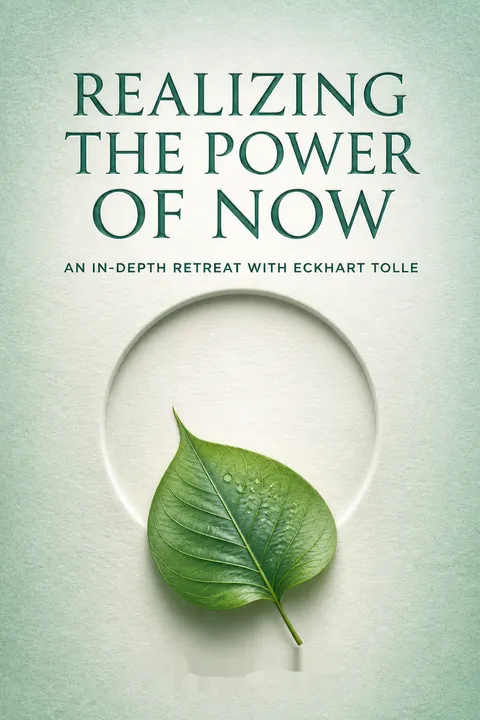
What's "Realizing the Power of Now" about?
- Exploration of Presence: The book is an exploration of the concept of presence and living in the now, as taught by Eckhart Tolle during a retreat.
- Shift from Thinking to Awareness: It emphasizes shifting from a mind-dominated existence to one of awareness and presence.
- Inner Peace and Stillness: Tolle guides readers to find inner peace and stillness by embracing the present moment and letting go of compulsive thinking.
- Practical Guidance: The book provides practical advice and exercises to help readers experience the power of now in their daily lives.
Why should I read "Realizing the Power of Now"?
- Deepen Understanding of Presence: It offers a deeper understanding of the concept of presence and how it can transform your life.
- Practical Exercises: The book includes practical exercises to help you apply the teachings and experience the benefits firsthand.
- Spiritual Growth: It is a valuable resource for anyone seeking spiritual growth and a more peaceful, fulfilling life.
- Guidance from Eckhart Tolle: As a renowned spiritual teacher, Tolle's insights and guidance are both profound and accessible.
What are the key takeaways of "Realizing the Power of Now"?
- Living in the Now: The importance of living in the present moment and the peace it brings.
- Beyond Thought: Understanding that true awareness lies beyond the realm of thought and mental constructs.
- Acceptance of What Is: Embracing and accepting the present moment as it is, without resistance.
- Inner Space and Stillness: Recognizing the inner space and stillness that underlies all experiences and thoughts.
How does Eckhart Tolle define "space consciousness" in "Realizing the Power of Now"?
- Beyond Object Consciousness: Space consciousness is the awareness that exists beyond the identification with thoughts and objects.
- Inner Stillness: It is characterized by an inner stillness and presence that is not dominated by the mind.
- Connection to the Universe: Tolle describes it as a connection to the vastness of the universe, both internally and externally.
- Gateway to Peace: Space consciousness is a gateway to experiencing peace and oneness with all that is.
What practical exercises does "Realizing the Power of Now" offer?
- Noticing Silence: One exercise involves noticing the silence between words and sounds to deepen awareness.
- Inner Body Awareness: Tolle suggests focusing on the aliveness within the body to anchor oneself in the present.
- Acceptance Practice: Practicing acceptance of the present moment, regardless of its form, is a key exercise.
- Mindful Walking: Engaging in mindful walking, where each step is taken with full awareness, is encouraged.
What is the significance of "allowing what is" in "Realizing the Power of Now"?
- Acceptance of the Present: Allowing what is means accepting the present moment without resistance or judgment.
- End of Suffering: This acceptance is crucial for ending suffering, as resistance creates inner turmoil.
- Gateway to Peace: By allowing what is, one opens the gateway to inner peace and stillness.
- Transcending the Mind: It helps transcend the mind's compulsive need to label and judge experiences.
How does Eckhart Tolle address the concept of "pain body" in "Realizing the Power of Now"?
- Accumulated Emotional Pain: The pain body is described as an accumulation of past emotional pain that lives within us.
- Triggered by Present Events: It can be triggered by present events, causing disproportionate emotional reactions.
- Transmutation through Presence: Tolle emphasizes that presence and awareness can transmute the pain body into consciousness.
- Acceptance and Observation: Observing and accepting the pain body without identifying with it is key to its dissolution.
What are the best quotes from "Realizing the Power of Now" and what do they mean?
- "Allowing what is to be as it is, because it is." This quote emphasizes the importance of acceptance and surrender to the present moment.
- "The universe consists of things and space." It highlights the duality of existence and the importance of recognizing the space or stillness that underlies all things.
- "The answer lies in stepping beyond thinking." This quote points to the necessity of transcending the mind to find true awareness and peace.
- "The simple act of noticing that, that's all that's needed for space consciousness to be present in you." It underscores the simplicity and power of awareness in accessing deeper consciousness.
How does "Realizing the Power of Now" suggest dealing with thoughts during meditation?
- Recognize Thought as Movement: Tolle advises recognizing thoughts as mere movements in consciousness, without getting drawn into them.
- Focus on Silence and Stillness: Direct attention to the silence and stillness that underlies thoughts to maintain presence.
- Acceptance of Thought Activity: Accept any thought activity without resistance, allowing it to pass naturally.
- Use of Anchors: Employ anchors like breath awareness or inner body sensation to stay grounded in the present.
What role does nature play in "Realizing the Power of Now"?
- Portal to Presence: Nature is seen as a portal to presence, offering a direct experience of stillness and beauty.
- Connection to the Whole: It helps individuals connect to the larger whole and experience oneness with the universe.
- Mindful Interaction: Tolle encourages mindful interaction with nature, such as observing without labeling, to deepen awareness.
- Healing and Rejuvenation: Nature provides a space for healing and rejuvenation, free from the mind's incessant chatter.
How does Eckhart Tolle describe the relationship between "inner space" and "outer space" in "Realizing the Power of Now"?
- Reflection of Each Other: Inner space and outer space are reflections of each other, both vast and infinite.
- Essence of Being: Inner space is the essence of being, the stillness within that mirrors the vastness of outer space.
- Beyond Form: Both inner and outer space exist beyond form, representing the unmanifested aspect of existence.
- Source of Awe: The recognition of this relationship can evoke a sense of awe and connection to the universe.
What is the ultimate goal of practicing the teachings in "Realizing the Power of Now"?
- Awakening to Presence: The ultimate goal is to awaken to presence and live in the now, free from the mind's dominance.
- Inner Peace and Joy: Achieving a state of inner peace and joy that is not dependent on external circumstances.
- Transcendence of Ego: Transcending the egoic mind and realizing one's true essence as consciousness.
- Living in Harmony: Living in harmony with oneself, others, and the universe by embracing the present moment fully.
About the Author
Other books by Eckhart Tolle

Download PDF
Download EPUB
.epub digital book format is ideal for reading ebooks on phones, tablets, and e-readers.








