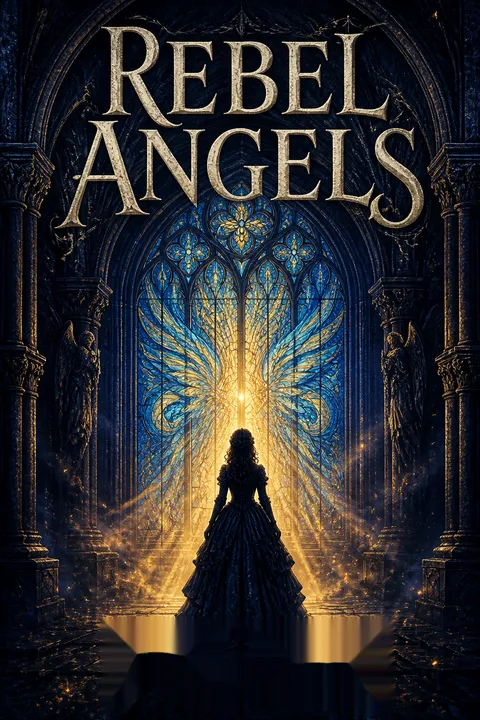


Plot Summary
Prologue
In a December account, Kartik recounts how the Rakshana summon him after the runes that once contained the realms’ magic are shattered. The brotherhood blames him for failing to report Gemma’s actions, then orders him to earn her trust, lead her to the hidden Temple, and bind its power for them.
They forbid him from entering the realms himself, and their promised protection turns suddenly into a threat: once Gemma has served her purpose, Kartik must kill her. He leaves the tribunal alive, still loyal to the only family he knows, but now carrying a mission that makes loyalty and affection enemies.
The opening gives the reader a dangerous advantage over Gemma: Kartik’s assignment makes his attention look like both care and surveillance. His obedience is not simple villainy. The Rakshana raised him, trained him, and offered him a place in a world that denied him choices, so rejecting them would mean losing his entire structure of belonging. The command to court and then kill Gemma turns intimacy into an instrument before their relationship can develop. That tension frames the novel’s central question in personal terms: whether a chosen bond can outweigh an inherited duty.
Pippa’s Empty Christmas
At Spence Academy, Gemma Doyle struggles through a Christmas craft lesson while grief for Pippa, her dead friend, unsettles every ordinary ritual. Felicity Worthington and Ann Bradshaw remain her closest companions, but their mourning has sharpened their differences: Felicity wants to return to the magical realms, while Ann fears being left behind.
Gemma pretends she can no longer open the passage, concealing that she has not truly tested her power since Pippa died. Her guilt makes secrecy feel safer than another mistake. At Pippa’s makeshift woodland memorial, the girls leave an angel ornament and argue over when they can go back. Afterward Gemma finds a note in Kartik’s familiar handwriting, summoning her to meet him.
Gemma’s first response to grief is not withdrawal but control. She conceals her ability because she believes withholding it can prevent another catastrophe, yet the lie also deprives Ann and Felicity of the chance to make an informed choice. Their friendship is already shaped by unequal access: Gemma can enter the realms, while the others depend on her invitation. The memorial makes absence tangible, but it cannot settle responsibility. By keeping her power secret, Gemma protects herself from pressure as much as she protects her friends from danger.
The Unbound Realms
Kartik catches Gemma in the snowy grounds and explains that destroying the Runes of the Oracle released the magic they had contained. With spirits now free to use it, he warns that hostile forces may strengthen themselves and threaten the boundary between worlds. The only known answer is the hidden Temple, the source of the realms’ power.
Gemma must locate it and speak the binding words Kartik gives her, though he cannot explain where the Temple lies. He also warns her against trusting anything in the realms. That night Gemma sees three unfamiliar girls dressed in white, and the next morning a new teacher, Miss Claire McCleethy, arrives at Spence after a secretive nighttime journey.
Kartik’s warning converts Gemma’s private guilt into an urgent public task. The magic is not merely a gift she can use to repair what hurts; it has become a resource that others can seize, with consequences beyond her own circle. Yet Kartik’s limited knowledge leaves Gemma responsible for solving a crisis whose rules she does not know. The girls in white and McCleethy’s unexplained arrival create two competing forms of evidence, visions and observation. Gemma must learn to interpret both without mistaking certainty for truth.
Pippa Walks Back
On Christmas night, Gemma, Felicity, and Ann reopen the passage to the realms and find the garden still radiant, though the ground where the runes stood is scorched. Pippa appears alive and delighted to see them. She explains that she never crossed the river after choosing to remain with a knight, and she eagerly helps the girls make flowers, jewels, and other small wonders.
Their relief overwhelms Gemma’s suspicion, even when Pippa warns that the Rakshana may want the Order’s power for themselves. Back at Spence, the girls discover that magic has followed them home: Ann’s ruby remains real, Felicity can fly, and Gemma can do the same. Pippa’s pleasure at killing a snake, however, leaves Gemma unsettled.
Pippa’s return offers a powerful form of wish fulfillment: the girls’ grief appears reversible, and the beautiful realm seems to reward their reunion. But the magic’s arrival in the ordinary world changes the terms of their adventure. What they create no longer disappears when they leave, so each wish carries consequences beyond play. Gemma’s unease about Pippa is psychologically credible but difficult to sustain against the relief of having her friend back. The scene tests whether love can coexist with doubt, especially when the person being doubted is the person everyone most wants to recover.
London’s False Recovery
In London, Gemma meets Simon Middleton, a courteous young aristocrat who treats her as more than a schoolgirl, and returns to a family strained by her father John Doyle’s laudanum addiction. Her brother Tom is trying to control their father’s supply while training at Bethlem Hospital, and Grandmama guards the family’s reputation.
After a magical visit to the realms, Gemma secretly wishes her father free of his craving. He wakes lively, tells stories, and seems restored, giving her a glimpse of the father she remembers. At a formal dinner, Simon’s family welcomes the Doyles, and Gemma learns that one of Tom’s patients, Nell Hawkins, believes herself tied to the Order and hunted by Circe. Gemma asks to visit Nell.
Gemma’s first use of magic at home is driven by care, not ambition. She wants to undo a source of suffering that has hollowed out her family, and the immediate improvement seems to validate her impulse. Yet a wish can alter appearances without resolving the conditions beneath them. The household’s secrecy about addiction resembles its broader social code: distress is managed privately so respectability can remain intact. Simon’s attention offers Gemma another possible self, one valued for her presence rather than her usefulness, while Nell’s case draws her back toward the danger she hoped to contain.
The Gorgon’s Warning
At the river, Gemma and her friends board the gorgon’s immense barge and ask it to carry them toward the Forest of Lights. The gorgon recounts an earlier conflict in which the Order restricted creatures’ access to the human world, then sealed magic inside the runes after a rebellion.
At the forest, centaurs escort the girls to Philon, who admits that the Order once relied on his people but later denied them power. He lends Felicity a bow and silver-tipped arrows, demanding a future share of the magic in return. On the voyage back, the girls follow a water nymph’s hypnotic song and nearly fall into the river. The gorgon rescues them only after Gemma orders it to lower its protective nets.
The journey complicates Gemma’s inherited picture of the Order as a benevolent authority. The gorgon’s history and Philon’s grievance show that protection and domination can share the same institutions. Philon’s demand is not a simple villain’s bargain: it arises from a past in which loyalty brought no lasting share of power. The nymphs make that political uncertainty bodily. Beauty can distract the girls from danger, while the gorgon’s selective warnings show that an ally’s usefulness does not guarantee trustworthiness. Gemma is learning that leadership means negotiating among injuries, not merely defeating an obvious enemy.
Magic Leaves the Garden
Back in London, the girls discover that magic can travel beyond the realms. Felicity uses it to present Ann as an aristocratic relation of the Duke of Chesterfield, inventing a Russian lineage that gives Ann access to fashionable society. At Felicity’s mother’s club, Ann sings in Russian through magic, dazzling the members, while Felicity humiliates Lady Denby with an enchantment.
Gemma senses other people’s thoughts and struggles to bear the crowd’s private fears and desires. Later she uses magic to stop a stranger from attempting suicide, then quietly repairs a child’s broken doll. These acts bring exhilaration, but each use makes the boundary between compassionate help and manipulation less clear.
The girls’ first London uses of magic expose how quickly social privilege can be manufactured and believed. Ann’s invented pedigree opens doors because the club’s members are prepared to treat rank as evidence of worth. Felicity’s retaliation against Lady Denby turns a grievance into public humiliation, while Gemma’s intervention for the suicidal stranger shows a more urgent use of power. Still, good intentions do not erase the asymmetry between the person casting an illusion and those unknowingly affected by it. The episode forces the girls to confront a difficult distinction: changing an unjust situation can also mean controlling other people.
The Name in the Anagram
Tom takes Gemma to Bethlem, where Nell Hawkins confirms that she knows about the Order and warns her to follow a true path. Nell grabs Gemma’s crescent amulet and bends it, as though searching its reverse for a hidden sign. The girls later buy a book on secret societies at the Golden Dawn, the bookseller advertised in McCleethy’s luggage.
Its account of secret names leads them to rearrange the teacher’s letters into an apparent reference to Circe. Gemma also notices that McCleethy visits Bethlem, then finds newspaper reports of vanished girls at schools listed in the teacher’s luggage. A letter from Saint Victoria’s confirms that McCleethy taught Nell there.
This investigation demonstrates how easily partial clues can harden into a convincing but mistaken story. The anagram seems precise, and the school records establish a genuine link between McCleethy and Nell, but neither proves that McCleethy is Circe. Gemma’s urgency encourages her to treat resemblance as identity. Nell’s damaged amulet gesture, meanwhile, offers a material clue whose meaning the girls do not yet understand. Their detective work is productive precisely because it is imperfect: each discovery advances them, but also reveals how fear can distort the interpretation of evidence.
Nell’s Riddle Dance
At Bethlem’s Christmas dance, Gemma finds Nell frightened after a visit from a woman she believes is Circe. During her turn before the guests, Nell recites a nursery-like sequence filled with references to the gorgon, the forest, the Untouchables, the path, and the Poppy Warriors. The audience mistakes it for nonsense, but Gemma recognizes that Nell is encoding directions and warnings.
When orderlies remove Nell, Gemma hides under her bed as the green-cloaked visitor searches the ward. Nell then draws Gemma into a vision of the girls’ past. Afterward, Gemma realizes that the crescent eye can function as a compass, and that following its direction matters more than following the apparent route shown by the girls in white.
Nell’s performance gives a silenced patient a brief and precarious form of agency. The hospital audience hears disorder where Gemma hears an organized warning, revealing how institutional labels can make meaningful testimony easy to dismiss. Yet Nell’s message remains difficult to separate from trauma, and Gemma must take its practical clues seriously without assuming she can fully decode its history. The compass introduces a counterweight to vision: instead of relying only on images and impressions, Gemma can test direction through an object. The distinction matters because the girls in white are not simply guides.
A Father’s Christmas Collapse
On Christmas Eve, Kartik tells Gemma that John has vanished into an opium den in East London. Gemma disguises herself in Tom’s clothes and follows Kartik through dangerous streets to Chin-Chin’s, where she finds her father drugged, stripped of his belongings, and unable to recognize the harm he is causing. She and Kartik carry him back to the carriage.
Gemma admits that her attempt to cure him with magic failed, while Tom confesses that medicine has not given him the power to save their father either. The next morning Kartik gives Gemma a protective charm, kisses her, and leaves to pursue advancement in the Rakshana. Gemma is left with her father’s relapse and an unresolved bond with Kartik.
The relapse exposes the difference between magical relief and recovery. Gemma’s wish briefly restored her father’s familiar warmth, but addiction returned because a desire cannot substitute for sustained treatment and the sufferer’s own participation. The opium den also confronts Kartik and Gemma with the social violence behind their inherited assumptions about caste and worth. Their emotional intimacy deepens through shared crisis, then fractures when Kartik leaves for the brotherhood. His departure is both a personal wound and a reminder that belonging can feel safer than choosing an uncertain future.
The Ball’s Bright Illusions
At Felicity’s Christmas ball, Gemma drinks absinthe with Simon and the girls, then experiences a vision of the Temple as a cathedral. The drink blurs her judgment, and Simon takes her away from the party, but Gemma’s vision interrupts their intimacy. In the ballroom, Cecily is about to expose Ann’s false aristocratic story.
Overwhelmed by the crowd’s thoughts, Gemma freezes everyone in place and alters Cecily’s response, turning the threatened exposure into public praise for Ann. She then learns that Felicity’s father has abused her and sees Felicity’s fear when the Poppy Warriors later exploit that trauma. The ball gives Gemma a glimpse of happiness, but its glamour conceals real vulnerability.
The ball gathers several forms of performance into one room: courtship, class, sobriety, and reputation. Gemma’s intervention saves Ann from humiliation, but it does so by removing Cecily’s agency and replacing one fiction with another. Her power offers immediate protection while making the truth harder to reach. Simon’s attentions are similarly complicated by the absinthe and the pressure of social expectation. Felicity’s concealed abuse reveals the cost of appearances most sharply: the family’s polished public image protects the adult who harms her, while leaving Felicity to interpret the violence as her own fault.
The Temple That Wasn’t
Following the crescent eye and the girls in white, Gemma, Felicity, and Ann find a splendid cathedral across a stretch of water and assume it is the Temple. Inside, bones embedded in the walls expose the building as a trap. Azreal and the Poppy Warriors surround them, suppress Gemma’s magic, and use each girl’s private fear to weaken her: Ann’s sense of worthlessness, Felicity’s shame, and Gemma’s guilt over her father.
Gemma proposes a hunt to gain time. Felicity shoots Azreal with Philon’s arrow, and the girls escape through the catacombs. During their flight across the moat, water nymphs overturn the boat and drag Ann under, leaving her ribbon floating on the surface.
The false cathedral is a structure built from borrowed authority: it looks like the sacred place the girls seek, but its beauty disguises bones and predation. The Warriors’ power depends less on brute force than on making the girls experience their own memories as evidence against themselves. Felicity’s shot matters because she acts while frightened, rather than waiting to feel invulnerable. Ann’s disappearance then makes the cost of escape immediate. The group survives its captors, but the rescue is incomplete, and Gemma’s earlier confidence in following appearances has brought them to the wrong place.
The Lagoon’s Price
Gemma returns to the realms with Felicity and Pippa, and the three find Ann bound on a rock in the water nymphs’ lagoon. Hester Moore, Gemma’s former teacher, joins them and helps resist the creatures’ song. Gemma swims out and ties a rope around Ann while the others pull from shore; the water nymphs attack, but Pippa throws one of the gorgon’s nets and destroys several.
Ann reaches land alive, and her own singing helps draw Felicity away from the water. Then the three girls in white arrive with a monstrous tracker. Hester stays behind to buy time, and the tracker takes her. Back in the garden, Gemma sees Pippa feeding on an animal carcass.
The rescue turns Ann’s voice from a source of social performance into practical strength: her singing helps her friends resist the nymphs’ lure. Cooperation succeeds where Gemma’s solitary use of power has often failed. But the victory demands another loss, as Hester stays behind and disappears with the tracker. Pippa’s feeding makes Gemma confront the possibility that remaining in the realms is changing her friend, even when Pippa still looks familiar. The scene refuses the comforting idea that affection can preserve someone unchanged. Saving one person does not automatically save the whole group.
Kartik Breaks Ranks
The Rakshana capture Gemma and insist that Miss McCleethy is an ally named Sahirah Foster, not Circe. Sahirah says Kartik’s real assignment was to kill Gemma after the Temple was found. When Gemma asks him directly, Kartik denies it, but his eyes give her reason to doubt him. She pretends to faint, uses the small blade Kartik gave her to block a door, and escapes with him.
He signals which exit to take, sacrificing his chance to join the brotherhood. At Hester Moore’s rooms, Gemma finds a letter claiming Moore has gone to work at a school where her sister is headmistress. Rearranging Moore’s full name identifies her as Sarah Rees-Toome, Circe, and a vision confirms she betrayed Nell’s schoolmates.
Kartik’s choice finally makes visible the conflict the prologue established. He has been shaped by the Rakshana’s demands, yet when faced with Gemma’s danger he acts against the only institution that has claimed him. His help does not instantly restore trust; rather, it gives him a chance to earn a different kind of belonging. The revelation about Hester is more devastating because Gemma trusted her as a teacher and ally. The name puzzle alone is not proof, but the vision supplies the missing history. Gemma’s confidence in her judgments has to be rebuilt from evidence she once misread.
The Temple Underfoot
After Gemma collapses from the strain of uncontrolled magic, Nell tells her that Circe cannot bind the power herself. Gemma leaves her sickbed, intercepts Felicity and Ann at the station, and returns with them to the realms. She recognizes the Caves of Sighs as the Temple hidden beneath their ruined appearance, guarded by the Untouchables.
There, Circe holds Nell and offers Gemma a place beside her. Pippa accepts Circe’s promise that she can remain in the realms, while Felicity cannot bring herself to shoot. When Circe threatens to sacrifice Nell, Gemma uses Felicity’s last arrow to kill Nell, denying Circe that power. Gemma then enters the well and binds the magic to herself, making its future depend on shared stewardship.
The climax forces Gemma to choose between outcomes that all carry moral injury. She kills Nell to prevent Circe from using her as a sacrifice, but intention cannot make the act clean. The decision marks a break from Gemma’s earlier wish to repair pain through private control. Her binding does not restore the old Order unchanged; its language places the power in a collective future rather than one faction’s exclusive possession. The Caves of Sighs become the Temple only when Gemma sees the people hidden there as possible guardians, not as scenery or obstacles.
A Different Kind of Order
With the magic bound, Pippa’s altered eyes and sharp teeth reveal that she cannot remain safely in the realms. Gemma tells her she must cross over; Pippa refuses and runs toward the Winterlands, while Felicity grieves the promise she cannot keep. Nell appears whole enough to cross the river and leaves Gemma with forgiveness she has not earned.
Gemma frees the gorgon from the Order’s bond, and the gorgon chooses to carry the girls home. Back in London, Gemma invites Kartik, now rejected by the Rakshana, to join her work without serving another master. She rejects Sahirah’s demand that the Order keep its power exclusive, leaves Simon’s family rather than accept a life built on concealment, and returns to Spence with Ann and Felicity.
The ending offers neither restoration nor a clean victory. Pippa’s departure preserves the cost of the girls’ earlier choices, while Nell’s crossing gives grief a form of release rather than erasure. Gemma’s political decision follows from these losses: she will not reproduce the Order’s monopoly merely because she now holds its power. Kartik’s new allegiance is voluntary, unlike the bond that shaped his childhood. Gemma also refuses Simon’s safe social world when it would require concealing too much of herself. Her emerging community is unstable, but it begins with consent and negotiation.
Analysis
Rebel Angels treats power as both a capacity to act and a temptation to substitute one person’s judgment for another’s. Gemma’s first magical wish, to cure her father, comes from love, yet it produces only a temporary reprieve. Her later spell to protect Ann prevents immediate humiliation but does so by overriding Cecily’s will. The novel therefore refuses an easy equation between benevolent motive and ethical action. What matters is not only what Gemma wants to fix, but whether she recognizes the limits of her authority.
The realms enlarge that problem politically. The Order has preserved balance by controlling magic, but the gorgon’s history and Philon’s grievance reveal that stability can conceal exclusion. The Rakshana, too, offer Kartik belonging in exchange for obedience. Gemma’s final binding rejects both the old monopoly and Circe’s personal ambition, though it does not promise that sharing power will be peaceful. Her choice is a wager on relationships and negotiation rather than a guarantee of harmony.
The novel’s intimate plots echo its political ones. Ann’s invented ancestry demonstrates how social status depends on stories others are willing to believe. Felicity’s family reputation hides abuse, while Gemma’s family hides addiction. These deceptions protect people briefly, but they also isolate those most in need of help. Nell’s fragmented warnings challenge the assumption that a distressed person has nothing coherent to say, while Gemma’s errors show that even a compassionate listener can mistake fear for evidence.
The ending preserves grief rather than dissolving it. Gemma cannot keep Pippa unchanged, undo Nell’s suffering, or make her father well by command. She can choose what to do with the power she has and who will stand beside her. The book’s strongest claim is not that choice defeats fate, but that accepting responsibility for a choice is the beginning of a more just form of power.
Review Summary
Rebel Angels received mostly positive reviews, with readers praising its atmospheric Victorian London setting, complex characters, and intriguing magical elements. Many found it an improvement over the first book, appreciating the deeper exploration of themes like friendship, family, and societal constraints. Some readers criticized the pacing and character development, while others loved the mystery and plot twists. The book's handling of sensitive topics like mental health and abuse was noted, though opinions varied on its effectiveness. Overall, fans of Gothic fantasy and historical fiction found it compelling.
People Also Read

Characters
Gemma Doyle
Reluctant magical heirGemma is a sharp, restless sixteen-year-old whose life is divided between the rules of Spence Academy and the dangerous freedom of the realms. Her mother’s death and her father’s addiction make her eager to repair what she cannot control, and that impulse can turn into secrecy or overreach. She is observant, funny, and socially uncertain, especially when measured against the beauty and status expected of a Victorian girl. Her friendships with Felicity, Ann, and Pippa give her a sense of belonging, but also expose the imbalance created by her unique access to magic. Gemma’s central struggle is learning that responsibility means more than having power: it means listening, accepting limits, and deciding who should share authority.
Kartik
Rakshana novice and watcherKartik is an Indian youth raised and trained by the Rakshana, a secret brotherhood that gives him discipline, education, and a place in the world. He is resourceful and guarded, skilled at surviving by observation and improvisation. His loyalty is shaped by gratitude as much as coercion, since the brotherhood has been his family since childhood. Gemma unsettles the certainty he has built around duty, while his attraction to her makes every act of trust more costly. Kartik’s beliefs about fate and rank conflict with Gemma’s conviction that people can choose differently. He often speaks through practical action, revealing more when he risks something than when he explains himself.
Felicity Worthington
Defiant archer and heiressFelicity is a wealthy, strikingly self-possessed student who understands how appearance and rank can open doors. Her wit and confidence mask a fierce need to control how others see her, while her archery reveals a capacity for focus beyond fashionable performance. She draws Ann into London society and can be generous when she chooses, yet she also uses status and magic to punish those who threaten her pride. Her friendship with Gemma is intimate but competitive, particularly where power and loyalty are concerned. Felicity’s sharpness should not be mistaken for invulnerability: she fears being powerless and unseen, and that fear shapes both her cruelty and her courage.
Ann Bradshaw
Scholarship girl with a voiceAnn is an orphaned scholarship student whose gentleness and self-effacing manners make it easy for wealthier girls to overlook her. She longs for beauty, romance, and a secure place in society, but her singing gives her a talent that demands attention on its own terms. Ann often avoids conflict because she fears that other people’s displeasure will cost her the little security she has. Her closeness to Gemma and Felicity gives her companionship, though their access to money and magic can sharpen her sense of dependence. Ann’s vulnerability is not weakness: beneath her hesitation lies a capacity to persist, create, and make herself heard.
Pippa Cross
Beloved friend beyond reachPippa is beautiful, charming, and accustomed to drawing affection from those around her. She enjoys romance and attention, but her sweetness can carry a possessive edge when she fears being displaced or forgotten. Her bond with Gemma and Felicity is deep, and her absence leaves a lasting wound in the group. Pippa’s desire to remain close to her friends reflects a human fear of separation, even as the realms complicate what closeness can safely mean. She is both a source of tenderness and a reminder that love does not give one person the right to decide what another should endure.
Miss Claire McCleethy
Exacting new teacherMcCleethy arrives at Spence as an arts instructor with an unusual accent, a strict teaching manner, and an evident interest in Gemma. She encourages discipline and tests her pupils through archery, while her unexplained history and carefully guarded belongings invite suspicion. To the girls, she represents an adult authority they cannot easily classify as safe or dangerous. Her presence draws Gemma into investigating the schools, symbols, and people connected to the Order.
Hester Moore
Former teacher and confidanteHester Moore is a former Spence art teacher whose curiosity about travel, myths, and women’s hidden histories once helped open Gemma’s world. She is perceptive and irreverent, willing to question social rules without pretending that questioning alone changes them. Her warmth makes the girls feel taken seriously, while her independence reflects the precarious life of a woman without wealth or family protection. Gemma trusts her judgment and seeks her help when danger becomes too large to face alone.
Nell Hawkins
Patient carrying a warningNell is a young patient at Bethlem whose experiences have left her frightened, disorganized, and difficult for others to understand. Her speech can seem like fragments of nursery rhymes, yet she notices threats that those around her dismiss. Her connection to Gemma grows through their shared knowledge of the Order and the realms. Nell’s story exposes the danger of treating distress as proof that a person has nothing meaningful to say.
Simon Middleton
Courteous aristocratic suitorSimon is a handsome, privileged young man who moves easily through London’s elite society and initially treats Gemma with unusual attention. His manners are polished, but he also enjoys gossip and the small power of knowing other people’s reputations. He offers Gemma a possible life of security and social acceptance, qualities that appeal to her after the instability of home. Their connection is shaped by what each assumes about the other, and by the distance between his protected world and the dangers Gemma carries.
Thomas Doyle
Brother trying to healTom is Gemma’s older brother, a medical student and clinical assistant at Bethlem. He tries to manage his father’s addiction through practical discipline, believing that science and responsibility should produce answers. His frustration grows when those methods fail, and his confidence often comes across as arrogance toward Gemma. Beneath it, he feels pressure to become the competent son his family needs. He is capable of kindness with patients and affection for his sister, even when Victorian expectations make equality between them difficult.
John Doyle
Gemma’s troubled fatherJohn is Gemma and Tom’s father, a former storyteller whose warmth and wit surface in moments when his addiction loosens its hold. His dependence on laudanum has damaged his health and strained the family, leaving Gemma torn between love and helplessness. He is not simply a problem for his children to solve: he remains a person with grief, memory, and a will that must be his own. His condition reveals the limits of secrecy, family loyalty, and well-intentioned attempts to control another person’s recovery.
Mrs. Nightwing
Severe headmistress and widowMrs. Nightwing governs Spence through rules, manners, and a carefully maintained reserve. She expects girls to become socially acceptable young women, yet her authority is more complicated than her stern public manner suggests. Her past grief and private attachments sit beneath the discipline she enforces. For Gemma, she embodies the institution’s power to shape girls, but also the possibility that a woman’s life contains hidden losses beyond the schoolroom.
Philon
Forest power brokerPhilon leads the Forest of Lights and speaks for creatures who once served the Order but were later denied access to its power. Elegant, strategic, and openly self-interested, Philon refuses to confuse old loyalty with present obligation. The weapons offered to Gemma’s party come with a debt, forcing her to consider what justice might mean to those excluded by the Order’s rule. Philon is neither a simple ally nor a straightforward enemy.
Asha
Guide among the UntouchablesAsha belongs to the Hajin, the people the Order has cast out and others dismiss as unworthy of notice. She knows the paths around the Caves of Sighs and offers protection through painted designs, but she does not give help without asking what Gemma is prepared to offer. Her authority comes from knowledge and attention rather than social rank. Asha forces Gemma to recognize that the disregarded may hold both the history and the power everyone else seeks.
The Gorgon
Bound river navigatorThe gorgon commands a vast barge that carries travelers along the river through the realms. Her serpent-covered head and binding to the Order make her frightening, but she is also a source of history about the old rebellion and the price of control. She answers questions selectively and follows the limits of her bond rather than the girls’ assumptions about loyalty. Her presence turns every journey into a negotiation with a creature whose past cannot be separated from the Order’s.
Sahirah Foster
Order teacher in disguiseSahirah appears in Gemma’s story through her role at Spence and her pursuit of the Order’s lost power. She is patient, disciplined, and willing to disguise her intentions to reach a larger purpose. Her conviction that the Order must retain authority places her at odds with Gemma’s desire for shared power. She understands sacrifice as the price of leadership, a belief that makes her both a formidable guide and a source of danger.
Mrs. Worthington
Felicity’s society-minded motherFelicity’s mother is a polished hostess who navigates fashionable society with practiced charm. Her attention to appearances and her complicated relationship with her daughter shape Felicity’s sense of what affection costs. She is concerned with social judgment, but her household contains tensions that etiquette cannot smooth away.
Mr. Fowlson
Rakshana enforcerFowlson is a scarred Rakshana operative who monitors Gemma and presses her to complete the search for the Temple. He treats the mission as organizational business and expects obedience, making him an immediate reminder that the brotherhood’s protection comes with demands.
Plot Devices
The Crescent Eye
Compass to hidden pathsGemma’s inherited amulet is an emblem of the Order and more than a keepsake. Its altered surface points toward a route the girls cannot otherwise recognize, giving material form to Nell’s warnings about staying on the true path. The amulet does not interpret what it finds or guarantee safety. Its guidance can lead the girls close to danger, so Gemma must combine its direction with judgment rather than treat it as an infallible map.
The Runes of the Oracle
Seal on the realms’ magicThe ancient runes once restricted access to the realms’ central power, allowing the Order to control who could draw upon it. Gemma breaks them while freeing her mother, releasing magic to creatures and humans alike. This act powers the novel’s crisis: it makes wonders possible in London, but it also enables predatory spirits to grow stronger. The broken runes turn an earlier rescue into a continuing responsibility.
The Three Girls in White
Visions that mislead and guideThese apparitions visit Gemma in dreams and waking visions, showing fragments of a past connected to Nell, the schools, and Circe. Their images are vivid but incomplete, leaving Gemma to decide whether they are warnings, manipulation, or both. They sometimes direct her toward real clues and sometimes draw the girls away from safety. The visions make perception itself part of the plot: seeing something clearly does not mean understanding who is showing it or why.
The Realms
A wish shaped, dangerous worldThe realms are a linked magical world where desire can take physical form, from jewels and flight to the girls’ transformations and visions. The garden first appears welcoming, but the river leads to territories with competing peoples, old grievances, and lethal enchantments. Magic can cross back into London, which gives the girls the power to alter social encounters and personal lives. The realms are not a private escape from reality; their magic carries consequences across the boundary.
The Well of Eternity
Choice becomes a bindingHidden within the true Temple, the well is the place where Gemma can face the magic and choose the form its binding will take. It makes the ending depend not only on finding a location but on deciding who may hold power afterward. Gemma’s words redirect the old system away from exclusive Order control and toward a future in which others may share responsibility. The well turns a physical confrontation into a decision about governance, sacrifice, and accountability.
Gemma Doyle Series

Download PDF
Download EPUB
.epub digital book format is ideal for reading ebooks on phones, tablets, and e-readers.








