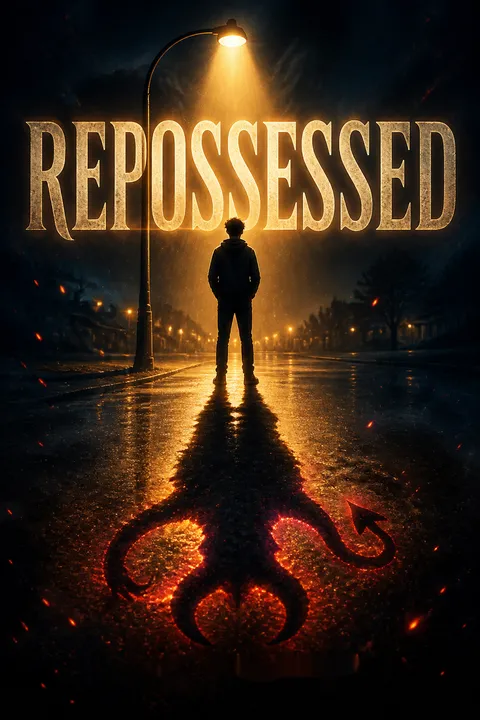


Plot Summary
A Life Stolen at the Curb
Kiriel has spent ages reflecting the guilt and sorrow of the dead in Hell, with no sense that the Creator notices his labor. Fed up, he slips away without telling his superiors and selects Shaun Simmons, a suburban teenager with a home and a school routine, as an easy way to sample human life.
Just as Shaun steps from the curb into the path of a speeding cement mixer, Kiriel pulls him back and takes control of his body. The abrupt change from bodiless existence to sight, sound, touch, and breath overwhelms him. Bailey, Shaun’s best friend, sees only a boy suddenly acting strangely. Kiriel heads home, delighted by the simplest miracle: walking.
Kiriel’s rebellion begins not as a bid for power but as a protest against being unseen. His choice of Shaun is practical, yet it immediately becomes ethically complicated: he saves Shaun from the instant of death by taking the life that was about to end. Human sensation gives Kiriel what his celestial existence lacked, but embodiment also confines him to one perspective and one body. The opening therefore makes physical life both a pleasure and a trespass, setting up the question of whether a good motive can excuse taking another person’s place.
The Body Becomes a World
Alone at Shaun’s house, Kiriel tests the body’s senses: he studies his face, handles clothes, and discovers pleasure in bathing and sexual release. A bath stretches so long that Shaun’s mother checks on him, then finds him emerging in a towel and wearing the new clothes she had bought for her son.
Kiriel eats enthusiastically, completes Shaun’s homework, and tries the neglected weight bench, while Jason, Shaun’s younger brother, meets his odd behavior with suspicion and contempt.
Kiriel notices the hostility between the brothers but does not yet grasp how much it matters. The family reads his sudden politeness and changed appearance as a possible teenage crush. That night, Kiriel fears sleep will return him to Hell, but wakes still inside Shaun.
The pleasures that seem trivial to humans arrive for Kiriel as revelations, making ordinary routines feel newly created. His curiosity is sincere, but it is also self-centered: he treats Shaun’s body and household as a laboratory, overlooking the relationships that give those routines meaning. Shaun’s mother interprets his helpfulness through familiar parental hopes, while Jason recognizes that something is wrong without being able to name it. Their contrasting reactions show how identity is not only a face or a voice. It is also a pattern others expect, trust, or resent.
Lane Notices Shaun
The next morning, Shaun’s cat, Peanut, hisses at Kiriel and scratches his fingertips when he reaches beneath the bed. The rejection stings, but Kiriel goes to school eager to keep exploring.
There he meets Lane Henneberger, a classmate who has quietly imagined romance with Shaun, though Shaun himself has barely noticed her. Kiriel sees her in person for the first time, touches her hair, and recognizes her attraction when she responds warmly to his unusual attention.
He mistakes his fascination with her appearance, habits, and presence for love. Wanting to explore sex through Shaun’s body, he decides Lane is the person he should pursue. His transformation is visible enough that Bailey begins questioning why Shaun is suddenly smiling and speaking so freely.
Peanut’s response offers Kiriel his first embodied experience of being recognized as an outsider, and he quickly interprets rejection as a judgment on his nature. At school, he makes a different mistake: because he can observe Lane’s private hopes, he assumes he understands her. His attraction combines sensory wonder with the power of information she does not know he possesses. That imbalance matters. Kiriel’s sincerity does not make his intentions harmless, and his growing interest in Lane exposes the gap between knowing facts about a person and understanding what that person wants.
Reed Throws the First Punch
At lunch, Kiriel tells Bailey that he intends to pursue Lane, then turns his attention to Reed McGowan, a classmate who routinely humiliates others. Kiriel confronts Reed about his insecurity and predicts that he will regret hurting people. Reed follows him outside and punches him in the jaw.
The blow gives Kiriel his first sharp experience of physical pain and reminds him that he is no longer a distant observer of human suffering. On the bus ride home, he decides not to withdraw from people. At home, he asks Jason for a cookie, accepts his hostility without retaliating, and invites him to Bailey’s house to play a game. Jason’s suspicion softens enough for him to come along.
Kiriel’s attempt to reform Reed repeats the error of his pursuit of Lane: he assumes that insight gives him permission to intervene. But the punch changes the cost of that assumption. Pain is no longer material he witnesses in others; it becomes a limit that governs his own choices. His response to Jason is quieter and more consequential. Instead of demanding affection, he offers an invitation and accepts distrust. Kiriel is beginning to learn that influence is not the same as control, though he still believes a well-aimed lesson can redirect another person.
Jason Enters the Picture
At Bailey’s house, Jason plays the video game with real skill while Kiriel studies Bailey’s room and its shelves. Photographs show Shaun beside Bailey at a birthday gathering, present but disengaged. Looking at those images, Kiriel feels grief for the teenager whose body he has taken, though Shaun would have died in the accident regardless.
Back home, Kiriel encourages Jason to socialize and helps him with schoolwork, winning a small measure of trust from Shaun’s mother. Later, while Kiriel uses Shaun’s computer, a message from Anius, an anxious supervisor in Hell, orders him to return. Kiriel refuses, then discovers sneezing and tears at the moonlit window. The physical world feels too precious to leave.
The photographs make Shaun’s absence tangible in a way that Kiriel’s abstract knowledge never could. Shaun’s life was not simply a set of habits to imitate; it had already left traces in the memories of Bailey and Jason. Kiriel’s grief marks a moral shift, because he begins to mourn the person whose place he occupies. Yet he also chooses to stay, valuing sensation over the obligations he abandoned. The warning from Anius raises the stakes without supplying the attention Kiriel craves. Even the threat confirms how little his superiors seem to understand what this experience means to him.
A Seed for Reed
On his next school day, Kiriel asks Bailey to look after Jason if anything happens to him, unsettling his friend with the sudden talk of death. He then invites Lane to Bailey’s house, claiming he needs help with geometry, and apologizes to Reed for exposing his private insecurity.
Reed dismisses the apology, but Kiriel hopes the warning may stay with him. After a teacher questions Shaun’s unexpectedly strong schoolwork, Kiriel finds Lane and arranges for her to visit Bailey’s home, where Bailey’s mother can supervise.
Kiriel’s plan to get Lane alone fails. Instead, Lane plays a video game with Jason, talks with Bailey about the books they both enjoy, and leaves with Kiriel walking her home. They hold hands, and Lane says she senses a sadness behind his changed expression.
Kiriel’s actions now carry more emotional risk because he is beginning to care about what happens after he leaves. His request to Bailey betrays a recognition that Jason needs protection, while his apology to Reed shows a tentative attempt to repair harm rather than simply diagnose it. With Lane, however, he still builds the encounter around his own hopes. The afternoon resists his script: Bailey and Jason become part of Lane’s experience, and her interest in Shaun grows through ordinary companionship. The handholding matters precisely because it is modest; connection begins where Kiriel’s plan for conquest fails.
No One Comes for Kiriel
After Lane leaves, Jason asks to try Bailey’s guitar, then wonders whether he could learn to play. Kiriel offers Shaun’s neglected instrument, and Jason’s interest gives the brothers a new subject to share. At dinner, Kiriel helps Shaun’s mother understand why her brother’s judgment has kept them distant.
Shaun’s father calls from a business trip, eager to speak with his son, but Kiriel cannot answer with Shaun’s warmth and passes the phone to Jason. That night Anius appears, not sent by the Boss but driven by worry about his own duties. Kiriel realizes that no one has been dispatched because his absence may not matter. Envy and doubt take hold: perhaps his punishment, and the souls’ torment, are not what he assumed.
These encounters reveal what Kiriel cannot reproduce by copying Shaun’s behavior: the accumulated trust between family members. Jason’s wish for a guitar lesson, the mother’s openness, and the father’s eager call all depend on bonds built before Kiriel arrived. Anius’s visit deepens the wound because it offers no personal concern, only procedural anxiety. Kiriel’s envy is therefore not merely a desire for human life. It is the recognition that humans matter to one another through particular histories, while he has been reduced to a function. His questions about Hell arise from that deprivation, not from new proof.
Reed Falls, Kiriel Enters Church
On what Kiriel expects to be his final day, Reed insults a student using a wheelchair. Kiriel trips Reed as he passes; Reed falls, injures his hand, and finds his friends unwilling to help. The act brings no relief. Kiriel recognizes that anger made him harm someone rather than change him, and he leaves school on foot.
He enters a Methodist church, reads from a Bible, and considers whether the Creator’s silence means that fallen beings and guilty souls have condemned themselves. For the first time, Kiriel addresses the Creator directly, asking to be noticed. The sanctuary offers no answer. Still carrying his questions, he walks on to Lane’s home, where her grandmother is asleep.
Kiriel’s retaliation is a turning point because it makes him resemble the people he has spent eternity judging. He responds to Reed’s cruelty by causing pain, and the injured boy’s brief triumph cannot erase that fact. In the church, Kiriel confronts a more unsettling possibility than divine punishment: that suffering may persist because its sufferers believe it must. His prayer is not a declaration of faith so much as an attempt to establish contact. The silence leaves the question unresolved, but it changes Kiriel’s position. He has moved from accusing the Creator at a distance to risking a direct appeal.
Lane Refuses the Script
At Lane’s house, Kiriel tells her she is beautiful and kisses her. When he hints at taking their intimacy further, Lane draws back and makes clear that she wants kissing, not sex. Kiriel realizes that her private romantic fantasies had not been permission for the encounter he planned. He sets aside his expectations, and they spend the afternoon kissing and resting together.
Before leaving, he again tells her she is beautiful, this time without trying to make the compliment a step toward anything else. Lane accepts it with a smile. Kiriel walks away disappointed that his sexual ambition has gone nowhere, yet pleased by a connection he had not been able to script. He returns home to find Jason waiting with Shaun’s guitar.
Lane’s refusal exposes the ethical flaw in Kiriel’s confidence: he has treated her imagined desires as a contract, when they were only private fantasies. Her boundary forces him to attend to the person in front of him rather than the information he has gathered about her. The scene does not punish desire; it distinguishes desire from entitlement. Kiriel’s willingness to remain with Lane on her terms marks a genuine change, although his disappointment shows that the change is incomplete. He has begun to value mutuality, but still has to loosen his grip on the outcome.
The Truck Reclaims the Curb
Jason is ready to take Shaun’s guitar back to Bailey’s, and Kiriel lets him keep it in exchange for a promise to speak someday with Carson, a shy classmate. Jason agrees, though Kiriel knows he cannot guarantee the promise will be kept. Kiriel then approaches Peanut, who finally allows him to pet him, and feels a gentler form of attachment than he found in sensation or lust.
Across the street, the angel Hanael waits in a moving van. Hanael explains that Kiriel must leave Shaun’s body through another collision, while Shaun will later awaken with his memories of Kiriel removed. Kiriel asks that Shaun not be treated harshly, then steps toward a speeding pickup. He leaves believing that even small acts may have mattered.
The ending gives Kiriel neither the explanation he longs for nor a clean victory. Shaun’s life must resume through a new collision, and Kiriel accepts the bodily pain required to restore the interrupted course. The guitar and the cat make his final attachments concrete: he has helped Jason imagine a different future and has received trust without earning it through force. Hanael’s language of function remains frustratingly opaque, but Kiriel no longer measures significance only by whether the Creator personally acknowledges him. He can leave with uncertainty and still believe that his actions may have altered someone’s possibilities.
Analysis
Repossessed uses comic culture shock to examine a serious asymmetry: Kiriel knows a great deal about human behavior but has never had to live with the consequences of his own. His early experiments treat bodies and relationships as experiences to collect. The more he feels, however, the less plausible detachment becomes. A punch makes suffering immediate; Shaun’s photographs make absence personal; Lane’s boundary exposes the danger of confusing private fantasy with consent.
The novel’s account of moral responsibility resists simple categories. Kiriel’s original rebellion may have begun from a desire to participate in creation, while his theft of Shaun’s body is knowingly selfish. Human beings, too, are not reduced to fixed labels. Reed can choose cruelty, Jason can be kinder than his reputation, and Kiriel can repeat the harm he condemns. The possibility of change depends on action, not on insight alone.
Relationships give the story its measure of personhood. Kiriel envies Shaun not for popularity or achievement, but because his family and friends hold a particular place for him. He cannot fabricate that history through imitation. Yet his brief acts of care may still create new possibilities for Jason, and his willingness to accept Lane’s terms marks a limited but genuine change. The resolution does not reward Kiriel with certainty or a divine explanation. Instead, it leaves him with responsibility for what he has touched and the possibility that meaning can arise through small effects, even when no authority confirms them.
Review Summary
Repossessed is a young adult novel about a demon who possesses a teenager's body to experience human life. Reviews are mixed, with some praising its humor, unique premise, and thought-provoking themes about humanity and spirituality. Others found it underwhelming or objectionable. Many appreciated the protagonist Kiriel's perspective on everyday experiences. Some felt the plot was thin or underdeveloped. Overall, readers found it an easy, entertaining read that raises interesting questions, even if it doesn't fully explore them.
People Also Read

Characters
Kiriel
Curious fallen angelKiriel is a fallen angel whose assigned work is to reflect the remorse of the dead. Long exposure to other beings’ guilt has left him frustrated, detached, and hungry for recognition. He chooses a human body to experience physical life, assuming that knowledge about people will be enough to guide his actions. His curiosity is comic in its attention to ordinary details, but it can turn intrusive when he treats another person’s desires as material for his own experiment. Kiriel’s growing attachment to Shaun’s family and friends challenges his belief that feeling and understanding are separate. He is most compelling when his confidence falters and he has to learn from the consequences of what he has done.
Shaun Simmons
The withdrawn teenagerShaun is a high school student who keeps much of himself hidden behind messy habits, low expectations, and a habit of avoiding attention. He is Bailey’s longtime friend and Jason’s older brother, though he rarely makes much effort to connect with Jason. Shaun’s quietness is not cruelty so much as a familiar retreat from relationships that demand attention or change. His body and household become the setting through which Kiriel discovers human life, but Shaun’s history cannot be fully borrowed: his family’s affection and friends’ memories belong to him. The distance between Shaun’s outward indifference and the bonds around him helps shape the novel’s questions about what a person leaves behind.
Jason
The guarded younger brotherJason is Shaun’s younger brother, a restless and curious boy whose behavior has often been mistaken for deliberate troublemaking. Adults and peers tend to focus on the things he breaks or the social cues he misses, leaving him wary of invitations and praise. His sarcasm protects him from the disappointment of expecting kindness and not receiving it. Jason is observant, capable at video games, and more considerate of others than his reputation suggests. He responds slowly to changes in Shaun, testing whether new warmth is sincere before trusting it. His interest in music offers a glimpse of what he might pursue if people made room for his curiosity.
Bailey
The easygoing best friendBailey is Shaun’s best friend, a relaxed and socially perceptive teenager who accepts much of what comes his way with humor. His easy manner makes him a steady presence, but it can also disguise how closely he watches Shaun’s sudden changes. He is comfortable with his interests, especially games and manga, and is willing to include Jason without turning the invitation into a test. Bailey’s kindness is practical: he shares his space, notices when someone is being targeted, and takes Kiriel’s unusual behavior seriously enough to question it. He also represents the ordinary continuity Kiriel envies, built from friendship and shared memories rather than grand declarations.
Lane Henneberger
The hopeful romanticLane is a classmate who has quietly imagined a romance with Shaun while believing herself less attractive than the girls her school treats as ideal. She is thoughtful, curious about what she reads, and more cautious in person than her private fantasies might suggest. Lane’s interest in Shaun makes Kiriel’s attention welcome at first, but she remains able to set limits when his assumptions outrun her wishes. Her character exposes the difference between wanting affection and consenting to every form of intimacy. Lane is not defined only by her crush: her conversations with Bailey, her interest in manga, and her own judgment give her a life beyond Kiriel’s plans.
Shaun’s mother
The watchful single motherShaun’s mother is a working parent trying to care for two sons who express their needs very differently. She worries about Jason’s isolation and hopes Shaun will become more considerate, while trying not to smother either boy. Her response to Shaun’s changed behavior mixes suspicion with the hope that he is growing up. She is more perceptive than Kiriel expects, particularly about the strain inside the family. Her own distance from her brother reveals that adults, too, can preserve old grievances by treating them as settled facts.
Peanut
The wary household catPeanut is Shaun’s cat, watchful and difficult for Kiriel to interpret. He reacts to the change in Shaun before the humans do, first with fear and then with cautious acceptance. His responses give Kiriel an unsettling measure of how completely he has displaced someone else. Peanut’s presence also draws out a form of attention that is gentler than Kiriel’s pursuit of sensation: the wish to approach without demanding anything in return.
Reed McGowan
The schoolyard tormentorReed is a student who uses intimidation and ridicule to establish power among his peers. His cruelty is rooted partly in insecurity, but Kiriel’s insight into that insecurity does not excuse Reed’s treatment of others. Reed’s confrontations with Kiriel reveal how difficult it is to change someone through exposure or humiliation. He remains a human being with the capacity to choose differently, even when Kiriel cannot force that choice.
Anius
Hell’s anxious overseerAnius oversees the overseers in Hell and approaches disorder as a threat to the system he serves. He is fussy, anxious, and more concerned with duties being performed than with the emotional reasons someone might abandon them. His visit to Kiriel provides a glimpse of celestial bureaucracy rather than the personal attention Kiriel has wanted. Anius is not a conventional villain; his earnestness and narrow sense of responsibility make him both comic and revealing.
Hanael
The serene heavenly messengerHanael is an angel who follows his appointed function with calm certainty. His beauty and composure contrast with Kiriel’s unruliness, but he is curious about the physical world and capable of sitting with Kiriel without immediate condemnation. Hanael offers explanations about responsibility and consequence while withholding the answers Kiriel most wants. Their conversation makes clear how differently two celestial beings can understand obedience, purpose, and the freedom to deviate.
Mrs. Darnell
Bailey’s observant motherMrs. Darnell is Bailey’s mother, an experienced parent who recognizes that Shaun’s request to study with Lane does not quite fit the situation. She keeps the teenagers in shared spaces without humiliating them and gives Lane room to spend time with the group. Her mix of humor and firm supervision makes her a practical safeguard, while her choices help turn an attempted private seduction into a more ordinary afternoon among friends.
Shaun’s father
The affectionate absent fatherShaun’s father lives apart from the family and sees his sons on a regular schedule. His cheerful call from a business trip reveals how much he looks forward to sharing time with them. He expects Shaun to respond with the familiarity of a son, reminding Kiriel that affection depends on a shared history he cannot reproduce.
Carson
The possible new friendCarson is a shy, uncoordinated student who shares some of Jason’s interests. Kiriel sees him as a possible friend for Jason, though Jason has not yet found the confidence to approach him. Carson represents an opening rather than a completed friendship.
Mr. Collins
The skeptical English teacherMr. Collins teaches Shaun’s English class and questions his sudden improvement after a strong quiz result. His suspicion reflects the school’s tendency to read a student through past performance. When Kiriel demonstrates knowledge of the assigned play, the teacher cautiously allows the grade to stand.
Plot Devices
The borrowed body
Embodiment through trespassKiriel takes over Shaun’s body just before the teenager’s planned death in a traffic accident. The possession gives the bodiless angel access to human sensation, daily routine, and relationships, while forcing him to imitate a life that already belongs to someone else. It drives the comedy of Kiriel’s first encounters with food, clothing, school, and family, but also creates the central ethical problem: he can experience Shaun’s world only by interrupting Shaun’s place in it.
The sensory awakening
Ordinary life made strangeKiriel’s new senses transform routine experiences into discoveries. He studies textures, tastes, sounds, and bodily reactions with the focus of an outsider, revealing how much human beings overlook because they have always had it. These experiments also move beyond physical novelty. Pain, tears, hunger, and touch give Kiriel emotions that he previously knew only through the souls in his care. Sensation becomes the means by which he begins to understand attachment and consequence, though it does not automatically teach him how to respect another person’s boundaries.
The reflected sins
Moral questions through experienceKiriel’s work in Hell has made him an observer of guilt, regret, and the traditional catalogue of sins. In Shaun’s body, he experiences desire, envy, anger, and the temptation to interfere in other people’s choices. Each encounter complicates his former certainty that he understands human wrongdoing. His attempt to shame Reed into change, followed by his own retaliation, shows that insight without restraint can reproduce the harm it claims to oppose. The device links the novel’s comic experiments to its questions about responsibility and free will.
The restored collision
Consequences of a stolen lifeKiriel’s takeover interrupts the course of Shaun’s life, so the ending must restore the moment he displaced. Hanael explains that Kiriel will have to leave Shaun’s body through another collision, while Shaun will eventually regain his place without retaining memories of Kiriel. This mechanism ties the opening traffic accident to the final choice and gives physical pain a role in repairing the interruption. It resolves the possession without answering Kiriel’s deeper questions about divine attention or the justice of his punishment.
Download PDF
Download EPUB
.epub digital book format is ideal for reading ebooks on phones, tablets, and e-readers.








