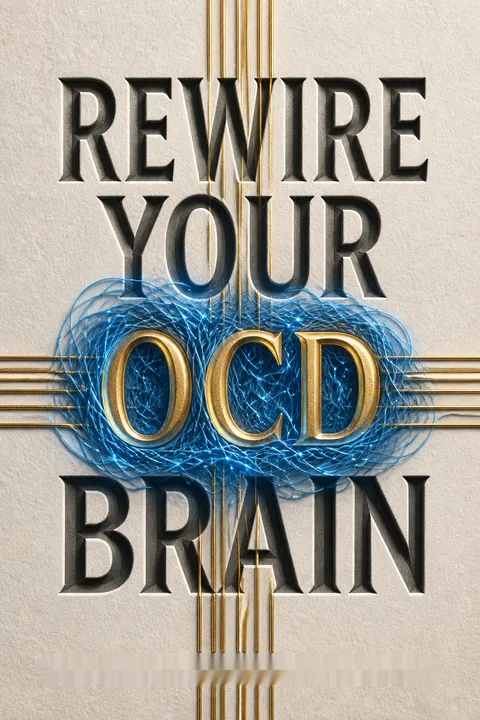


Key Takeaways
Treat OCD as a brain pattern, not evidence of personal failure
Blame less, learn more. OCD reflects interacting brain processes, inherited tendencies, and life experiences. It is not a sign of weak character or a choice. The brain’s capacity to change its connections and responses is called neuroplasticity. Repeated ways of thinking and acting can strengthen certain patterns, while new experiences and skills can help shape different ones. The authors describe this change as rewiring, not as replacing a faulty brain with a perfect one.
Responsibility without blame. OCD can involve intense focus, which may be useful in some situations but exhausting when doubt or detail-checking takes over. Understanding the pattern can shift the question from “What is wrong with me?” to “What response can I practice?” Knowledge is not a cure by itself, but it can help people seek treatment and practice skills with less shame.
What's valuable here is the distinction between responsibility and blame. Blame treats symptoms as a moral defect; responsibility asks what can be done with the situation that exists. That distinction resembles rehabilitation after injury: a person did not choose the injury, yet training may still restore some function. The brain-change framing can make practice feel possible rather than punitive. It should not suggest that effort alone resolves OCD, however. A biological account can reduce stigma, but it cannot explain every individual case or replace skilled care.
Read anxiety as an alarm, not proof that danger is present
Two routes to alarm. The book describes a fast amygdala pathway that reacts to rough sensory information and a slower cortex pathway that interprets it in more detail. The amygdala is involved in the body’s defense response, including a pounding heart, tense muscles, or nausea. Those sensations are real, but they can appear even when there is no immediate danger. A snake-like shape on a path might trigger a jump before the cortex identifies it as a harmless vine.
Check the signal. The cortex can also alarm the amygdala by imagining danger, such as turning an ordinary headache into a feared illness. Understanding the defense response can prevent bodily anxiety from being mistaken for proof that a feared thought is true. The authors do not suggest ignoring genuine hazards; the point is that anxiety alone cannot establish that one exists.
The alarm metaphor is useful because it separates the intensity of a reaction from the accuracy of its interpretation. This resembles a smoke detector that can sound in response to burnt toast: loudness is information about the detector, not conclusive evidence of a house fire. That perspective can reduce the temptation to treat every surge of anxiety as a command. The metaphor has limits: alarms sometimes detect real hazards, and bodily symptoms may warrant medical attention. The practical task is not automatic disbelief, but a more deliberate check of the evidence.
Let intrusive thoughts pass without turning them into verdicts
Thoughts are not intentions. The authors report that unwanted intrusive thoughts are common, with studies finding them in roughly 80% to 90% of people. What can turn one into an obsession is repeatedly attending to it and treating its presence as meaningful. Cognitive fusion is the tendency to believe a thought is an accurate account of reality. Thought-action fusion is the related belief that having a thought makes acting on it more likely or morally significant.
Distress is not proof. A person disturbed by an image of harming someone may conclude that the image reveals hidden intent. The book argues that the thought and the fear it provokes do not, by themselves, demonstrate such intent. Its practical invitation is to recognize the thought as mental activity rather than a verdict about character, desire, or what will happen.
This distinction can interrupt a common reasoning error: confusing mental availability with intention. People routinely imagine unlikely events without wanting them, and emotional distress can reflect how threatening the idea feels rather than a wish to enact it. That is a useful corrective to shame. Still, a thought should not be assessed in isolation when there is credible evidence of intent, planning, or immediate risk. The book’s point applies to intrusive thoughts as symptoms, not as a universal rule that thought content never matters.
Stop buying temporary relief with rituals that reinforce the fear
Relief can train repetition. A compulsion is a repeated behavior or mental act used to answer a feared situation or reduce distress. Checking, cleaning, counting, mentally reviewing, and asking for reassurance can all serve this function. Relief arrives quickly, which makes the action more likely to be repeated. But the feared trigger has not been experienced without the ritual, so the brain has little chance to learn that the ritual was unnecessary.
The loop tightens. Someone who checks a stove to settle doubt may feel calmer for a moment, then doubt returns and another check seems necessary. The ritual can become a second source of trouble, consuming time and strengthening the link between uncertainty and checking. The authors advise noticing not only visible rituals but also covert responses, such as repeatedly replaying a memory to obtain certainty.
This is a clear example of negative reinforcement: a behavior becomes more persistent because it removes an unpleasant feeling. The same mechanism operates in many forms of avoidance, from procrastination to reassurance-seeking. Short-term relief is not evidence that a strategy is working over the long term; it may be the very reward that keeps the cycle alive. Yet not every repeated action is a compulsion, and practical checks can be appropriate. The distinction depends on function, rigidity, distress, and interference, not merely on how often an action occurs.
Face targeted triggers without rituals so the brain can learn safety
Experience teaches the alarm. Exposure and response prevention, or ERP, is a cognitive behavioral treatment that brings a person into contact with a feared trigger while preventing the usual compulsion. A trigger is a cue, situation, object, thought, or sensation that activates anxiety. An exposure hierarchy is a planned sequence of situations, ranked by how distressing they are, so practice can begin at a manageable level. The book identifies ERP as a well-supported treatment for OCD and recommends working with a clinician trained in it.
Aim at a real goal. Monica’s anxiety about disorder was linked to childhood experiences of mess and parental conflict. In therapy, she practiced leaving some household tasks undone while focusing on caring for her children. She did not use cleaning to immediately erase the distress. Exposure can be gradual, and its purpose is not to prove that every feared possibility is impossible, but to practice facing uncertainty without rituals.
ERP turns an abstract neuroscience explanation into a behavioral experiment: encounter the cue, refrain from the ritual, and observe what happens. The crucial learning may be that distress is tolerable, even if anxiety does not fall quickly during a session. That broader aim matters because improvement need not depend on waiting for a perfect feeling of calm. Exposure should be planned around meaningful goals and appropriate safety, ideally with a qualified OCD clinician, especially when symptoms are severe or the trigger is complex.
Replace obsessive attention; do not wage war on thoughts
Attention needs somewhere to go. Trying to force a thought out of mind often keeps attention fixed on it. The authors recommend replacing obsessive focus with another activity or thought, rather than arguing with the obsession or repeatedly checking whether it has disappeared. For example, someone troubled by a perfectionistic thought while gardening might redirect attention to the next practical task, such as putting tools away or planning dinner.
Train a different response. Cognitive restructuring means identifying and revising interpretations that intensify anxiety. Mindfulness means observing present experience with attention and without immediately judging or trying to change it. Both can help a person notice a thought as a thought, then choose where to place attention. The mind will wander; the practice is to return attention without treating each distraction as failure.
The distinction between suppression and redirection is important. Trying not to think about something can keep its representation active, while deliberately attending to another task gives attention a competing destination. Mindfulness adds a different skill: noticing the thought without automatically following its storyline. These methods are not identical, and neither guarantees that an intrusive thought will stop appearing. Their more realistic promise is changing how much authority and time the thought receives. For some people, focused attention on internal sensations can itself be uncomfortable, so practice can be adapted.
Calm the body with practiced breathing, relaxation, and acceptance
Regulate without demanding control. Slow, deep breathing can support the body’s calming response. The authors describe practicing about five to six breaths per minute for five to ten minutes. Progressive muscle relaxation, a technique of briefly tensing and then releasing muscle groups, offers another route. Guided imagery or meditation may suit people who find those approaches useful. If attention to breathing makes anxiety worse, a muscle-focused technique may be a better fit.
Let discomfort be present. These practices can reduce arousal, but they cannot guarantee that anxiety disappears on command. The authors also encourage accepting sensations such as trembling or a pounding heart instead of treating them as proof of danger. Relaxation is a support for functioning, not a required ritual that must be completed before someone can face an important situation.
A body-based strategy can be powerful because anxiety is not only a set of beliefs; it is also a physical state that can narrow attention and make flexible thinking harder. Slow breathing and muscle release give people something concrete to practice when analysis is going nowhere. Acceptance prevents the technique from becoming another test of perfect control. That qualification matters: if a person repeatedly breathes until anxiety feels exactly right before acting, relaxation may start serving the same avoidance function as a compulsion.
Exercise regularly and protect sleep to steady the threat system
Use movement as support. The book links aerobic exercise with lower anxiety, reporting that even around twenty minutes may help in the short term. It recommends regular activity, such as brisk walking, cycling, or swimming, rather than relying only on exercise during a crisis. The proposed explanation is that movement uses energy mobilized by the defense response and is associated with changes in brain systems involved in mood and threat.
Make room for sleep. The authors emphasize that too little or disrupted sleep can leave the amygdala more reactive. They recommend protecting a consistent, sufficiently long sleep period, with seven to nine hours described as a typical range that allows more REM sleep. A calming routine and less worry-focused activity near bedtime may help. Persistent sleep problems can have medical causes and may need professional evaluation.
Exercise and sleep belong in a serious account of mental health because they influence how much physiological strain a person brings into daily challenges. They can widen the margin for coping, much as adequate recovery improves performance in other demanding activities. They are not substitutes for OCD treatment, and access is unequal: disability, caregiving, shift work, pain, or unsafe surroundings can make these recommendations difficult. Presenting them as supportive options rather than moral obligations keeps a useful biological insight from becoming another source of self-criticism.
Question certainty, perfection, and catastrophe before they fuel obsession
Spot the belief beneath the fear. The book identifies several thinking patterns that can intensify anxiety and make intrusive thoughts harder to dismiss: perfectionism, catastrophizing, overestimating the likelihood of danger, intolerance of doubt, and exaggerated guilt or responsibility. These beliefs can make a small mistake seem disastrous or an unlikely threat seem urgent. Cognitive restructuring asks whether the interpretation is supported by evidence and whether a less alarming explanation also fits.
Separate planning from looping. Joan hears that an unexpected work meeting is scheduled and assumes she may be fired. The meeting itself does not establish that conclusion; her interpretation increases her anxiety. Useful problem-solving identifies a concrete action and then moves forward. Repeatedly turning over the same unanswered “what if” question without new information is more likely to sustain worry than resolve it.
This section offers a practical bridge between cognitive therapy and uncertainty tolerance. The aim is not to replace every negative thought with an optimistic one, but to distinguish evidence from prediction and to stop treating possibility as probability. That distinction is especially helpful when an anxious mind demands certainty before action. At the same time, some concerns really do call for planning or changed behavior. A balanced approach asks whether there is actionable evidence, rather than assuming that every worry is either irrational or a warning that must be obeyed.
Choose life goals over the impossible goal of zero anxiety
Measure progress by participation. The authors argue against making total freedom from anxiety the goal. Instead, identify what OCD is preventing: completing work, attending a family event, sleeping rather than cleaning, or taking part in something meaningful. A clear goal can supply motivation to tolerate distress without giving a ritual control of the decision. Setbacks are part of the process, not proof that change is impossible.
Use support wisely. The book encourages readers to seek a therapist experienced in OCD, particularly with ERP and cognitive behavioral approaches. A clinician can help choose appropriate exposures and adjust the work to the person’s circumstances. Reading and practicing skills can support treatment, but they do not replace professional assessment when symptoms are intense, daily life is restricted, or other health concerns are present. The central measure is whether a person is reclaiming valued activities, not whether every intrusive thought has vanished.
A function-based goal is more durable than a symptom-free standard because it allows progress to count even when discomfort remains. This aligns with values-based approaches to behavior: action can be guided by what matters, not only by what feels pleasant in the moment. It also avoids turning recovery into another perfectionistic project. The emphasis on professional support is important because exposure is challenging and must be individualized. Self-help can provide language and direction, while clinical care can address severity, safety, co-occurring problems, and barriers that a general book cannot assess.
Analysis
The book’s most useful contribution is not simply its description of brain regions, but the practical division of labor it gives the reader: the cortex generates interpretations and mental scenarios, while the amygdala contributes to the bodily alarm. That map helps explain why a thought can feel urgent without being a reliable report about reality. It also connects three levels that are often discussed separately: attention, bodily arousal, and learned behavior. A distressing thought attracts attention, anxiety lends it credibility, and a ritual provides relief that rewards repetition.
The model is deliberately simplified. Contemporary neuroscience describes anxiety and OCD through distributed, interacting networks rather than a clean contest between two brain parts. The book’s fast and slow pathways are useful teaching devices, not a full account of perception or conscious emotion. Likewise, not every OCD trigger can be traced to a clear conditioning event, and an individual does not need to recover such an origin for treatment to help.
The strongest clinical thread is ERP. It addresses the loop through experience rather than reassurance: encounter a relevant trigger, refrain from the ritual, and learn that uncertainty and distress can be tolerated. Its value is broader than waiting for anxiety to decline within a single session. Learning may include discovering that a feared outcome does not occur, or that discomfort can be carried without ritualized control. Cognitive restructuring and mindfulness offer complementary ways to alter how thoughts are interpreted and attended to.
Exercise, sleep, breathing, and relaxation are sensible supports, but they should not be confused with stand-alone cures. Their usefulness depends on circumstance, and attempts to use them as compulsory prerequisites for action can reproduce the same control cycle. The book is most persuasive when its neuroscience reduces shame and points toward concrete, professionally supported practice, rather than implying that a simplified brain diagram explains every person’s OCD.
Review Summary
Rewire your OCD brain receives mostly positive reviews, with readers praising its scientific approach to understanding OCD and anxiety. Many find the explanations of brain function and neuroscience helpful in managing symptoms. The book offers practical strategies and coping mechanisms, emphasizing mindfulness and exposure therapy. Some readers note the content can be repetitive or dense at times. Overall, it's recommended for those seeking a deeper understanding of OCD, though perhaps not as a first resource for newcomers to the topic.
People Also Read







Glossary
Neuroplasticity
The brain’s capacity to changeNeuroplasticity is the brain’s ability to alter its connections and patterns of response through experience, learning, and practice. In the book, it explains why OCD-related patterns are not necessarily fixed: repeated thoughts and behaviors can strengthen certain circuits, while new experiences and skills can support different responses.
Amygdala pathway
A fast threat routeThe amygdala pathway is the book’s name for a rapid route by which sensory information reaches the amygdala before detailed cortical processing is complete. This speed can support quick protective reactions, but the information may be incomplete, so the alarm can respond to harmless cues as if they signal danger.
Cortex pathway
A slower interpretive routeThe cortex pathway describes sensory information traveling from the thalamus to the cortex for more detailed processing before influencing the amygdala. The cortex can identify details that a rapid alarm may miss, but it can also interpret ordinary sensations or imagined events as threatening and thereby contribute to anxiety.
Defense response
The body’s threat reactionThe defense response is the set of physical changes that the book associates with amygdala activation. These changes prepare the body to fight, flee, or freeze and can include faster heart rate, muscle tension, and digestive changes. The response is real, but its presence does not prove that a danger exists.
Cognitive fusion
Treating thoughts as factsCognitive fusion is the tendency to treat a thought, image, or urge as though it accurately reflects reality. In OCD, someone may interpret an unwanted thought as evidence that a feared event is likely or that the thought reveals something important about their character. The book encourages recognizing mental events without automatically accepting their apparent meaning.
Thought-action fusion
Equating thought with actionThought-action fusion is the belief that having a particular thought, image, or urge makes a matching action more likely, or makes the thought morally equivalent to acting. It can make ordinary intrusive thoughts feel threatening. The book distinguishes the occurrence of a thought from a person’s intentions and behavior.
Trigger
A cue linked with alarmA trigger is an object, situation, sensation, thought, sound, or other cue that activates anxiety because it has become associated with threat. The cue itself may be harmless. The book explains that triggers can develop through prior experiences and can be addressed through new experiences in which the cue is encountered without the expected danger or ritual.
Exposure and response prevention (ERP)
Face cues, resist ritualsERP is a cognitive behavioral treatment for OCD. Exposure means deliberately encountering a relevant trigger; response prevention means refraining from the compulsions or avoidance normally used to reduce distress. Practiced in a planned and appropriate way, ERP gives the person an opportunity to learn that anxiety can be tolerated without ritualized behavior. The book recommends working with a clinician trained in the method.
Exposure hierarchy
A graded exposure planAn exposure hierarchy is an ordered list of trigger-related situations ranked by how distressing they are expected to be. It helps a person and therapist plan exposure practice, often beginning with a manageable situation and moving toward more difficult ones. The hierarchy is tailored to the person’s goals and is not a universal sequence.
Cognitive restructuring
Revising unhelpful interpretationsCognitive restructuring is a method for identifying thoughts or beliefs that intensify distress, examining the evidence for them, and developing a more balanced interpretation. In the book, it is used to address patterns such as catastrophizing, perfectionism, and assumptions about what other people think. It changes how situations are interpreted, not the objective facts of a situation.
Mindfulness
Present-focused, nonjudgmental attentionMindfulness is the practice of attending to present experience, including sensations, emotions, and thoughts, with curiosity rather than immediate judgment or attempts to control. In the book, it helps people notice thoughts as mental events, return attention when it wanders, and tolerate anxiety without becoming absorbed in obsessive analysis.
FAQ
What's "Rewire Your OCD Brain" about?
- Overview: "Rewire Your OCD Brain" by Catherine M. Pittman and William H. Youngs is a guide to understanding and managing obsessive-compulsive disorder (OCD) using neuroscience-based strategies.
- Focus: The book explains the neurophysiology of anxiety and OCD, offering practical skills to help individuals break free from obsessive thoughts and fears.
- Approach: It provides user-friendly explanations and treatment options that can be developed with or without a clinician, making it accessible to both therapists and individuals struggling with OCD.
Why should I read "Rewire Your OCD Brain"?
- Understanding OCD: The book demystifies OCD, helping readers understand what is happening in their brains and how to regain control from obsessive thoughts.
- Practical Skills: It offers actionable strategies based on neuroscience to manage and reduce OCD symptoms effectively.
- Empowerment: Readers are encouraged to shift from feelings of shame and blame to self-compassion and empowerment, gaining freedom from OCD's control.
What are the key takeaways of "Rewire Your OCD Brain"?
- Neuroscience Insights: Understanding the roles of the amygdala and cortex in OCD can help manage symptoms.
- Skill Development: The book emphasizes the importance of skill-building to rewire the brain and reduce OCD symptoms.
- Self-Compassion: It encourages a shift from self-blame to self-compassion, empowering individuals to take control of their lives.
How does "Rewire Your OCD Brain" explain the role of the amygdala in OCD?
- Amygdala's Role: The amygdala acts as an early warning system, often overreacting to perceived threats and triggering anxiety.
- Defense Response: It initiates the fight, flight, or freeze response, leading to physical and emotional symptoms of anxiety.
- Learning and Triggers: The amygdala learns through association, creating triggers based on past negative experiences, which can be retrained through exposure.
What strategies does "Rewire Your OCD Brain" suggest for calming the amygdala?
- Relaxation Techniques: The book recommends deep breathing, muscle relaxation, and imagery-based relaxation to activate the parasympathetic nervous system and calm the amygdala.
- Exercise and Sleep: Regular aerobic exercise and sufficient REM sleep are crucial for maintaining a calm amygdala.
- Mindfulness and Meditation: These practices help reduce amygdala activation and promote a state of calmness.
How does "Rewire Your OCD Brain" propose managing obsessive thinking?
- Defusing Obsessions: The book advises against treating thoughts as dangerous and encourages defusing them by recognizing them as mere thoughts.
- Replacing Thoughts: Instead of trying to suppress obsessions, it suggests replacing them with other thoughts to weaken their circuitry.
- Mindfulness: Practicing mindfulness helps in observing thoughts without judgment and reducing their impact.
What is the significance of cognitive restructuring in "Rewire Your OCD Brain"?
- Changing Thoughts: Cognitive restructuring involves identifying and changing self-defeating beliefs that activate the amygdala and increase anxiety.
- Interpretation Matters: The book emphasizes changing interpretations of situations to prevent unnecessary amygdala activation.
- Coping Thoughts: Replacing self-defeating thoughts with coping thoughts can reduce anxiety and help manage OCD symptoms.
How does "Rewire Your OCD Brain" address the concept of neuroplasticity?
- Brain's Flexibility: The book highlights the brain's ability to change its structures and responses through neuroplasticity.
- Rewiring the Brain: By understanding and applying specific strategies, individuals can rewire their brains to reduce OCD symptoms.
- Lasting Changes: The focus is on making lasting changes in brain circuitry to resist anxiety and compulsions.
What are the best quotes from "Rewire Your OCD Brain" and what do they mean?
- "The amygdala is not logical": This quote emphasizes that the amygdala's responses are based on past experiences and not always accurate, highlighting the need for retraining.
- "Neurons that fire together wire together": This underscores the importance of changing thought patterns to rewire the brain and reduce OCD symptoms.
- "Courage is not the absence of anxiety": This quote encourages readers to push through anxiety to regain control over their lives.
How does "Rewire Your OCD Brain" suggest using exposure with response prevention (ERP)?
- ERP Explained: ERP involves exposing oneself to triggers without engaging in compulsions, allowing the amygdala to learn that the trigger is not dangerous.
- Gradual Exposure: The book recommends a gradual approach to exposure, starting with less anxiety-provoking situations.
- Therapist Guidance: Working with a therapist can enhance the effectiveness of ERP by providing support and ensuring proper exposure.
What role does mindfulness play in "Rewire Your OCD Brain"?
- Focus and Observation: Mindfulness helps individuals focus on the present moment and observe their thoughts without judgment.
- Reducing Anxiety: It reduces amygdala activation and helps manage anxiety by promoting acceptance and non-reactivity.
- Strengthening Focus: Mindfulness strengthens the ability to focus attention, aiding in managing obsessions and reducing their impact.
How does "Rewire Your OCD Brain" empower individuals with OCD?
- Self-Compassion: The book encourages shifting from self-blame to self-compassion, empowering individuals to take control of their lives.
- Knowledge and Skills: By understanding the brain's role in OCD and learning practical skills, readers gain the tools to manage their symptoms.
- Freedom from OCD: The ultimate goal is to help individuals find freedom from the control of OCD and live more fulfilling lives.
About the Author
Other books by Catherine M. Pittman

Download PDF
Download EPUB
.epub digital book format is ideal for reading ebooks on phones, tablets, and e-readers.








