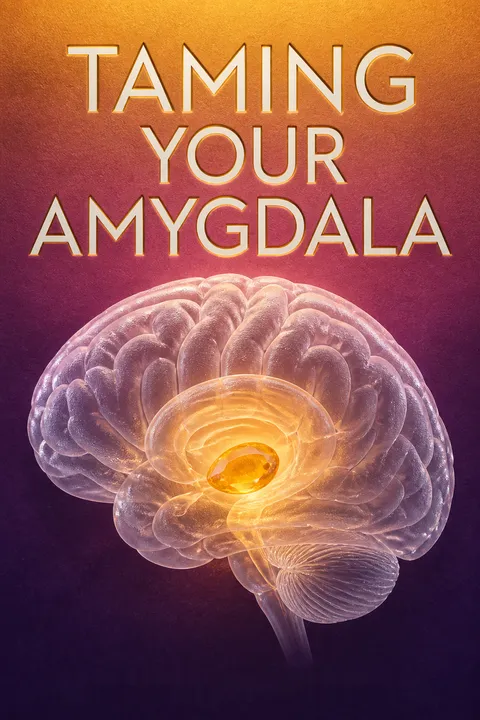


Key Takeaways
Tame your amygdala by calming its baseline and retraining its triggers
An alarm, not a ruler. The amygdala helps detect danger and prepare the body to respond. Its alarm can be useful when a car swerves into your lane, yet it can also react to a work presentation as if it were a physical threat. The bodily fear is real, even when the danger estimate is mistaken. Anxiety is not a character flaw, and eliminating all fear is neither possible nor desirable. The practical goal is to stop anxiety from deciding which parts of life are off limits.
Two routes to change. Pittman’s central approach is to calm the brain’s general reactivity through daily habits and relaxation, then teach it that particular triggers can be safe through new experience. Progress is measured by whether a person can pursue meaningful goals, not by achieving a perfectly anxiety-free life.
The alarm metaphor helps separate a feeling from a fact: intense fear deserves attention, but it does not automatically prove danger. That distinction can reduce shame and create room for choice. It also makes the book’s goal more humane than a promise of total calm. A limitation is that the amygdala is not a single anxiety switch; emotions emerge from interacting brain systems, learning, and context. The model is most useful as an accessible guide to action, not as a complete map of every anxiety disorder.
Separate the brain's rapid alarm from its slower interpretation
Speed versus detail. Pittman describes two routes by which the brain can activate the defense response. The amygdala pathway carries rough sensory information quickly to the amygdala. The cortex pathway takes longer, but it can interpret context, recognize details, and connect a sensation to memory. In the book’s example, a student startles at a toy rat in a freezer, then realizes it is plastic and turns on the pranksters. His heart still pounds after his cortex identifies the harmless object.
Thoughts can sound alarms. The cortex can also activate the amygdala by imagining a threat, even without an immediate danger. A text message, for instance, may prompt someone to anticipate a breakup before reading its contents. Noticing whether anxiety began with a sensation or an interpretation can help identify what kind of response may help.
This distinction explains why reassurance based on logic may arrive too late to prevent a bodily surge. It also suggests a useful sequence: settle the immediate reaction, then examine what the situation means. The distinction is a teaching tool, not a clean division between a primitive emotional brain and a rational one. Rapid and reflective processes interact, and the cortex itself can misread events. Treating both sensations and interpretations as fallible gives the model more precision without dismissing how frightening the reaction feels.
Use your body to settle the alarm before demanding clear thinking
Panic speaks physically. The defense response can speed the heart, tense muscles, interrupt digestion, and narrow attention toward perceived danger. Those changes can make it harder to plan or concentrate. Pittman recommends responding through bodily signals rather than trying to talk the amygdala out of fear. Slow diaphragmatic breathing is one option: breathe gently and deeply, allowing the abdomen to expand, then exhale without holding the breath. Her paced-breathing exercise aims for about five or six breaths a minute.
Find a workable reset. Progressive muscle relaxation, which involves briefly tensing and then relaxing muscle groups, and vivid imagery of a calming place are alternatives. These techniques may be most useful before an anticipated stressor or during a pause. Breathing is not right for everyone, especially if attention to breath increases distress. The practical test is whether a technique helps a person feel more able to stay present.
The useful insight is that regulation need not begin with a persuasive argument. Slow breathing and muscle release make changes in bodily arousal more tangible, giving attention something concrete to do when concentration is strained. This resembles a broader principle in emotion regulation: people can sometimes shift an emotional state by changing posture, movement, or sensory focus. Still, calming exercises are tools, not proof that a situation is safe, and they do not resolve every source of anxiety. Flexibility matters more than loyalty to one technique.
Protect a full night of sleep to make the alarm less reactive
Sleep changes the threshold. The book links insufficient sleep with stronger amygdala reactions and weaker communication with brain regions involved in regulating emotion. It cites research in which two days limited to three hours of sleep were associated with higher reported anxiety and reduced amygdala to prefrontal connectivity. Sleep and anxiety can then reinforce each other: anxious arousal makes falling asleep harder, while poor sleep can make the next day feel more threatening.
Preserve the whole night. REM sleep periods grow longer toward morning, so cutting sleep short can remove some of the later sleep that the book identifies as important. Pittman recommends consistent bed and wake times, a dark and cool room, and keeping work out of bed. She also advises limiting late caffeine and evening screen light. These habits are practical targets, though sleep needs and disruptions vary among people.
Sleep is not merely recovery time added after the important work of the day. It is part of the conditions under which emotional regulation operates, which makes bedtime a relevant anxiety intervention rather than a luxury. The feedback loop described here also explains why a bad night can feel like evidence that the next day is unsafe. The book emphasizes eight hours and REM sleep, but sleep duration is not identical for everyone, and persistent insomnia may need specialized care. A steady, workable routine is a stronger target than guilt over an imperfect night.
Use movement and steady meals to make anxiety less combustible
Move with the alarm. The defense response prepares the body for exertion, so aerobic movement can use some of that activation. Pittman describes a client who felt anxious while driving and stopped to jog briefly, then returned to the car feeling calmer. For longer-term benefits, she suggests building toward about 30 minutes of aerobic activity three to five times a week, adapting activity to health and ability. Even a brisk walk can count.
Notice fuel and stimulants. Caffeine can increase arousal and interfere with sleep, so tracking its timing and amount may reveal a personal link to anxiety. Skipped meals or sharp blood-sugar changes can also produce symptoms such as shakiness, irritability, and a racing heart. Regular meals containing protein and fiber may help some people avoid those swings. These habits support steadier regulation; they are not substitutes for medical assessment when symptoms are concerning.
Movement is a particularly intuitive match for a body primed to run or fight, and regular activity may support mood as well as physical health. Food and caffeine tracking can also turn vague anxiety into a testable pattern: does the spike follow a late coffee, a missed meal, or neither? That stance encourages observation rather than rigid dietary rules. The book’s glucose discussion should not be taken as a diagnosis of hypoglycemia, which requires clinical evaluation. Individual responses vary, and exercise must fit a person’s health circumstances.
Choose fears by the life they block, not by how frightening they feel
Measure what matters. Anxiety changes across situations and days, so Pittman recommends recording symptoms, intensity, timing, and possible triggers for about a week. The point is not to monitor forever or turn feelings into a scorecard. A brief record can show patterns, such as stronger anxiety after poor sleep or around a particular task.
Let goals set priorities. List activities anxiety has interrupted, then rate each goal for personal importance and anticipated anxiety. One client recovering from near-drowning distinguished visiting a lake, which felt manageable, from swimming there, which remained highly frightening. Separating those goals revealed a first step she had not considered. Pittman suggests beginning with a small number of meaningful goals, rather than trying to defeat every fear. Success means recovering valued activities, not chasing the lowest possible anxiety score.
The book shifts the question from “How anxious am I?” to “What do I want anxiety to stop taking from me?” That makes measurement serve a value-based decision instead of becoming another demand for self-surveillance. Separating a broad fear into distinct goals also exposes smaller choices hidden inside avoidance. Someone may not be ready to swim, but could still visit the lake. A caution is that tracking can heighten attention to symptoms for some people. The suggested short trial, followed by a decision about its usefulness, respects that possibility.
Teach a trigger safety through repeated, direct, manageable exposure
Triggers are learned links. A trigger is an object, place, person, or situation the amygdala has associated with a negative experience. The association does not have to be logical, and a person may not consciously remember how it formed. A car passenger seat, for example, became frightening for one client after he was in an accident there, even though the seat itself did not cause the crash.
Build new experience. Exposure means deliberately encountering a trigger without the feared harm occurring, allowing the brain to form a different association. Pittman recommends breaking a goal into steps, rating distress from 0 to 100, and repeating each step. Avoidance can preserve fear by preventing new learning. The book emphasizes staying until distress falls substantially and warns that safety rituals can undermine learning. For significant trauma or severe anxiety, it recommends working with a therapist trained in exposure.
Exposure turns the idea of learning into something observable: a feared cue is present, the person remains in contact with it, and new information becomes possible. The method is not simply “face your fear” at maximum intensity. Gradual steps can preserve agency and make repetition feasible. One nuance is that a successful exposure need not always end with anxiety nearly gone; learning that uncertainty or distress can be tolerated may matter too. For trauma, compulsions, or real physical risk, professional guidance helps distinguish therapeutic practice from overwhelming or unsafe confrontation.
Question the interpretations that turn uncertainty into imminent danger
Thoughts are inputs. The amygdala can react to images and predictions generated in the cortex as if they signal danger. Common patterns include expecting the worst, assuming what others think, treating a setback as disaster, demanding perfection, and confusing a thought with a likely event. A person who finds a pet missing might jump from an empty yard to an imagined fatal accident, then discover the animal safely with neighbors.
Replace, then check. Cognitive restructuring means identifying an anxiety-provoking interpretation, examining the evidence, estimating what is actually likely, and considering how to cope if it happens. Pittman advises replacing an unhelpful thought with a more useful focus rather than simply trying to suppress it. This does not require pretending everything will turn out well. It means treating a prediction as a hypothesis, not as a report from the future.
This approach combines cognitive skepticism with practical compassion. The aim is not to shame a person for having a frightening thought, but to stop giving every mental image the authority of a forecast. Testing evidence and naming a coping response can return attention to what is known and controllable. There is an important boundary: some worries reflect real danger or structural hardship, not distorted thinking. In those cases, realistic problem-solving and external support matter more than reframing. The method works best when it improves accuracy, not when it pressures people to sound positive.
Make worry earn its keep by turning each concern into a plan
Worry can prompt preparation. Humans can imagine future problems, which can help with planning. In Pittman’s prehistoric example, anticipating a stream flooding gives a woman reason to move her family’s hut. The useful result is the plan, not the hours spent rehearsing disaster. Once a response exists, repeated worry can keep the body activated without adding protection.
Decide, then disengage. Specify the concern, choose a practical action, and return to the day. If the outcome cannot be controlled, make a coping plan for what to do if it occurs. A host worried that a guest may become disruptive can agree in advance with a partner on how they will respond. For persistent worry, Pittman suggests scheduling a brief daytime worry period and postponing other worries until then. A plan need not guarantee certainty; it needs to be workable.
The distinction between anticipation and problem-solving is a powerful test of whether thinking is still useful. A plan converts mental rehearsal into preparation; returning to the same scenario without new information mainly renews distress. Scheduling worry can also make attention feel more steerable, rather than treating every intrusive concern as an emergency. Yet not all uncertainty yields to planning, and the demand to produce a solution can become another loop. For uncontrollable outcomes, the relevant plan is about coping, seeking help, or accepting limits, not manufacturing certainty.
Analysis
The book’s strongest contribution is its translation of anxiety into a sequence that feels less mysterious: a cue or thought is interpreted as threat, bodily defenses activate, and avoidance can prevent corrective learning. That account gives readers several entry points. They can change the conditions around the reaction, regulate bodily arousal, examine an interpretation, or practice encountering a trigger. The goal-setting exercises keep those tools attached to ordinary life, where the stakes are not abstract calm but driving, working, relationships, and recreation.
The amygdala is a useful organizing image, but the book sometimes treats it as though one structure were the central author of fear. Contemporary neuroscience is more distributed: perception, memory, autonomic response, attention, and conscious feeling involve interacting systems, and the same bodily sensations can have different meanings across contexts. This does not invalidate the book’s approach. It suggests reading its neuroscience as a practical model rather than a literal wiring diagram. The body can be genuinely alarmed without providing a reliable verdict about what is happening.
The exposure guidance is especially actionable because it insists on repetition, clear steps, and linking practice to a personally meaningful goal. Its emphasis on waiting for distress to fall is a familiar and often useful way to teach persistence. A broader learning perspective also asks what the person discovers, including whether the feared outcome occurs and whether distress can be carried without escape. Anxiety reduction is one possible sign of learning, not the only one.
The lifestyle recommendations widen the frame beyond willpower. Sleep, movement, caffeine, and regular eating can affect the conditions in which anxiety unfolds. Their effects are individual, and none should be treated as a cure-all or a substitute for clinical care. Taken together, the book is best understood as a self-management guide: understand the alarm, stop granting it automatic authority, and reclaim actions that matter, while seeking professional support when symptoms are severe, persistent, or trauma-related.
People Also Read






Glossary
defense response
body's protective activationThe coordinated bodily and emotional response the book associates with perceived danger. It can include changes such as faster heartbeat, tense muscles, and heightened attention, alongside fear or anxiety. Pittman describes it as preparing a person to fight, flee, or freeze, even when the perceived threat is not an immediate physical danger.
amygdala pathway to anxiety
rapid sensory alarm routeThe fast route described in the book, in which sensory information reaches the thalamus and then the amygdala before detailed cortical processing is complete. This pathway can initiate a defensive reaction quickly, but it operates on relatively rough information and may react before a person consciously understands what is happening.
cortex pathway to anxiety
interpreted thought alarm routeThe route in which sensory information is processed and interpreted by the cortex, then influences the amygdala. The cortex can add context, memories, and predictions, so it can correct a quick misreading or activate anxiety through an imagined threat. The resulting defensive response still depends on the amygdala.
exposure
practice with a feared triggerA planned practice of encountering a feared object, situation, thought, or image without the expected harm occurring. Repeated exposure gives the person and their amygdala new experience to learn from. The book recommends direct, manageable practice, and professional guidance when the trigger or anxiety is especially difficult.
exposure hierarchy
ranked exposure stepsAn ordered list of situations related to a trigger, arranged from less distressing to more distressing. Each step is rated according to the individual's anticipated discomfort, then used to plan gradual exposure. The hierarchy breaks a broad goal into specific practices, such as approaching an animal at increasing distances.
subjective units of distress (SUDs)
personal distress ratingA rating used to describe how much distress a person experiences in a particular situation. In the book's exposure exercises, the scale runs from 0, meaning no distress, to 100, meaning the worst imaginable distress. The score is personal, helping a person plan steps and observe how distress changes during practice.
cognitive restructuring
revise unhelpful interpretationsA method for examining thoughts that may be intensifying anxiety. A person identifies the prediction, checks what evidence supports it, estimates its likelihood, and considers how to respond if it occurs. The aim is not forced optimism, but a more balanced interpretation and a useful coping thought.
cognitive fusion
mistaking thoughts for factsA pattern in which a person treats a thought, worry, or mental image as though it were evidence that an event is true or likely to happen. The book links this tendency to anxiety because the amygdala may react to the thought as a danger signal. Labeling a thought as a thought can create distance from it.
exposure with response prevention
exposure without safety ritualA form of exposure in which a person encounters a feared trigger while refraining from a ritual or habitual action used to feel safe. The book explains that relying on the ritual may preserve the belief that the trigger is dangerous. This technique is often used for obsessive-compulsive difficulties and may require therapist guidance.
Download PDF
Download EPUB
.epub digital book format is ideal for reading ebooks on phones, tablets, and e-readers.








