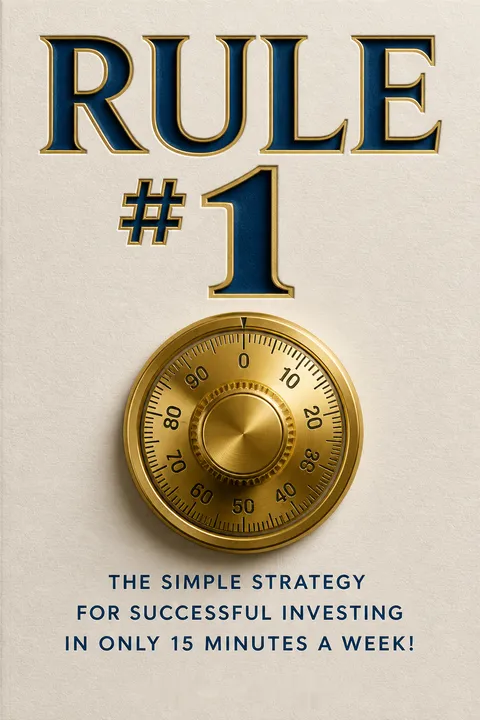


Key Takeaways
Buy a durable business only when its price leaves room for being wrong.
A rough start. Phil Town’s investing story begins far from Wall Street. A former river guide, he nearly steered a raft into a dangerous rapid. One passenger, a self-made millionaire, later taught him to invest. Town says he borrowed $1,000 and became a millionaire five years later. The anecdote explains the book’s central idea, Rule #1: reduce the chance of losing money by buying a business that is both strong and available at a substantial discount to its estimated value.
Discipline over certainty. In practice, the method asks investors to understand a business, assess its durability and leadership, estimate its value, and wait for a lower price. Town presents this as low-risk investing, not speculation. But no stock purchase is risk-free, and an attractive price cannot guarantee a profit. The useful lesson is more modest: a good business can still be a bad purchase if the price is too high.
The raft story gives the method a memorable origin, but the investment lesson does not depend on treating one person’s success story as proof. Its strongest idea resembles a safety margin in engineering: a design should tolerate some error rather than work only if every assumption is perfect. That is a valuable standard for financial decisions, where estimates are uncertain and losses can compound. The important distinction is between reducing risk and removing it. A discount may cushion a mistaken estimate, but it cannot protect against every business failure, market shock, or need to sell at a bad time.
Own businesses you understand, not tickers you hope will rise.
Start with familiarity. Town’s Three Circles exercise helps identify industries an investor may understand. List what brings passion, what skills or experience are already present, and where money is earned or spent. Overlapping interests can suggest businesses to research. A former river guide, for instance, might investigate travel or recreation companies because the industry connects with lived experience. The 10-10 Rule adds a discipline: consider buying only a business one would be willing to own for ten years, even if the actual holding period is shorter.
A costly exception. Town describes losing $5 million after investing in NeXT-related businesses, despite hearing enthusiastic endorsements from programmers. He lacked a reliable record of performance and did not understand the technology well enough. His conclusion is to treat unfamiliarity as a reason to stop, not as a gap that confidence can fill.
Familiarity can make research more meaningful: a customer may notice service quality, pricing, or changing preferences that are invisible in a spreadsheet. But knowing a product is not the same as understanding its economics. A loyal user may mistake affection for evidence of a durable advantage. The strongest version of Town’s exercise is therefore not “invest in what feels familiar,” but “use familiarity to generate questions, then test the business.” The NeXT loss illustrates why expertise borrowed from enthusiastic insiders should not substitute for a business model that can be independently assessed.
Demand a moat, then make financial history verify the story.
Test the advantage. A Moat is a durable advantage that makes it hard for competitors to take customers or profits. Town identifies five possible sources: strong brands, protected secrets or patents, control of a valuable channel, high switching costs, and the ability to compete through lower prices. A beloved product alone is not enough; the advantage must be defensible and useful over time.
Check the numbers. Town’s Big Five are return on invested capital, sales growth, earnings-per-share growth, equity or book-value growth, and free-cash-flow growth. He looks for each to average at least 10% over ten years, then checks shorter periods for signs of slowing. In his examples, Dell’s strong historical figures contrasted with Gateway’s weak ones. These measures are evidence to investigate, not proof that a company will keep succeeding.
Pairing a business story with several financial measures is a useful defense against persuasive branding and management hype. It resembles triangulation: confidence improves when different indicators point in the same direction. Yet historical ratios can reflect accounting choices, acquisitions, or a favorable phase of an industry, and a past record cannot establish that an advantage will endure. The thresholds are best treated as screening rules rather than universal laws. A business with lower growth may still be sound, while impressive growth can conceal fragility. The key question is whether the numbers and the competitive explanation fit together.
Judge executives by aligned incentives and candid reporting, not polished mission statements.
Look for stewardship. Town wants leaders who behave like long-term owners: their interests should broadly align with shareholders, and their communications should make setbacks understandable rather than bury them in optimistic language. He recommends reading annual reports, checking compensation, and examining whether senior executives own meaningful shares. A CEO who explains problems and how the company is responding gives investors more to assess than one who offers only slogans.
Read actions carefully. Town contrasts candid reporting by Whole Foods’ John Mackey with executives whose letters obscured poor results. He also points to Enron leaders who sold shares while employees were being encouraged to hold or buy. Insider sales can be a warning, but Town acknowledges they may have other explanations. Compensation and trading activity are clues to investigate, not definitive verdicts on a leader’s character.
This section tackles a classic agency problem: executives control decisions that affect owners, but their incentives may not match owners’ interests. Candor matters because investors cannot evaluate what they cannot see. Clear reporting also makes accountability possible, a principle shared by good governance and public institutions. Still, executive ownership is not an automatic guarantee of alignment, and stock sales can reflect taxes, diversification, or planned expenses. A sound assessment combines incentives with behavior and results. The telling question is not whether a leader sounds humble, but whether the company’s choices and disclosures support that impression.
Calculate a cautious value, then insist on a half-price entry.
Work backward from the future. Town’s Sticker Price is his estimate of a business’s value today. He projects current earnings per share ten years forward using a conservative growth estimate, multiplies the result by an estimated future price-to-earnings ratio, then discounts that future share price to meet a 15% annual return target. For the future growth estimate, he compares historical performance with analysts’ forecasts and generally selects the lower figure. For the future price-to-earnings ratio, he uses the lower of the company’s historical average and twice the estimated growth rate.
Build in a buffer. With his assumptions, a future price is roughly four times today’s Sticker Price. Town then sets the desired purchase price at half the Sticker Price, creating a Margin of Safety. The Rule of 72 offers a quick approximation for doubling times, but calculators provide more accurate projections.
The calculation is useful less as a machine for discovering the one true value than as a way to expose assumptions. A small change in expected growth or the future price-to-earnings ratio can substantially change the result, especially across a decade. Choosing conservative inputs and demanding a discount can counter overconfidence, but conservative inputs are not automatically correct. The 15% target and half-price threshold are Town’s rules, not guarantees of safety or suitable returns for every investor. A valuation is most informative when it is tested across several plausible scenarios, not treated as a precise forecast.
Avoid deep losses because recovery math punishes every broken compounding chain.
Losses take asymmetric work to repair. A 50% drop requires a 100% gain just to return to the starting point. An 80% drop requires a 400% gain. Town uses this arithmetic to explain why protecting capital matters to his compounding strategy. He tells of investors who lost substantial savings by holding declining shares or following advice to buy more as prices fell. The lesson is not that every decline means a business is failing; it is that a large loss can leave an investor needing a recovery that may never arrive.
Preserve the ability to continue. Town rejects the comforting idea that a loss is irrelevant until shares are sold. He argues that a lower market price affects current wealth even when an investor still owns the shares. His framework responds with business research, a purchase discount, and rules for reassessing a position.
The arithmetic is exact, and it makes the cost of a severe drawdown intuitive. It also helps explain why avoiding catastrophic impairment matters more than chasing a headline return. But price declines can reflect either deteriorating fundamentals or temporary pessimism, and treating every decline as a reason to exit can lock in losses or disrupt a sound plan. The analytical task is to distinguish a change in business value from a change in market mood. Risk controls work best when they are set before stress arrives, rather than improvised in response to fear.
Let fundamentals choose the business, and price signals govern when to act.
Watch the market’s momentum. Town’s Three Tools are the MACD, the Stochastic indicator, and a moving average. He interprets them as signs of buying or selling pressure and recommends entering when all three signal a buy, then leaving when all three signal a sell. In his view, large institutional investors move more slowly than small investors, and the indicators can help reveal the direction of their trading. He applies the tools only after a company has passed his business and valuation tests.
Use an exit checklist. Town says to sell when the business no longer meets his standards or when the market price rises above the Sticker Price. The indicators add a timing rule to that valuation-based approach. He also recommends paper trading first, so investors can practice reading signals before putting money at risk.
The separation between choosing a business and timing a trade is a thoughtful attempt to keep short-term market movement from replacing fundamental analysis. However, technical indicators summarize past prices; they do not reliably reveal why investors are trading or predict what happens next. Signals can lag, conflict, or reverse quickly, and frequent trading can add costs and tax consequences. Their best role is therefore limited: a structured prompt to review a position, not evidence that a loss has become impossible. The business case and the timing signal should remain distinct judgments.
Concentrate only after proving your process, and cap speculative bets at 10%.
Know what concentration costs. Town argues for holding a small number of businesses that an investor understands, rather than spreading money across dozens of unfamiliar companies or a broad fund. He suggests roughly one business for portfolios up to $10,000, two for portfolios up to $20,000, and no more than about five for many individual investors. His Risky Biz portfolio is reserved for less predictable companies, such as young technology firms. He says to consider it only after building a larger portfolio and to limit it to 10% of total holdings.
Treat the limit seriously. Town’s point is that attention is finite: a short list can be researched and monitored more carefully. But concentration also means a single mistaken judgment can damage a large share of savings. A limited speculative allocation does not turn a speculative investment into a safe one.
A focused portfolio can make careful research feasible, especially for an investor with limited time. The trade-off is that fewer holdings leave more exposure to company-specific failure. Understanding a business may reduce informational risk, but it cannot eliminate disruption, fraud, or an industry-wide shock. Town’s 10% cap acknowledges that distinction, although the appropriate limit depends on an investor’s circumstances and ability to absorb losses. Concentration is a deliberate risk choice, not a free reward for confidence. The method is most persuasive when its advocates are explicit about that cost.
Rehearse with paper trades, eliminate high-interest debt, and scale in stages.
Practice before risking savings. Paper trading means recording imaginary purchases and sales at real market prices to rehearse research, entries, exits, and record keeping. Town recommends starting with no real money, then moving gradually to a first $1,000 investment and adding funds as confidence grows. He also urges investors to pay off expensive consumer debt: earning a hoped-for 15% while paying 18% interest leaves the household behind before taxes or mistakes are considered.
Make the system manageable. Town recommends keeping a watch list of businesses that meet his criteria, using tax-advantaged accounts where appropriate, and limiting time spent checking prices. Thoroughly researching a company can take several hours, even if routine monitoring is brief. Paper practice may make the mechanics familiar, but the book’s claims of high returns should not be mistaken for a reliable outcome.
The gradual approach is valuable because it makes learning and decision review concrete. A trading journal can reveal whether an investor follows a plan or changes rules whenever prices become uncomfortable. Paying down high-interest debt also offers a certain reduction in interest costs, unlike an uncertain investment return. Still, simulated trades cannot fully reproduce the emotional pressure of seeing real savings fall, and their results depend on assumptions about execution costs and taxes. Practice is preparation, not proof of skill. Any real-world transition should be cautious and consistent with the investor’s financial needs.
Analysis
Rule #1 is a practical investing manual built around a tension: investors should think like long-term business owners, yet use market signals to move in and out of shares. Its strongest contribution is a sequence of questions that slows impulsive buying. Does the investor understand the business? Does it have a defensible advantage? Do financial records support that case? Are managers credible? Is the price low enough to allow for error? The sequence turns investing from a search for exciting stocks into a process of rejecting weak or poorly priced opportunities.
The book is also unusually confident about what that process can deliver. Its proposed 15% annual return, description of investing as nearly risk-free, and claim that the approach takes little weekly time are not established by the personal anecdotes and selected historical examples it presents. The valuation model depends on forecasts of earnings growth and future valuation multiples, neither of which can be known with certainty. A 50% discount may help absorb errors, but it does not make an estimate correct. Likewise, technical indicators cannot ensure an investor exits before a crash.
The sharpest tension is between concentrated ownership and risk control. Concentrating in a few businesses may reward deep research, but it also makes an investor more dependent on a handful of judgments. Broad diversification sacrifices the chance to outperform dramatically, while reducing the damage a single company can cause. The book is most useful when treated as a demanding framework for evaluating individual businesses, not as a promise to beat diversified investing or earn a fixed return. Its durable lesson is procedural: understand what is owned, question the price, assess management, and acknowledge what remains uncertain.
Review Summary
Rule #1 receives mostly positive reviews for its accessible approach to value investing. Readers appreciate Town's straightforward explanations of complex concepts and his focus on long-term growth. Many find the book helpful for beginners, though some criticize its oversimplification and lack of diversification advice. The "15 minutes a week" claim is disputed by several reviewers. Overall, readers value the book's insights into fundamental analysis and its practical approach to stock selection, despite some disagreements with specific recommendations.
People Also Read









Glossary
Rule #1
Capital-preservation investingThe book’s central principle is to avoid losing money by buying a business the investor understands, believes can endure, and estimates is worth more than its market price. Town makes this practical through business research, valuation, and a required discount. The rule describes an investing goal, not a guarantee that losses can be prevented.
Four Ms
Four business checksTown’s name for four questions used to evaluate a potential investment: whether the business has Meaning to the investor, a durable competitive Moat, trustworthy Management, and a sufficient Margin of Safety in its purchase price. The sequence combines personal understanding, business quality, leadership assessment, and valuation before an investor decides to buy.
Moat
Durable competitive advantageA business characteristic that helps protect profits and customers from competitors over time. Town describes advantages based on brands, secrets or patents, control of a channel, customer switching costs, and the ability to compete on price. In his method, a claimed advantage should be supported by financial history and judged for its durability.
Big Five
Five business measuresThe five financial measures Town uses to screen a company: return on invested capital, sales growth, earnings-per-share growth, equity or book-value growth, and free-cash-flow growth. He looks for long-term averages of at least 10% and compares shorter periods for deterioration. These are screening criteria within his approach, not universal proof of a sound business.
Sticker Price
Estimated business valueTown’s estimate of a share’s fair value based on projected earnings per share ten years ahead and an estimated future price-to-earnings ratio, discounted to meet his 15% annual return target. The estimate depends on assumptions about growth and valuation. Town’s label does not imply that a market price must converge to it on a predictable schedule.
Margin of Safety
Discount below estimated valueThe difference between a business’s estimated value and the price paid for it, intended to cushion errors in valuation or changes in circumstances. Town’s standard purchase price is 50% below his Sticker Price. A Margin of Safety can reduce exposure to an overestimate of value, but cannot eliminate investment risk.
Rule of 72
Approximate doubling-time shortcutA mental arithmetic shortcut for estimating how long it takes money to double at a given annual growth rate. Divide 72 by the percentage rate to estimate the number of years. For example, at 12% growth, the estimate is about six years. Town uses it for rough projections and acknowledges that calculators give more precise results.
Three Tools
Price-trend indicatorsTown’s group of technical indicators for timing trades: the MACD, the Stochastic indicator, and a moving average. He recommends entering when all three signal buying and exiting when all three signal selling. The indicators are derived from market prices and momentum; they do not establish a company’s value or guarantee the direction of future prices.
Risky Biz
Limited speculative allocationTown’s label for a small portfolio allocation to businesses that do not fully meet his Rule #1 standards, often because they lack a long operating history or are difficult to understand. He recommends considering it only after investors have experience and a substantial core portfolio, and limiting it to 10% of total holdings.
10-10 Rule
Long-term ownership mindsetTown’s discipline of considering a business as if it might be owned for ten years, even if the actual investment is sold sooner. The exercise is meant to discourage casual speculation and prompt investors to understand what they are buying. It does not require holding every investment for a decade.
Three Circles
Personal research filterAn exercise that sorts interests and experience into three areas: what a person is passionate about, what they are good at, and where they earn or spend money. Overlaps can point toward industries worth researching because the investor may already know something about their customers or products. The exercise generates candidates, but does not establish investment quality.
Emotional Rule of Investing
Fear-driven timing expectationTown’s humorous label for the feeling that a stock falls immediately after purchase and rises when an investor stays out. He uses the idea to describe how fear and regret can distort decisions. His proposed response is to apply a written business and valuation process, then use defined signals rather than reacting to every price change.
FAQ
What's Rule #1: The Simple Strategy for Successful Investing in Only 15 Minutes a Week! about?
- Simple Investment Strategy: The book outlines a straightforward approach to investing, aiming for a 15% return with minimal risk.
- Business Focus: It emphasizes buying businesses rather than stocks, encouraging readers to think like owners.
- Four Ms Framework: Introduces the Four Ms—Meaning, Moat, Management, and Margin of Safety—as essential criteria for evaluating investments.
Why should I read Rule #1 by Phil Town?
- Accessible for Everyone: Phil Town explains investing in an easy-to-understand manner, suitable for both novices and experienced investors.
- Proven Methodology: The strategies are based on principles used by successful investors like Warren Buffett and Benjamin Graham.
- Time-Efficient: Promises effective investment management in just 15 minutes a week.
What are the key takeaways of Rule #1 by Phil Town?
- Don’t Lose Money: The primary rule is to avoid losing money, foundational to successful investing.
- Margin of Safety: Buy businesses at a significant discount to their intrinsic value to protect against unforeseen losses.
- Focus on Quality: Invest in companies with a strong competitive advantage (Moat) and good management for long-term success.
What is the Four Ms framework in Rule #1?
- Meaning: Ensure the business aligns with your values and that you understand it well enough to want to own it entirely.
- Moat: Look for a competitive advantage that protects the business from competitors, ensuring its long-term viability.
- Management: Assess the quality and integrity of the management team, as they play a crucial role in the company’s success.
- Margin of Safety: Always buy at a price significantly below the calculated intrinsic value to minimize risk.
How do I identify a Moat according to Rule #1?
- Competitive Advantage: A Moat is a feature that allows a company to maintain its competitive edge, such as brand loyalty or patents.
- Market Entry Barriers: Businesses with high entry barriers, like Coca-Cola, are less likely to face competition, indicating a strong Moat.
- Sustainability: Ensure the Moat is sustainable over the long term, as this will help predict the company’s future success.
What are the Big Five numbers in Rule #1?
- ROIC: Return on Investment Capital should be at least 10% over the last ten years, indicating effective use of capital.
- Sales Growth Rate: Should be above 10% per year for ten years, showing consistent demand for the company’s products.
- EPS Growth Rate: Earnings per Share growth should meet the same threshold, reflecting profitability and operational efficiency.
How do I calculate the Sticker Price in Rule #1?
- Current EPS: Start with the current Earnings Per Share, which is readily available on financial websites.
- Future EPS Growth Rate: Estimate the growth rate based on historical performance, particularly focusing on equity growth.
- Future PE Ratio: Determine an appropriate Price/Earnings ratio to apply to the future EPS to find the Sticker Price.
What is the importance of Management in Rule #1?
- CEO Integrity: A good CEO should be owner-oriented, aligning their interests with those of the shareholders.
- Visionary Leadership: Effective management should have a Big Audacious Goal (BAG) that drives the company forward.
- Transparency: Management should communicate openly about challenges and strategies, ensuring that investors are well-informed.
How does Rule #1 address the concept of Margin of Safety?
- Buying at a Discount: The Margin of Safety is the difference between the Sticker Price and the price you pay, ideally buying at 50% of the value.
- Risk Mitigation: This concept protects investors from potential losses by ensuring they don’t overpay for a business.
- Investment Certainty: A strong Margin of Safety provides a cushion against market fluctuations, allowing for more confident investment decisions.
How can I use Tools to improve my investing according to Rule #1?
- Technical Indicators: Tools like MACD, Stochastics, and Moving Averages help track market trends and momentum, guiding when to buy or sell.
- Monitoring Institutional Activity: These tools allow you to see when institutional investors are buying or selling, providing insights into market sentiment.
- Risk Management: By using these indicators, you can protect yourself from significant losses and make informed decisions based on market movements.
What is the Emotional Rule of Investing (ERI) in Rule #1?
- Definition of ERI: The Emotional Rule of Investing states that after you buy a stock, its price will likely drop, leading to fear and second-guessing.
- Overcoming ERI: Focus on the fundamentals of the business and the analysis you've conducted rather than short-term price fluctuations.
- Long-Term Perspective: Maintain a long-term view of your investments, understanding that market volatility is normal and that good businesses will recover over time.
What are the best quotes from Rule #1 and what do they mean?
- “Don’t lose money.”: This encapsulates the core philosophy of the book, emphasizing the importance of capital preservation.
- “Buy a dollar for fifty cents.”: Highlights the strategy of seeking undervalued businesses to maximize returns.
- “Change your thoughts, and you change your world.”: Encourages a mindset shift towards proactive and informed investing, essential for success.
About the Author
Download PDF
Download EPUB
.epub digital book format is ideal for reading ebooks on phones, tablets, and e-readers.








