

Key Takeaways
Manage the work, not adults who can manage themselves
Shift from people to process. Templar’s central argument is that managers should set direction, organize work, and make sure the conditions for success exist, rather than supervise every movement. His garden analogy makes the distinction: the manager decides what the garden needs, while a capable gardener handles the work without someone hovering over the spade.
Give people room to act. Agree on the result, provide resources, and check progress at sensible points. When work goes wrong, examine the process and the manager’s choices, not just the employee’s mistake. The goal is a team that can manage its own tasks while its manager concentrates on coordination and direction.
What's valuable here is the move from surveillance to design. A manager who improves workflow, clarifies ownership, and removes obstacles can raise performance without making every decision personally. The garden image also has a limit: people are not equipment, and their judgment, motivation, and safety are part of the work itself. Treating employees as self-directing adults requires real authority and support, not merely transferring responsibility downward while retaining all control.
Make ordinary work matter, then align everyone around shared outcomes
Connect tasks to people. Templar argues that employees give more when they understand how their work affects others. Advertising sales, for example, can help small companies reach customers and help a publication stay in business. Even work that looks routine can contribute to a useful service, if the manager can explain the connection sincerely.
Build a team around a common aim. The book draws on Belbin’s nine team roles: Plant, Resource Investigator, Coordinator, Shaper, Monitor Evaluator, Team Worker, Implementer, Completer, and Specialist. The roles describe different contributions, not a ranking of people. A group becomes a team when members focus on a shared result and recognize how their distinct strengths fit together.
Meaning and coordination reinforce each other. Purpose gives a task a reason to matter, while shared goals let different specialists combine their efforts. Belbin’s vocabulary can help teams discuss contributions without assuming everyone should lead or generate ideas. Still, purpose should not be manufactured as a motivational slogan. Employees notice when a claimed social benefit is thin, or when a grand mission is used to excuse unreasonable workloads. Specific, credible connections are more persuasive than lofty language.
Hire for complementary strengths, then let talent outgrow the manager
Choose people deliberately. Templar distinguishes the job to be done from the kind of person who can do it well. A strong résumé is not enough if the candidate cannot collaborate in the particular team. He recounts hiring a qualified manager who treated colleagues as competitors, a mismatch he regretted because he had not thought carefully enough about the person the team needed.
Develop people without guarding your status. Templar also points to publisher Barry Cunningham, who accepted the first Harry Potter book after at least eight publishers had turned it down. His lesson is to recognize potential, give capable people responsibility, and help them grow into larger roles. Training successors and tolerating early mistakes are signs of confidence, not threats to authority.
This is a useful correction to the instinct to hire people who resemble the manager or have the most polished credentials. Complementary strengths can improve a team’s range, while succession planning prevents expertise from becoming a bottleneck. The practical challenge is that potential is uncertain, and a weak hiring decision can impose costs on colleagues. Structured interviews, multiple perspectives, and clear performance expectations help turn talent spotting from intuition into a more accountable judgment.
Set achievable targets and standards your team can predict
Make the target credible. A goal can be demanding without being fantasy. Templar warns against setting inflated targets merely to impress senior leaders. If a target cannot be met with available capacity, the manager should present evidence, explain the constraint, and propose a realistic alternative rather than quietly passing the pressure down.
Make standards steady. The book describes a manager whose changing moods made staff unsure whether a report needed to be quick or immaculate. The team became anxious, and its standards varied with the manager’s temperament. Clear expectations, applied consistently, let people know what good work means. A few important boundaries are more useful than a large pile of petty rules.
Predictability is a form of fairness. When standards shift without explanation, employees spend effort guessing what the manager wants instead of doing the work. The same is true of targets: a goal that is knowingly impossible can undermine trust and encourage distorted reporting. Consistency should not mean rigidity, though. New evidence, changing conditions, and individual accommodations may justify exceptions, provided the reasons are explicit and comparable cases are treated fairly.
Own the team's failures, and give its successes public credit
Take responsibility upward. Templar argues that when a team misses a target, the manager should examine their own decisions: who was assigned the work, what support was available, and whether risks were anticipated. Blaming a junior employee for a client loss avoids the more useful question of why that employee was placed in charge of the account.
Share recognition outward. When the team succeeds, praise its work publicly and sincerely. The manager may have contributed, but the result depended on other people’s labor too. This exchange, accepting accountability while giving credit away, can build loyalty because employees see that the manager will not sacrifice them to protect personal standing.
This principle links leadership to stewardship: authority carries responsibility for the conditions in which others work. It also counters a common incentive problem, where leaders claim wins and distribute blame. Yet accountability should not become a ritual of taking fault without investigating causes. Teams need honest analysis of individual choices, process failures, and resource constraints. Protecting employees from unfair blame is compatible with candid feedback and clear consequences.
Make meetings earn their cost, and end with decisions
Start with a purpose. Templar identifies four reasons to meet: build a team, share information, generate ideas and decisions, or collect information and decide. If a meeting is only for passing along updates, a shorter channel may do. Invite only people whose contribution is needed, start on time, and prevent the discussion from drifting into unrelated business.
Turn talk into action. Every agenda item should finish with either a decision or a plan that identifies what happens next. Templar recommends splitting groups larger than six into smaller committees that report back. He also favors brief meetings and a relaxed atmosphere, while rejecting gimmicks that make the gathering feel like a game rather than useful work.
A meeting is a coordination cost, not proof that coordination occurred. Clear purpose and assigned next steps make it easier to tell whether the time was worthwhile. The book’s emphasis on control and brevity is useful against rambling, but speed is not the only measure of effectiveness. A meeting that silences dissent may finish promptly while missing crucial information. Good facilitation makes space for relevant disagreement, then closes with a decision and ownership.
Use trust and recognition to make responsibility grow
Show that trust is real. Delegation means giving someone a task and then allowing them to do it, rather than checking every few minutes. New responsibilities may bring mistakes, but those mistakes can teach skills that instruction alone cannot. The manager should provide guidance, notice progress, and intervene when the stakes require it, without taking back every task at the first imperfect attempt.
Recognize useful effort. Templar recommends timely, specific thanks, including when someone handles an unusual extra demand or works hard on an unsuccessful attempt. Recognition should name what the person did and why it helped. He also advocates modest celebrations of small wins, so progress is visible rather than reserved for major victories.
Trust and recognition work best together. Delegation signals confidence, while specific feedback helps employees understand which contribution mattered. This can create a reinforcing cycle: people take on more, learn, and become more capable. The distinction between effort and outcome matters, especially in uncertain work. Celebrating effort should not imply that results are irrelevant or that repeated avoidable failures need no response. The manager’s job is to reward learning and contribution while remaining clear about standards.
Protect time for strategy instead of letting the inbox steer
Count time as a resource. Templar recalls calculating the combined hourly cost of a meeting that spent half an hour debating a purchase. The discussion cost nearly twice as much as the equipment under consideration. His point is to ask whether an activity is worth the time it consumes, including the manager’s own salary and attention.
Reserve space to think ahead. He recommends setting aside thirty minutes a week to consider questions such as how to improve sales, reduce staff turnover, or streamline a process. Email can create the illusion of productive work because the inbox empties, but replies are not necessarily the work that produces results. Prioritize by the organization’s actual goals, not by whichever request arrived most recently.
The calculation makes opportunity cost visible: time spent on one issue cannot be spent elsewhere. Protected planning time also creates a counterweight to reactive work, which is often urgent but not strategically important. The book places strong emphasis on profit as the test of value. That can clarify priorities in a commercial firm, but public services, nonprofits, and safety functions need broader measures. The useful question is not simply whether an activity makes money, but whether it advances the organization’s legitimate purpose.
Treat mistakes and competition as information, not insults
Review what went wrong. Templar advises managers not to hide mistakes or brood over them. Examine the decision, ask what contributed to the result, and identify what should change next time. He also warns that a successful routine can stop working as technology, markets, staff, or expectations change. Good management therefore includes the willingness to unlearn familiar methods.
Study alternatives. A lost client or order can reveal what a competitor is doing better. The manager can investigate the difference, learn from it, and adapt rather than simply complain. Planning for failure matters too: a presentation might lose power, an order might not arrive, or a deadline might prove tighter than expected. Prepare backups, then adjust when reality differs from the plan.
This approach turns setbacks into feedback instead of threats to identity. It connects operational learning with adaptation: teams that can discuss errors without concealment have a better chance of correcting repeated problems. But learning requires more than collecting lessons. Someone must be able to change the process, and the organization must distinguish a thoughtful experiment from negligence. Competitor imitation also has limits. The aim is to understand why an alternative works, not copy it without regard to local conditions.
Keep authority clean: protect people, speak truth, refuse dangerous shortcuts
Decide where the line is. Templar argues that managers need principles they will not abandon for convenience or pressure. He recounts a request to recreate a written warning that could not be found during a dismissal dispute. The point is not to decide that specific case for the reader, but to recognize the need to know in advance what conduct is unacceptable.
Use power responsibly. Managers are accountable for people’s safety, the effects of their products, and the information they give staff, bosses, and customers. The book also urges managers to defend their teams from unfair treatment and avoid office rivalries built on deception. Speaking plainly about risks, documenting concerns, and refusing to cut corners protect both trust and the people affected by a decision.
Integrity is more than personal virtue in this account. It is a practical safeguard in roles where one decision can affect workers, customers, and the public. A manager who can name a boundary early is less vulnerable to gradual pressure to bend it. The difficult cases are rarely as clear as an obviously dangerous shortcut, however. Ethical judgment also requires seeking advice, documenting uncertainty, and weighing harms rather than assuming that personal conviction alone resolves every conflict.
Build a career that leaves room to go home
Keep work in proportion. Templar’s colleague Bob urged him to leave at a reasonable hour and spend time with his young family. Bob’s team trusted him and willingly worked hard, which Templar connects to his respectful, relaxed style. The story challenges the idea that visible overwork is the same as effective management.
Notice the cost of the job. Templar recommends recognizing personal signs of stress, protecting sleep and health, and remembering that work is only one part of life. He also says managers should face the possibility that a role or industry may stop fitting them. Leaving, changing direction, or setting limits can be more sensible than letting a job consume every source of meaning and energy.
The story is a useful counterexample to the belief that managerial credibility depends on being constantly available. Recovery and relationships can give work a healthier boundary, while trust can reduce the need for performative long hours. Still, Bob’s success is an anecdote, not proof that leaving early produces loyalty or promotion in every workplace. The stronger lesson is to judge commitment by the quality of leadership and results, not by hours spent in view of the office.
Analysis
Templar presents management as a practical code for people promoted into responsibility without necessarily being taught how to lead. Its structure is deliberately modular: short rules address team behavior, personal discipline, relationships with senior leaders, customers, and colleagues. The abundance of rules is both a strength and a challenge. It supplies memorable prompts for everyday decisions, but its advice sometimes points in opposing directions. Managers should listen, yet remain in control; be warm, yet maintain distance; trust staff, yet impose firm boundaries; support the company, yet refuse unethical instructions. The reader must judge which principle governs the situation rather than follow every rule mechanically.
The most coherent idea beneath the list is stewardship. The manager is accountable for the working conditions, processes, standards, and resources that shape a team’s performance. This reframes leadership away from personal heroics and toward enabling others. Delegation, praise, hiring, and public credit all fit that logic. So does the insistence that mistakes belong in the learning process, not only in a blame ledger.
The book’s tone is confident and comic, using stories about botched hiring, dysfunctional bosses, and the colleague Bob to make abstract advice vivid. That voice keeps management from feeling like a sterile technical discipline. Yet some prescriptions are too absolute. Zero tolerance can become inflexible, secrecy can obstruct collaboration, and the claim that business exists only for profit does not fit every organization or every responsibility. Other advice, such as treating employees as tools, sits uneasily beside the book’s appeals to respect and care.
The most useful way to read the rules is as prompts for conscious judgment, not as a universal operating manual. Ask whether a rule improves clarity, capability, fairness, or trust in the situation at hand. That test preserves Templar’s practical ambition while leaving room for different teams, industries, and human needs.
Review Summary
The Rules of Management receives mostly positive reviews, with an average rating of 3.88/5. Readers appreciate its concise, practical approach to management principles, covering both team and self-management. Many find it useful for both new and experienced managers, praising its straightforward style and actionable advice. Some reviewers note that while the content is valuable, the writing can be simplistic. The book is commended for its comprehensive coverage of management topics and its ability to remind readers of important practices they may have overlooked.
People Also Read










Glossary
Belbin's nine team roles
A map of team contributionsA framework, attributed in the book to Meredith Belbin, that describes nine types of contribution within a team: Plant, Resource Investigator, Coordinator, Shaper, Monitor Evaluator, Team Worker, Implementer, Completer, and Specialist. Individuals may perform one or more roles. Templar recommends using the framework to understand a team’s mix of strengths and organize people toward a collective goal.
Minimalist management
Control through less interferenceTemplar’s name for a management style that reduces unnecessary rules, reports, and interruptions while allowing skilled employees to do their work. The manager still sets direction and remains accountable, but avoids meddling to prove authority. The aim is to achieve more through clear priorities, capable people, and light-touch coordination rather than constant oversight.
FAQ
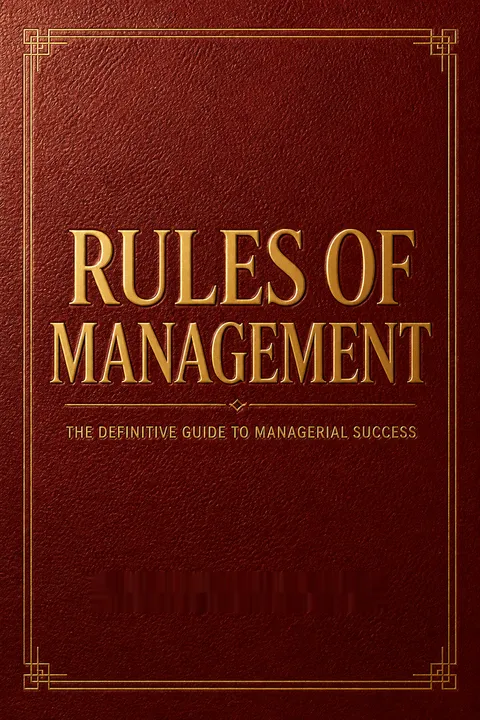
1. What’s "Rules of Management: The Definitive Guide to Managerial Success" by Richard Templar about?
- Comprehensive guide to management: The book offers a practical, no-nonsense collection of "rules" for managers at any level, focusing on both managing teams and managing oneself.
- Unwritten and unspoken rules: Templar emphasizes the importance of the often-overlooked, unwritten rules that make managers effective, beyond what is taught in formal training.
- Two-part structure: The book is divided into two main sections: "Managing Your Team" and "Managing Yourself," each with actionable advice.
- Accessible and relatable: Written in a conversational, witty style, the book uses real-world examples and anecdotes to illustrate its points, making it easy to apply in daily management.
2. Why should I read "Rules of Management" by Richard Templar?
- Practical, actionable advice: The book distills management wisdom into clear, concise rules that can be implemented immediately, regardless of your experience level.
- Focus on real-world challenges: Templar addresses the everyday realities and frustrations of management, offering solutions that go beyond theory.
- Boosts confidence and effectiveness: By following these rules, managers can become more confident, respected, and successful in their roles.
- Applicable to all managers: Whether you manage one person or a thousand, the rules are designed to be universally relevant and adaptable.
3. What are the key takeaways from "Rules of Management" by Richard Templar?
- Management is both art and science: Success comes from mastering both formal processes and the subtle, human aspects of leadership.
- Self-management is as important as team management: Effective managers must manage their own time, stress, and development as rigorously as they manage others.
- Consistency, trust, and respect are vital: Setting clear standards, trusting your team, and earning respect (rather than just being liked) are central themes.
- Continuous learning and adaptability: The best managers are always learning, open to feedback, and ready to adapt to change.
4. How does Richard Templar define the role of a manager in "Rules of Management"?
- Getting results through others: Templar aligns with definitions from Harvard and Peter Drucker, emphasizing that managers achieve outcomes by enabling others.
- Managing processes, not just people: The real job is to manage strategies and processes, allowing people to manage themselves within clear boundaries.
- Buffer and leader: Managers act as a buffer between higher management and staff, translating directives and protecting their teams.
- Standard-setter and role model: Managers must set the tone, standards, and culture for their teams through their own behavior.
5. What are the most important rules for managing a team according to "Rules of Management"?
- Get them emotionally involved: Inspire your team to care about their work and see its broader impact.
- Set clear, realistic targets: Ensure goals are challenging but achievable, and communicate them transparently.
- Encourage autonomy and trust: Delegate effectively, let people make mistakes, and show visible trust in their abilities.
- Celebrate and reward effort: Recognize both successes and honest efforts, fostering a positive, motivating environment.
- Handle conflict and differences: Be sensitive to friction, respect individual differences, and create a supportive team atmosphere.
6. What are the key self-management strategies in "Rules of Management" by Richard Templar?
- Work hard and set the standard: Lead by example in work ethic, punctuality, and professionalism.
- Prioritize and focus: Cut out unnecessary tasks, focus on what drives results, and value your time.
- Be proactive and adaptable: Plan ahead, embrace change, and be ready to unlearn outdated methods.
- Manage stress and health: Recognize signs of stress, maintain work-life balance, and look after your physical and mental well-being.
- Keep learning and seeking feedback: Continuously improve by learning from mistakes, competitors, and feedback from others.
7. How does "Rules of Management" by Richard Templar suggest handling meetings and communication?
- Purpose-driven meetings: Only hold meetings with a clear objective, and ensure every agenda item leads to an action plan.
- Efficiency and punctuality: Start on time, never wait for latecomers, and keep meetings as brief as possible.
- Make meetings engaging: Break the mold of boring meetings by fostering a relaxed, open atmosphere without resorting to gimmicks.
- Encourage open communication: Listen to ideas from all team members, adapt your style to individuals, and avoid always having the last word.
8. What does Richard Templar say about hiring and developing talent in "Rules of Management"?
- Find the right people: Be very good at identifying not just the right skills, but the right personalities and attitudes for your team.
- Hire raw talent: Prioritize potential, intelligence, and energy over experience alone; nurture those who can grow.
- Make your team better than you: Invest in developing your team members so they can surpass your own abilities.
- Delegate and let go: Trust your hires, delegate responsibility, and avoid micromanaging.
9. How does "Rules of Management" by Richard Templar address dealing with conflict and discipline?
- Set clear boundaries: Establish and enforce key rules from day one, practicing zero tolerance for breaches that matter.
- Be ready to prune: Don’t hesitate to remove team members who consistently underperform or disrupt the group.
- Handle friction swiftly: Be sensitive to early signs of conflict and address them diplomatically before they escalate.
- Fairness and consistency: Treat everyone equally, avoid favoritism, and ensure discipline is applied uniformly.
10. What are Richard Templar’s views on motivation and recognition in "Rules of Management"?
- Praise and encourage: Use positive reinforcement liberally, both before and after achievements, to boost morale.
- Celebrate all wins: Recognize not just big successes but also small efforts and even honest failures.
- Personalize recognition: Tailor praise and encouragement to individual preferences and personalities.
- Foster a culture of support: Encourage team members to motivate and help each other, creating a collaborative environment.
11. What are some of the best quotes from "Rules of Management" by Richard Templar and what do they mean?
- "Management is an art and a science." – Success requires both technical skills and human understanding.
- "Build your team and then trust them to get on with it." – Effective delegation and trust are key to high performance.
- "If you don’t set the standard, raise the tone, be the person you want your team to be, then you won’t be a truly great manager." – Managers must lead by example in all things.
- "No money, no business. No business, no job." – Always keep the bottom line in focus and prioritize what drives results.
- "If you always do what you’ve always done, you’ll always get what you’ve always gotten." – Emphasizes the need for innovation and adaptability.
12. How can I apply the advice from "Rules of Management" by Richard Templar in my daily work?
- Start with self-awareness: Regularly assess your own habits, strengths, and weaknesses, and seek feedback to improve.
- Implement rules gradually: Choose a few rules that resonate most and consciously practice them until they become habits.
- Focus on relationships: Build trust, respect, and open communication with your team, peers, and superiors.
- Stay adaptable and keep learning: Be open to change, new ideas, and continuous personal and professional development.
- Balance work and life: Remember to go home, manage stress, and maintain a healthy perspective on your role as a manager.
About the Author
Other books by Richard Templar





Download PDF
Download EPUB
.epub digital book format is ideal for reading ebooks on phones, tablets, and e-readers.








