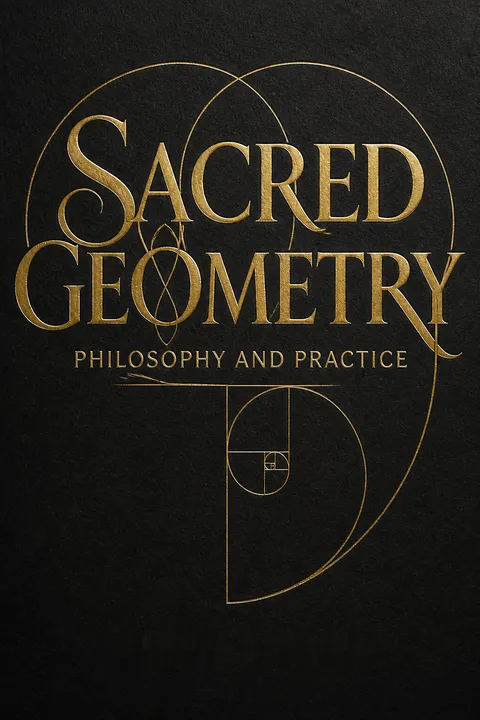


Key Takeaways
Use geometric drawing to study relationships, not just measurements.
Geometry trains attention. Lawlor presents geometry as more than a technique for measuring land or designing buildings. After the Nile’s annual floods erased property boundaries, Egyptian surveyors redrew them, making geometry a practical act of restoring order. In the classical curriculum, geometry studied spatial relationships alongside arithmetic, astronomy, and music, which studied number, time, and sound.
Forms become contemplative tools. Lawlor asks readers to construct diagrams themselves, so that relationships become visible rather than remaining abstract claims. He distinguishes the variable object, its formal model, and the underlying process that produces it. In this view, geometry can connect measurable shapes with questions about how order arises.
The book’s most durable invitation is methodological: draw, compare, and notice what a form permits. A diagram is an external thinking tool, allowing the eye and hand to test relationships that prose can obscure. That makes geometry useful even for readers who reject its spiritual interpretation. The caution is that a pattern’s clarity does not establish its metaphysical meaning. A square can be measured with certainty; claims that it reveals a cosmic principle require additional argument.
Treat unity as a source of difference, not a pile of separate parts.
One gives rise to two. In Lawlor’s account, creation is not made by assembling separate units. Unity divides from within itself, producing relations and contrasts. The circle represents undivided unity, while the square represents unity organized into directions and measurable parts. Number, in this framework, has a qualitative side: twoness means duality, while fourness evokes the material world of the square.
Zero becomes a philosophical argument. Lawlor contrasts ancient geometry, which he says begins with One, with modern mathematics, which uses zero. He distinguishes zero as a placeholder for an empty position from zero treated as a number, and traces the latter’s transmission from India through Arabic scholarship into Europe. He argues that zero encourages a worldview of emptiness and separation.
The distinction between a whole and its parts remains fertile across systems theory: a living system is not always explained by listing its components, because relations among them shape what the system can do. Lawlor’s historical claim about zero, however, is much less secure than his geometric demonstrations. Mathematical notation has developed through multiple traditions, and a symbol’s use does not dictate a culture’s theology. Zero is also indispensable for modern arithmetic, not evidence that reality itself is nothing.
Follow the square's diagonal to watch one form generate another.
A line changes the scale. Begin with a square whose side is one unit. Its diagonal measures the square root of two. Build a new square using that diagonal as its side: the new square has twice the original area. The drawing makes a general theme of the book tangible: a simple operation can generate a new form while preserving a precise relationship to its source.
Three roots, three roles. Lawlor treats the square roots of two, three, and five as symbolic principles of transformation. He calls the root of two generative, the root of three formative, and the root of five regenerative, linking the last to the Golden Proportion. These labels are part of his interpretive system, not mathematical definitions.
The diagonal is a strong teaching example because its geometry is exact while its decimal expression continues indefinitely. It shows how a finite construction can embody a relationship that cannot be captured by a terminating decimal. That distinction is useful in mathematics and design: an exact structure can be known through relations even when a numerical approximation is all that can be written. The symbolic names assigned to the three roots are evocative, but they should be read as a metaphysical vocabulary layered onto the mathematics.
Use overlapping circles to see shared boundaries become a new form.
Overlap creates the Vesica. Draw two equal circles so that each circle’s center lies on the other’s circumference. Their shared lens-shaped region is the Vesica Piscis. Lawlor shows how this construction contains equilateral triangles and a rectangle related to the square root of three, and how further circles can be used to construct regular polygons, including a hexagon.
A bridge in sacred art. The shared region becomes a symbol of mediation between opposites, such as heaven and earth or creator and creation. In Christian imagery, the fish-shaped Vesica is associated with Christ, while medieval Gothic architecture is presented as an expression of this formative geometry. The same drawing can therefore function as a mathematical construction and a cosmological image.
The lens is compelling because it gives a visible shape to intersection: neither circle disappears, yet their overlap has its own boundary and properties. This makes the figure a useful metaphor for relational thinking, where interaction produces something that cannot be attributed to either participant alone. The metaphor should not be confused with proof that a religious symbol was designed from a specific geometric doctrine. Historical interpretation depends on context, records, and comparison, not geometric resemblance by itself.
Treat the Golden Section as a relation, not a magic number.
A division that refers back. The Golden Proportion divides a line so that the whole relates to its larger part as that larger part relates to the smaller. The resulting ratio of longer to shorter segment is approximately 1.618. Lawlor emphasizes that it is first a relationship, not simply a decimal. He also connects it to the pentagon, whose diagonal and side have this proportion.
A model of integrated growth. Lawlor sees this division as a way to imagine change that remains connected to its source. He discusses its use in traditional art and architecture and relates it to human-body canons, including the navel’s position. He explicitly cautions against claiming that the Golden Proportion appears throughout all of nature, though he associates it with forms of heightened harmony.
The Golden Section earns its appeal from a real mathematical property: a proportion can repeat at different scales without losing its defining relation. That makes it a powerful design tool and a memorable model of self-similar organization. But the ratio’s reputation often outruns the evidence. Measurements of artworks and bodies can be selective, and the presence of a ratio does not establish that an artist intended it or that observers universally prefer it. Its strongest value here is as a precise construction and interpretive lens, not a universal beauty detector.
Track how growth oscillates around an ideal instead of moving straight toward it.
Approximation by alternation. Lawlor describes a Diaphantine method for approaching the square root of two with whole-number ratios. Starting from side and diagonal values of one and one, the construction produces pairs such as 2 and 3, 5 and 7, then 12 and 17. Their ratios alternate above and below the irrational value, while drawing closer to it. The corresponding sequence continues with pairs such as 29 and 41.
A model of rhythmic change. Lawlor calls this pattern the Principle of Alternation and connects it to cycles in nature, including the opposing downward growth of a root and upward growth of a shoot. The point is not that every process follows this exact numerical series, but that development can proceed through repeated overshooting and correction rather than a straight, uniform approach.
Alternating approximation provides an unusually clear bridge between mathematical procedure and a broader model of learning. Iterative methods in computation also improve estimates through successive corrections, and feedback systems often oscillate as they approach stability. The analogy becomes less reliable when it is treated as a law governing all biological or cosmic change. Still, as a mental model it replaces the fantasy of smooth progress with a more realistic rhythm: each correction carries information about the previous error.
Read each new layer of growth as a record of what came before.
The gnomon preserves its origin. A gnomon is a shape added to an existing figure so that the enlarged figure remains similar to the original. Lawlor uses the growth of a square as a basic example, then connects this pattern to shells and temple plans. In a shell, successive chambers remain part of the structure, so the new form visibly contains earlier stages.
Growth can store time. Lawlor extends this idea to logarithmic spirals and additive number sequences such as 1, 1, 2, 3, 5, 8, where each new term sums the previous two. He links such sequences to patterns in plants and treats gnomonic growth as a way to picture time accumulating in form. The central image is not replacement, but expansion that retains its history.
This is one of the book’s most productive images because it connects structure with memory. In biology, development often depends on earlier organization, while in architecture and cities, new layers coexist with older ones. The shell makes that continuity immediately legible. The Fibonacci sequence does appear in some natural growth patterns, but its occurrence is neither universal nor proof of a single hidden design. The gnomonic idea works best as a way to ask what a structure preserves as it changes.
Connect musical intervals to geometric ratios through three kinds of mean.
Three means mediate change. Lawlor presents arithmetic, geometric, and harmonic means as ways to relate two extremes. For the numbers 6 and 12, the arithmetic mean is 9 and the harmonic mean is 8. Together with the endpoints, these form the progression 6, 8, 9, 12, which the book connects to musical intervals.
Ratios become audible. In the example, 6 to 12 is an octave, 6 to 8 is a fourth, and 8 to 12 is a fifth. A guitar string illustrates the basic principle: shortening a vibrating string changes its frequency in a proportional way. Lawlor uses this connection to argue that geometry describes spatial relations while music makes proportional relations audible.
The mathematics of vibrating strings gives this section unusually firm ground. Musical intervals are not merely cultural metaphors; their frequency ratios can be measured, and simple ratios often produce stable consonances in many tuning systems. The connection also helps explain why number can describe both space and sound without claiming that the two are identical. One limitation is that musical harmony is culturally shaped, and actual tuning systems vary. The ratios illuminate a deep pattern, but they do not exhaust what music means.
Approximate the circle with a square to study spirit entering measure.
The circle and square meet. In Lawlor’s symbolism, the circle represents unmanifest unity, while the square represents the measurable world. Squaring the circle means seeking a square comparable to a circle in perimeter or area. An exact construction is impossible with the classical compass-and-straightedge tools, so the book presents an approximation instead.
A numerical and symbolic exercise. One construction discussed by Lawlor produces a value for pi of about 3.1416404, close to its true value of about 3.1415927. He treats the small difference as part of a larger meditation: the infinite or unmeasured becoming intelligible through finite form. The construction is therefore both a geometric approximation and an image of translation from the unmanifest into the manifest.
The exercise is a useful reminder that mathematical models can be extraordinarily close without being exact. It also separates two questions that are often blurred: how accurately a construction approximates a quantity, and what philosophical meaning a reader assigns to it. The geometric limit is genuine, while the spiritual interpretation is optional. Modern mathematics makes the boundary precise; it does not require treating the circle as spirit or the square as matter. The symbolism can enrich attention without replacing proof.
Read five regular solids as a map of Lawlor's cosmic imagination.
Volume completes the picture. Lawlor’s five regular solids are the tetrahedron, cube, octahedron, dodecahedron, and icosahedron. Each has equal faces and edges. In the cosmology associated with Plato, the cube is linked to earth, the tetrahedron to fire, the octahedron to air, the icosahedron to water, and the dodecahedron to a fifth element.
Human form as a cosmic pattern. Lawlor calls this approach anthropocosmic: it treats the human being as both a product of cosmic development and a pattern that reflects the whole. Temples, body-proportion canons, and geometric diagrams become ways to picture that relation. For him, drawing these forms is not only a study of shape, but a practice for contemplating how mind, body, and universe might belong to one order.
The solids provide a satisfying culmination because they move geometry from lines and surfaces into volume. Their symmetry is mathematically exact, and their history shows how mathematical objects can organize cosmological imagination. The element assignments, however, are symbolic correspondences rather than findings of physics. Likewise, the idea that the human body mirrors the cosmos can inspire architectural and artistic systems, but it needs independent evidence if offered as a scientific claim. The framework is most convincing as a history of meaning-making through form.
Analysis
Lawlor’s book is a hybrid: part geometry workbook, part history of symbolic systems, and part metaphysical argument. Its organizing movement is unusually coherent. A reader begins with the act of drawing, follows forms as they divide and generate further forms, then sees those relations reappear in proportion, music, architecture, human anatomy, and cosmology. The strongest passages are those where a construction can be checked directly: the square and its diagonal, the Vesica Piscis, the Golden Proportion, and the musical ratios. These give the reader a practical experience of how geometry can make relationships visible.
The book is harder to summarize than a conventional mathematics text because it moves continually between proof, metaphor, and claims about nature. A geometric identity may be exact; its interpretation as a symbol of spiritual creation is a further claim. Lawlor often presents the two in one flow, which is aesthetically persuasive but can make their different evidentiary status easy to miss. The distinction matters especially when he links zero to philosophical nihilism, invokes modern physics as confirmation of ancient cosmology, or makes claims about biology and perception. Those proposals should be treated as the author’s worldview, not as conclusions established by the diagrams. The central value survives that caution. Sacred geometry here is less a catalog of hidden ratios than a discipline of attention: construct a form, notice what is implicit within it, and ask how a new relation can arise without erasing its source. The reader does not need to accept that a pentagon embodies divine life or that a temple reproduces the universe. The book remains useful as an invitation to see mathematics as a language of relations, and to notice how human cultures turn such relations into images of order. Its most illuminating tension is also its limit: geometry can support contemplation, but it cannot by itself settle the metaphysics built upon it.
People Also Read


Glossary
Archetypal, ectypal, and typal
Process, model, and instanceLawlor distinguishes three levels of form. The typal is the particular, variable object encountered in experience. The ectypal is the unmanifest formal model that guides such objects. The archetypal is the active principle or process expressed through the model and its instances. The distinctions let him move from material examples toward general patterns of formation.
Vesica Piscis
Lens of two circlesThe Vesica Piscis is the lens-shaped region formed when two equal circles overlap, with each circle’s center on the other’s circumference. Lawlor treats it as a generative geometric figure, from which triangles, a rectangle, and regular polygons can be constructed. He also interprets it as a symbolic meeting place between complementary realms.
Golden Proportion
Self-related line divisionThe Golden Proportion divides a line into a larger and smaller part so that the whole relates to the larger part as the larger part relates to the smaller. The longer segment divided by the shorter is approximately 1.618. Lawlor presents it as a geometric relationship with connections to pentagonal forms, design, and spiritual symbolism.
Principle of Alternation
Progress through rhythmic reversalLawlor uses this term for a pattern in which successive approximations or stages move alternately above and below a stable relationship. His example is a whole-number sequence approaching the square root of two. He extends the pattern into a metaphor for natural growth, where opposing movements cooperate in a continuing process.
gnomonic expansion
Growth retaining earlier formGnomonic expansion occurs when a new shape is added to an existing figure so that the enlarged figure remains similar to the original. The added part is a gnomon. Lawlor uses the idea to describe cumulative forms such as shells, architectural plans, and spirals, where new growth incorporates rather than simply replaces earlier stages.
Diaphantine Mathematics
Whole-number approximationsLawlor uses this name for procedures that express irrational relationships through sequences of whole-number ratios. The ratios alternate above and below an incommensurable value while approaching it more closely. His principal example is the square root of two. The method links exact geometric relations to increasingly accurate numerical approximations.
mediation
A mean joining extremesIn Lawlor’s account, mediation studies how a mean term relates two extremes. He discusses arithmetic, geometric, and harmonic means as distinct forms of this relation. These structures are presented as mathematical patterns with applications to musical intervals and as philosophical models for how differences can be joined without becoming identical.
Anthropocosm
Human as cosmic patternThe Anthropocosm is Lawlor’s name for a view in which the human being is not merely one object within the universe, but a pattern that summarizes or reflects cosmic organization. This idea informs his readings of human proportions, temple design, and sacred geometry. It is a metaphysical framework, not a scientific finding established by proportion alone.
Platonic solids
Five regular polyhedraThe Platonic solids are the tetrahedron, cube, octahedron, dodecahedron, and icosahedron. Each has congruent regular faces, equal edges, and the same arrangement at every vertex. Lawlor presents them as fundamental forms of volume and discusses traditional correspondences between four solids and elements, with the dodecahedron linked to a fifth element.
Download PDF
Download EPUB
.epub digital book format is ideal for reading ebooks on phones, tablets, and e-readers.








