

Key Takeaways
Protection earns its place only when it improves long-run compounding.
Safety has a price. Spitznagel defines investment risk as exposure to losses, especially losses that can permanently weaken a portfolio. A safe haven is not simply an asset that feels secure or rises during one frightening episode. It is a payoff that reduces consequential losses, and cost-effective protection must also improve wealth growth over time. This reframes the investor’s dilemma: taking too much risk can cause ruin, while avoiding risk altogether can leave wealth unable to meet its goals.
Measure the whole result. The author’s proposed test is practical: compare a protected portfolio with an otherwise comparable unprotected one, including the protection’s cost. A strategy that reduces volatility but leaves investors poorer has not solved the problem he cares about.
The strength of this standard is that it refuses to treat safety as automatically beneficial. It asks who pays for protection, what danger it actually covers, and whether the combined arrangement works. That is a useful corrective to products marketed through reassuring labels. The hard question is what counts as a comparable portfolio: investors differ in liabilities, time horizons, and tolerance for losses. A single growth measure cannot settle every household’s needs, but it does expose a real tradeoff that a volatility statistic can obscure.
A severe loss can erase years of gains that equal-sized wins cannot restore.
Returns multiply through time. If a portfolio loses 50%, it must then gain 100% just to return to its starting value. A loss of 73%, like the hypothetical merchant’s cargo loss, requires a gain of roughly 270% to recover. This is why the arithmetic average of returns can mislead: it adds gains and losses as if they occurred on a ledger, while actual wealth compounds one period into the next.
Use the geometric view. The geometric average captures the rate at which wealth grows after repeated gains and losses. Daniel Bernoulli used a logarithmic measure of wealth to make this compounding effect visible. In Spitznagel’s framing, a large loss pushes wealth down a steepening curve, making it harder for later profits to repair the damage.
This is a powerful distinction between a return statistic and the capital base that must survive to earn future returns. It also explains why leverage can turn an attractive average into a disastrous path: losses shrink the stake, while obligations remain. The geometric measure is not a promise about any single outcome, however. It summarizes a pattern of compounding under specified assumptions. Investors still need to consider liquidity, cash needs, and the possibility that losses arrive in clusters rather than as independent events.
Insurance can lose on average yet improve the merchant’s compounded outcome.
A Baltic voyage illustrates the paradox. Daniel Bernoulli imagined a merchant sending cargo worth 10,000 rubles through pirate-prone waters, with 3,000 rubles in savings. If 5 trips in 100 lose the cargo, an 800-ruble premium costs more than the insurer’s actuarially fair price. The merchant’s expected arithmetic loss from buying that insurance is 300 rubles per trip.
Compounding changes the comparison. Without insurance, a lost cargo badly reduces the capital available for the next voyage. In Bernoulli’s calculation, the merchant’s geometric expected wealth is 12,081 rubles without insurance, compared with 12,200 with insurance. The policy loses value as a standalone wager, yet its protection against a ruinous loss more than offsets that cost within the ongoing business.
The example makes opportunity cost concrete: a premium is not judged in isolation but against the damage it prevents to the capital that funds future activity. This logic appears in insurance, safety engineering, and disaster planning, where prevention can be worthwhile even when the bad event is uncommon. The calculation depends on the stated loss probability, premium, and repeated business model. Change those conditions, and the policy may stop helping. The lesson is not to buy insurance at any price, but to evaluate the protected system.
Optimize for the path you will experience, not an average across parallel lives.
The two demons represent two scoreboards. In Spitznagel’s thought experiment, Schrödinger’s demon lets a gambler experience every possible outcome at once. That world rewards the arithmetic average. Nietzsche’s demon allows only one realized sequence, repeated forever. That resembles an investor’s actual experience: wealth follows one path, not the average of thousands of alternative portfolios.
A favorable expectation can hide a bad typical result. In the book’s dice example, an all-in wager has a positive arithmetic expected return of 3.3% per roll. Yet after 300 rolls, the median compounded result is near zero, while an ending wealth around 19,000 times the starting stake is extraordinarily rare. The difference arises because a few spectacular paths inflate the average, while many paths suffer compounding losses.
This distinction is the heart of non-ergodicity: an average across possible worlds need not describe what one participant experiences through time. It is especially useful when an investment’s payoff distribution is highly skewed. Still, a median is not a complete risk policy. A household unable to survive a low-percentile outcome may care more about the worst plausible paths than about the middle one. The thought experiment clarifies which average can mislead, but choosing a prudent percentile remains a judgment about obligations and resilience.
Classify protection by its crash payoff, not by its reassuring name.
Three payoff shapes organize the landscape. A store-of-value asset aims to hold relatively steady, providing a cushion or funds to reinvest after losses. An alpha safe haven is expected to gain during a crash, but may also earn positive returns in ordinary periods. An insurance safe haven accepts small, frequent costs in exchange for a large conditional payout when a crash occurs. Real strategies can blend these shapes.
Labels can mislead. Spitznagel also describes hopeful havens, whose protective performance is noisy; unsafe havens, which may fail precisely when needed; and diworsifier havens, which lower portfolio fluctuations while potentially dragging down returns. The relevant question is not whether an asset is called a hedge, but how its payoff behaves against the risk the portfolio needs to reduce.
The taxonomy is valuable because it shifts attention from asset categories to conditional behavior. A bond, commodity, or strategy does not protect simply by belonging to a familiar class. This resembles reliability engineering: a component is useful only if it functions under the failure conditions that matter. The weakness is that historical payoff shapes can be mistaken for stable properties. A label based on past crashes may offer false confidence if market structure or investor behavior changes.
Evaluate the protection inside the portfolio, where its real value emerges.
Parts can misprice the whole. Spitznagel’s Xs and Os profile combines the main portfolio’s returns with a safe haven’s conditional returns. The combined payoff matters because assets interact as wealth is rebalanced and compounded. A protection strategy can have a weak or negative standalone average and still improve the total portfolio by cushioning losses that would otherwise shrink future investment capital.
The reshuffling test makes the point. In the author’s model, the insurance payoff helped when its returns aligned with stock-market crashes. Randomly pairing the same safe-haven returns with different stock-market years removed much of that benefit. The returns of each component were unchanged, but the portfolio’s compounded result worsened. Protection depends not just on what an asset earns, but on when it earns it relative to the portfolio’s losses.
This is a strong argument against judging portfolio components as isolated line items. The same principle appears in systems design: a part’s function depends on its connections and timing. Yet portfolio-level tests can also become overly tailored to chosen histories and assumptions. The reshuffling exercise demonstrates that conditional alignment matters; it does not establish that a measured relationship will persist. A sound evaluation should inspect both the combined outcome and the stability of the relationship that produces it.
Treat every safe-haven claim as a hypothesis that can fail.
The book borrows a scientific discipline. Spitznagel uses modus tollens, a form of deduction: if a strategy truly provides cost-effective protection, adding it should raise the portfolio’s compound growth under the test conditions. If it does not, the claim fails that test. Strong performance alone cannot prove the explanation, since many unrelated causes can produce a good result.
His bootstrap creates alternative histories. He samples from 120 annual S&P 500 returns, from 1901 to 2020, to generate 10,000 hypothetical 25-year paths. He then compares a stock portfolio with portfolios containing different safe-haven payoffs. The method avoids assuming a tidy probability distribution, but it still relies on the historical return sample as a guide to possible outcomes.
The emphasis on attempted refutation is a useful antidote to cherry-picked success stories. The bootstrap also makes comparisons visible rather than hiding them inside a complex model. Its limits matter: resampling historical years cannot generate events absent from the record, and independent draws can underrepresent persistence or changing market regimes. Statistical rejection boundaries do not remove model risk. The method is best understood as a transparent stress-testing framework, not as a machine that certifies future safety.
Historical safe havens often fail when their payoff shape changes.
The empirical record is mixed. In Spitznagel’s bootstrap, a store-of-value cartoon and an alpha cartoon did not raise the median compound growth of the S&P portfolio when adjusted to comparable downside protection. A two-percent allocation to the insurance cartoon did raise median CAGR by 0.5 percentage points. Among real-world examples, three-month Treasury bills and trend-following CTA strategies failed his cost-effectiveness test; gold passed over the full sample with a 0.3-point gain.
That result was not stable. Gold’s measured net effect varied across three 16-year periods: positive in 1973-1988, negative in 1989-2004, and slightly negative in 2005-2020. Long-term Treasury results also shifted sign across periods. The author argues that these assets’ protection depends partly on changing economic conditions, making their historical behavior unreliable as a permanent trait.
These findings usefully separate a promising full-period result from a dependable strategy. A hedge that works only under certain inflation or interest-rate conditions may still be useful, but it requires understanding the conditions and bearing the periods when it disappoints. The reported comparisons are specific to the author’s data, allocation rules, and benchmark. They should not be read as universal rankings or current investment advice. Regime shifts make historical evaluation essential, but also limit its predictive reach.
Favor protection that covers severe losses with the smallest allocation.
Efficiency drives the safe haven frontier. Spitznagel’s frontier ranks payoffs by how much downside protection they provide and how much portfolio return they consume. The more explosive the crash payoff, the less capital may be needed to improve a portfolio’s worst paths. A small allocation can therefore impose a smaller ordinary-period cost while still cushioning a major loss.
The author’s insurance cartoon shows the tradeoff. It loses its entire allocation in ordinary years but pays a large return in severe stock-market declines. In the historical simulation, a two-percent allocation lifted median CAGR while improving the fifth-percentile CAGR used to compare risk. By contrast, steady-return cartoons required much larger allocations and still underperformed. The principle is not that every option-like payoff works, but that protection should be judged by crash benefit per unit of cost.
This is the book’s most distinctive investment design principle: seek concentrated protection against the losses that most damage future compounding, rather than broadly diluting every fluctuation. It also explains why a small, costly-looking position can matter more than a large, comfortable one. The difficult implementation problem is identifying genuinely convex protection at a tolerable price. A payoff that looks explosive in a model may carry liquidity, execution, or counterparty risks that the simplified cartoon excludes.
Choose durable protection that does not require forecasting the next crash.
Strategic protection avoids the timing trap. A tactical hedge is switched on and off in response to forecasts. Spitznagel argues that this makes risk control depend on predicting the very events it is meant to handle. A strategic approach keeps protection in the portfolio and evaluates whether its ongoing cost is justified by its conditional payoff.
The final standard is robustness. The investor gets only one realized sequence of returns, so the goal is not to win an imaginary contest across every possible world. It is to shape the range of outcomes so that a severe loss does not destroy the capital needed for future growth. The author calls the disposition behind this acceptance amor fati, or loving one’s fate: prepare without pretending to know which market path will arrive.
The argument is strongest when applied to protection whose payoff is mechanical and whose cost is transparent. It is weaker when the hedge depends on a statistical relationship that can disappear, or when maintaining it creates an unacceptable drag. No forecast requirement does not mean no ongoing review. A robust policy can be steady in purpose while still being reassessed for price, counterparties, and changing portfolio needs.
Analysis
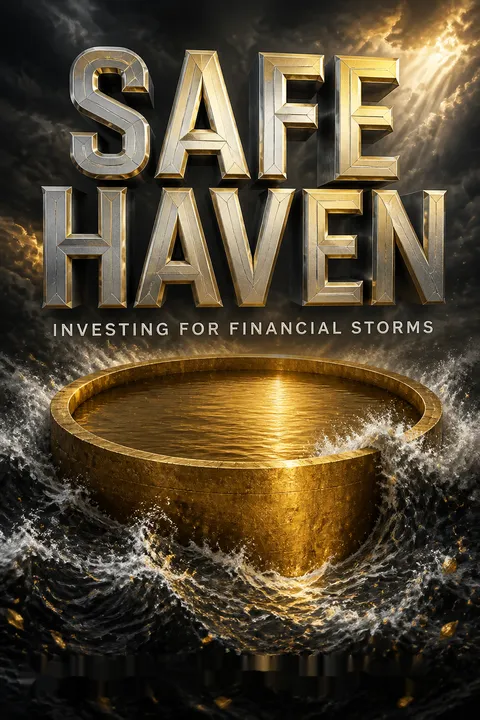
Safe Haven is a finance argument built as a chain of thought experiments, historical episodes, and empirical tests. Its central move is to replace conventional risk-adjusted performance with compounded wealth as the decisive scoreboard. Bernoulli’s logarithmic treatment of wealth supplies the mathematical hinge: losses are not symmetrical with gains because capital compounds sequentially. Nietzsche’s one-path thought experiment then gives that arithmetic a human consequence. Investors do not experience the average of parallel outcomes; they experience one history.
The book’s most useful contribution is not a particular asset recommendation but a way to interrogate protection. It asks whether a payoff is aligned with portfolio losses, what it costs in ordinary periods, and whether its joint effect improves compounded results. The merchant’s insurance example makes the logic intuitive, while the taxonomy warns that familiar assets may not behave reliably enough to count as safe havens. This framework encourages skepticism toward both reassuring labels and sophisticated-looking risk measures.
The empirical claims need careful boundaries. The bootstrap draws repeatedly from a finite historical sample, which offers transparent comparisons but cannot reveal unknown events or guarantee that past dependencies recur. Annual returns also compress intrayear crises and recovery sequences. Most importantly, the book’s favorable result for insurance-like payoffs depends on how the payoff is specified, how allocations are selected, and which downside percentile defines comparable risk. Those choices are analytical judgments, not neutral facts.
The author’s own firm performance claim is not a substitute for an independently reproducible investor experience. Specialized execution, pricing, fees, and access may separate a professional strategy from a copyable product. Readers should therefore take the strongest lesson as methodological: protection should be evaluated as part of a portfolio, under explicit assumptions, against the losses that threaten its capital base. The theory is compelling; implementation and evidence remain conditional.
Review Summary
Safe Haven received mixed reviews, with praise for its unique perspective on risk mitigation and investing philosophy. Readers appreciated the mathematical concepts and challenging of conventional wisdom. However, some found the writing style difficult and lacking practical examples. Critics noted the absence of specific investment advice, while supporters viewed this as intentional, encouraging readers to think independently. The book's complexity divided opinions, with some finding it enlightening and others struggling to grasp its concepts. Overall, it's considered a thought-provoking read for experienced investors seeking a fresh approach to portfolio management.
People Also Read








Glossary
Emolumentum medium
Average logarithmic wealthDaniel Bernoulli’s measure for valuing a risky wager. It averages the logarithms of possible ending wealth outcomes, then converts that average back into wealth units. The method reflects the fact that a loss has a different compounding consequence depending on the investor’s starting wealth and on how much capital remains to invest.
Non-ergodicity
Average paths divergeA condition in which the average across many possible outcomes does not match the result experienced by one participant through time. In Spitznagel’s investing discussion, a few highly profitable paths can raise the arithmetic average while the typical compounded path remains poor. It cautions investors against treating an ensemble average as their likely personal outcome.
Petersburg merchant trade
Insurance improves compoundingThe book’s name for a strategy that may lose money on an arithmetic average yet improve a portfolio’s compound growth by preventing severe losses. Bernoulli’s merchant example shows an expensive cargo policy reducing expected standalone profit while preserving more wealth for future voyages, producing a higher geometric outcome under the example’s assumptions.
Safe haven frontier
Protection-cost spectrumA way of comparing safe-haven payoffs by the downside protection they provide and the cost they impose on portfolio growth. More efficient crash protection requires less capital for a given reduction in severe losses, potentially moving a strategy toward higher cost-effectiveness. The frontier is a comparative framework, not a guarantee that any particular payoff will remain effective.
Safe haven imposters
Misleading protection typesAssets or strategies that appear to offer reliable portfolio protection but may not do so when needed or at an acceptable cost. Spitznagel groups them as hopeful havens, whose payoff is noisy; unsafe havens, vulnerable during the very crisis they are meant to hedge; and diworsifier havens, which reduce measured fluctuations while potentially lowering compounded wealth.
Bootstrap
Resampling historical outcomesA statistical method that repeatedly samples observations from an existing dataset, with replacement, to create alternative sequences and estimate a range of outcomes. In the book, historical annual S&P 500 returns are resampled into hypothetical 25-year paths and compared with paths that include safe-haven payoffs. The technique avoids specifying a theoretical return distribution, but remains limited by the historical sample.
Xs and Os profile
Combined payoff comparisonA diagram that places a portfolio’s main investment payoff alongside a safe haven’s payoff and shows their combined result across market conditions. It helps distinguish the protection’s standalone return from its effect inside the portfolio. The combined profile makes the timing and shape of conditional returns visible, rather than reducing the comparison to average returns or correlations.
Amor fati
Love of one’s fateA Nietzschean idea, translated as love of one’s fate, that Spitznagel applies to investing. It means arranging one’s exposure so that the realized path can be accepted rather than regretted, without claiming to know in advance which path will occur. In the book, it supports preparation for uncertainty rather than passive resignation or market prediction.
FAQ
What's "Safe Haven: Investing for Financial Storms" about?
- Purpose of the book: "Safe Haven: Investing for Financial Storms" by Mark Spitznagel explores strategies for investing in a way that mitigates risk during financial downturns while still aiming to increase wealth over time.
- Focus on risk mitigation: The book emphasizes the importance of cost-effective risk mitigation, challenging the conventional wisdom that risk mitigation necessarily comes at the expense of returns.
- Philosophical and practical approach: It combines philosophical insights, particularly from Nietzsche, with practical investment strategies to provide a comprehensive guide to safe haven investing.
Why should I read "Safe Haven: Investing for Financial Storms"?
- Unique perspective on investing: The book offers a fresh perspective on investing by focusing on risk mitigation as a means to enhance wealth, rather than just a defensive measure.
- Comprehensive framework: It provides a logical and practical framework for understanding and implementing safe haven strategies, making it valuable for both novice and experienced investors.
- Philosophical insights: The integration of philosophical concepts, such as Nietzsche's eternal return, adds depth to the discussion of investment strategies, encouraging readers to think critically about their approach to risk.
What are the key takeaways of "Safe Haven: Investing for Financial Storms"?
- Cost-effective risk mitigation: The book argues that risk mitigation should not be seen as a trade-off against wealth creation but as a strategy that can enhance returns over time.
- Importance of geometric returns: It emphasizes the significance of geometric average returns over arithmetic averages, highlighting the impact of compounding on wealth.
- Holistic investment approach: The book advocates for a holistic view of investing, where the interactions between different components of a portfolio are considered to maximize overall returns.
What is the "Petersburg Merchant Trade" concept in the book?
- Insurance analogy: The Petersburg Merchant Trade is an analogy used to explain how insurance can be a cost-effective risk mitigation strategy, even if it appears costly in the short term.
- Geometric vs. arithmetic returns: It illustrates how the geometric effect of risk mitigation can outweigh its arithmetic cost, leading to higher overall returns.
- Strategic risk management: The concept underscores the importance of strategic, rather than tactical, risk management in investing.
How does Mark Spitznagel define a "safe haven" in investing?
- Risk mitigation focus: A safe haven is defined as an investment that mitigates risk, particularly during financial downturns, while ideally enhancing wealth over time.
- Payoff characteristics: Safe havens are characterized by their payoff profiles, which should provide protection against significant losses in a portfolio.
- Variety of forms: Safe havens can take various forms, such as insurance, store-of-value assets, or alpha strategies, each with different payoff dynamics.
What is the "Safe Haven Frontier" mentioned in the book?
- Spectrum of performance: The Safe Haven Frontier represents a spectrum of safe haven payoff shapes that can provide increasing cost-effectiveness in risk mitigation.
- Cost-effectiveness line: It delineates the edge of the envelope along which safe havens can push to achieve maximum efficiency in mitigating risk.
- Strategic guidance: The frontier serves as a guide for investors to identify and implement the most cost-effective safe haven strategies.
What role does Nietzsche's philosophy play in "Safe Haven: Investing for Financial Storms"?
- Eternal return concept: Nietzsche's idea of the eternal return is used as a thought experiment to emphasize the importance of getting investment decisions right, as if they will be repeated indefinitely.
- Life affirmation: The book encourages investors to adopt a mindset of "amor fati," or love of one's fate, to embrace the outcomes of their investment decisions.
- Philosophical depth: Nietzsche's philosophy adds a layer of depth to the discussion of risk and investing, encouraging readers to think critically about their approach to financial decisions.
How does the book address the "great dilemma of risk"?
- Catch-22 of risk: The book discusses the dilemma where taking too much risk can lead to losses, while taking too little can result in missed opportunities for wealth creation.
- Solution through risk mitigation: It proposes that the solution lies in cost-effective risk mitigation, which can enhance returns while managing risk.
- Strategic approach: The book advocates for a strategic, rather than tactical, approach to risk management, focusing on long-term wealth growth.
What is the significance of geometric average returns in the book?
- Compounding impact: Geometric average returns are emphasized for their ability to reflect the true impact of compounding on wealth over time.
- More accurate measure: The book argues that geometric averages provide a more accurate measure of investment performance than arithmetic averages.
- Focus on growth rate: By focusing on the growth rate of wealth, investors can better understand the long-term effects of their investment decisions.
What are the best quotes from "Safe Haven: Investing for Financial Storms" and what do they mean?
- "Of all that is written, I love only what a person hath written with his blood." This Nietzsche quote underscores the importance of deeply understanding and committing to one's investment strategies.
- "Don't lose money." This Buffett-inspired principle highlights the critical importance of risk management in investing.
- "A ship in harbor is safe, but that is not what ships are built for." This quote encourages investors to embrace risk strategically, rather than avoiding it entirely.
How does the book differentiate between tactical and strategic investing?
- Tactical investing: Tactical investing involves making short-term predictions and adjustments to a portfolio, often requiring precise timing and forecasting.
- Strategic investing: Strategic investing focuses on long-term goals and maintaining a consistent approach to risk management, without relying on predictions.
- Emphasis on strategy: The book advocates for strategic investing as a more reliable and effective approach to managing risk and enhancing returns.
What is the "Kelly Criterion" and how is it applied in the book?
- Betting strategy: The Kelly Criterion is a formula used to determine the optimal size of a series of bets to maximize the geometric average of wealth.
- Application to investing: The book applies the Kelly Criterion to investing, suggesting that it can help investors determine the optimal allocation to safe havens.
- Balancing risk and reward: By using the Kelly Criterion, investors can balance the trade-off between risk and reward to achieve the best long-term outcomes.
About the Author
Other books by Mark Spitznagel

Download PDF
Download EPUB
.epub digital book format is ideal for reading ebooks on phones, tablets, and e-readers.








