

Key Takeaways
Read late antiquity with Ctesiphon beside Rome, not in Rome's shadow.
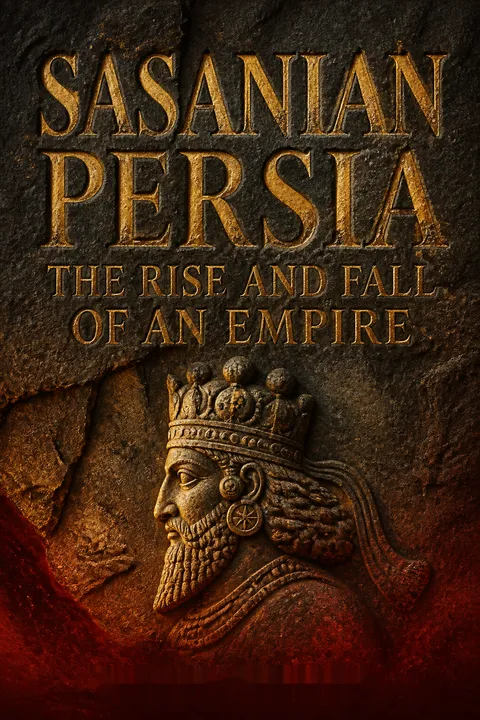
A second imperial center. The Sasanian Empire lasted from the third to the seventh centuries and was not simply Rome's eastern enemy. Its capital, Ctesiphon, rivaled Rome and Constantinople, while Sasanian power and cultural influence reached from the Mediterranean and Arabia to India, Central Asia, and the Silk Road. Daryaee argues that the empire helped shape the institutions and outlook of the later Persianate world, and that the Abbasid caliphate adopted important parts of its governing model.
A wider historical map. The book follows not only rulers and wars, but religion, society, language, administration, and trade. Its central correction is to histories that treat Persia as a brief interruption in Roman affairs: the Sasanians had their own political ambitions and regional networks, and helped define the world in which both Rome and early Islam operated.
What's striking is how much changes when Persia is treated as a center rather than a border. The standard Rome-versus-barbarians story can make neighboring societies appear only when they threaten the imperial capital. Ctesiphon instead reveals a connected late antique world, where rival states exchanged people, technologies, religious ideas, and administrative practices. This perspective also sharpens the book's argument about inheritance: conquest does not necessarily erase the institutions of the conquered. The comparison is useful, though influence should not be mistaken for simple one-way borrowing or a single, uniform Sasanian legacy.
Ardashir turned a provincial victory into a durable idea of Iran.
A local rise becomes empire. In 224 CE, Ardashir defeated the last Arsacid ruler, Ardawan, at Hormozgan and began building a new empire from Persis, the Persian heartland. His family had ties to the fire temple of Anahid at Istakhr, giving its rise both political and religious roots. Ardashir took the title King of Kings and used the name Iranshahr for the realm he claimed to rule.
A territory with meaning. Inscriptions and monuments presented kingship as sanctioned by the gods and cast the empire as an ordered Iranian realm. The distinction between Iran and non-Iranian lands did not mean the latter lay outside Sasanian control. Under Ardashir's son Shapur I, the empire demonstrated its military reach by capturing Roman Emperor Valerian in 260 CE and relocating people, including skilled workers, into Sasanian cities.
The founding story shows that political identity is built, not merely inherited. Ardashir's victory mattered, but so did the language, rituals, and monuments that made a new ruling family's claim seem to represent a much older community. This resembles a broader pattern in state formation: a government turns a contested territory into a shared political idea through public symbols and repeated administration. The distinction between Iranian and non-Iranian lands also warns against reading Iranshahr as a modern nation-state. It was an imperial concept, flexible enough to include conquered peoples without erasing their difference.
Treat Sasanian religion as negotiated power, not a single creed.
Orthodoxy took work. Zoroastrianism became the official religion, but its doctrines and institutions developed over time. The priest Kerdir promoted a stronger religious hierarchy, established fire temples, and persecuted groups including Manichaeans, Christians, Jews, and Buddhists. Under Shapur I, however, the prophet Mani was initially permitted to preach. That tolerance ended under later rulers, and Mani was imprisoned and died in custody.
Pluralism became policy. Jews had recognized leaders who dealt with the government, while Christianity grew through both local communities and people moved into the empire after wars. In 410 CE, Christians convened a synod with royal approval. The state increasingly treated religious communities as groups to be governed through their own leaders, while the King of Kings retained authority over the empire. Accommodation could ease political tensions, but it did not prevent episodes of persecution.
This account makes religious policy legible as a problem of government as well as belief. A ruler could value a universal faith's potential to bind diverse subjects, while priests feared losing authority and officials feared divided loyalties. That tension helps explain why the same empire could support a religious institution at one moment and suppress its adherents at another. The word pluralism needs care here: communities could gain formal standing without equality, and recognition often served state control. Even so, the record complicates any picture of a uniformly Zoroastrian society.
The empire's order depended on hierarchy, cities, and who paid.
Rank shaped daily life. Sasanian religious texts described society as four estates: priests, warriors, farmers, and artisans. This was an ideal order, not a complete photograph of lived society. Priests and warriors held high status, agriculture sustained the tax base, and artisans and merchants were often ranked lower despite their economic importance. Women’s rights depended heavily on status and family position; royal women could wield influence, and two queens ruled during the seventh-century crisis, but legal texts were written from a strongly male-centered perspective.
Cities were state projects. Kings founded or rebuilt cities, roads, bridges, and dams, often settling deported populations and skilled workers there. Urban growth strengthened administration and production, but also brought coercion and social strain. The contrast between elite banquets and the poor, enslaved, and displaced makes clear that imperial prosperity was not shared evenly.
The four-estate scheme is valuable precisely because it exposes the difference between a society's official self-description and its actual complexity. Similar gaps appear wherever institutions classify people to make them governable: the categories can organize duties while concealing unequal power. The book's examples of forced settlement, slavery, and women constrained by law prevent the urbanization story from becoming an uncomplicated tale of progress. Its strongest social insight is that infrastructure and hierarchy were linked. The same city that enabled commerce and administration could also concentrate labor, taxation, and state surveillance.
Kavad and Khusro made bureaucracy and small landholders the state's backbone.
Crisis opened a path. In the late fifth century, Kavad I faced economic distress, powerful nobles, and a priesthood deeply involved in government. He backed Mazdak, a religious reformer associated with more equal sharing of property and wealth. The movement challenged entrenched privilege, though hostile accounts portrayed its social effects as chaos. Kavad was deposed in 496 CE, escaped to the Hephthalites, and returned to power in 499.
Reform outlasted revolt. Kavad began changes later associated with his son Khusro I. The state surveyed farmland and reorganized taxation, while authority over the army was divided among four regional commanders. Khusro weakened the great noble houses and relied more on dehgans, small landholders who served as local officials, tax collectors, and soldiers. These reforms made government more systematic, but strengthened local elites whose interests could diverge from the crown.
The sequence links social protest to state capacity. A challenge to concentrated wealth did not simply end with the suppression of its advocates: it pushed rulers to address poverty and rebuild the machinery of taxation and military command. This is a useful distinction between ideological victory and institutional consequence. Khusro's reforms strengthened the center by cultivating smaller landholders, yet those landholders also gained leverage locally. Administrative efficiency is rarely neutral. It can make a state more resilient while creating new intermediaries whose loyalty depends on the benefits they receive.
Follow Persian merchants from Gulf ports to Chinese coin hoards.
Trade joined distant regions. Agriculture remained the main source of livelihood, supported by irrigation works such as qanats, but the empire also profited from trade. Ports including Siraf and Bushire connected Persian Gulf commerce to routes across the Indian Ocean. Sasanian silver drahms, standardized at about 4.25 grams, circulated widely and have been found as far away as China. Persian merchants competed with Roman traders for silk and other goods, while trade also linked the empire to India, Arabia, and East Africa.
Exchange moved ideas too. Merchants were often private operators rather than agents of a centrally directed trading system. Meanwhile, scholars and translators brought Greek and Indian works on subjects such as medicine, astronomy, philosophy, and games into Persian intellectual life. The empire was therefore not only a military corridor between East and West. It was a setting where goods, techniques, and knowledge were adapted and passed onward.
The trade story shifts attention from borders to the connective tissue of empire: ports, roads, coinage, and merchant partnerships. Finds of coins far from their minting regions show how material evidence can reveal connections that political chronicles barely mention. The chapter also resists a common simplification: state power mattered, but private merchants did much of the commercial work. That distinction is important for interpreting economic reach. A government can secure routes and standardize money without controlling every transaction, and thriving exchange can depend on networks that outlast the ruler who protects them.
Khusro II's spectacular conquests exposed the danger of imperial overreach.
Victory reached its limit. Khusro II began his reign by recovering the throne with Roman help, then launched a vast campaign after the Roman emperor Maurice was murdered. Sasanian forces took Syria and Jerusalem in 614 CE, Egypt in 619, and other Roman territories. The scale of success made the empire appear close to overwhelming its western rival.
The reversal was brutal. Emperor Heraclius counterattacked from 624, striking into Sasanian territory. By 628, Khusro II had been deposed, and a treaty returned the conquered lands to Rome. The royal family then fractured: Kavad II killed many potential heirs, Queen Buran briefly ruled, and rival claimants competed for power. When Arab Muslim armies entered Iraq, they faced an empire exhausted by long wars and succession struggles. Ctesiphon fell after the defeat at Qadisiyya in 636; Yazdgerd III was killed at Merv in 651.
The collapse is not presented as a sudden verdict on a supposedly weak civilization. It follows a familiar but consequential sequence: expansion raises military costs, reversal damages legitimacy, and contested succession prevents coordinated recovery. The Sasanian case also shows why battlefield strength cannot be measured by an empire's greatest moment alone. The army, treasury, and political coalition must remain functional after a defeat. The book carefully rejects inflated troop totals in later accounts, a reminder that victory narratives often enlarge the defeated opponent to magnify the conqueror's achievement.
A fallen dynasty can leave its administration and identity intact.
The conquest was not a reset. After the Sasanian state fell, local officials and dehgans continued to administer communities and territories under new rulers. The early caliphate adopted elements of Sasanian administrative practice, while Persian expertise and literary traditions remained influential. Members of the royal family also sought refuge and recognition in China; Yazdgerd's son Peroz established a Persian presence there, though not a restored empire.
Political names survive power. The book traces Iranshahr from a Sasanian imperial idea into a longer Persian historical memory. This continuity did not mean that institutions or identities stayed unchanged. Rather, people and practices were repurposed within new political arrangements. The empire's end therefore marks a transfer and transformation of authority, not the disappearance of Persian society or its contribution to the wider region.
This is a useful corrective to narratives that equate a decisive military conquest with total social replacement. Governments can fall while administrative skills, local relationships, and political vocabulary remain useful to whoever takes power. Such continuity is not evidence that nothing changed; it is evidence that change often proceeds through reuse. The Sasanian example invites a more precise question than whether an empire survived: which institutions endured, who operated them, and whose interests did they serve under the new regime?
Read hostile chronicles against coins, seals, inscriptions, and archaeology.
The archive is uneven. Sasanian history must be reconstructed from sources written in different languages and at different times. Royal inscriptions offer valuable evidence for the third century, but present events through the king's self-justifying perspective. Roman, Armenian, and Syriac accounts preserve details while reflecting religious and political bias. Later Arabic histories, especially al-Tabari, preserve earlier material but were written centuries after the events they describe.
Material evidence checks the story. Coins help track rulers, claims to legitimacy, and monetary circulation. Seals and clay impressions reveal offices and administrative geography, while archaeology illuminates settlement, buildings, and trade. No single source can tell the whole story. Daryaee's method is to compare these forms of evidence, reading each for what it can establish and for the interests that shaped what it says.
The method is one of the book's lasting contributions because it turns source criticism into a practical habit: ask who made the record, when, for whom, and what other evidence could test it. This is especially important when the archive is dominated by imperial elites or religious communities describing rivals. Coins and seals do not eliminate bias, but they answer different questions from chronicles and can expose gaps in their narratives. The limitation is equally instructive: fragmentary evidence often supports a plausible reconstruction rather than certainty, so confidence should match the source.
Analysis
Daryaee's book is both a political history and an argument about how historical visibility is produced. Its central intervention is to restore the Sasanian Empire to the same analytical scale as Rome, rather than letting Roman sources determine when Persia matters. This is not just a matter of adding another dynasty to a timeline. It changes the explanatory frame: the Sasanians emerge as makers of institutions, imperial geography, religious policy, and commercial networks that shaped the political world inherited by early Islam.
The strongest through-line is the tension between central ambition and distributed power. Kings claimed to impose order, but depended on priests, noble families, regional commanders, merchants, and local landholders. Those groups could strengthen the state, contest its policies, or continue governing when royal authority collapsed. Kavad's and Khusro's administrative changes illustrate the paradox particularly well: reforms could weaken older aristocrats and improve central control while empowering local actors with their own bases of influence. The resulting durability of institutions did not guarantee the durability of the dynasty.
The account also treats religion as a governing relationship rather than a catalogue of beliefs. Zoroastrianism supplied a language of legitimacy, yet the empire contained Christians, Jews, Manichaeans, and other communities with their own institutions. Accommodation and persecution were not opposites so much as competing responses to the problem of ruling a plural society. The result is a more useful portrait than either a uniformly tolerant empire or a monolithic religious state.
The book's evidentiary method is essential to its conclusions. Royal inscriptions, hostile foreign histories, later chronicles, coins, seals, and archaeological remains each reveal different layers of the past. Their disagreements are not merely obstacles; they show how rulers and communities sought to control memory. Since many details remain uncertain, the most persuasive claims are those built through comparison rather than reliance on a single narrative tradition.
Review Summary
Sasanian Persia receives generally positive reviews for its comprehensive coverage of the Sassanid Empire's history, religion, economy, and culture. Readers appreciate its detail and scholarly approach, though some find it dry or challenging to read. Many note its value as a rare English-language resource on the subject. Criticisms include occasional inconsistencies, confusing language, and a lack of engaging narrative. Overall, reviewers recommend it as an informative, well-researched introduction to Sassanian studies, despite its academic tone.
People Also Read






Glossary
Iranshahr
Sasanian imperial realmThe Sasanian name for the realm of the Iranians and an important political idea, not simply a label for a modern nation. It connected territory, kingship, and Iranian identity. Sasanian sources distinguished it from non-Iranian lands, even when those lands were under Sasanian rule.
an-Ērān
Non-Iranian landsA Sasanian category for lands regarded as outside Iranshahr's Iranian core. The distinction was political and ideological, not a straightforward map of independent states: territories classified as non-Iranian could still be controlled by the Sasanian Empire.
dehgān
Local landholding eliteA small landholder who became increasingly important in late Sasanian society. Dehgans could collect taxes, serve in the military, and manage local affairs. Reforms associated with Kavad I and Khusro I strengthened their role, making them important intermediaries between imperial government and local communities.
kust
Imperial quarterOne of the four broad regions into which the late Sasanian Empire was divided for military and related administrative purposes. Each quarter was associated with a commander, or spahbed. The arrangement helped the state manage threats on several frontiers, though details of the divisions remain debated.
xwarrah
Royal divine gloryA concept of glory or fortune associated with legitimate Iranian kingship. In Sasanian royal ideology, possession of xwarrah helped signify a ruler's right to govern. Khusro II used the idea in royal messaging, connecting his authority to a deep Iranian tradition of divinely supported kingship.
driyōšān jādaggōw ud dādwar
Advocate and judge of the poorA Sasanian official title meaning advocate and judge of the poor. The office joined legal and social responsibilities, including concern for people who needed protection or aid. Its appearance reflects the state's recognition that poverty and social tension required more than punishment alone.
FAQ
What is Sasanian Persia: The Rise and Fall of an Empire by Touraj Daryaee about?
- Comprehensive single-volume history: The book offers a detailed overview of the Sasanian Empire from 200 to 700 CE, covering its political, social, religious, economic, and cultural history.
- Interdisciplinary approach: Daryaee synthesizes evidence from Middle Persian inscriptions, coins, Roman and Armenian sources, and archaeological findings to reconstruct the empire’s story.
- Significance in world history: The Sasanians are presented as a pivotal post-Hellenic imperial power, shaping the Persianate world and influencing the foundations of Islamic civilization.
Why should I read Sasanian Persia: The Rise and Fall of an Empire by Touraj Daryaee?
- Unique English-language resource: It is the only comprehensive, accessible English book dedicated solely to the Sasanian Empire, making it essential for students and scholars of Iranian, Roman, and early Islamic history.
- Updated and fresh scholarship: The book incorporates new materials and perspectives, offering a modern understanding of Sasanian political, religious, and social dynamics.
- Broader historical context: Understanding the Sasanians is crucial for grasping the complexities of late antiquity and the transition to the Islamic era.
What are the key takeaways from Sasanian Persia: The Rise and Fall of an Empire by Touraj Daryaee?
- Imperial innovation and legacy: The Sasanians established a sophisticated state system, influencing later Islamic governance and Persianate culture.
- Religious and cultural pluralism: The empire managed a diverse population with multiple religions and languages, balancing Zoroastrian orthodoxy with tolerance and conflict.
- Causes of decline: Internal strife, religious tensions, and external pressures, especially the Arab Muslim conquest, led to the empire’s fall and the end of Zoroastrian dominance.
What are the best quotes from Sasanian Persia: The Rise and Fall of an Empire by Touraj Daryaee and what do they mean?
- “Know that kingship is religion and religion is kingship.” This phrase encapsulates the Sasanian ideology of inseparability between political and religious authority.
- “King of Kings of Iranians and non-Iranian.” Found on Sasanian coins, this formula projects imperial ideology and the universal ambitions of the Sasanian monarchy.
- “Reading sources against the grain.” Daryaee’s methodological advice highlights the need to critically assess biased sources, especially those hostile to the Sasanians.
How does Touraj Daryaee reconstruct Sasanian history in Sasanian Persia: The Rise and Fall of an Empire?
- Diverse textual sources: He uses Middle Persian royal inscriptions, Arabic and Persian chronicles, Roman, Armenian, and Syriac accounts, each with their own perspectives and biases.
- Material culture and archaeology: Coins, seals, bullae, and architectural remains supplement textual evidence, providing insights into administration, economy, and society.
- Critical historiography: Daryaee emphasizes a critical reading of sources, especially those written by adversaries of the Sasanians, to achieve a balanced historical reconstruction.
What were the main political events and dynastic changes in the Sasanian Empire according to Touraj Daryaee?
- Foundation and expansion: Ardashir I’s victory over the Arsacids in 224 CE marked the beginning of the Sasanian dynasty and territorial expansion.
- Dynastic struggles and reforms: Succession conflicts, reforms under Khusro I and Kavad I, and the rise of the dehgāns (landed gentry) shaped the empire’s administration and military.
- Decline and collapse: The empire weakened after Khusro II, with internal strife, short reigns, and eventual conquest by Arab Muslim forces under Yazdgerd III.
How does Sasanian Persia: The Rise and Fall of an Empire by Touraj Daryaee describe the Sasanian social and class structure?
- Four estates system: Society was divided into priests (āsrōnān), warriors (artēštārān), husbandmen/farmers (wāstaryōšān), and artisans/merchants (hutuxšān), each with distinct roles.
- Urban and nomadic balance: The empire integrated nomadic tribes into its military and society while promoting urban development and administration.
- Rise of the dehgāns: The landed gentry became increasingly important, especially after the sixth century, serving as local administrators and military leaders.
What languages and literary traditions are explored in Sasanian Persia: The Rise and Fall of an Empire by Touraj Daryaee?
- Multilingual empire: Middle Persian was the dominant language, but Parthian, Greek, Armenian, Georgian, Syriac, and various Iranian dialects were also used.
- Religious and political implications: The Zoroastrian priesthood promoted Middle Persian and discouraged Greek, influencing the linguistic landscape of the empire.
- Rich literary corpus: Middle Persian texts include royal inscriptions, religious commentaries, philosophical works, and legal codes, reflecting the intellectual and religious life of the empire.
How does Sasanian Persia: The Rise and Fall of an Empire by Touraj Daryaee explain the role of religion in Sasanian society and governance?
- Zoroastrianism as state religion: The Sasanians promoted a codified Zoroastrian orthodoxy, with priests playing key roles in administration and law.
- Religious diversity and conflict: The empire was home to Manichaeans, Christians, Jews, and others, with periods of both tolerance and persecution.
- Integration of church and state: Religious and political authority were closely linked, with charitable endowments supporting temples and clergy.
What does Sasanian Persia: The Rise and Fall of an Empire by Touraj Daryaee reveal about the Sasanian economy and administration?
- Agricultural foundation: The economy relied on extensive irrigation and state investment in water management to support agriculture and population growth.
- Urbanization and trade: The Sasanians promoted city-building, controlled key trade routes, and facilitated commerce with India, China, and the Roman world.
- Sophisticated bureaucracy: The empire was divided into provinces, districts, and villages, with officials overseeing administration, justice, and military organization.
How did foreign influences shape Sasanian culture and knowledge according to Touraj Daryaee?
- Philosophical and scientific exchange: The Sasanians absorbed Greek and Indian knowledge in medicine, astronomy, and philosophy, despite some anti-Hellenic tendencies.
- Translation and transmission: Middle Persian incorporated loanwords and concepts from neighboring cultures, reflecting active translation efforts.
- Cultural conduit: The empire served as a bridge for ideas between East and West, influencing later Islamic civilization and preserving classical knowledge.
What is the significance of Sasanian coinage, seals, and archaeological evidence in understanding the empire, as discussed by Touraj Daryaee?
- Imperial propaganda and ideology: Coins bore formulaic legends and royal imagery, projecting the authority and universal claims of the Sasanian monarchy.
- Economic and administrative insights: The widespread minting of silver drahms and copper coins, along with mint marks, reveals a monetized economy and administrative divisions.
- Social and religious clues: Seals and inscriptions provide information about social hierarchy, religious affiliations, and the daily life of officials and elites.
Download PDF
Download EPUB
.epub digital book format is ideal for reading ebooks on phones, tablets, and e-readers.








