

Plot Summary
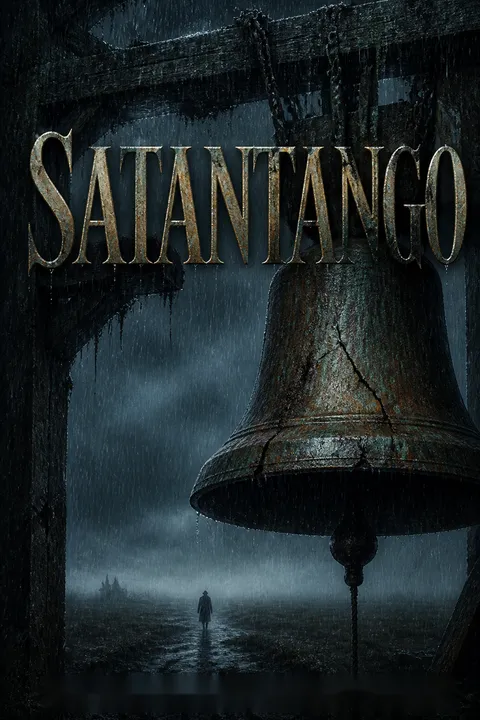
The Bells Over Szikes
Before dawn, the lame machinist Futaki wakes to bells no one else seems to hear. Their brief ringing sharpens his fear that he is trapped on the failing estate, and he vows to leave. Instead, he discovers his neighbor Schmidt preparing to slip away with money earned from the estate’s poultry.
Futaki blocks him, learns that Kráner is part of the scheme, and insists the cash be divided rather than stolen outright. As the rain closes over the fields, Mrs. Schmidt packs for departure and the men wait for night. Then word arrives that Irimiás, the charismatic former manager everyone thought dead, is coming back. Futaki abandons his own plan to flee and heads for the bar.
The bells give private dread the shape of an omen, but the first tangible crisis is ordinary betrayal over money. Futaki’s decision to claim his share rather than expose Schmidt shows how survival on the estate depends less on trust than on negotiated complicity. His sudden hope in Irimiás is not evidence of a new possibility so much as a transfer of dependence: unable to imagine a future he can build, Futaki attaches himself to the return of someone who once seemed able to organize the world. The rain makes that choice feel both urgent and futile.
The Men Called Back
In town, Irimiás and his companion Petrina are summoned to a government office after returning from an unexplained absence. A new captain threatens them with imprisonment and orders them to work under his authority, though neither man is told plainly what the larger project involves.
At a bar, a strange humming unsettles the room; Irimiás responds with extravagant threats, then turns toward the estate, where he expects the residents to be waiting. On the road, they meet Sanyi, the adolescent Horgos son who had spread the story of their deaths. He reminds Irimiás of a promised reward for lying, then shows a photograph proving they are alive. Sanyi follows them, hungry for a place beside the man he admires.
Irimiás’s authority is established through performance before its source is explained. He can frighten a bar, unsettle Petrina, and make Sanyi trail him, yet the captain’s threats reveal that he too is constrained by forces above him. The office turns obedience into an administrative demand, while Irimiás turns it into personal charisma. Sanyi’s attachment adds a smaller, more intimate version of the same dynamic: he mistakes proximity to power for recognition. The humming, never explained, disturbs the ordinary world without clarifying it, preparing a story in which signs provoke action but rarely provide dependable knowledge.
The Doctor Leaves His Window
The estate doctor has arranged his life around a window, notebooks, measured drinks, and the careful placement of every object. When Mrs. Kráner says she can no longer fetch his supplies, he resents her and refuses to consider how dependent he has become. Needing more liquor, he sets out through the rain for the bar, stopping at the abandoned mill to warm himself beside the Horgos sisters.
Outside, little Esti clutches his coat, but the doctor impatiently shakes her off and follows when she runs. He collapses in a flooded ditch before reaching the bar. By morning, a passing driver has hauled him onto his cart and carried him toward town, leaving Esti alone in the storm.
The doctor’s system of observation appears to protect him from chaos, but its precision is purchased by shrinking his life until an ordinary supply problem becomes an emergency. His encounter with Esti exposes the moral cost of that retreat: he sees her as an interruption to his errand, not a child asking for help. The collapse then reverses his habitual position. The watcher becomes a body at the roadside, dependent on a stranger’s intervention. His notebooks record other people’s movements, yet this moment shows how little such attention guarantees when attention has become a substitute for care.
A Bar Waits for Resurrection
At the bar, driver Kelemen recounts meeting Irimiás and Petrina on the road, confirming Mrs. Halics’s report that the supposedly dead men are approaching. The residents gather in the storm, each turning the news into a private promise. Mrs. Schmidt imagines a more glamorous life beside Irimiás; the headmaster hopes to recover his former standing, while the others expect work, money, or simply a way out.
The landlord watches his stock and fears the return of a man who once claimed influence over his business. As the night stretches on, drink replaces waiting. Kerekes plays the accordion, Halics dances with Mrs. Kráner, and the headmaster dances with Mrs. Schmidt. By dawn, the exhausted company has collapsed among the bottles.
The bar becomes a theater where each resident rehearses a different future, but none asks what Irimiás can actually deliver. Their fantasies are sharply individual: romance for Mrs. Schmidt, restored status for the headmaster, escape for the others. The shared dance briefly makes the crowd feel like a community, though its warmth comes from drink and borrowed music rather than mutual understanding. The landlord’s anxious attention to his inventory counters their hope with a practical fear of loss. Their anticipation is already a form of surrender, because they have begun arranging their desires around a man who has not yet arrived.
Esti’s Money Tree
While the adults drink, Esti hides in an attic pigeon loft, believing Sanyi has entrusted her with a secret: money buried by the canal will grow into a tree. She adds her small savings and waters the spot, imagining that wealth will win her a safer place in the family. When she finds the hole disturbed, Sanyi admits he took the money and mocks her belief.
Esti has already stolen rat poison. Feverish and desperate to prove herself, she fights with the family cat, Micur, then forces the poison into the animal’s milk. Carrying Micur’s body, she finds the empty hole and wanders through the rain to the ruined Weinkheim estate. There she swallows half the poison and lies down beside the cat.
Sanyi’s invented tree turns Esti’s need for belonging into a task with a promised reward. She invests not only her coins but her faith in the brother who sometimes offers kindness and often uses her vulnerability against her. When the deception collapses, she tries to convert helplessness into power by mastering the cat, then converts that power into an act she cannot undo. The poisoned milk and the empty hole make the fantasy’s logic brutally concrete: both nourishment and wealth have been promised, but neither can sustain her. Esti’s private tragedy unfolds while the adults mistake their own gathering for the night’s central event.
Irimiás Claims the Blame
After Esti’s body is found near the ruined manor, Irimiás addresses the residents at the bar. He presents the death as a collective failure, describing how the child wandered near them while they drank and danced. The accusation makes the shaken group accept his authority as the person who can interpret their guilt and organize a response.
He then describes a proposed community on the estate, where shared work will supposedly provide security and dignity. When the residents offer their savings, Irimiás first acts reluctant to accept the sacrifice, then directs part of the money toward Esti’s funeral. He leaves them believing that their loss has been folded into the foundation of a better life.
Irimiás does not need to invent the residents’ shame; he gives it a script and a destination. By connecting Esti’s death to their drinking, he transforms diffuse remorse into obedience, then presents the cooperative scheme as a form of repair. His theatrical reluctance makes the offer of money feel voluntary, even as the group has been led to see him as the only person capable of rescuing them. The funeral contribution further binds hope to guilt. Their savings become more than cash: they are the price of believing that a preventable tragedy can be made useful.
Leaving the Estate Behind
The residents prepare to move to Almássy Manor, convinced Irimiás will restore the abandoned estate. The landlord, who has lost both customers and control of the plan, decides to return to town with his coffin and remaining possessions. Before departing, Kráner and his wife smash their furniture rather than leave it for others; the headmaster tears apart his door and window.
Futaki packs his few belongings but cannot make himself move at once, then watches the others gather at the engine house. They set off with carts and a wheelbarrow, celebrating as though the road itself confirms their freedom. After hours of rain and quarrels, they reach the manor, inspect its rotten rooms, and settle in for the night.
Their departure is not a clean break but an act of destruction that makes return harder. The smashed furniture and broken doors give physical form to their belief that the old life must be erased before a new one can begin. Yet the ruin they reach is not a ready-made refuge; it is a building whose grandeur survives only as a shell. Their celebration on the road briefly masks this mismatch. Futaki’s hesitation registers what the others suppress: leaving the estate removes familiar constraints without giving them control over what comes next.
Veils Above the Manor
As the villagers sleep in the manor, Irimiás, Petrina, and Sanyi approach by a shorter road. Near the overgrown park, they hear laughter and see a veiled body, resembling Esti, rise above the trees and vanish into the clouds. Petrina is terrified; Irimiás calls the sight a hallucination, though he admits it has frightened him.
Soon afterward he turns violently on Petrina, then continues into town with Sanyi. There, Irimiás seeks out Páyer, a dealer in weapons, and asks for supplies. He also arranges to borrow a truck from the bar owner, Steigerwald. The uncanny sight does not halt his practical work: he keeps moving toward the official and clandestine business that will determine the villagers’ next destination.
The vision briefly makes the residents’ account of Esti’s death seem unstable, but the men cannot establish what they saw or what it means. Irimiás’s quick dismissal protects his authority from the supernatural while his private fear complicates the image of him as an all-knowing guide. His assault on Petrina turns that fear outward, restoring hierarchy through force. Then weapons, a truck, and a meeting with Páyer pull the scene back toward logistics. In this novel, the uncanny does not replace material power; it appears beside it, equally resistant to explanation and equally capable of shaping behavior.
The Manor Becomes a Trap
At dawn, the villagers wake cold and hungry in the manor and begin to suspect they have been abandoned. Kráner calls the scheme a con, and Schmidt demands his money back from Futaki. When Futaki resists, Schmidt kicks him in the face, breaking the gathering into panic and accusation.
Irimiás arrives soon afterward and rebukes them for turning on one another. He says the manor plan must be suspended because officials oppose the location, then assigns each household elsewhere: Schmidt to a butcher in Elek, the Kráners to a tailoring business in Keresztúr, and the Halicses to an Evangelical rectory in Póstelek. He gives them small advances and orders them to observe their new surroundings. Futaki receives a night-watchman job and chooses to go alone.
The manor’s promise collapses not through a dramatic revelation but through practical reassignment. Irimiás converts the residents’ disappointment into another order, preserving their dependence by giving each household a task and a new place to wait. The instruction to observe turns ordinary employment into surveillance, while the modest advances make the separation appear manageable. Schmidt’s attack on Futaki reveals how quickly shared hope becomes a search for someone nearby to blame. Futaki’s choice to separate himself suggests a nascent resistance, though his battered body and limited options make independence less a victory than a lonely wager.
Lives Reduced to Files
After the residents are dispersed, government clerks work through a document describing them for the authorities. They struggle to convert Irimiás’s crude, contradictory character judgments into the polished language of an official report.
In the process, intimate weaknesses become administrative categories: Schmidt’s limited judgment makes him useful, the headmaster is labeled cowardly, and Futaki is described as both dangerous and valuable. The clerks compress the messy people they have never met into a file that can be stored and acted upon.
Their labor gives the captain’s earlier threats a paper form. The estate’s former community now exists across separate workplaces, while the state’s record gathers its members back together as objects of assessment.
The clerks’ painstaking edits expose bureaucracy as a machine for making uncertainty usable. They do not clarify Irimiás’s judgments so much as smooth them into forms the institution can retain. The report’s authority comes from its tone, not from reliable knowledge of the people described. Its labels also reveal how the state values subjects: not by their capacity for freedom, but by their usefulness, risk, and manageability. The residents have been dispersed geographically, yet the file makes them legible as a group again, bound by an unseen system of observation.
The Doctor Rewrites Dawn
After a hospital stay caused by his collapse, the doctor returns to his room and finds his possessions largely undisturbed. He resumes his notebooks, recording the neighbors’ likely movements and soon convincing himself that his written descriptions can influence what happens on the estate.
When bells ring again, he takes them as confirmation and follows the sound to the ruined chapel at Hochmeiss. There he finds a frightened old man ringing a small bell and shouting incomprehensibly.
The doctor recognizes that his supposed heavenly summons was an ordinary, distressing sound. Back in his room, he nails the door shut, settles beside his window, and begins writing about the morning Futaki first heard the bells. The narrative ends where his new account begins.
The doctor’s discovery of a power to shape events is presented as a fragile delusion built from years of observing without participating. The chapel visit punctures his interpretation of the bells, but it does not restore him to shared reality. Instead, he closes off his room and turns back to writing, converting failure into the beginning of another record. The ending makes the narrative itself part of the doctor’s attempt to impose sequence on disorder. His return to the opening does not resolve the estate’s fate; it shows how easily a closed system can mistake repetition for control.
Analysis
Satantango depicts a community whose poverty is material, but whose deeper deprivation is the loss of credible ways to act together. The estate’s residents can recognize decay in roofs, wages, roads, and bodies, yet they cannot coordinate a response without handing authority to someone who claims to understand the whole. Irimiás exploits that need without being a simple outsider: he too is pressured by official power, and his charisma may be as much a tool for survival as a sign of mastery. The result is a chain of delegated hopes. Each person waits for another person, an institution, a promised job, or a supernatural sign to make the next step possible.
The doctor offers a private counterpart to this collective dependence. He seeks mastery by recording the world from behind his window, converting neighbors into entries and movements into evidence. His belief that writing can shape events is extreme, but it grows from the same impulse that animates Irimiás’s plans: the refusal to accept that human intention may have little leverage over circumstance. The novel does not simply ridicule that impulse. It shows why people need it, then measures its cost when they mistake a story of control for control itself.
Esti’s tragedy is the sharpest measure of the adults’ failures. While the residents gather to await rescue, a child tries to earn affection through a fabricated promise and is left alone with the consequences. Irimiás turns her death into a moral summons, but his speech also redirects the survivors’ grief into obedience and investment. The novel’s circular structure keeps that transformation from feeling like resolution. Departures happen, assignments are made, records are filed, and the doctor begins again. Motion continues, but the book refuses to certify it as progress.
Review Summary
Reviewers of Satantango largely praise its hypnotic, demanding prose style — long, unbroken paragraphs that mirror the novel's themes of cyclical despair and stagnation. Set in a decaying Hungarian village, the book follows desperate inhabitants awaiting a possibly fraudulent savior, serving as both political allegory and universal meditation on human weakness. Comparisons to Kafka, Beckett, and Bernhard are frequent. Some readers find the deliberately oppressive style rewarding; others find it impenetrable. The 2025 Nobel Prize award brought renewed attention to this widely considered masterpiece.
People Also Read





Characters
Futaki
The doubtful machinistA lame former machinist who remains on the estate after its collapse, Futaki is alert to danger but repeatedly tempted by the promise that someone else can restore order. His physical pain and his memories of skilled work give him a practical sense of what is broken, yet he struggles to turn that knowledge into an independent plan. He is capable of suspicion, as his confrontation with Schmidt shows, but suspicion does not free him from dependence on Irimiás. Futaki’s inner life moves between dread and hope, and he often mistakes a brief reprieve from despair for proof that circumstances have changed.
Irimiás
The returning organizerA former manager of the estate, Irimiás has a commanding presence and a gift for making people feel that their confusion has a purpose. He speaks in plans, assigns roles, and can turn a crowd’s shame or frustration toward a goal he defines. Yet his dealings with officials show that he is not wholly free to act, and his confidence sits beside signs of strain and anger. To the residents, he represents competence and possibility; to his companion, he is at once leader and unpredictable master. His influence rests on a mixture of real practical skill, carefully staged concern, and the hopes others place in him.
The Doctor
The watchful recluseThe unnamed doctor has withdrawn from medical practice into a tightly managed room overlooking the estate. He records the weather, the residents, and the placement of objects, treating observation as a defense against decay and forgetfulness. His need for order is not simply professional; it protects him from the demands of other people and from his own fear of bodily decline. He relies on neighbors for supplies while resenting their intrusion, a contradiction that leaves him isolated but never truly self-sufficient. His notebooks give him a private structure for experience, even as their precision reveals how narrow his contact with life has become.
Esti
The overlooked youngest childThe youngest Horgos child is a withdrawn girl whose family treats her as troublesome and unreliable. Having been removed from special schooling and pushed out of household work, she has learned to survive by watching doors, hiding in unused spaces, and waiting to be summoned. Her inner life is vivid, shaped by imagined safe places, memories of her father, and a longing to be trusted by her older brother. She is unusually receptive to promises that offer her a role or a future, because ordinary family life has given her little sense of agency. Her attention to small details coexists with an urgent need to believe.
Petrina
The anxious companionPetrina travels with Irimiás and serves as his uneasy, talkative counterweight. Physically awkward and quick to complain, he is also loyal, observant, and more frightened than he wants others to know. He tries to understand Irimiás’s plans but is often excluded from them, leaving him to fill the gaps with jokes, guesses, and appeals to common sense. His mixture of bravado and panic makes him both comic and vulnerable. Petrina’s loyalty is genuine, though it rarely gives him equal standing with the man he follows.
Schmidt
The volatile neighborSchmidt is Mrs. Schmidt’s husband and one of the estate’s restless laborers. He wants enough money and security to escape, but his impatience often turns into anger at the people closest to him. His arrangements with Kráner reveal his willingness to maneuver for advantage; his later conflicts reveal how quickly fear can make him violent. Schmidt mistrusts Irimiás and resents Futaki’s influence, yet he remains vulnerable to the same hopes that draw the others into the organizer’s plans.
Mrs. Schmidt
The ambitious dreamerMrs. Schmidt is married to Schmidt and imagines escape through a life more glamorous than the estate can offer. Her confidence and sensual presence attract several men, but her deepest hopes center on Irimiás and the future she associates with him. She is not merely a romantic fantasist: she recognizes the limits of her circumstances and hungers for a chance to remake herself. Her expectations make her especially susceptible to promises that combine personal attention with a route away from poverty.
Kráner
The forceful farmerKráner is a physically imposing farmer married to Mrs. Kráner. He drinks heavily, quarrels easily, and likes to take charge, especially when others appear uncertain. His confidence can rally the residents, but it also sharpens competition and resentment among them. Beneath his bluster is a practical desire for work, money, and a more durable place to live. He is drawn to collective schemes when they seem to promise action, though he is quick to accuse others when those schemes disappoint him.
Mrs. Kráner
The commanding spouseMrs. Kráner manages much of the practical work around her marriage to Kráner and is more forceful than her husband in many domestic situations. She can pack, plan, scold, and improvise under pressure, but she also participates in the estate’s drinking and flirtations. Her interest in leaving is grounded in the hard limits of their present life, even when she adopts the group’s hopeful expectations. She is a capable organizer whose confidence can become destructive when departure feels like the only meaningful action.
Halics
The timid revelerHalics is Mrs. Halics’s husband, a small, timid man who seeks shelter in drink and company. He is easily intimidated, yet the bar’s music and noise can briefly make him feel bold and admired. His passivity frustrates his wife, who sees him as morally and practically inadequate. Halics often notices how little control he has over events but prefers temporary comfort to confrontation, making him both a target of other people’s judgments and an accomplice to his own inertia.
Mrs. Halics
The apocalyptic believerMrs. Halics is a religiously intense woman who reads events through sin, judgment, and divine purpose. Her faith gives her a sense of moral height in a community she regards as corrupt, while her marriage to Halics deepens her contempt for ordinary weakness. She is capable of recognizing danger, but her certainty can turn rumor into revelation and make her an unwitting participant in the crowd’s excitement. The Bible is both comfort and instrument: it allows her to interpret a world she otherwise cannot control.
The Headmaster
The displaced schoolmasterThe unnamed headmaster is an educated man whose school and former authority have disappeared along with the estate’s institutions. He still imagines himself as a natural leader and looks for signs that his status might be restored. His self-importance masks insecurity, especially in his romantic fantasies and his need to be treated with respect. He wants order and recognition, but he is as dependent on Irimiás’s plans as the people he privately considers beneath him.
The Landlord
The wary bar ownerThe landlord runs the estate’s bar and measures its troubles in bottles, debts, and lost customers. He is calculating and self-protective, but his ambition exceeds the modest business he has built. Irimiás’s return threatens his claim to success and his control over the room where the residents gather. The landlord understands how desire and resentment move through the crowd, yet he cannot make that knowledge protect his livelihood.
Sanyi Horgos
The scheming older brotherSanyi is Esti’s older brother, a sharp-tongued adolescent who knows how to exploit other people’s hopes. He tells Irimiás’s supposed death story and expects a reward, then invents the money tree to draw Esti into his private scheme. His behavior mixes calculation with cruelty, but his admiration for Irimiás also makes him eager to be accepted by a powerful adult. Sanyi wants money, independence, and recognition, though he rarely considers the cost his schemes impose on his sister.
Mrs. Horgos
The hard-pressed motherMrs. Horgos is the mother of Esti, Sanyi, and the older Horgos girls. She drinks, complains, and struggles to manage a household already strained by poverty and family conflict. Her authority is inconsistent: she can order her children around but offers Esti little protection or understanding. She is more concerned with immediate survival than with the inner lives of her children, a failure that helps make the family home another place from which Esti must hide.
Kelemen
The returning bus driverKelemen is a local driver whose account of meeting Irimiás and Petrina carries news back to the estate. He is talkative, defensive, and often drunk, so listeners doubt his details even when they believe his main point. His story helps transform rumor into collective expectation.
Kerekes
The blind accordion playerKerekes is a blind farmer who drinks at the bar and plays the accordion when the others demand music. His physical strength and musical skill make him part of the gathering, though he remains apart from its arguments. The instrument briefly gives the room a shared rhythm.
The Captain
The official enforcerThe captain is the government official who summons Irimiás and Petrina and insists they work within his authority. He speaks for a system that values compliance, yet his own position is guarded by threats, paperwork, and force. His polished appearance contrasts with the decaying offices around him.
Páyer
The arms dealerPáyer is a sleepy, self-possessed weapons dealer whom Irimiás approaches for supplies. He treats dangerous business as routine commerce and expects payment for his cooperation. His dry manner gives the town’s shadowy negotiations an air of ordinary business.
Tóth
The bar acquaintanceTóth is a bald acquaintance Irimiás and Petrina meet in a town bar. He is sociable and eager for news, but his conversation also reflects a life of small acquisitions and routine local politics. He briefly connects the pair to the ordinary world beyond the estate.
The Horgos Sisters
The stranded older sistersEsti’s older sisters work at the abandoned mill and complain about the money and responsibility demanded by their family. Their quarrel reveals a household in which each person is trying to escape dependence without offering much care to the others. They share Esti’s cramped circumstances but respond to them with anger and resignation.
Plot Devices
The Unplaced Bells
A signal without certaintyThe doctor and Futaki hear bells whose source is unclear. The sound draws Futaki’s attention to the possibility of change and later sends the doctor toward the ruined chapel. Its apparent significance is repeatedly larger than the evidence supporting it, making the bells a test of how fear and hope turn ambiguous sensations into instructions.
Irimiás’s Promise
Hope as leverageIrimiás’s proposed cooperative gives the estate residents a concrete image of work, security, and escape. Because the plan answers needs they cannot meet alone, the villagers offer money and accept his direction. When the manor scheme is suspended, he replaces it with jobs in distant places, keeping them attached to a future he continues to define. The promise operates as both motivation and leverage.
The Observation Network
People turned into informationIrimiás orders the scattered residents to watch their surroundings and report what they learn. The government paperwork later turns those observations and personal descriptions into official records. The network links remote workplaces to institutional power, while presenting surveillance as useful work and mutual responsibility. It echoes the doctor’s private habit of recording the estate, though his notebooks seek control through observation rather than through organized reporting.
The Doctor’s Notebooks
Order written against decayThe doctor keeps notes on the estate, his neighbors, the weather, and the arrangement of his room. At first the notebooks preserve observations and defend the routine that lets him remain apart. Later he begins to believe his descriptions can affect what people do. The notebooks therefore shift from records into a possible instrument of control, though the text leaves the doctor’s claimed power uncertain.
The Repeating Tango
A circle mistaken for progressThe book’s sections move forward through the estate’s collapse, then reverse their numbering and return to earlier events. The residents likewise leave one place only to enter another arrangement of dependence. The tango suggests motion that does not necessarily produce change: people circle through hope, conflict, and renewed obedience while the larger pattern remains difficult to escape.
Download PDF
Download EPUB
.epub digital book format is ideal for reading ebooks on phones, tablets, and e-readers.








