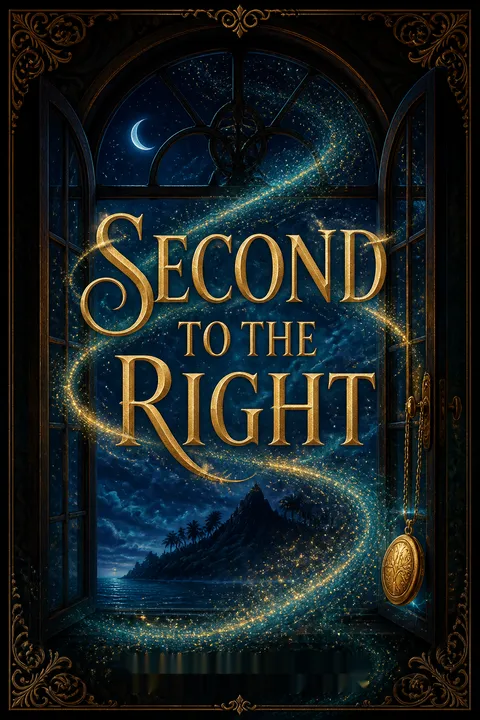


Plot Summary
Prologue
After returning through the Veil, Peter Pan watches Gwen from a tree outside her London home. She is an adult, unlike the girl he remembers from Wendy’s stories, and the acorn locket at her throat recalls the woman who once changed his life.
Peter hesitates to approach, then sees Gwen return from a night out in tears. Her grief pulls him toward the open window, though he knows bringing another Darling woman to Neverland could alter him again.
The prologue gives Peter the first move, but not the first explanation. His watchfulness makes Gwen the object of a decision before she knows a choice is being made, establishing a tension between romantic attention and intrusion. The locket links her to Wendy before Peter knows who Gwen is as an individual, suggesting that inheritance can become a script imposed by the living. His hesitation acknowledges the cost of attachment, yet he acts anyway. The prologue’s circular echo of Wendy’s first encounter with Peter promises a retelling while quietly warning that repetition does not guarantee the same outcome.
Gwen's Eighteenth Birthday Breaks
Gwen turns eighteen while caring for Michaela, her older sister, whose cancer has returned despite another remission. At the club, Michaela gives Gwen their family’s acorn locket, a keepsake bearing a reminder to live in the face of death. Gwen then finds Jamie, the boyfriend she has trusted, kissing Bella, his former girlfriend.
When he grabs Gwen’s wrist and refuses to let her leave, she knees him and escapes to Michaela. Back home, grief and anger drive Gwen to sweep her vanity onto the floor. Peter appears in her bedroom and identifies her as a descendant of Wendy Darling. Still shaken and intoxicated, Gwen accepts his invitation to Neverland and leaves London with him.
Gwen’s birthday concentrates the novel’s competing forms of inheritance: the locket passes down a family history, while Michaela’s illness makes the future feel frighteningly short. Jamie’s betrayal compounds Gwen’s old burden of caring for others with the humiliation of having trusted the wrong person. Her escape is not a simple rejection of responsibility; she leaves while still emotionally tethered to Michaela. Peter’s arrival offers wonder at the precise moment Gwen is most vulnerable, making the invitation both liberating and ethically uneasy. The story begins by asking whether choosing pleasure can be an act of self-recovery, or merely another decision made before its costs are visible.
A Camp Above the Ground
Gwen wakes in Neverland beside Lilleybell, Peter’s jealous faerie, who resents her arrival and mocks the fact that Peter chose Gwen over her sick sister. Gwen defends Michaela, then walks away before the insult can turn into a fight. Peter and the Lost Boys find her in the forest and invite her to Mermaid Lagoon.
There she meets Ryder, the playful flirt; Tripp, the attentive protector; and Eben, the guarded fighter, whose restraint only sharpens Gwen’s curiosity. Peter shows her the island from a treetop lookout, but the beauty cannot erase her worry about Michaela and the life she left behind. The boys’ attention tempts her to stay long enough to discover what Neverland offers.
Neverland welcomes Gwen through abundance, but its social structure immediately makes belonging conditional. Lilleybell treats Gwen as a rival and invokes Michaela’s illness as a weapon, turning Gwen’s most private fear into a public test. Gwen’s defense of her sister establishes that her loyalty is not a decorative virtue: she will risk acceptance rather than let someone demean Michaela. The Lost Boys offer a contrasting form of kinship, with distinct styles of care and attraction. Yet the forest’s beauty and their warmth do not resolve Gwen’s obligations. Her first choice to remain is therefore provisional, made between the relief of escape and the fear that escape might become abandonment.
The Lagoon Changes Everything
On the rough trail to the lagoon, Tripp catches Gwen when she jumps from a ledge and promises to keep her safe. The mermaids welcome Peter but turn hostile when they notice Gwen, confirming that Neverland’s beautiful inhabitants can also be dangerous. Peter later kisses Gwen in a hidden grotto, then abruptly withdraws, saying he cannot pursue her.
Before Gwen can make sense of the rejection, the Lost Boys spot the Jolly Roger near Fae territory and leave to investigate. In the rain, Gwen kisses Eben, who answers with unexpected intensity. Ryder catches them, but keeps his disappointment playful. The storm forces the group back to camp, where Gwen is left wondering whether Peter’s retreat means indifference or fear.
This section makes attraction inseparable from risk. Tripp’s catch offers a physical image of dependence that Gwen welcomes after years of carrying responsibility alone, while the mermaids expose the danger hidden beneath Neverland’s glamour. Peter’s interrupted kiss destabilizes the emotional refuge he has offered; Gwen answers that uncertainty by choosing Eben, but her choice is also a bid to recover agency after rejection. Ryder’s response keeps the group’s affection from becoming a simple contest, though it does not erase the possibility of hurt. The sudden appearance of the pirate ship shifts the romance into a larger conflict, ensuring that Gwen’s emotional decisions will unfold inside a world with real consequences.
Hook's War Still Burns
While the storm traps Gwen at camp, Ryder explains that Captain James Hook survived the famous battle and returned to Neverland with a rebuilt crew and a trained crocodile. Peter had been left alone after Wendy took the original Lost Boys home, and the island suffered as his grief deepened. Ryder also describes how Peter gathered the current Lost Boys, including himself, after each boy had fled a painful life beyond the Veil.
The next morning, Peter apologizes for leaving Gwen behind and agrees to take her to observe the pirates, though he insists the outing must remain reconnaissance. Lilleybell supplies faerie dust after Eben bargains with her. Peter’s promise draws Gwen toward danger, while the boys begin preparing her to face it.
Ryder’s account revises a childhood ending into a political history. Wendy’s departure was not a neat conclusion for Peter; it left a vacuum that weakened the island and gave Hook room to return. The Lost Boys’ arrivals reveal another side of Neverland: it is both a refuge for abandoned young men and a community whose safety depends on Peter’s leadership. Gwen’s request to see the pirates tests the difference between being protected and being treated as capable. Peter’s reluctant agreement preserves that tension. The faerie dust is not merely magical equipment; it shows how access to power depends on negotiation, especially when Lilleybell’s jealousy makes cooperation precarious.
Trust Becomes a Test
At the practice field, Eben teaches Gwen to throw faerie-dusted knives and gives her a set of her own. That evening, a game of Trust or Faith exposes that Gwen has kissed Eben, provoking Peter’s jealousy. When Eben asks whether Peter will share Gwen, Peter condemns the idea and accuses Eben of treating her casually.
Their argument turns into a fistfight until Gwen stops them and insists she can choose her own lovers. Peter later apologizes but still refuses to offer her a relationship. Gwen spends the night beside Ryder and Tripp, then slips away at dawn to find Eben. He admits his feelings have become more than lust, returns to her the kiss, and prepares her for the pirate expedition.
The game converts flirtation into a question of power: who gets to define Gwen’s place among the Lost Boys, and who gets to decide what her desire means? Peter frames restraint as protection, but his refusal to explain himself leaves Gwen to bear the emotional cost. Eben’s challenge exposes how the brothers’ loyalty can harden into possessiveness, while Gwen’s intervention rejects both a pedestal and a permission system. Her quiet night with Ryder and Tripp shows that affection need not be reduced to a single rivalry. Seeking Eben at dawn, she turns from being discussed to initiating the next encounter, a small but consequential reclamation of choice.
The Jolly Roger Attacks
With Lilleybell accompanying them, the group reaches the bay and discovers the pirates have lured them into danger. Lilleybell’s careless presence helps expose their position; a cannon blast scatters the Lost Boys, and a pirate drags Gwen toward the shore. She breaks his nose, then stabs him with one of Eben’s knives, but he tears away her locket before she escapes.
Gwen runs into Hook, whose striking appearance unsettles her, and Peter carries her out of the battle. At the grotto, Peter stops treating his feelings as a danger he can avoid: he admits he wants Gwen despite the pain he expects when she leaves. They become lovers, and Peter agrees to let the other Lost Boys pursue her too.
The attack forces the story’s romantic fantasy into contact with bodily danger. Gwen’s knife training pays off when she uses the weapon to escape, but the loss of her locket makes survival emotionally costly: the object is her remaining link to Michaela and home. Hook’s first appearance complicates the familiar division between hero and villain by provoking attraction even as he represents a genuine threat. Peter’s confession follows Gwen’s near capture, exposing how fear of loss has governed his earlier distance. His agreement to share her is not a frictionless resolution. It is an attempt to choose intimacy without controlling Gwen, while accepting that the arrangement will test his jealousy and the brothers’ bonds.
Pleasure Blurs the Calendar
After the battle, Gwen reunites with Ryder, Tripp, and Eben, and the Lost Boys confirm Peter’s decision to let them pursue her. During the spring-cleaning celebration, they offer Gwen Lush, a ceremonial tea that intensifies sensation. She chooses to drink it, and the four share an intimate night that leaves her feeling cherished rather than responsible for everyone else.
As the days pass, Gwen briefly forgets Michaela’s name, then retrieves it through the locket’s inscription and is alarmed by how easily Neverland blurs her memories. May Day arrives before she feels ready. The nymph Amara prepares Gwen for the festival, creating a flower dress for her, while Peter gives her a replacement acorn pendant after the original locket was lost.
The group’s intimacy gives Gwen an experience of care that does not require her to earn it through service. Her decision to take Lush is presented as a choice, but the tea also makes the boundaries of choice worth scrutinizing: heightened sensation can deepen connection while narrowing reflection. The more consequential danger comes from time and memory. Gwen’s momentary inability to recall Michaela’s name converts a fantastical escape into a threat to the person who anchored her life. The locket works as more than a sentimental heirloom; it helps her resist the island’s pull. Peter’s replacement pendant offers affection, but cannot substitute for the memories bound to the original.
May Day Turns to Capture
At the May Day gathering, Peter presents Gwen with a new acorn pendant and brings her to Tiger Lily, the Fae princess who helps govern Neverland. As the celebration’s rites begin, pirates breach the village defenses. Peter sends Ryder and Tripp to fight and assigns Eben to guard Gwen, while Tiger Lily takes her into a fortified house.
There she shows Gwen a journal kept by Tinkerbell, which describes Peter’s earlier attempt to keep Wendy in Neverland. Tiger Lily argues that Peter is repeating that pattern and that Gwen’s fading memories will make her forget why she must return. Hook appears, and Tiger Lily’s claim that Gwen is leaving willingly collapses when Gwen sees Eben is gone. Hook takes her to the Jolly Roger.
The festival’s public promise of fertility and renewal is abruptly replaced by military disorder, making the community’s rituals look vulnerable rather than timeless. Tiger Lily’s journal gives Gwen evidence that Peter’s history may include coercion, but the document does not settle whether his present intentions are identical. Its force comes from timing: Gwen is already losing memories and has just accepted a replacement for the object that ties her to home. Her trust fractures before she can test the evidence with Peter. The apparent absence of Eben turns suspicion into certainty for her, though the narrative has not yet established why he left. Hook’s intervention exploits that uncertainty and converts romantic doubt into physical captivity.
Hook Returns the Locket
Aboard the Jolly Roger, Hook returns Gwen’s original locket, and its photograph and inscription restore her memories of Michaela. He tells her that time in Neverland has passed differently, perhaps weeks or months, and Gwen fears what that absence has cost her sister. Though Hook offers her a life at sea, Gwen asks instead to write a farewell letter for Peter and the Lost Boys.
In a charged encounter, she accepts Hook’s promise to deliver it and chooses sexual intimacy with him, even as captivity and alcohol complicate the freedom of that choice. She writes the letter, then leaves with Lucius, a prince who escorts her through the Veil. Hook remains aboard his ship, and Gwen returns to London alone.
The restored locket reverses the erosion of memory, but it also makes Gwen confront the time she has lost. Hook uses accurate information and a real act of restitution to become more persuasive, not necessarily more trustworthy. His offer of a letter gives Gwen a concrete reason to negotiate with him, while the sexual encounter exposes the novel’s sharpest ambiguity around consent: Gwen expresses desire, yet she is captive, intoxicated, and dependent on Hook to fulfill her request. The scene resists a clean label of either uncomplicated romance or simple coercion. Gwen’s return is an act of loyalty to Michaela, but it carries grief for a world and relationships she cannot yet understand.
London Cannot Be Escaped
Lucius brings Gwen to her childhood home, where she finds Michaela alive but visibly weakened and receiving hospice care. Gwen tells her sister what happened in Neverland, and Michaela believes her. Gwen begins making plans to sell the house and seek better cancer care, determined to resume the role of protector.
Michaela stops her: she has accepted that she is dying and does not want Gwen to erase her own future in service to an inevitable loss. She urges Gwen to return to Neverland and pursue the people she loves. The book ends Gwen’s London reunion with that choice unresolved. She has recovered the reason she came home, but must now decide whether loyalty means staying beside Michaela or honoring her sister’s wish.
The reunion transforms Gwen’s sense of duty rather than simply relieving it. Michaela is not a passive object of care; she names the cost of Gwen’s self-erasure and refuses to let illness dictate her sister’s whole future. Gwen’s plan to sell the house shows how quickly she tries to regain control through practical labor, but Michaela redirects the question from logistics to desire. Their conversation complicates the assumption that sacrifice is the purest form of love. The ending leaves Gwen’s decision open, preserving the conflict between finite time with a dying sister and a possible life beyond the Veil. Her return home becomes a threshold, not a conclusion.
The Council Forbids Rescue
In Neverland, Peter destroys the old underground home in anger after Gwen’s departure. Eben returns and explains that Lilleybell summoned him to help carry an injured faerie named Silas; he believed Gwen was safe with Tiger Lily and did not know Hook would take her. Peter accuses him of failing her, but the Neverland Council interrupts before the brothers can settle the matter.
Tiger Lily claims Gwen chose the pirates, and the Pixie Elders and Nico vote against a rescue. Even Tiger Lily breaks the tie against Peter, framing his attachment as a threat to his duty. The Council orders him to obey. Peter refuses to accept the ruling and asks the Lost Boys to choose whether they will stand with him.
The final shift into Peter’s perspective reclassifies an apparent betrayal as a disastrous error of trust: Eben left for a concrete debt, not to abandon Gwen. That correction does not undo the harm, but it exposes how quickly fear turns incomplete evidence into certainty. The Council’s vote makes private attachment a matter of governance, treating Peter’s love as a danger to the island rather than a human bond. Tiger Lily’s testimony and Tinkerbell’s journal leave the truth contested, while the refusal to rescue Gwen raises the stakes beyond romance. Peter’s ultimatum to the Lost Boys ends the book not with a rescue, but with a fractured community poised to choose sides.
Analysis
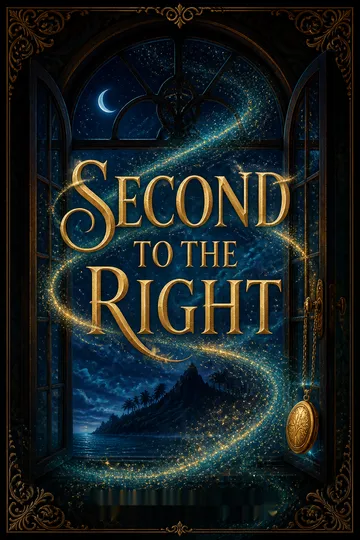
Second to the Right recasts Neverland as both refuge and risk. Gwen arrives after betrayal and exhaustion, and the island gives her sensory abundance, erotic attention, and a community that does not ask her to be a caretaker first. That relief is real, but it is not free: time slips, memory thins, and Peter’s history with Wendy makes desire vulnerable to repetition. Gwen’s central struggle is not simply whether to stay with a lover. It is whether self-sacrifice is the only form of loyalty she trusts, and whether pleasure can coexist with responsibility.
The book complicates romantic protection by placing it beside control. Peter’s fear of losing Gwen can look like devotion, but his past behavior and the Council’s scrutiny make his motives difficult to read. Gwen repeatedly asserts that she chooses her partners, while her captivity aboard the Jolly Roger tests how meaningful consent remains when power and survival are unequal. Her encounters are not interchangeable: affection, jealousy, pleasure, and danger carry different consequences in each relationship.
Objects and rituals externalize what Gwen struggles to hold internally. The locket preserves her bond with Michaela; faerie dust makes belief a condition of movement; May Day links desire to the island’s survival. The ending refuses a simple resolution. Michaela urges Gwen toward a life of her own, while Peter faces a Council that forbids rescue and a group of brothers who must decide whether to follow him. The story closes on competing loyalties, leaving Gwen’s freedom and Neverland’s future unsettled.
Review Summary
Second to the Right receives mixed reviews, with an average rating of 3.58/5. Some praise its steamy Peter Pan retelling and enjoyable characters, while others criticize poor writing, lack of plot, and underdeveloped world-building. Positive reviews highlight the sexy Lost Boys and Hook, while negative reviews cite issues with grammar, pacing, and character development. Many readers find the protagonist Gwen annoying and the relationships rushed. Despite criticisms, some readers eagerly anticipate the sequel, while others DNF'd or regret reading it.
People Also Read

Characters
Gwendolyn Mary Darling Carlisle
The reluctant runawayGwen is an eighteen-year-old Londoner, Wendy Darling’s descendant, and Michaela’s younger sister. After losing her parents, she has taken on work, study, and much of her sister’s care, leaving little space for her own wants. Jamie’s betrayal sharpens her fear that trusting someone means becoming vulnerable to harm. In Neverland, curiosity and desire draw her toward Peter and the Lost Boys, but she repeatedly insists that attraction must remain her choice. Her self-protective instincts compete with a powerful sense of responsibility, especially when she considers Michaela’s illness. Gwen’s development centers on learning to recognize care as something she may receive, not only something she must provide, while confronting the cost of choosing between two worlds.
Peter Pan
Neverland's guarded protectorPeter leads the Lost Boys and acts as one of Neverland’s protectors. Wendy’s departure left him with a history he conceals behind confidence, adventure, and a refusal to admit how deeply he can be hurt. Gwen’s resemblance to Wendy’s family draws him toward her, but he also recognizes that his attachment could affect both her freedom and the island’s balance. He is protective, impulsive, and uncomfortable with emotional uncertainty; his instinct is often to decide what is safest before explaining his reasons. Around Gwen, jealousy unsettles his authority and forces him to reckon with the difference between protecting someone and controlling the terms of her life.
Michaela
Gwen's fierce older sisterMichaela is Gwen’s older sister and closest remaining family. Cancer treatment has left her physically frail, but her humor, directness, and concern for Gwen remain strong. She sees through Gwen’s defenses and challenges her when caretaking becomes a way to avoid having a life of her own. The family locket links the sisters to their mother and to generations before them, giving Michaela a tangible way to pass on both memory and affection. Her relationship with Gwen is loving but not sentimental: she wants her sister to be present with her, without making herself disappear in the process.
Tripp
The steady guardianTripp is one of Peter’s Lost Boys, a patient and observant man whose calm manner makes Gwen feel safe. He helps her navigate Neverland’s rough paths, asks about her life without forcing her to disclose more than she wants, and notices how much responsibility she carries for Michaela. His instinct is to protect, but he also encourages Gwen to keep hold of her own identity. Tripp’s polished courtesy can conceal a more forceful passion, a contrast that makes him difficult to reduce to a simple gentlemanly type. His bond with the other Lost Boys is familial, and his care for Gwen grows within that shared loyalty.
Ryder
The generous charmerRyder is a sociable Lost Boy whose humor softens tense moments and draws Gwen into the group. Beneath his flirtatious confidence is an old wound: he left a loving family after struggling with reading and believing he could not meet their expectations. He is candid about his feelings and careful not to treat Gwen as a disposable conquest, despite his reputation for casual encounters. Ryder also serves as a storyteller, giving Gwen the history that Peter is reluctant to share. His warmth makes him an emotional bridge between Gwen and the Lost Boys, while his insecurities reveal how much belonging matters to him.
Eben
The watchful fighterEben is a skilled fighter whose brooding reserve makes his attention difficult for Gwen to interpret. He gives her faerie-dusted throwing knives and patiently teaches her to use them, combining practical care with a guarded emotional life. His relationship with Lilleybell is casual and complicated, while his attraction to Gwen unsettles the distance he usually maintains. Eben is perceptive about Peter’s fear and about Gwen’s limited time in Neverland, even when he struggles to name his own intentions. His sense of obligation can pull him in conflicting directions, and his sharp humor appears most clearly when he feels safe among the other Lost Boys.
Captain James Hook
The alluring adversaryHook is Peter’s old enemy and captain of the Jolly Roger. He is disciplined, theatrical, and dangerous, with a cultivated appearance that challenges Gwen’s inherited image of a traditional pirate. His rivalry with Peter is personal as well as military, and he uses patience and persuasion alongside force. Hook notices Gwen’s divided loyalties and offers her things she urgently wants, including the return of her locket and a chance to communicate with the Lost Boys. His appeal lies partly in his ability to recognize her desire for freedom, though the power imbalance between captor and captive makes his attention unsettling.
Tiger Lily
The island's political guardianTiger Lily is a Fae princess and a leader responsible for the safety of her people. She regards Neverland’s stability as a duty that outranks personal affection, and she expects Peter to serve the island before his own desires. Her confidence and command of ceremony give her authority, but her private decisions reveal how far she will go to protect the order she believes in. She and Peter share a long history that includes friendship and intimacy, though their loyalties do not always align. Gwen’s arrival challenges Tiger Lily’s judgment about what Peter’s attachment may cost the island.
Lilleybell
Peter's jealous faerieLilleybell is Peter’s faerie companion, able to shift between a tiny winged form and a human-sized one. Her emotions are intense and focused, and jealousy often governs how she treats Gwen. She has a complicated, nonexclusive relationship with the Lost Boys, particularly Eben, and expects her place in their lives to matter. Her spite makes her a source of conflict, but her dependence on affection also makes her more than a one-note antagonist. Lilleybell’s access to faerie dust gives her influence over the boys’ movement and plans, even when personal resentment clouds her judgment.
Jamie Holder
Gwen's unfaithful boyfriendJamie is the attractive boy Gwen has admired for years and recently begun dating. He presents himself as attentive, but dismisses Michaela’s concerns and treats Gwen’s trust carelessly. His conduct forces Gwen to confront how easily infatuation can make warning signs seem harmless.
Bella
Jamie's former girlfriendBella is Jamie’s former girlfriend, whose continued involvement with him exposes his dishonesty to Gwen. She acts with confidence in public and shows little concern for the damage her presence causes.
Tinkerbell
A faerie from Peter's pastTinkerbell is an earlier faerie companion of Peter’s. Her journal records her observations of his attachment to Wendy and gives Tiger Lily a historical account of events that Gwen herself cannot remember. Her perspective is useful but not neutral, since she writes from within a jealous and intimate relationship.
Lucius
The reluctant escortLucius is a prince from another realm who escorts Gwen through the Veil. Blunt and visibly displeased by the task, he nevertheless completes it and shows an unexpected interest in Michaela.
Amara
The generous mountain nymphAmara is an experienced mountain nymph who prepares Gwen for May Day. She treats Gwen with warmth, gives her a flower-made dress, and warns her not to mistake beauty for goodness.
Mira
The ocean nymph guideMira is an ocean nymph who helps guide Gwen through the communal bathing preparations before May Day. Her direct manner reflects Neverland’s unfamiliar customs.
Fauna
The outspoken forest nymphFauna is a forest nymph who helps prepare Gwen for the festival. Her blunt observations expose the social curiosity surrounding Gwen’s place beside Peter.
Smee
Hook's brutal boatswainSmee is a large, intimidating member of Hook’s crew who carries out his captain’s orders. His physical obedience makes him an immediate threat to anyone Hook captures.
Nico
The beasts' representativeNico is the eldest prince among the beasts and represents them on the Neverland Council. He supports the Council’s formal authority, even when Peter believes its decision is unjust.
The Pixie Elders
The faerie ruling councilThe Pixie Elders are Neverland’s senior faerie authorities and members of its governing Council. They value order and the island’s survival, often expressing judgment through collective decisions rather than individual relationships. Their allegiance to procedure places them in tension with Peter’s personal loyalties.
Plot Devices
The Acorn Locket
Memory's tetherThe locket passes through Gwen’s family and carries a photograph of Gwen and Michaela alongside an inscription about mortality. Michaela gives it to Gwen on her eighteenth birthday, making it both a gift of love and a reminder that their time together is finite. In Neverland, the locket helps Gwen recover her thoughts of home when the island’s influence begins to blur them. Its loss during the pirate attack deepens her vulnerability, while its return aboard the Jolly Roger reconnects her to Michaela. The object turns memory into something material: Gwen can hold it when the life she left feels distant.
The Veil
A door between livesThe Veil connects London and Neverland, allowing Peter to bring Gwen across and Lucius to escort her home. Crossing is not a simple journey: faerie dust and a happy thought enable flight, while time passes differently on either side. Gwen experiences only a short stay, but Hook warns that weeks or months may have passed in London. This gap makes the crossing a plot mechanism and an emotional pressure point. Every visit risks separation from loved ones and uncertainty about what has happened in the world left behind.
Faerie Dust
Flight through beliefFaerie dust allows people to fly when joined with a happy thought and enough belief. Peter uses it to bring Gwen to Neverland, and the Lost Boys depend on it for travel and reconnaissance. The dust is scarce when Lilleybell withholds it, so the boys must negotiate with her before approaching the pirates. This makes magic dependent on both an emotional condition and a relationship: Gwen cannot fly by technique alone, and the group cannot move freely without Lilleybell’s cooperation.
The May Day Rites
Renewal with a costSpring cleaning and May Day frame Neverland’s seasonal life. The Lost Boys prepare their camp, while the nymphs and satyrs treat the festival as a ritual that sustains the land through fertility and union. Lush tea heightens sensation during the celebrations, offering Gwen an intense experience of belonging. Yet the rites also mark time moving forward, and Gwen’s memories of home begin to fade as May Day approaches. The celebration is both a promise of renewal and a countdown to the choice between Neverland and London.
Tinkerbell's Journal
A contested recordTiger Lily uses Tinkerbell’s miniature journal to show Gwen how Peter behaved after Wendy left Neverland. Its entries describe Peter’s attempt to prevent Wendy’s return and the damage her departure caused him and the island. The journal supplies evidence that Gwen’s fear of being kept in Neverland is not baseless, but it reaches her through Tiger Lily, who has political reasons to prevent Peter from becoming emotionally compromised. The record therefore creates suspicion without resolving whether Peter intends to repeat the past.
The Neverland Chronicles Series

About the Author
Download PDF
Download EPUB
.epub digital book format is ideal for reading ebooks on phones, tablets, and e-readers.








