

Key Takeaways
A semicolon can create rhythm, speed, suspense, and productive uncertainty.
More than a pause. The semicolon is often taught as a boundary between sentence parts, but its effect depends on the writing around it. Raymond Chandler uses semicolons in his essays to give repeated judgments a firm, measured pulse. In his detective fiction, one rare semicolon appears as the usually guarded Philip Marlowe reflects on his lack of a real home, making the pause feel unusually vulnerable.
Speed has a sound. Irvine Welsh uses the mark to slip an extra thought into a narrator’s fast-moving voice. Rebecca Solnit uses successive semicolons to carry readers quickly across a series of claims. A semicolon can slow a sentence or propel it; its job is not defined by pause length alone.
The mark works like a control on rhetorical tempo. In music, a rest can create tension, but a quick transition can create momentum; punctuation can do both by shaping how readers group and anticipate ideas. This makes the semicolon less like a traffic signal with one fixed meaning and more like a cue interpreted through its surroundings. The approach also asks something of readers: pace and emphasis are not merely delivered by the writer, but assembled during reading. That flexibility is a strength, though it means no single punctuation rule can predict an effect in every voice.
Read punctuation at paragraph scale, where its real work becomes visible.
Follow the whole passage. Herman Melville’s Moby-Dick contains roughly 4,000 semicolons across about 210,000 words. His earlier Typee, about half as long, has roughly 845. The difference reflects more than sentence length: Moby-Dick wanders from whale hunting into science, religion, color, and human nature. Its semicolons help keep those excursions connected to the book’s larger movement.
Context changes the effect. A mark isolated in a sample sentence cannot show whether it builds character, sustains an argument, or carries a reader into a digression. The book’s close readings place punctuation inside paragraphs and whole works. That matters because a mark’s effect can be shaped by its neighbors, the narrator’s voice, and the reader’s expectations.
This method resembles analysis in film and music: a single frame or note rarely explains a scene or a composition. Context reveals function, while repetition reveals pattern. Melville’s semicolons become legible as part of a large-scale design rather than a tally of grammatical decisions. There is also a useful caution here. Punctuation can be altered by editors, printers, and later editions, so a close reading may establish what a mark does in a particular text without proving who chose it or why. Interpretation remains powerful, but its claims should match the evidence.
Learn punctuation as a changing practice, not a timeless code.
A mark was designed. The semicolon appeared in Venice in 1494, when printer Aldus Manutius included it in a book by Pietro Bembo. Its form joined a comma and a colon, and its intended pause fell between theirs. Early humanists experimented with punctuation, often treating it as a matter of a writer’s taste and a reader’s delivery rather than a system of fixed laws.
Rules gained authority. From the eighteenth century onward, grammar books increasingly presented English as a system that could be organized through rules. In the nineteenth century, grammarians promoted observation and sentence diagrams to make grammar resemble science, while arguing over how much punctuation could be governed. The semicolon’s modern reputation grew from this history, not from an eternal, self-evident function.
The history exposes a familiar error: once a convention becomes habitual, its origins disappear and it starts to feel like nature. That transformation is not unique to punctuation. Categories in law, education, and science can acquire authority through institutions and repetition, even when their boundaries were once debated. Watson’s account helps separate shared convention from timeless necessity. It does not follow that conventions are worthless; people need common expectations to coordinate. The key distinction is whether a rule is treated as a helpful agreement or as proof that every other practice is defective.
Notice when punctuation follows fashion, not immutable logic.
Marks go in and out. In the nineteenth century, grammarians described parentheses as outdated and advised writers to use colons sparingly. The semicolon, by contrast, became fashionable, taking work from both marks and, at times, from the comma. Goold Brown even argued that the semicolon’s very name depended on the continued use of the colon, yet his own enormous grammar book leaned heavily on semicolons.
Usage shifts around rules. Manuals tried to explain punctuation as a logical system, but writers’ habits were also shaped by changing taste. The semicolon’s rise and later narrowing show that punctuation does not simply progress toward a final, perfect code. A mark can feel elegant in one period and fussy in another, even when its basic shape and potential uses remain available.
Fashion is not the opposite of structure. A convention can spread because it feels useful, elegant, or socially current, then be justified afterward by a tidy explanation. This is a reminder to distinguish a rule’s rationale from the history of its popularity. It also complicates claims that one punctuation style is simply more natural: what feels effortless to a generation may be an inherited preference. Still, fashion alone cannot decide whether a choice works. The useful question is not whether a mark is fashionable, but whether it serves the passage’s purpose and audience.
A punctuation mark can change law, but cannot remove judicial bias.
A statute became a dispute. A Massachusetts liquor law passed in 1875 had a comma where a later printed version placed a semicolon. In 1900, a court read the semicolon as restricting late-night sales, including at hotels. The decision triggered years of public anger and legislative debate, until voters approved a change in 1906. The mark mattered, but so did competing accounts of the law’s history and purpose.
Interpretation has human stakes. In the 1916 trial of Irish nationalist Roger Casement, a comma in a later version of a medieval treason law figured in arguments over whether his actions abroad counted as treason. In 1927, Salvatore Merra was executed after a disputed reading of a jury verdict. These cases show that punctuation can become evidence, but it cannot settle meaning by itself.
Legal interpretation makes visible what ordinary reading can conceal: words do not apply themselves. Courts must decide which documents, precedents, and intentions matter, and punctuation can become a focal point for that discretion. The danger is not simply that a mark is ambiguous, but that institutions may treat one reading as inevitable while discounting alternatives. Transparent reasoning and attention to context are therefore more protective than pretending punctuation can eliminate judgment. At the same time, the cases do not show that punctuation is irrelevant; they show that its influence depends on human choices that should be examined.
Let ambiguity invite readers in when precision would flatten the thought.
Not every gap is a flaw. In the first edition of The Portrait of a Lady, Henry James describes a kiss and its aftermath with spare, suggestive language. When he revised the scene years later, he expanded the sentence and explained more of the character’s experience. The earlier version leaves room for readers to infer what the moment means; the revision narrows that room.
Uncertainty can do work. William James, Henry’s philosopher brother, argued that vague language can suit a subject whose boundaries are themselves unclear. The book also discusses a sentence by Ludwig Wittgenstein whose semicolon permits more than one reading, while a translator’s version resolves the uncertainty into a single proposition. Ambiguity is not always desirable, but it can make reading an act of participation rather than mere reception.
This is an important distinction between obscurity that blocks understanding and openness that generates it. In literature, an unresolved relation can let readers test interpretations against their own experience; in technical instructions or contracts, the same uncertainty may create avoidable risk. The value of ambiguity is therefore contextual, not absolute. James’s revisions also show how explanation can reduce imaginative labor while increasing certainty. A writer’s craft includes deciding which burden belongs to the reader: the work of inference can be frustrating, but removing every gap can leave a text with less life.
Develop stylistic control through close reading, not rule memorization.
Study choices in context. Watson describes teaching students who wanted to know how to make language do what they intended. Memorizing punctuation rules did not answer that question. A more useful practice is to read attentively, compare a writer’s choice with plausible alternatives, and notice what changes in rhythm, voice, or emphasis.
Slow down the eye. The book recommends copying passages by hand as a way to notice their construction. Chandler’s work offers a revealing contrast: his essays use semicolons confidently, while his detective novels rarely do. That difference suggests the mark serves the needs of a particular genre and narrator, rather than reflecting a writer’s simple preference or ability. Close reading turns punctuation from a test into a set of choices to examine.
The practice resembles deliberate study in music or visual art: copying a passage can make patterns perceptible that fluent reading skips over. It also develops a more useful kind of expertise than rule recall, because it asks what a form accomplishes under particular conditions. This is not an argument against reference books. A style guide can answer questions and keep a project consistent, especially when many people are editing together. But consistency is a production goal, not a full theory of good writing; stylistic judgment requires attention to effects and context.
Treat standard English as access to power, not proof of intelligence.
Form can carry an argument. In his “Letter from Birmingham Jail,” Martin Luther King Jr. uses a long sequence of semicolon-linked examples of segregation, delaying the conclusion that explains why waiting for change is intolerable. The sentence makes readers experience an accumulation of injuries before reaching its claim. Its formal, learned register also addresses the white clergymen who were among its intended readers.
Access is not neutrality. David Foster Wallace urged Black students to master Standard Written English because it carries influence in American institutions. Watson grants the practical stakes but criticizes placing the full burden of adaptation on students. The standard can provide access, yet treating it as the only legitimate way to speak can exclude people and mistake prestige for intellectual merit.
The distinction between access and superiority is crucial. A shared formal register can help a speaker enter institutions, while the institution’s preference for that register remains open to criticism. Sociolinguistic code-switching can be a resource, but it should not become an excuse for listeners to ignore ideas expressed differently. King’s passage also demonstrates that formal conventions can be repurposed: the semicolon helps make excluded experience audible within a register the audience recognizes. The challenge is to expand who must adapt, rather than making marginalized speakers solely responsible for translation.
Make understanding the goal before correcting someone’s grammar.
Rules have a limited job. Punctuation guides can help writers coordinate with readers, and rules can offer useful constraints, much like a poetic form. But no single manual captures every effective choice, and correctness alone cannot make writing persuasive, graceful, or humane. The book’s conclusion asks readers to treat rules as tools rather than as the outer boundary of language.
Correction can become evasion. Pointing out a grammatical error may distract from a person’s claim instead of answering it. Watson argues that language knowledge creates an opportunity to help communication, particularly when someone is learning English or using a less prestigious variety. The practical test is whether a correction clarifies something important or merely lets the critic avoid engaging with the message.
This principle connects linguistic judgment to conversational ethics: understanding requires attention to what a person is trying to communicate, not only to whether the form meets a preferred standard. That does not make all corrections petty. In safety instructions, legal documents, or collaborative editing, precision can prevent real confusion. The distinction is purpose and proportion. A correction that serves the reader is different from one used to rank the speaker. Treating rules as tools preserves their practical value without turning them into a substitute for listening.
Analysis
Watson’s central move is to turn the semicolon from a miniature grammar problem into a lens on how people make meaning. Its history links a Venetian printing innovation to centuries of disputes over taste, science, education, and authority. Its literary appearances demonstrate that punctuation can shape pace, voice, and uncertainty. Its legal appearances reveal a harder truth: even a seemingly precise text needs human interpreters, and those interpreters bring institutional power and social prejudice with them.
The book is especially persuasive when it shows rather than merely asserts that punctuation is contextual. Chandler’s different use of the mark in essays and detective fiction, Melville’s dense connective prose, and James’s revisions make the case through close reading. This method models a transferable skill: examine not only whether a sentence appears to obey a rule, but what its form does to the reader and to the surrounding argument.
The political argument extends the literary one. Standard English can be a passport into powerful institutions, but its authority should not be confused with intellectual superiority. King’s controlled register shows how convention can be used strategically; the critique of Wallace asks why the adaptation burden falls so often on those already excluded. The conclusion’s ethical emphasis on understanding follows from this history: grammar criticism can clarify communication, but it can also become a respectable-looking way to dismiss a speaker.
Two qualifications sharpen the book’s case. First, the history of punctuation destabilizes claims of timeless rules, but shared conventions still matter where ambiguity has practical costs. Second, close reading can explain an effect in a printed text without proving the author intended it; editors and typesetters sometimes shape the marks readers encounter. Watson’s strongest conclusion is therefore not that rules or intentions are useless, but that neither can replace judgment. Punctuation is both a system of conventions and a resource for expression, and reading well means holding those facts together.
Review Summary
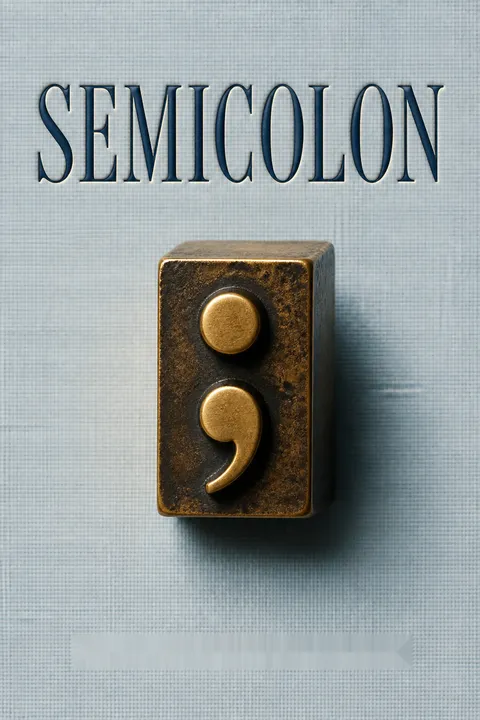
Semicolon by Cecelia Watson explores the history, controversy, and creative use of the semicolon in writing. Readers found it surprisingly engaging, praising Watson's wit and insights into grammar, punctuation, and language evolution. The book challenges rigid grammatical rules, advocating for a more flexible approach to punctuation. While some wished for more practical guidance, most appreciated the book's blend of history, literary analysis, and cultural commentary. Watson's writing style and thoughtful arguments resonated with grammar enthusiasts and casual readers alike.
People Also Read

Glossary
Induction
Examples toward general rulesIn the nineteenth-century grammar project, induction meant reasoning from observed examples of English toward general principles. Grammarians promoted this approach partly to make language study resemble empirical science and to teach students habits of observation. Turning observations into rules, however, could make a changing practice seem more fixed than it was.
Prescriptivist
Sets language rulesA prescriptivist describes or promotes how language ought to be used, rather than focusing only on how people use it. Watson notes that historical grammarians do not fit neatly into a strict prescriptivist category: even authors who laid down rules acknowledged taste and exceptions, while observers of usage could also recommend norms.
Descriptivist
Describes language usageA descriptivist aims to observe and describe language as people use it, rather than imposing rules based primarily on how it should be used. The book cautions that the label can oversimplify historical grammarians. Those who emphasized observation could still make recommendations, and those who prescribed rules often recognized that actual usage and personal judgment mattered.
Prosody
Rhythm and sound in speechProsody concerns the rhythm, stress, intonation, and related sound patterns of language. Earlier approaches often connected punctuation to prosody, treating marks as guides to pauses and delivery. Nineteenth-century grammarians disputed whether punctuation belonged mainly to prosody, written form, or syntax as they tried to organize it into a systematic subject.
Rhetorical pause
Pause shaped by speakingA rhetorical pause is a break associated with how a speaker or reader might deliver language aloud. In the history Watson recounts, some grammarians treated punctuation as a way to mark such pauses and shape the music of prose. Later rule systems increasingly distinguished these pauses from breaks required to signal sentence structure.
Grammatical pause
Pause marking sentence structureA grammatical pause is a break understood as necessary to clarify the structural or logical relations within a sentence, rather than simply to reflect oral delivery. By the late nineteenth century, many grammarians favored this view and narrowed punctuation’s role. The distinction helped recast punctuation as a matter of syntax instead of primarily rhythm.
Standard Written English (SWE)
Prestigious written English varietyStandard Written English is the conventional form of English associated with education and professional or institutional authority in the United States. The book discusses David Foster Wallace’s argument that students should learn it to gain access to power, while questioning the assumption that this standard is neutral or the only legitimate form of expression.
Semicolon Law
Disputed Massachusetts liquor statuteThe Semicolon Law was the popular name for a Massachusetts liquor statute whose punctuation affected how its restrictions were interpreted. A semicolon in a later printed version helped support a ruling that limited late-night sales, including sales by hotels. The dispute produced years of court, legislative, and public controversy before voters approved a revised law in 1906.
FAQ
What's "Semicolon: How a Misunderstood Punctuation Mark Can Improve Your Writing, Enrich Your Reading and Even Change Your Life" about?
- Exploration of the Semicolon: The book delves into the history, usage, and cultural significance of the semicolon, a punctuation mark often misunderstood and misused.
- Historical Context: It traces the semicolon's journey from its invention in the 15th century by Italian humanists to its modern-day controversies and applications.
- Cultural and Linguistic Impact: The book examines how the semicolon has been perceived over time, including its role in legal battles and its symbolic representation of language, class, and education.
- Broader Themes: Beyond punctuation, the book explores themes of grammar, language evolution, and the tension between rules and personal expression in writing.
Why should I read "Semicolon" by Cecelia Watson?
- Unique Perspective: The book offers a fresh and engaging perspective on a seemingly mundane topic, revealing the semicolon's rich history and cultural significance.
- Improves Writing Skills: By understanding the semicolon's role and potential, readers can enhance their writing style and clarity.
- Broader Language Insights: It provides insights into the evolution of language rules and the ongoing debate between prescriptive and descriptive grammar.
- Engaging Narrative: Watson's storytelling combines historical anecdotes, legal cases, and personal experiences, making it an entertaining and informative read.
What are the key takeaways of "Semicolon"?
- Semicolon’s Versatility: The semicolon is a versatile punctuation mark that can enhance clarity, rhythm, and style in writing.
- Historical Evolution: The semicolon has evolved from a tool for clarity to a symbol of pretension and confusion, reflecting broader changes in language and society.
- Grammar and Rules: The book challenges the rigid adherence to grammar rules, advocating for a more flexible and personal approach to punctuation.
- Cultural Reflection: The semicolon serves as a lens to examine cultural attitudes towards language, education, and class.
How does Cecelia Watson suggest using the semicolon effectively?
- Enhance Clarity: Use semicolons to link closely related independent clauses, providing a clearer connection than a period.
- Create Rhythm: Employ semicolons to create a rhythmic flow in writing, especially in complex lists or when balancing parallel structures.
- Express Nuance: Use semicolons to convey subtle relationships between ideas, allowing for more nuanced expression than other punctuation marks.
- Avoid Overuse: While versatile, semicolons should be used judiciously to avoid cluttering the text and confusing the reader.
What are the best quotes from "Semicolon" and what do they mean?
- "The semicolon is a place where our anxieties and our aspirations about language, class, and education are concentrated." This quote highlights the semicolon's symbolic role in reflecting societal attitudes and tensions.
- "Great punctuation can create music, paint a picture, or conjure emotions." Watson emphasizes the artistic potential of punctuation beyond mere grammatical function.
- "There was no time when everyone spoke flawless English and people punctuated ‘properly’." This challenges the myth of a golden age of perfect grammar, advocating for a more realistic view of language evolution.
- "The semicolon’s biography is also a story about grammar and language more generally." The semicolon serves as a microcosm for broader discussions about language rules and their impact.
How does "Semicolon" address the tension between grammar rules and personal expression?
- Historical Context: The book explores how grammar rules have shifted from personal taste to rigid systems, often causing confusion rather than clarity.
- Personal Expression: Watson advocates for a balance between following rules and allowing personal expression, emphasizing the importance of context and intention in writing.
- Critique of Rule-Based Systems: The book critiques the over-reliance on rule-based systems, suggesting that they can stifle creativity and individuality in writing.
- Encouragement of Flexibility: Watson encourages readers to view grammar rules as guidelines rather than strict laws, promoting a more flexible and adaptive approach to language.
What historical events and figures are discussed in "Semicolon"?
- Invention by Italian Humanists: The semicolon was invented in the 15th century by Italian humanists as a tool for clarity in writing.
- Legal Battles: The book discusses legal cases where the semicolon played a crucial role, such as the Massachusetts Semicolon Law and the trial of Sir Roger Casement.
- Influential Writers: Figures like Raymond Chandler and Herman Melville are examined for their use of the semicolon in literature.
- Cultural Shifts: The book traces cultural shifts in the perception of the semicolon, from a trendy punctuation mark to a symbol of pretension.
How does Cecelia Watson use personal anecdotes in "Semicolon"?
- Academic Journey: Watson shares her own experiences as a "reformed grammar fetishist," illustrating her evolving relationship with grammar rules.
- Professional Conflicts: She recounts a dispute with her PhD adviser over a semicolon, which sparked her interest in the punctuation mark's history.
- Teaching Experiences: Watson draws on her teaching experiences to highlight the challenges and rewards of helping students navigate grammar and punctuation.
- Personal Reflections: Throughout the book, Watson reflects on how her understanding of language and punctuation has shaped her as a writer and thinker.
What role does the semicolon play in legal contexts, according to "Semicolon"?
- Ambiguity in Law: The semicolon has been at the center of legal disputes due to its potential to create ambiguity in legal texts.
- Massachusetts Semicolon Law: A notable case involved a semicolon in a liquor law, leading to widespread confusion and legal challenges in Massachusetts.
- Casement Trial: The trial of Sir Roger Casement hinged on the interpretation of a semicolon in a treason statute, illustrating the punctuation mark's legal significance.
- Judicial Interpretation: The book explores how courts have grappled with punctuation in legal interpretation, often leading to contentious rulings.
How does "Semicolon" challenge traditional views on grammar and punctuation?
- Critique of Prescriptivism: Watson critiques the prescriptive approach to grammar, which emphasizes strict adherence to rules, advocating for a more descriptive and flexible perspective.
- Historical Perspective: The book provides a historical perspective on how grammar rules have evolved, challenging the notion of a fixed and unchanging set of rules.
- Encouragement of Creativity: Watson encourages writers to embrace creativity and personal expression in their use of punctuation, rather than being constrained by rigid rules.
- Reevaluation of Language: The book invites readers to reevaluate their relationship with language, considering how punctuation can enhance communication and expression.
What insights does "Semicolon" offer on the relationship between language and power?
- Language as Power: The book explores how language and punctuation can reflect and reinforce power dynamics, particularly in legal and educational contexts.
- Standard Written English: Watson discusses the role of Standard Written English as a marker of education and privilege, highlighting its impact on social mobility and access.
- Rhetorical Strategies: The book examines how figures like Martin Luther King Jr. used punctuation strategically to convey powerful messages and advocate for social change.
- Challenging Norms: Watson challenges readers to question linguistic norms and consider how language can be used to empower marginalized voices.
How does "Semicolon" address the cultural significance of punctuation?
- Symbol of Class and Education: The semicolon is portrayed as a symbol of class and education, reflecting societal attitudes towards language and literacy.
- Cultural Shifts: The book traces cultural shifts in the perception of punctuation, from a tool for clarity to a marker of pretension and elitism.
- Literary and Artistic Value: Watson highlights the literary and artistic value of punctuation, emphasizing its role in shaping meaning and style in writing.
- Broader Implications: The book explores the broader implications of punctuation for communication, identity, and cultural expression, encouraging readers to consider its significance beyond grammar rules.
Download PDF
Download EPUB
.epub digital book format is ideal for reading ebooks on phones, tablets, and e-readers.








