

Key Takeaways
Read English as a record of contact, not a pure inheritance
A language made by arrivals. English grew through successive encounters, not from a sealed native source. Celtic languages left place names and a few words; Roman Latin contributed vocabulary; Germanic settlers supplied much of Old English; Norse speakers gave English everyday words such as they and both. After the Norman Conquest of 1066, French words entered nearly every area of life, and Renaissance travel and scholarship brought in words from across the world.
Purity is a poor guide. Old English had perhaps 50,000 words, yet roughly nine out of ten later fell out of use. Even its Germanic core was reshaped by borrowing. English became itself by absorbing outsiders, not by resisting them.
What's striking is that the language's history undermines the idea that borrowing is a recent corruption of English. Its ordinary vocabulary is already a record of migration, conquest, trade, and cultural exchange. That makes the dictionary's subject less like a family tree with one pure root and more like a layered map of contact. The history also raises a question of whose encounters count: the surviving written record favors literate institutions and powerful groups. A language can be profoundly mixed while its archive still gives some speakers far more visibility than others.
Make dictionaries report how people speak, not dictate how they should
From rules to records. Early English dictionaries often explained difficult words or translated between languages. Robert Cawdrey's 1604 book, the first monolingual English dictionary, listed about 3,000 mostly fashionable or difficult words. Samuel Johnson's 1755 dictionary was far more ambitious, with 43,500 headwords and 118,000 quotations. Johnson first hoped to stabilize English, but the language's constant change made that impossible. His dictionary became a record of usage rather than a rulebook.
English has no academy. Unlike French and Italian, English has never had a central authority tasked with protecting its purity. Its dictionaries therefore describe words as people use them, including shifts in meaning, spelling, and status. The OED's ambition grew from that tradition: explain the evidence, not simply pronounce what counts as correct.
The distinction between describing and prescribing is essential because both activities are often called dictionary work. A historical dictionary can show that a usage exists without recommending it in every setting. That separation gives readers better evidence for deciding how to write, while leaving room for practical style rules in schools, professions, and public institutions. The limit is that recording usage is never entirely neutral: editors choose which texts to consult, which examples to print, and how to divide senses. Description reduces authority's reach, but it does not remove editorial judgment.
Trace meanings through dated evidence, not a single tidy definition
Words have biographies. The OED followed historical principles: editors gathered dated examples of words, arranged them over time, and used their contexts to distinguish meanings. A quotation slip, a small card or sheet recording a word in context with its date and source, supplied evidence for an entry. For example, quotations showed that affected could describe pretentious behavior, something desired, or a person who was mentally ill. Context and chronology helped separate these senses.
Scale made the method visible. The first edition contained 414,825 words and 1,827,306 illustrative quotations, selected from about five million submissions. Examples did more than decorate definitions. They showed when a sense appeared, how it changed, and whether an apparent meaning was more than an isolated mistake.
This method treats meaning as something inferred from evidence across time, rather than as a fixed property waiting to be announced. It resembles historical research: a claim becomes stronger when multiple dated sources support it and when a proposed change can be traced. The method also exposes its own limits. Printed quotations preserve only a fraction of speech, and the survival of texts is uneven. A citation-rich entry can be rigorous without representing every community or conversation. The achievement is not a perfect capture of language, but a transparent account of what the surviving record can establish.
Break giant research into small tasks thousands can perform
A public reading project. In 1857, Dean Richard Chenevix Trench argued that English dictionaries missed obsolete words, meanings, and early uses. A complete remedy required reading far more literature than a small editorial team could manage. The Philological Society invited readers to search books, newspapers, and other sources, then send in quotations. James Murray renewed the appeal in 1879, asking for about a thousand helpers. More than 800 people responded, from Britain and places as far away as India, Australia, and the United States.
Coordination mattered. At the Scriptorium, staff checked submissions, sorted the slips alphabetically and by date, and grouped examples by meaning. By 1882, about 3.5 million slips had arrived, with roughly a thousand more coming in each day. The labor was widely distributed, but editorial decisions remained centralized.
The OED's volunteer system shows how a project can expand its reach by dividing an immense task into repeatable contributions. Its success depended not simply on goodwill, but on instructions, shared formats, local coordinators, and editors able to check the results. That combination still defines collaborative research: participation supplies breadth, while standards make contributions comparable. The arrangement was also unequal. Much of the reading was unpaid, and the editors controlled how material entered the finished work. Participation widened the evidence base without giving every contributor equal authority over interpretation.
Budget for complexity before deadlines turn scholarship into crisis
The forecasts collapsed. When Oxford agreed to publish the dictionary in 1879, the plan called for about 7,000 pages, a decade of work, and £9,000. The completed first edition took 54 years from Murray's appointment, reached roughly 16,000 pages, and cost about £300,000. Editors had underestimated the labor of sorting evidence, checking sources, distinguishing senses, researching origins, and correcting intricate proofs.
Pressure could damage the work. Murray was expected to produce 704 pages each year, even when a single word could consume much of a day. The Press's secretary, Philip Gell, pressed for speed and cost control, but also pushed for Henry Bradley to become a second senior editor with independent responsibility. That change helped the project move forward. The story is not simply that deadlines are bad: adequate staffing and clear authority mattered, while crude output targets did not measure scholarly difficulty.
The mismatch between forecast and reality is a lesson in how organizations misprice work whose hardest tasks are not visible at the outset. Page counts are easy to budget; resolving ambiguity, correcting inherited errors, and verifying sources are not. Gell's role complicates a simple story of visionary editors resisting shortsighted managers. His pressure was often damaging, yet the structural change he imposed helped share the burden. Good governance must protect quality while making work survivable, and should revise its measures when the work itself proves the original measures inadequate.
Design the archive so the work survives its workers
The project nearly lost its evidence. Before Murray took charge, editor Frederick Furnivall had distributed quotation slips among volunteers and subeditors, then lost track of many collections. Some packets were missing, some had been left in damp rooms, and one cache had attracted rodents. Murray had to locate and recover this material before he could edit it. About two million inherited slips eventually reached him, but gaps still required fresh reading.
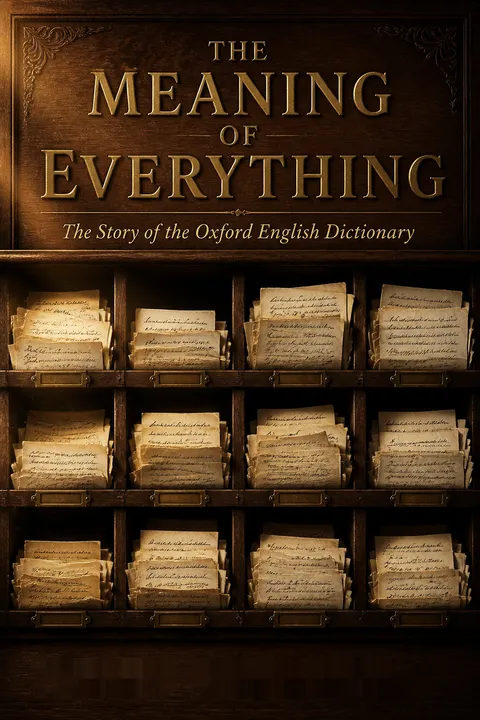
Storage became infrastructure. Murray's first Scriptorium at Mill Hill had 1,029 pigeonholes for sorting slips, a vast expansion from Herbert Coleridge's original 54. The room was small and uncomfortable, but it gave the growing archive a stable home. The system let editors retrieve, compare, and revise evidence instead of relying on memory or scattered piles.
The tale of the lost slips makes a basic point about knowledge work: collecting evidence is not enough if it cannot be found, checked, or handed on. A pigeonhole is not glamorous, but it turns individual reading into a usable institutional memory. The same principle applies to any long-running archive: preservation, labeling, and access are part of the intellectual method, not administrative afterthoughts. Yet systems only preserve what has been gathered. Missing sources and uneven survival remain invisible unless the project actively searches for gaps, as Murray's renewed reading appeals demonstrate.
Remember the lives behind the dictionary's millions of citations
Contributors were people, not just inputs. William Chester Minor, a former army surgeon who was confined to Broadmoor after killing a man during a period of severe mental illness, read and indexed books in the asylum. For more than two decades, he supplied quotations requested by the editors. Fitzedward Hall, an estranged scholar living in isolation, spent years checking proofs and offering corrections, though he never met Murray. Their contributions were different, but both became indispensable.
The team was broader still. J. R. R. Tolkien worked on difficult W words, including walrus. Edith and Elizabeth Thompson helped read and revise proofs for decades. The OED's lists also included tradespeople, clergy, scholars, and readers who were rarely remembered outside its pages.
These biographies show how large reference works depend on forms of labor that can disappear behind the finished authority of the book. The OED's acknowledgments preserve names, but a name in a preface cannot fully recover a person's circumstances or motives. Minor's story is especially powerful, but it should not turn serious illness into a sentimental redemption plot. Meaningful work can offer structure and connection; it is not a cure for mental illness, nor does it erase harm. The more careful lesson is that a person's contribution can matter even when their life resists easy interpretation.
Treat every finished dictionary as a dated snapshot, not a final verdict
The 1928 ending was provisional. The first edition's completion took 71 years from the project's beginning. It recorded the language as editors could establish it, but new words and meanings kept arriving. A 1933 supplement added 867 pages, including words such as radium that had emerged while the main dictionary was being made. Robert Burchfield's four-volume supplement, published from 1972 to 1986, added about 50,000 more words.
The record had to be recombined. In 1989, the second edition integrated the original dictionary and its supplements into a single alphabetic sequence. It contained 615,100 words and 2,436,600 quotations. The book's design endured, but its contents needed continuing revision. The OED's history is therefore not a story of capturing English once and for all, but of building a structure capable of being updated.
A dictionary's authority grows when it makes change legible, not when it pretends change has stopped. Each edition provides a reliable reference point for its own evidence and editorial decisions, while the next edition can repair omissions and record new usage. That is a form of versioning: stability for readers at a given moment, revision across time. The challenge is deciding what qualifies as lasting usage rather than a brief novelty. No editorial threshold eliminates judgment, but a continuing record makes those judgments more open to scrutiny than a claim of permanent completeness.
Analysis
The OED's story is often told as a triumph of scholarship, but its deeper subject is the machinery that makes knowledge durable. A word becomes a dictionary entry only after someone notices it, records it in context, dates the source, sorts it among competing examples, and argues for a definition. The printed volume hides this chain of decisions. Winchester restores it, showing that authority is produced through millions of small acts of attention, along with budgets, filing systems, editorial disputes, and human endurance.
The book also complicates the idea of authorship. Murray is its central figure, but the dictionary could not have been made by Murray alone. Trench supplied the intellectual case, Coleridge and Furnivall assembled early materials, Bradley and later editors shared the editorial burden, and volunteers supplied evidence on a scale no single scholar could achieve. Even the workers who sorted paper and checked proofs helped determine what could be known. The project is collective, though credit and control were not distributed evenly.
Its most important tension is between completeness and change. The OED aimed to record English in its entirety, yet English had no fixed boundary and continued to grow while the editors worked. The project could finish its first edition only by accepting that completion meant a carefully bounded record, not final possession of the language. Supplements and revisions are therefore not embarrassing repairs to a failed promise. They are the logical consequence of treating language as historical evidence.
The book's Victorian setting deserves attention, too. The project drew on an expansive public of readers, yet it was shaped by institutions, class hierarchies, and an era confident in Britain's cultural authority. Its archive is enormous, but no archive is neutral or complete. The enduring achievement lies less in having captured every voice than in creating a disciplined method for showing what the evidence supports, where meanings changed, and where further searching remains necessary. The dictionary is monumental not because English stands still, but because the work of documenting it can continue.
Review Summary
The Meaning of Everything receives mostly positive reviews for its engaging history of the Oxford English Dictionary's creation. Readers appreciate Winchester's storytelling and humor, though some find parts dry or lacking depth. Many enjoy learning about the dictionary's origins, the people involved, and the immense scale of the project. Critics note occasional errors and a focus on personalities over linguistic details. Overall, it's recommended for word enthusiasts and those interested in the OED's development, despite some pacing issues.
People Also Read


Glossary
historical principles
Usage traced through timeA lexicographic method that explains words through dated evidence of their use. Editors arrange quotations chronologically, distinguish senses through context, and show how spelling, meaning, and usage change. Rather than prescribe an ideal form, the method records the language as it appears in surviving written sources.
quotation slips
Evidence cards for word useSmall pieces of paper on which readers recorded a word as it appeared in a source, together with the quotation, date, author, and publication details. OED editors sorted these slips by headword and date, then used them to identify different meanings and document changes in usage.
fascicle
A separately issued sectionA section of the OED printed and sold before the full volume was complete. Oxford published the work in fascicles to release portions of the dictionary and bring in revenue during a project expected to take many years. The individual parts could later be bound together into volumes.
Scriptorium
The dictionary's editorial workshopJames Murray's name for the workroom where OED staff organized quotation slips, researched words, drafted definitions, and prepared material for printing. The first Scriptorium stood in his garden at Mill Hill, and a later one was built behind his Oxford home. Its pigeonholes and shelves made the growing archive accessible to editors.
desiderata
A list of evidence still neededLists compiled by OED editors identifying words or uses for which additional quotations were wanted. Editors sought earlier examples, clearer evidence, or citations that could help establish a meaning. The lists directed readers toward gaps in the record rather than asking them to collect material without a specific research need.
basis of comparison
Grouped quotations for sense analysisHerbert Coleridge's name for alphabetically organized collections of quotations used to compare how a word appeared in different contexts. By examining examples together, an editor could decide whether they showed one meaning or several distinct senses. The method anticipated the OED's later practice of sorting evidence before drafting definitions.
About the Author
Download PDF
Download EPUB
.epub digital book format is ideal for reading ebooks on phones, tablets, and e-readers.








