

Key Takeaways
Separate repeatability from truth before trusting a measurement.
Two different tests. Accuracy is how close a result comes to the intended or true value. Precision is how consistently repeated results agree with one another. A set of shots clustered together but far from the bull’s-eye is precise, not accurate. Shots scattered around the bull’s-eye may be accurate on average, but not precise. The distinction matters because a machine can repeat the same mistake flawlessly.
Numbers can mislead. Pi can be written with many decimal places, making it precise, while a shorter rounded version may be accurate enough for a particular task. The right degree of detail depends on what the measurement must do. In engineering, tolerance means the permitted variation in a part’s dimensions. Tighter tolerances allow less variation, but do not by themselves prove that the design or measurement is correct.
What's striking is how easily consistency gets mistaken for truth. The same trap appears in data analysis: a model can make highly repeatable predictions while relying on biased inputs or a faulty assumption. Separating precision from accuracy encourages a useful question: what is the result being compared against, and how trustworthy is that reference? More decimal places can create an impression of authority without improving a decision. The book's distinction is especially valuable because it turns an abstract argument about exactness into a practical diagnostic.
Precision began when Wilkinson made steam cylinders repeatable by machine.
A practical beginning. In 1776, ironmaster John Wilkinson applied a rigid boring method to the cylinders of James Watt’s steam engines. Earlier engines leaked steam because their cylinders were uneven, leaving gaps around the piston. Wilkinson held the iron workpiece firmly and bored it with a supported cutting tool, producing a straight, consistent interior. Watt reported that the gap varied by no more than the thickness of a shilling, about one-tenth of an inch.
Repeatability changed everything. Wilkinson’s achievement was not simply making one fine object by hand. He could produce cylinders to a reliable standard, and his workshop went on to bore hundreds for Watt’s engines. Better-fitting pistons made the engines more efficient and useful. The book treats this union of a machine tool and a practical need as a turning point: precision became reproducible manufacturing, not merely individual craftsmanship.
The episode illustrates a recurring feature of technological change: a new capability becomes transformative when it solves a bottleneck in an existing system. Watt had an improved engine concept, but poor cylinders prevented it from working well at scale. Wilkinson’s contribution was therefore not a lone invention in isolation, but a connection between design, materials, tools, and production. This systems view is more illuminating than the familiar story of the solitary genius. It also cautions against treating precision as progress by itself. Its value depends on the problem it helps solve.
Build standards and tools that let precision travel between workshops.
From skill to system. Henry Maudslay improved the iron lathe and its slide rest, which held cutting tools steady and moved them in controlled increments. This made it possible to produce screws and components with consistent dimensions. He also used a three-surface method to establish flatness: two surfaces can fit together even if each has matching flaws, so a third is needed to expose and remove errors. Joseph Whitworth advanced precise measurement and standardized screw threads, making parts more compatible across manufacturers.
Standards enable cooperation. A carefully made component has limited reach if no one else can reproduce or measure it. Shared standards let distant workshops make parts that fit the same design. That principle underlies modern supply chains, where many firms contribute components to one product. But standards also distribute power: whoever sets the specification can shape what counts as acceptable and what other makers must produce.
Precision here resembles a common language. A shared standard allows separate people and organizations to coordinate without relying on personal trust or repeated negotiation. That can make production more dependable, but it can also narrow the range of designs and methods that are recognized as legitimate. Standards are never just neutral rulers. They embody choices about acceptable variation, cost, and performance. The distinction between measurement and governance is useful well beyond engineering, from software compatibility to public metrics.
Interchangeable parts empowered armies and factories, but displaced skilled makers.
Parts that could trade places. In 1785, French gunsmith Honoré Blanc demonstrated that pieces from different musket locks could be mixed and reassembled because they had been made to the same pattern. Thomas Jefferson saw the demonstration and urged American officials to adopt the method. Eli Whitney later claimed to do the same, but his famous display relied on whole locks and specially chosen gunstocks, not genuinely interchangeable components. More effective American production came from makers such as Simeon North and John Hall, who used machine tools and gauges to produce consistent parts.
The social cost. The Portsmouth Block Mills used machines to make the Royal Navy’s pulley blocks. They produced the navy’s annual demand of 130,000 blocks with about ten workers, replacing a much larger body of skilled craftspeople. Mechanization increased output and cut costs, but also shifted work away from experienced artisans toward machine tending. Precision made mass production possible, while making some kinds of expertise less economically valuable.
The book refuses to treat standardization as an uncomplicated triumph. Interchangeable parts make repair faster and production cheaper, but they also change who possesses valuable knowledge. Craft skill does not vanish because it is useless; it can lose value because institutions reorganize work around machines. This is a useful lens for current automation debates: productivity gains are real, but their benefits and burdens are unevenly distributed. A technology's social meaning depends partly on who owns the equipment, who sets production goals, and who has alternatives when work changes.
Ford needed precision more than Rolls-Royce did.
Two meanings of quality. Henry Royce built cars by hand, slowly and at high cost. The Silver Ghost was famously reliable, and the company produced roughly two cars a day. Skilled workers could adjust a part during assembly, including filing it to fit. Henry Ford pursued a different goal: a car for a much larger public. The Model T relied on a moving assembly line and components made precisely enough to fit without individual adjustment. A single ill-fitting part could slow the line or stop it.
Scale depended on sameness. Ford sold about 16.5 million Model Ts. Its price fell from $850 at launch to $260 by 1925 as production became more efficient. Swedish inventor Carl Edvard Johansson’s gauge blocks helped factories measure components consistently. Precision was essential to Ford’s system not because the car was more luxurious, but because mass production required parts to be interchangeable at speed.
This comparison separates precision from prestige. The handmade car can absorb variation through skilled labor; the assembly line cannot. That difference remains relevant wherever production is automated: standardization is not simply a quality preference, but a condition of throughput. At the same time, handmade adjustment can preserve flexibility that rigid production systems lack. Neither model is universally superior. The best choice depends on whether a product's purpose rewards customization, scale, repairability, or low cost, and on who can afford each trade-off.
Check the measuring instrument before trusting the perfect result.
A perfect mirror, measured wrong. The Hubble Space Telescope’s primary mirror was polished to extraordinary smoothness, but its edge had the wrong shape. The cause was a faulty null corrector, an optical instrument used to check the mirror. A worn patch of coating made a laser reflect from the wrong point. Technicians compensated with three thin washers, trusting the instrument’s reading rather than questioning its setup. The mirror was off by a tiny fraction of a human hair, yet the first images were badly blurred.
Repair through redesign. NASA engineers could not bring the telescope back to Earth. Jim Crocker devised a way to install corrective optics, inspired by the adjustable showerhead in his hotel. Astronauts fitted the device in orbit, and the telescope began returning sharp images. The episode shows that checking an object is not enough: the measuring tool, its calibration, and the assumptions behind its use must also be verified.
This is a vivid case of measurement becoming part of the system it claims to judge. A test instrument can certify a flawed product if both share the same hidden assumption. The lesson extends to audits, benchmarks, and automated quality checks: verification needs independent methods, not merely more confidence in the same procedure. The repair also demonstrates the value of design for correction. In complex systems, resilience often comes less from preventing every error than from making errors detectable and recoverable.
In safety-critical engineering, tiny process errors can unleash enormous forces.
A small defect, a violent failure. In 2010, Qantas Flight 32 suffered an engine explosion shortly after leaving Singapore. The investigation traced the event to a short oil-feed pipe with a wall made too thin in one place by a misaligned machining operation. A fatigue crack widened over repeated flights. Hot oil escaped into the engine, ignited, and helped destroy a spinning turbine disc. Fragments damaged the aircraft’s systems, but the crew managed to land safely.
Inspection is part of engineering. The defective pipe had passed factory checks, and other similar parts were already in service. The failure therefore involved more than a machining error: it exposed problems in inspection, recordkeeping, and the workplace practices that allowed a nonconforming part to pass. In high-stakes systems, reliability depends on the whole production chain, including the procedures that catch mistakes before they reach the aircraft.
The incident challenges the comforting idea that safety follows automatically from sophisticated design. A technically advanced machine can remain vulnerable to ordinary organizational failures: rushed work, weak inspection, or poor communication. Safety engineering therefore treats production culture as part of the mechanism, not as background context. Yet zero-error expectations can be misleading too. Complex systems cannot guarantee that nothing goes wrong; they can build multiple barriers so that one defect does not become a catastrophe.
GPS turned timekeeping into a global answer to where am I.
Location from signal timing. After Sputnik began transmitting radio pulses in 1957, scientists used changes in signal frequency to estimate the satellite’s motion. That work helped inspire Transit, a U.S. Navy satellite navigation system. A later approach used the time a signal takes to travel from a satellite to a receiver. Because the signal travels at a known speed, timing differences reveal distance; signals from several satellites let the receiver calculate its position.
Clocks hold the system together. GPS satellites carry highly accurate atomic clocks, and their timing signals support both navigation and precise synchronization. The system began as a military tool, then became available to civilian users. Its reach now extends beyond maps and directions to tasks that depend on accurate time and location. The deeper idea is easy to miss: modern navigation works because the world can coordinate around shared, continuously corrected measurements of time.
GPS shows how an abstract standard becomes an everyday public utility. Users see a blue dot, while the underlying service depends on clocks, satellites, ground stations, and correction signals working together. This makes location less a simple fact than a calculated relationship among instruments. The convenience is enormous, but dependence creates vulnerabilities: a system that centralizes navigation can also become a point of failure or control. The book's account encourages appreciation of hidden infrastructure without mistaking its ubiquity for inevitability.
Moore's law made miniaturization a business imperative with physical limits.
Smaller circuits, more capacity. In 1965, Gordon Moore forecast that the number of components on an integrated circuit would grow rapidly, with computing power rising as transistors shrank. His prediction became a target that helped drive the semiconductor industry. Intel’s first commercial microprocessor, the 4004, contained 2,300 transistors. Modern chips contain billions. Smaller transistors can make chips faster and cheaper to produce, encouraging manufacturers to continue reducing their size.
The machine behind the chip. ASML’s enormous photolithography systems use light to transfer intricate circuit patterns onto silicon wafers. Newer extreme ultraviolet methods push the process toward atomic scales, where interference and material limits become serious constraints. Moore’s law is therefore more than a forecast: it is an organizing ambition for the industry. But physical limits mean that progress cannot be assumed to continue in the same form indefinitely.
Moore's law illustrates how forecasts can become coordination devices. Once firms, investors, and customers organize expectations around a rate of improvement, the prediction helps create pressure to meet itself. That pressure has produced remarkable technical gains, while also encouraging a cycle in which faster and smaller becomes an end in its own right. The important question is not only whether miniaturization can continue, but which human needs justify its cost. A more powerful device is not automatically a more useful one.
Use precision to detect realities too faint for human senses.
Measuring the almost invisible. LIGO uses laser interferometers, instruments that split a light beam, send its parts along separate paths, and compare them when they return. A passing gravitational wave can change the relative lengths of the paths by an extraordinarily small amount. In September 2015, detectors in Washington State and Louisiana registered matching signals from a distant cosmic event, providing evidence for gravitational waves predicted by Einstein.
Scale is no obstacle. LIGO’s detectors stretch across kilometers, yet their test mirrors and measurement systems must register changes far smaller than ordinary experience can imagine. Semiconductor factories use enormous machines to make tiny circuits; LIGO uses enormous instruments to measure tiny changes across vast distances. In both cases, precision is not decoration. It extends human observation into domains that unaided senses cannot reach.
LIGO makes precision feel less like a manufacturing obsession and more like an extension of perception. Its significance lies not simply in measuring a small quantity, but in making a new kind of evidence available. That is a powerful argument for fundamental research: instruments can change what questions are answerable. At the same time, detection depends on careful interpretation, not machinery alone. A signal acquires meaning through comparison, modeling, and independent confirmation, reminding readers that measurement and judgment remain partners.
Make room for craft and resilience beside machine-made perfection.
Japan values both. Seiko makes tens of thousands of quartz watches a day, yet it also revived the handmade Grand Seiko, whose watchmakers produce only about a hundred watches daily. The mechanical watch is less accurate, but its skilled assembly remains worth preserving to people who value the craft. The Japanese aesthetic term wabi-sabi describes an appreciation for natural irregularity, impermanence, and handmade character.
Nature tests our priorities. After the 2011 tsunami devastated Minamisanriku, bamboo endured or rapidly returned where many precise, manufactured objects had been destroyed. The contrast is not an argument against engineering. It is a reminder that human-built precision exists within a changing natural world. A mature society can value exact machinery for what it does while also protecting craft, flexibility, and forms of resilience that cannot be reduced to tighter tolerances.
The closing contrast offers a needed correction to the assumption that more exactness is always better. Handmade work can carry cultural knowledge and meaning that standardized production does not capture, while flexible materials may survive conditions that rigid engineered objects cannot. Still, craft should not be romanticized as a substitute for reliable infrastructure, especially where safety is at stake. The stronger principle is pluralism: choose precision where interchangeability and measurement matter, and preserve other values where human attention, adaptation, or beauty matter more.
Analysis
The book’s deepest contribution is to recast precision as a social infrastructure rather than a synonym for excellence. A gauge block, a standard screw, or an atomic clock matters because it lets people coordinate work across distance and time. The history therefore runs from a cylinder that made Watt’s steam engine usable to systems that locate ships, manufacture microprocessors, and detect gravitational waves. At each stage, the crucial achievement is not merely smaller error. It is reproducible agreement about what counts as a correct result.
That agreement has two faces. Interchangeable parts make repair and mass production possible, but they also reorganize labor and concentrate authority in those who design standards and own machinery. Precision can democratize access, as with the Model T, while making skilled work less valuable. It can create reliable observation, as with LIGO, yet also produce a false assurance when an instrument is miscalibrated, as Hubble’s mirror demonstrated. Exactness is therefore neither inherently humane nor inherently dangerous. Its effects depend on purpose, governance, and safeguards.
The narrative also exposes a tension in modern innovation. Industries often treat continued miniaturization and tighter tolerances as measures of progress, even when customers may not need each increment. Physical limits make that race finite, while the examples of Japanese craft and post-tsunami bamboo suggest that durability, adaptability, and meaning cannot be captured by dimensional accuracy alone. The alternative is not a retreat from engineering. It is a richer account of quality, one that asks whether a system is fit for purpose, resilient when it fails, and socially worth its costs. Precision is most powerful when treated as a tool for judgment, not as judgment itself.
Review Summary
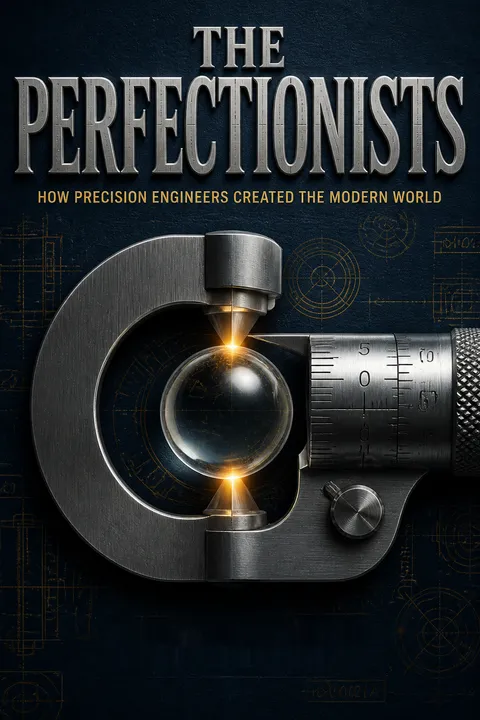
The Perfectionists explores the history of precision engineering and its impact on modern society. Winchester weaves engaging stories of inventors and innovations, from early steam engines to GPS satellites. Readers appreciate the author's enthusiasm and storytelling, though some find the structure disjointed. The book offers fascinating insights into technological advancements but occasionally gets bogged down in technical details. While not for everyone, it's a compelling read for those interested in engineering history and the pursuit of precision in manufacturing and measurement.
People Also Read





Glossary
Precision
Repeatability of resultsIn engineering, precision describes how consistently repeated measurements or manufactured parts agree with one another. A result can be precise without being accurate: a machine may repeatedly produce the same value or component while missing the intended target. Precision becomes especially consequential when parts must fit together or be reproduced at scale.
Accuracy
Closeness to the targetAccuracy is the closeness of a measurement or result to its intended or true value. It differs from precision, which concerns how closely repeated results agree with each other. A group of measurements can be accurate on average but scattered, or tightly clustered yet inaccurate if they share the same error.
Tolerance
Allowed dimensional variationTolerance is the permitted variation in a manufactured part’s dimensions or geometry. A part intended to fit with another needs a specified range within which its size may vary. Tighter tolerances permit less variation and generally demand more exact manufacturing and inspection. Precision describes consistency; tolerance defines the limits a design accepts.
Machine tool
Machine that makes partsA machine tool shapes or processes materials, especially metal, through operations such as cutting, boring, drilling, or milling. It can also be understood as a machine that makes components for other machines. Machine tools helped turn precision from a craft achievable in a few objects into a repeatable basis for manufacturing.
Interchangeable parts
Parts made to shared dimensionsInterchangeable parts are components manufactured to common specifications so that one can replace another in an assembly without custom fitting. The idea depends on consistent measurement and production. It supports simpler repair and high-volume manufacturing, but it can also reduce the economic value of some forms of individual handcraft.
Jo blocks
Precision length standardsJo blocks, also called gauge blocks, are hardened metal blocks made to precisely known lengths. They can be combined by wringing their flat faces together to create a measurement close to a required dimension. Invented by Carl Edvard Johansson, they helped factories check whether components met specifications and could fit together reliably.
Traceability
Link to a measurement standardTraceability is the documented connection between a measurement and an accepted standard through a chain of comparisons. For example, a watch’s time can be related through calibration to an atomic clock. Traceability lets different instruments and organizations compare results using a shared reference rather than relying on isolated measurements.
Moore's law
Forecast of chip growthMoore’s law is Gordon Moore’s forecast that the number of components on integrated circuits would grow rapidly as their size shrank. The prediction became a powerful target for the semiconductor industry and helped shape investment and product expectations. Its continuation depends on overcoming physical and manufacturing limits at increasingly tiny scales.
LIGO
Gravitational-wave observatoryLIGO, the Laser Interferometer Gravitational-Wave Observatory, uses large laser interferometers to detect minute changes in distance that may be caused by gravitational waves passing through Earth. Its paired observatories in the United States recorded matching signals in 2015, providing evidence for the phenomenon and opening a new way to study cosmic events.
wabi-sabi
Beauty in imperfectionWabi-sabi is a Japanese aesthetic sensibility that values natural irregularity, impermanence, roughness, and handmade character. In the book, it offers a counterpoint to the pursuit of machine-made precision. The term helps explain how a culture can value exact manufactured objects while also respecting crafts whose appeal depends on variation and human touch.
About the Author



Download PDF
Download EPUB
.epub digital book format is ideal for reading ebooks on phones, tablets, and e-readers.








