

Key Takeaways
Treat each sentence as your only promise to the reader.
Intention is invisible. A reader encounters words, not the writer’s private plan. A sentence can therefore communicate something quite different from what its author meant, and the reader has no reliable way to correct the mismatch. Klinkenborg’s central discipline is to know what each sentence literally says, what it leaves unsaid, and what it suggests. The hardest task is often the first: seeing the actual sentence instead of the intended one.
Clarity builds trust. Short sentences make that check easier because their parts are easier to inspect. Each sentence should carry its own meaning rather than depend on the writer’s explanation or on a reader guessing what was meant. Grammar, implication, and rhythm all shape the promise being made.
The sentence-as-promise model makes writing an ethical practice as well as a craft. In ordinary conversation, a speaker can clarify a muddled remark; on the page, the sentence must do more of that work itself. This is especially useful in nonfiction, where unclear wording can distort facts or assign actions to the wrong people. Still, precision is not the same as eliminating every possible interpretation. Good prose can sustain productive ambiguity, but it needs to make that ambiguity feel chosen rather than accidental.
Shorten sentences until you can hear every choice.
Use brevity as training. Short sentences are not childish, and long ones are not inherently sophisticated. Klinkenborg recommends writing short while learning to control syntax, because a compact sentence makes weak verbs, misplaced phrases, and unnecessary words harder to hide. Remove words one at a time and notice what changes. A word earns its place by doing real work, not merely because it appeared in the first draft.
Then vary the rhythm. The aim is not a page of clipped declarations. Strong long sentences are possible when their components remain clear and purposeful. Varying length and structure gives prose movement, while the space between sentences can carry an echo or pause. The supposed need to make writing “flow” can mislead writers into accepting easy, unexamined sentences.
Brevity works here as a diagnostic instrument, much like simplifying a complicated model to see which parts are essential. The important skill is not sentence minimalism, but control: writers can expand again once they understand what each clause contributes. Rhythm also depends on contrast, so uniform shortness eventually becomes its own predictable pattern. A useful test is whether each sentence’s length serves its thought, rather than whether the sentence meets an arbitrary word count.
Read sentences as crafted objects, not just containers of meaning.
Meaning is only one layer. A sentence also has sound, pace, word history, imagery, and social associations. Changing its wording changes more than a detachable message. To read like a writer, examine why a sentence uses this verb, this order, or this rhythm, and imagine how a small revision would alter its effect. Klinkenborg points to writers as different as John McPhee, Joan Didion, and W. H. Auden to show how varied sentence-making can be.
Study what you notice. Read passages aloud, compare their sentence lengths, and mark their nouns and verbs. These modest exercises reveal patterns that a summary of the passage would miss. A piece is an ecosystem of words and structures: its character comes partly from how those elements interact, not only from what the writing can be paraphrased to mean.
This approach treats close reading as a form of apprenticeship. It shifts attention from extracting a lesson to noticing the decisions that make a passage feel precise, funny, restrained, or vivid. That resembles learning music by listening for phrasing rather than only identifying a song’s tune. The practice is most productive when analysis stays curious. A reader can overinterpret every comma; the aim is not to invent a hidden intention for each choice, but to become more sensitive to its effect.
Revise while composing, before provisional sentences become your plan.
Composition already includes revision. A writer often changes words and rhythm in the mind before putting a sentence on the page. Klinkenborg treats that work as composition, not a separate preliminary stage. Imagine a sentence fully, test its possibilities, and write it down when it is closer to what it needs to be. Then revisit it in context. The point is not to avoid mistakes, but to keep every sentence available for reconsideration.
Read with fresh ears. Rereading aloud slows the eye and makes awkward rhythm, repetition, and syntax easier to detect. A faint sense that something is wrong is useful evidence, even before the writer can name the problem. Revision also means looking for missed opportunities: a clearer verb, a more exact thought, or a new direction revealed by changing one sentence.
Treating revision as thinking dissolves the false prestige of the first draft. It also explains why changing a sentence can change the idea itself: language is not merely packaging for finished thought, but a tool for developing it. The method can demand patience, particularly under deadlines, and some writers benefit from drafting freely before editing. The underlying principle still holds: a draft is material, not a contract. Its sentences deserve scrutiny even when they arrived quickly.
Notice what catches your attention before turning it into material.
Attention comes before interpretation. Klinkenborg describes noticing as the moment a detail, phrase, action, or thought interrupts the ordinary current of awareness. Practice by identifying what drew attention and how the mind moved toward it, without immediately converting it into a metaphor, lesson, or polished line. The observation does not have to become a note or a finished piece. Letting it go can be part of the exercise.
Interest supplies discipline. Writers often reach for subjects and language that seem officially important, borrowing other people’s authority. Klinkenborg argues that a writer must authorize their own perceptions by taking them seriously enough to examine them. What interests the writer is not automatically interesting to everyone else, but precise sentences can invite a reader into that perception.
The instruction to notice without instantly interpreting protects observation from becoming a hunt for ready-made symbols. It also makes writing less dependent on dramatic life events: a writer can begin with the ordinary detail that genuinely holds attention. This has an affinity with observational practices in science, where description is separated from explanation to reduce premature conclusions. The distinction cannot be absolute, since selection already reflects perspective. Its value lies in making that selection visible and deliberate.
Let sentences discover the piece instead of obeying an outline.
Planning can close paths. An outline arranges ideas before the writer knows what the act of writing might uncover. Klinkenborg favors research, reading, observation, and notes, followed by patient thought and sentence-making. Begin with a sentence that interests you, not necessarily a dramatic opening, and follow the possibilities it creates. The next sentence may belong somewhere else in the piece; order can be discovered rather than decided in advance.
Rearrange what you learn. Evidence often arrives in clumps: a quotation, an interview, or events in chronological order. The writer can separate those materials into details and place them where they matter to the reader. Chronology and logic are options, not compulsory structures. The piece should bear witness to what the writer has perceived, rather than merely display research in the order it was gathered.
This is a model of inquiry-led composition: the writer works with evidence, but does not confuse the sequence of research with the sequence that best conveys its meaning. It can produce structures that feel discovered rather than mechanically imposed. The caution is that abandoning outlines does not remove the need for organization, especially in complex reporting or argument. Readers still need orientation, and factual claims need traceable support. The useful distinction is between a flexible map and a predetermined route.
Trust an alert reader instead of building a handrail between every idea.
Do not write for a helpless audience. Klinkenborg challenges the schoolroom habits of announcing each paragraph’s point, overexplaining connections, and signaling every turn with formal transitions. Clear sentences can stand apart while still relating to one another. A gap may give the reader room to infer a connection, and a paragraph need not begin by summarizing itself.
Trust has two sides. Readers are both literal: they stumble over errors and unintended ambiguity, and curious: they can follow an unfamiliar path when the prose is clear. Writers should imagine both capacities. This does not mean withholding necessary context. It means avoiding needless explanation that treats the reader as passive, while giving enough information about time, place, and action to keep the reader oriented.
Trusting readers is not simply a stylistic preference. It changes the division of labor: prose supplies reliable cues, while readers make reasonable connections. That partnership can create a more active experience than constant signposting. Yet readers differ in background knowledge, attention, and familiarity with a subject. The best alternative to overexplaining is not obscurity, but careful calibration: preserve the reader’s ability to infer while supplying the context required to make inference possible.
Use grammar to prevent accidental meanings, not to display sophistication.
Syntax has consequences. Grammar is not a schoolroom etiquette test; it helps writers see how sentences assign action, connect ideas, and create ambiguity. A student sentence discussed by Klinkenborg tries to join singing, floorboards, and an attic with one passive construction, leaving it unclear what sound comes from where. Rebuilding it with clear subjects and active verbs restores the scene.
Know the words you use. Check a dictionary when meaning, pronunciation, or history is uncertain. Klinkenborg recounts mistaking “autopsia” for a kind of collection before learning that its roots refer to seeing for oneself. Word histories can reveal a shade of meaning, while exact names give the world more substance than vague labels. The point of technical knowledge is control, not obedience to rules for their own sake.
Grammar matters most when it safeguards the reader’s ability to picture events and follow responsibility. This is particularly important in nonfiction, where passive constructions can obscure who acted or what happened. The book’s emphasis on dictionaries also resists the assumption that familiar words are fully understood. One qualification: etymology can illuminate a word’s history, but present usage determines much of its current meaning. A writer should consult history without mistaking it for a final definition.
Earn authority through clear perception, not an impressive subject.
The prose earns trust. A compelling subject cannot rescue indifferent sentences. Klinkenborg locates a writer’s authority in clear language and clear perception, because readers can stop reading whenever they choose. Authority is not a credential the writer possesses independently; it is the reader’s willingness to keep following.
Choose a role on the page. The narrator is not simply the writer’s unfiltered self. Every piece makes choices about the speaker’s relation to the subject and reader. Even sincerity must be enacted through directness, rhythm, and tone; declaring a feeling does not make a reader feel it. Style, in this account, grows from sustained interest in shaping sentences, rather than from adding conspicuous signs of individuality.
This view usefully separates authority from status. A reader may grant credibility to an unfamiliar writer whose language is observant and exact, while skepticism can persist toward someone with impressive credentials. It also clarifies why voice is partly relational: the narrator is a presence created in language, not simply a personality transferred onto the page. Still, craft cannot substitute for evidence. In factual writing, perceived authority must be matched by accuracy and responsible sourcing.
Leave room for implication, but make the literal sentence dependable.
Silence can carry meaning. Writing by implication means allowing a sentence to suggest more than it states, so the reader can complete a thought and hear its echo. Excess words, explanations, and crowded clauses leave less space for that participation. A well-placed pause or a relation between separate sentences may do work that an explicit explanation would flatten.
Restraint needs precision. Implication is not a license for muddle. If the literal wording is unclear, the reader cannot tell whether an unstated meaning is intentional. Klinkenborg’s revision aims toward brevity, directness, clarity, rhythm, and variation, while preserving what can be left unsaid. A piece is finished through judgment, not a universal rule: the writer stops when the work feels complete under its actual limits.
Implication makes reading collaborative. The reader contributes memory, inference, and emotional response, which can give a small sentence more reach than explicit explanation. But silence is meaningful only against a stable literal ground. If the reader cannot identify what happened, ambiguity becomes a burden rather than an invitation. This distinction is useful across forms: compression can intensify a scene or argument, but clarity must remain strong enough to support what the prose chooses not to spell out.
Analysis
Klinkenborg’s book is a craft manual organized around a provocative reversal: writing does not begin with a finished thought that sentences merely transmit. Sentences are the writer’s working units of attention, and their construction can alter what the writer thinks. From that premise follows a coherent practice: notice before interpreting, read closely, compose and revise together, and treat every sentence as a choice with consequences for the reader.
The book’s most valuable intervention is its attack on false maturity. Long sentences, elaborate transitions, formal vocabulary, and predetermined structures often imitate authority without producing clarity. Short sentences are not a universal style prescription but a way to expose those imitations. The book’s recurring examples of grammatical misfires make the point concrete: a misplaced modifier or weak conjunction can create a scene the writer never intended. Precision is not cosmetic. It is part of meaning.
Its approach also makes writing more democratic. Authority comes not from having an extraordinary subject or a sanctioned identity, but from attending carefully to what one perceives and finding language that lets another person see it. That is a demanding form of self-trust, not permission to treat every private impression as fact. In nonfiction especially, perception must remain answerable to evidence.
The method has limits as a universal recipe. Some writers need outlines to manage large projects, and some readers need explicit transitions or context. The book’s strongest ideas survive that qualification because they concern awareness rather than prohibition. An outline can be useful without becoming a substitute for thought; a transition can guide without treating readers as incapable. Likewise, implication can enrich prose only when literal meaning remains secure. The lasting lesson is not to write short, avoid structure, or distrust every convention. It is to test each convention against the sentence in front of you, and keep only what helps it say precisely what it should.
Review Summary
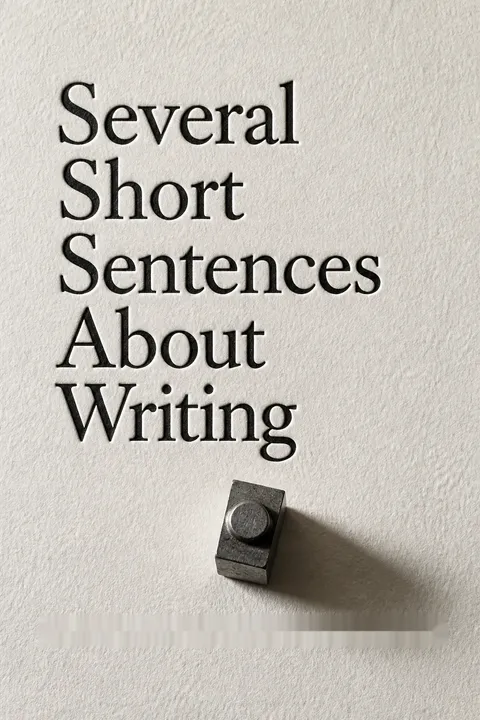
Several Short Sentences About Writing receives mixed reviews. Many praise its unique approach, focusing on crafting strong individual sentences and challenging conventional writing advice. Readers appreciate Klinkenborg's insights on noticing details, trusting one's voice, and writing with clarity. However, some find the book's style pretentious and repetitive. Critics argue that its emphasis on brevity may stifle creativity. Despite polarizing opinions, many consider it a valuable resource for both new and experienced writers, offering fresh perspectives on the craft of writing.
People Also Read





Glossary
volunteer sentence
Unexamined, predictable sentenceA sentence that seems to arrive ready-made because the writer is looking past the wording toward an intended meaning, a whole-piece plan, or the wish to finish. It often relies on familiar phrasing and predictable structures. Klinkenborg argues that its apparent ease is not evidence of inspiration; revision is needed to test whether it deserves to remain.
writing by implication
Meaning beyond stated wordsA way of writing in which carefully chosen wording, rhythm, and the space between sentences allow the reader to infer more than the text directly states. The reader helps complete the thought. Implication depends on clarity: when the literal sentence is confusing, the reader cannot reliably distinguish deliberate silence from accidental ambiguity.
self-authorization
Trusting your own perceptionsThe writer’s gradual decision to treat personal observations and thoughts as worthy of attention, rather than waiting for teachers, institutions, or established subjects to grant permission. It is developed through the work of writing clearly and discovering what one can actually say. It does not make an observation automatically true or important to every reader.
perfection enough
Completion under real limitsKlinkenborg’s phrase for the practical judgment involved in finishing a piece. There is no objective point at which every possible improvement has been made. A writer stops when the work feels as complete as circumstances allow, recognizing that more time, research, or revision might change it, but cannot be available without limit.
FAQ
What's "Several Short Sentences About Writing" about?
- Focus on Sentences: The book emphasizes the importance of crafting individual sentences, suggesting that writing is fundamentally about making sentences.
- Challenging Conventional Wisdom: Klinkenborg argues against traditional writing advice, proposing that much of it is misleading and harmful.
- Experimentation Over Rules: The book encourages writers to experiment with language and structure rather than adhere to rigid rules.
- Self-Discovery in Writing: It aims to help writers discover their unique voice and style by focusing on clarity and directness.
Why should I read "Several Short Sentences About Writing"?
- Unique Perspective: The book offers a fresh take on writing, challenging conventional methods and encouraging personal exploration.
- Practical Advice: It provides actionable insights into sentence construction, making it useful for writers at any level.
- Encourages Creativity: By focusing on experimentation, it fosters a creative approach to writing.
- Improves Clarity: The emphasis on clear, concise sentences can enhance the readability and impact of your writing.
What are the key takeaways of "Several Short Sentences About Writing"?
- Sentence Clarity: Understanding what each sentence says, doesn't say, and implies is crucial.
- Short Sentences: Starting with short sentences can help writers focus on clarity and rhythm.
- Reader Trust: Trusting the reader's intelligence allows for more nuanced and engaging writing.
- Self-Authorization: Writers must authorize themselves to notice and value their perceptions and thoughts.
How does Verlyn Klinkenborg suggest improving sentence clarity?
- Focus on Actual Words: Pay attention to what your words are actually saying, not just what you intend them to say.
- Remove Unnecessary Words: Eliminate words that don't add value to the sentence to enhance clarity.
- Experiment with Structure: Try different sentence structures to find the most effective way to convey your message.
- Read Aloud: Reading your work aloud can help you catch issues with rhythm and clarity.
What is Verlyn Klinkenborg's view on traditional writing advice?
- Critique of Conventional Wisdom: Klinkenborg believes much traditional advice is untested and can be harmful.
- Encourages Testing: He suggests that writers should test all advice to see what works for them personally.
- Focus on Individual Needs: Writing should be tailored to the writer's unique style and needs, not a one-size-fits-all approach.
- Rejects Rigid Rules: The book advocates for flexibility and experimentation over strict adherence to rules.
What are the best quotes from "Several Short Sentences About Writing" and what do they mean?
- "Know what each sentence says, what it doesn’t say, and what it implies." This emphasizes the importance of understanding the full impact of your sentences.
- "Short sentences aren’t hard to make. The difficulty is forcing yourself to keep them short." This highlights the challenge of maintaining brevity and clarity.
- "Your job as a writer is making sentences." This underscores the book's focus on the fundamental role of sentence construction in writing.
- "Writing isn’t a conveyer belt bearing the reader to 'the point' at the end of the piece, where the meaning will be revealed." This suggests that writing should be engaging throughout, not just at the conclusion.
How does "Several Short Sentences About Writing" address the concept of reader trust?
- Trust the Reader: The book encourages writers to trust the reader's intelligence and ability to follow the narrative without excessive guidance.
- Avoid Over-Explanation: By not over-narrating or over-explaining, writers can create a more engaging and dynamic reading experience.
- Reader's Role: The reader is seen as an active participant in the writing, capable of understanding and interpreting the text.
- Implicit Promises: Writers should be aware of the implicit promises their sentences make to the reader and ensure they are fulfilled.
What is the significance of self-authorization in writing according to Verlyn Klinkenborg?
- Empowerment: Writers must empower themselves to value their own perceptions and thoughts.
- Overcoming Doubt: Self-authorization helps writers overcome self-doubt and the fear of not being "allowed" to write in a certain way.
- Personal Discovery: It encourages writers to discover their unique voice and style through experimentation.
- Independence: Writers should not rely on external validation but trust their own judgment and creativity.
How does Verlyn Klinkenborg suggest writers handle the concept of "flow"?
- Flow as a Reader's Experience: Flow is something the reader experiences, not the writer.
- Hard Work Over Flow: Writing is hard work, and the idea of effortless flow can be misleading.
- Avoiding Writer's Block: By accepting the difficulty of writing, writers can avoid the trap of writer's block.
- Focus on Quality: The quality of sentences is more important than the ease with which they are written.
What role does rhythm play in writing according to "Several Short Sentences About Writing"?
- Essential Element: Rhythm is a vital component of effective writing, influencing how sentences are perceived.
- Variety in Rhythm: Writers should aim for variety in sentence rhythm to maintain reader interest.
- Reading Aloud: Reading work aloud can help writers identify and improve the rhythm of their sentences.
- Rhythm and Meaning: The rhythm of a sentence can enhance its meaning and impact.
How does "Several Short Sentences About Writing" redefine the concept of revision?
- Revision as Discovery: Revision is not just about fixing errors but discovering new possibilities within sentences.
- Continuous Process: Writing and revising are intertwined processes, not separate stages.
- Focus on Sentences: Revision should focus on improving individual sentences for clarity and impact.
- Embrace Change: Writers should be open to reimagining their work during revision, not just making minor adjustments.
What practical exercises does Verlyn Klinkenborg recommend for improving writing?
- Sentence Auditions: Try out multiple sentences to find the one that best fits the piece.
- Reading Aloud: Regularly read your work aloud to catch issues with rhythm and clarity.
- Diagramming Sentences: Learn to diagram sentences to better understand their structure and improve clarity.
- Experiment with Structure: Regularly experiment with different sentence structures to find the most effective way to convey your message.
Download PDF
Download EPUB
.epub digital book format is ideal for reading ebooks on phones, tablets, and e-readers.








