

Key Takeaways
Look past election day: power also lives in rules voters never debated
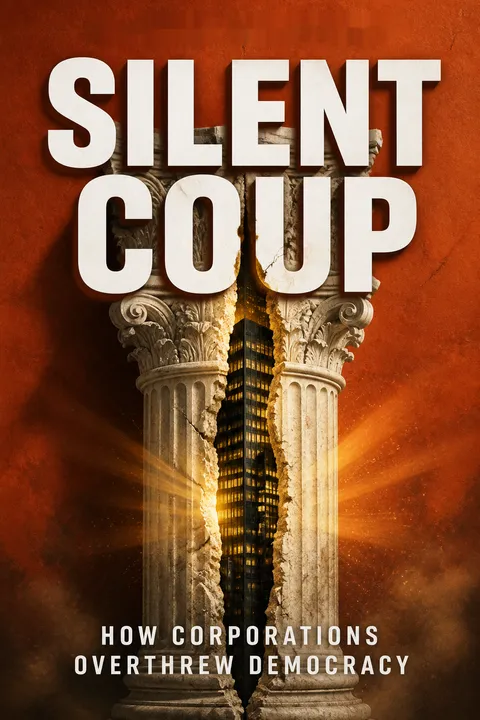
Power has an infrastructure. Claire Provost and Matt Kennard trace a system that reaches beyond campaign finance and lobbying. International legal rules can let investors challenge public policy; development budgets can finance private firms; special zones can place workplaces outside ordinary oversight; and private security can shift control over force away from public institutions. The authors call this a silent coup, not a single seizure of government, but a gradual transfer of decision-making capacity away from voters and communities.
Follow the money and rules. Their reporting moves from El Salvador and South Africa to Myanmar, Poland, Colombia, Italy, and the United States. Interviews with residents and workers are paired with legal records, investment disclosures, and historical archives. The recurring question is practical: who gets to decide what happens to land, work, resources, and public safety, and who can challenge that decision?
What's striking is the book's attention to infrastructure rather than spectacle. A dramatic scandal may disappear from headlines, while treaties, contracts, and corporate structures continue shaping choices long afterward. This resembles institutional analysis in political science: power often works by setting the menu of available decisions, not by issuing visible commands. The broad synthesis is persuasive, though the phrase silent coup can imply a coordinated plot. The evidence more often shows overlapping systems, designed by different actors, that repeatedly advantage corporate interests.
A $315 million mining claim made El Salvador's water law a global liability
A case with a price tag. Canadian junior miner Pacific Rim sought about $315 million after El Salvador did not approve its proposed gold mine. The company argued that it had been encouraged to explore and was owed compensation, including for future profits. The government said the project lacked necessary permits and land rights, while residents feared contaminated water. The claim was heard through investor-state dispute settlement, a system allowing foreign investors to take certain disputes with governments to international tribunals.
A costly defense. The tribunal eventually ruled for El Salvador and ordered the company to pay $8 million toward legal costs. But the country's defense had cost $12 million, and the case consumed years of official attention. In 2017, after a broad public campaign, lawmakers banned metal mining nationwide. The outcome shows how a government can prevail legally and still pay a substantial price for exercising public authority.
The case makes an important distinction between winning a lawsuit and avoiding its effects. A claim can drain public funds, occupy officials, and create uncertainty even when the state ultimately prevails. That is a familiar feature of litigation risk in other fields: the cost of defending a right can discourage its use. Still, one dispute cannot establish how often governments change policy because of potential claims. Its force lies in showing a plausible mechanism, then making the fiscal and political burden visible.
Treat investment treaties as durable transfers of power, not harmless paperwork
The objections came early. The authors trace investor-state arbitration to proposals promoted by bankers and lawyers during the Cold War, when newly independent countries were reconsidering foreign ownership and control. In 1964, twenty-one countries, mostly from Latin America, voted against the World Bank's proposed system at a meeting in Tokyo. They objected that foreign investors could gain a privileged route to sue sovereign governments outside domestic courts. The proposal proceeded despite this opposition.
Consent can outlast its moment. Over subsequent decades, bilateral investment treaties and other agreements gave investors access to tribunals. Once signed, these commitments could be difficult to unwind, in part because some treaties included sunset clauses that kept protections in force after withdrawal. In South Africa, investors challenged post-apartheid rules requiring mining companies to transfer ownership to Black South Africans. The government settled on terms more favorable to investors, amid concern about further claims.
The history complicates the comforting idea that the system simply malfunctioned after being created for neutral purposes. The record described here includes early objections and deliberate promotion by powerful advocates. Yet historical intent should not be collapsed into a claim that every later case was planned by one group. Institutions acquire momentum through treaties, professional incentives, and accumulated precedent. This makes treaty review a governance question, not just a technical legal exercise: future governments inherit commitments that can narrow their options.
Measure aid by its recipients, not the generosity of the headline
Aid is not a simple transfer. Official development assistance is public spending classified as aid under agreed rules, but much of it does not go directly to recipient governments or communities. In 2014, direct budget support was less than 6 percent of global aid spending. Much of the rest flowed through international agencies, NGOs, contractors, and suppliers. The UK also counted some spending at home, including scholarships and military training, toward its aid total.
Public money can reach private empires. The World Bank's private-sector branch, the International Finance Corporation, invested in companies including a Salvadoran mall operator and a Tanzanian diamond mine. The authors question whether the expected benefits, such as jobs and growth, justified public support for firms that could often seek commercial financing. Their broader point is to look beyond budget targets and ask who receives the contract or investment, what public benefit is promised, and whether local people can verify it.
This account shifts evaluation from inputs to incidence: the key issue is not how much a donor spends, but who ultimately gains and bears the cost. That is also central to public finance, where a subsidy can look generous in aggregate while concentrating benefits among a narrow set of firms. Aid-funded projects can produce employment or infrastructure, so corporate involvement is not automatically proof of failure. The stronger test is additionality: would the project happen without public support, and do its gains reach people who need them?
Ask who controls the workplace inside every promised jobs zone
Zones change the rules of place. Special economic zones are designated areas where business conditions differ from those outside, often through tailored tax, customs, or investment rules. The International Labour Organization estimated that more than 66 million people worked in over 3,500 such zones. Governments promote them as engines of exports and employment, but their effects depend on the conditions workers face and the influence local communities retain.
Jobs can arrive without voice. In Myanmar, Thilawa zone construction displaced farmers who said they had lost homes, land, and livelihoods. In Cambodia, unions described barriers to entering zones and organizing workers. The book also recounts Shenzhen, where migrant workers faced insecure status and, as factories moved or closed, pressure to leave the city they had helped build. Counting new jobs alone misses wages, safety, organizing rights, displacement, and whether local businesses benefit.
A jobs promise is incomplete unless it specifies job quality and who has bargaining power. This is a labor-economics issue as much as a human-rights concern: workers' ability to organize affects wages, safety, and how productivity gains are shared. The authors also show that a zone can shape the surrounding economy, not merely its fenced perimeter. The caution is that zones vary widely. Their name alone does not prove that labor protections disappear, so scrutiny should focus on actual law, enforcement, and workers' experience.
A gated development can privatize land, public space, and political voice
A city can be a company project. The authors visit Lavasa, an Indian development where a corporation managed major aspects of the planned city, including land use and services. Its manager described corporate control as temporary, lasting until the city was developed. But homes were priced far beyond what most people could afford, and the project remained unfinished. In Hanoi, luxury developments marketed calm, greenery, and clean air behind walls, while nearby former farmers described losing land and livelihoods.
Public space can become conditional. The book also examines privately owned public spaces and London's Royal Docks Enterprise Zone, where public land and tax incentives were offered to attract private investment. Such arrangements raise questions about who can set rules, gather, or object. A polished master plan may provide infrastructure efficiently, but its appearance of order can obscure who is excluded from the benefits and who has authority over the place.
These examples expose a tension between the language of urban efficiency and the democratic value of voice. A private developer may coordinate services quickly, but residents need durable ways to contest decisions that affect homes, access, and public space. In urban planning, this is the difference between consultation as a one-time event and accountability as an ongoing relationship. The critique does not require rejecting private construction. It asks whether public authority has set enforceable boundaries before land and governance become difficult to reclaim.
Follow offshore addresses to find who pays for public services
A mailbox can redirect value. Mauritius built a large offshore financial sector through low taxes, limited disclosure, and treaties with other countries. By 2015, global businesses registered there held assets reported at more than $630 billion, over fifty times the island's GDP. Companies can use treaty-shopping to select advantageous agreements, or transfer pricing to shift reported profits between subsidiaries. Some such arrangements are legal, but opacity makes it difficult to judge their effects on public revenue.
Development finance can follow the structure. Malawi Mangoes operated farms in Malawi but received World Bank financing through a company registered in Mauritius. The authors found other development-financed firms using offshore entities too. This matters because taxes fund public services, and money routed through low-disclosure jurisdictions can make it harder for governments and citizens to see where profits are booked and what tax is paid. The book distinguishes this wider accountability concern from the narrower crime of tax evasion.
The distinction between illegal evasion and legal avoidance matters. A structure can comply with law and still frustrate the public purpose of a development investment by obscuring profits and tax contributions. This is an information problem: citizens cannot assess whether an arrangement is fair if ownership, revenues, and obligations are hidden. At the same time, offshore registration alone does not establish wrongdoing. Better disclosure and project-level tax reporting would allow scrutiny to rest on evidence rather than suspicion.
When security becomes a product, protection follows wealth, not need
Private guards outnumber police in many places. The authors assembled data for eighty-one countries and found more private security guards than police officers in countries containing over half the world's population. In the United States, the figures cited were about 1.1 million private guards and 660,000 police officers. In India, estimates put private security employment at 7 million, compared with 1.7 million police. The data are incomplete, but the scale points to a major shift in who provides everyday security.
Access follows ability to pay. Private guards protect offices, gated developments, airports, and detention facilities. The book argues that this can make security a service purchased by those with money, rather than a public guarantee shared equally. It also describes private contractors working alongside state forces at Palestinian checkpoints, where residents said they could not distinguish guards from soldiers. Weak oversight makes responsibility harder to locate when force is used.
Security is not just a service; it determines who can move, gather, and feel safe. When protection is distributed by purchasing power, inequality becomes physical, visible in walls, guards, and controlled entrances. This also creates an accountability puzzle: private employees may exercise public-like authority without the same transparency expected of public agencies. The evidence is not fully comparable across countries, as the authors acknowledge through gaps in their dataset. Even so, the direction of the shift deserves attention.
Trace corporate violence beyond the badge, uniform, and balance sheet
Protection can serve expansion. In Colombia, banana company Chiquita acknowledged making payments totaling $1.7 million to a right-wing paramilitary group between 1997 and 2004. Families later alleged that paramilitary violence had killed their relatives and helped secure land for corporate operations. Their US lawsuit sought to hold the company accountable, but years of legal obstacles left plaintiffs waiting for a resolution. In Honduras, farmers accused the private security personnel of palm-oil company Dinant of intimidation and violence. The company denied systematic abuse.
Responsibility is hard to pin down. The book follows how corporations may hire security, pay armed groups, or operate amid violence while claiming limited knowledge of its consequences. In the Honduras case, a World Bank watchdog found that the IFC's support for Dinant had failed to follow its own policies for protecting communities. The authors show that legal accountability often lags far behind harm, especially where local institutions are weak or victims face danger for speaking out.
The essential analytical move is to treat security spending as part of a business model, not an incidental expense. Contracts, payments, and land acquisition can connect corporate strategy to coercion even when executives do not directly wield weapons. But allegations, admissions, and judicial findings are different kinds of evidence and must remain distinct. The book's cases are strongest when they preserve those distinctions and track the documentary record. Accountability depends on that precision, especially when the stakes are life, land, and reputation.
Do not outsource nuclear laboratories without pricing secrecy and safety
Private management raises public stakes. Los Alamos National Laboratory, where the first atomic bombs were developed, shifted to a Government Owned, Contractor Operated arrangement. A private consortium led by Bechtel managed the facility for the government. The annual management fee reportedly rose from about $8 million under the previous arrangement to $80 million. The lab's nuclear work and public funding remained, but some information about staffing, spending, and performance became harder to obtain under commercial confidentiality.
Failure carries an enormous bill. In 2014, radioactive waste at a New Mexico disposal site burst open after mistakes in how waste was treated. Federal investigators faulted contractors for failures in procedures and oversight. The cleanup was estimated to cost more than half a billion dollars. The authors also describe worker safety concerns and retaliation claims at nuclear facilities. The case asks whether a profit-driven management structure is suited to work where errors can endanger workers, communities, and future generations.
This case sharpens the problem of contracting out high-risk public functions. A government can delegate operations, but it cannot delegate away the consequences of a nuclear accident. In principal-agent terms, the public is the ultimate risk-bearer while contractors may control information and implementation. Performance measures and cost savings are therefore inadequate if they fail to capture long-term safety and environmental liabilities. The book's evidence supports scrutiny of the contract model, though it does not prove that every private operator will perform worse than a public one.
Turn local resistance into public evidence before hidden systems harden
People on the ground see the machinery. In El Salvador, community organizers, journalists, and residents kept attention on the mining dispute and the threat to water. Their campaign contributed to a nationwide metal-mining ban in 2017. In Hamburg, residents organized for public control of energy networks, and a 2013 referendum passed by a narrow margin. These stories show that resistance is not only protest; it can involve legal work, public information, organizing, and alternative ways to govern resources.
Reporting connects distant decisions to daily life. The authors' investigation began with mentor Gavin MacFadyen urging them to pursue difficult questions and gather evidence. They traveled to twenty-five countries, paired interviews with archives and company records, and traced money through institutions that rarely made headlines. Their final challenge is to make such reporting matter beyond publication: citizens need accessible information about tribunals, aid investments, land deals, and security contracts to contest decisions made in their name.
The book's hope is procedural, not sentimental: people can challenge concentrated power when they can identify it, document its effects, and coordinate beyond one locality. This echoes the role of investigative journalism as a public infrastructure for accountability. Yet exposure alone is not reform. Information must connect to institutions capable of changing rules, and movements need durable coalitions rather than episodic attention. The examples of El Salvador and Hamburg show why local knowledge matters, while also showing that victories can be costly and politically contingent.
Analysis
Silent Coup is strongest as a work of investigative synthesis. Its reporting joins four domains that are often treated separately: investor-state arbitration, development finance, territorial carve-outs, and privatized security. The central insight is not simply that corporations lobby governments. It is that legal, financial, geographic, and coercive arrangements can make corporate interests unusually durable, sometimes narrowing the choices available to elected officials without an explicit transfer of sovereignty. The recurring field reporting gives this claim human scale: water users in El Salvador, displaced farmers in Myanmar, workers in Polish warehouses, and asylum seekers in Italian shelters encounter distant institutional choices as immediate constraints.
The book's historical material deepens the argument by showing that criticism of investor protections was voiced when the system was being built. That challenges narratives of accidental overreach. Still, the phrase silent coup is more persuasive as a description of cumulative institutional effects than as evidence of one coordinated design. The systems differ in purpose, legal basis, and accountability. A tribunal, aid lender, special zone, and security contractor cannot be reduced to one mechanism, and investments may create useful infrastructure or jobs even when their distribution is unequal. Those distinctions matter if critique is to guide reform rather than only express distrust. The book's most useful test is therefore comparative and empirical: identify who controls the decision, who bears its risks, what information is available, and whether affected people can appeal or change the arrangement. Its case studies illuminate mechanisms, but they do not by themselves establish how prevalent each harm is or prove that every investment treaty suppresses regulation. The authors are most convincing when they show the chain of evidence from contract to consequence. Their wider challenge is to make public debate match the long time horizons and cross-border coordination of corporate power. Democracy requires more than periodic voting; it requires institutions that let people see, contest, and revise the rules governing their shared resources.
Review Summary
Silent Coup receives mostly positive reviews, with readers praising its in-depth investigation of corporate influence on global democracy. Many find the book eye-opening and informative, highlighting how corporations manipulate international systems for profit. Some criticize the writing style as uneven or lacking cohesion. Reviewers appreciate the book's global perspective and historical context but note it offers few solutions. Overall, readers consider it an important work that exposes the extent of corporate power in undermining democratic processes worldwide, though some find it overwhelming or depressing.
People Also Read







Glossary
investor-state dispute settlement (ISDS) system
Investor claims against statesA system allowing foreign investors to bring certain disputes with governments before international arbitration tribunals. Investors commonly rely on protections in treaties or contracts, and may seek compensation for government measures they say harmed their investments. The book argues that the cost and risk of claims can influence public policy even when a government ultimately wins.
International Centre for the Settlement of Investment Disputes (ICSID)
World Bank arbitration centreA World Bank institution established in 1966 to administer investment disputes between states and foreign investors. Many cases are brought under investment treaties that provide investors access to arbitration. ICSID does not decide every such dispute, but it became the leading venue for many of the cases investigated in the book.
bilateral investment treaties (BITs)
Treaties protecting foreign investmentAgreements between two countries that establish protections for investors from one country operating in the other. Many BITs give foreign investors access to international arbitration if they believe the host state has violated treaty protections. The book emphasizes that these commitments can persist after signing and may be difficult to withdraw from quickly.
regulatory chill
Policy restrained by lawsuit riskThe possibility that a government will delay, weaken, or abandon a proposed law because it fears an investor claim and the expense or damages such a claim could bring. The book describes officials and advocates who saw this risk as a factor in decisions, while acknowledging that its influence can be difficult to measure directly.
official development assistance (ODA)
Officially classified aid spendingThe formal OECD category for qualifying aid spending by donor governments. Its rules allow several forms of spending, including loans and some expenditure that remains in the donor country, to count toward aid totals. The book argues that headline ODA figures reveal little about the final recipients or the distribution of benefits.
International Finance Corporation (IFC)
World Bank private-sector investorA member of the World Bank Group that provides financing and advice to private companies and governments. It can make loans and equity investments, and it describes its work as supporting development through private enterprise. The book examines investments in businesses ranging from supermarkets and hotels to mines, hospitals, and agribusinesses.
special economic zones (SEZs)
Areas with distinct business rulesDesignated territories where some conditions for business differ from those elsewhere in a country. Differences may involve investment, trade, customs, or taxation, and can include specialized infrastructure or incentives. The book examines how zones attract investors while raising questions about labor rights, displacement, local accountability, and whether their policies influence the wider country.
global business companies
Mauritius offshore entitiesCompanies registered within Mauritius's global business system, which offers a framework for international business activity, including lower taxes and limited public disclosure. Such entities can hold or route investments while operating elsewhere. Their use is not, by itself, proof of illegal conduct, but the book argues that opacity can make tax and ownership accountability difficult.
Government Owned, Contractor Operated (GOCO)
Public assets run by contractorsA model in which the government owns a facility or asset while a private contractor operates it. The book discusses GOCO management in the US nuclear weapons complex, including laboratories and waste facilities. The government remains responsible for the public consequences, while contractors control important operational decisions and may receive performance-based fees.
El No de Tokyo
Opposition to investor arbitrationThe name associated with the 1964 vote in Tokyo in which twenty-one countries opposed the World Bank's proposed investor-state dispute system. Many objected that it could let foreign investors sue sovereign governments outside domestic courts and receive legal privileges unavailable to local citizens. The proposal went forward despite this bloc's opposition.
FAQ
What’s Silent Coup: How Corporations Overthrew Democracy by Claire Provost and Matt Kennard about?
- Exposes hidden corporate power: The book investigates how transnational corporations have systematically expanded their influence, often undermining democratic governance and public interest.
- Global investigative journalism: Drawing on years of reporting and travel to 25 countries, the authors reveal the mechanisms corporations use to insulate themselves from democratic control.
- Four-part structure: It covers corporate justice, welfare, utopias, and armies, illustrating the global systems corporations have built to protect their interests.
- Critical perspective on democracy: The authors argue that these corporate expansions amount to a “silent coup” against democracy, challenging readers to reconsider where real power lies in society.
Why should I read Silent Coup: How Corporations Overthrew Democracy by Claire Provost and Matt Kennard?
- Reveals hidden power structures: The book uncovers how corporations quietly control key aspects of governance, law, and security, often out of public view.
- In-depth, credible reporting: Based on extensive global investigations, interviews, and archival research, it provides detailed evidence rather than abstract theory.
- Empowers informed citizenship: Understanding these dynamics is crucial for anyone interested in democracy, justice, and the future of public accountability.
- Call to action: The book encourages readers to engage critically with political processes and advocate for more transparent, equitable systems.
What are the key takeaways from Silent Coup: How Corporations Overthrew Democracy?
- Global corporate legal systems: Corporations use international treaties, tax havens, and special economic zones to protect profits and override national laws.
- Privatization of security and force: Private security companies and military contractors have eroded the state’s monopoly on legitimate force, increasing inequality and impunity.
- Aid and development co-opted: International aid often funds private companies and corporate interests, rather than directly helping the poor.
- Resistance and hope: Despite pervasive corporate influence, grassroots and political movements worldwide offer models for reclaiming democracy and justice.
How do Claire Provost and Matt Kennard investigate corporate power in Silent Coup?
- On-the-ground reporting: The authors traveled to 25 countries, interviewing activists, lawyers, officials, and workers for firsthand accounts.
- Archival and data research: They accessed historical documents, legal cases, and investment data to trace the origins and evolution of corporate legal and financial systems.
- Following the money: The investigation analyzes how public funds and legal frameworks support corporate power globally.
- Personal encounters: The book includes stories from activists and insiders, making complex systems accessible and engaging.
What is the international investor-state dispute settlement (ISDS) system as explained in Silent Coup?
- Definition and function: ISDS allows corporations to sue governments in international tribunals if policies threaten their profits, often bypassing national courts.
- Threat to sovereignty: The system can impose large financial penalties on states, discouraging governments from enacting progressive laws.
- Secrecy and industry: ISDS has become a lucrative, secretive industry involving elite lawyers and third-party funders, with little transparency or accountability.
- Real-world examples: Cases like Pacific Rim vs. El Salvador and Vattenfall vs. Germany show how ISDS is used to challenge environmental and public health regulations.
How does Silent Coup by Claire Provost and Matt Kennard describe Special Economic Zones (SEZs) and private cities?
- Corporate-controlled enclaves: SEZs and private cities are areas where corporations have significant control over land, labor, and governance, often with reduced regulations and tax incentives.
- Global spread and impact: The book traces SEZs from Ireland to China, India, Vietnam, and beyond, showing their role in creating “islands” outside democratic oversight.
- Social and environmental costs: These zones often displace communities, suppress workers’ rights, and exacerbate inequality, benefiting mainly multinational corporations.
- Worker exploitation: SEZs frequently restrict union activity and labor protections, leading to poor working conditions and social unrest.
What role does Mauritius play as a “fiscal paradise” in Silent Coup?
- Tax haven for corporations: Mauritius is depicted as a key node in the global network of tax havens, offering low taxes and financial secrecy to multinationals and the wealthy.
- Facilitates tax avoidance: The island enables practices like treaty-shopping and transfer pricing, draining public resources from poorer countries, especially in Africa and India.
- Development paradox: While Mauritius boasts strong economic indicators, the book highlights growing inequality and questions the sustainability of its offshore finance-driven model.
- Impact on global South: Mauritius serves as a gateway for investments that often bypass local economies, undermining development and public welfare.
How does Silent Coup explain the privatization of security and the use of force by corporations?
- Rise of private security: The book documents the growth of private security companies and military contractors protecting corporate interests, often beyond state control.
- Historical continuity: Modern private military companies are linked to colonial-era mercenaries and chartered companies with their own armed forces.
- Case studies of violence: Examples include Chiquita’s payments to paramilitaries in Colombia and private militias in Honduras, illustrating the human cost and impunity of corporate violence.
- Erosion of state authority: Privatization of force undermines the state’s monopoly on legitimate violence, increasing inequality and reducing accountability.
What insights does Silent Coup offer about the privatization of nuclear weapons labs in the US?
- GOCO model explained: The Government Owned, Contractor Operated (GOCO) model has shifted management of nuclear labs to private consortia, aiming for efficiency but raising concerns.
- Safety and secrecy issues: The book reveals increased secrecy, safety lapses, and cost overruns under private management, including radioactive leaks and fires.
- Economic and social impact: While labs bring wealth to some communities, surrounding areas often remain impoverished, highlighting stark inequalities.
- Transparency concerns: Privatization has led to diminished transparency and worker protections in critical national security facilities.
How does Silent Coup describe the impact of corporate legal and financial systems on democracy?
- Erosion of democratic control: Corporations use international treaties and tribunals to challenge and overturn government policies, limiting elected officials’ ability to regulate in the public interest.
- Regulatory chill: Governments may avoid or dilute progressive laws, such as environmental protections or labor rights, out of fear of costly investor lawsuits.
- Parallel power structures: Supranational corporate empires operate outside of public scrutiny, effectively displacing sovereign communities and countries.
- Undermining public accountability: These systems constrain governments’ ability to enact policies reflecting the public will, undermining democracy.
What are some examples of grassroots resistance and activism highlighted in Silent Coup?
- Global grassroots movements: The book shares stories from local communities fighting mining companies in El Salvador, workers organizing in SEZs, and activists opposing corporate influence worldwide.
- Risks faced by activists: It documents threats, violence, and repression against those challenging corporate power, including murders of anti-mining activists and suppression of labor organizers.
- Hope and resilience: Despite obstacles, these struggles represent “an act of precious resistance,” showing that people are fighting back to reclaim democracy and justice.
- Models for change: The authors highlight successful campaigns and ongoing efforts that inspire hope for more democratic and just futures.
What are the best quotes from Silent Coup: How Corporations Overthrew Democracy and what do they mean?
- Benjamin Zephaniah: “Silent Coup reveals the truth about how little our votes mean when corporations and dirty dealers are pulling their corrupt strings in the background.” This underscores the book’s central theme of hidden corporate control undermining democracy.
- Noam Chomsky: “An ugly world, out of control, unaccountable, but with overwhelming power.” This highlights the secretive and unaccountable nature of corporate legal and financial systems.
- Vandana Shiva: “Sovereign communities and countries are being displaced by sovereign companies and the supranational systems they have built to establish their control, creating in the process our age of corporate colonialism.” This quote captures the book’s argument that corporate power is a new form of colonialism.
- Call to action: The quotes collectively emphasize the urgency of understanding and resisting corporate power to reclaim democracy and justice.
Download PDF
Download EPUB
.epub digital book format is ideal for reading ebooks on phones, tablets, and e-readers.








