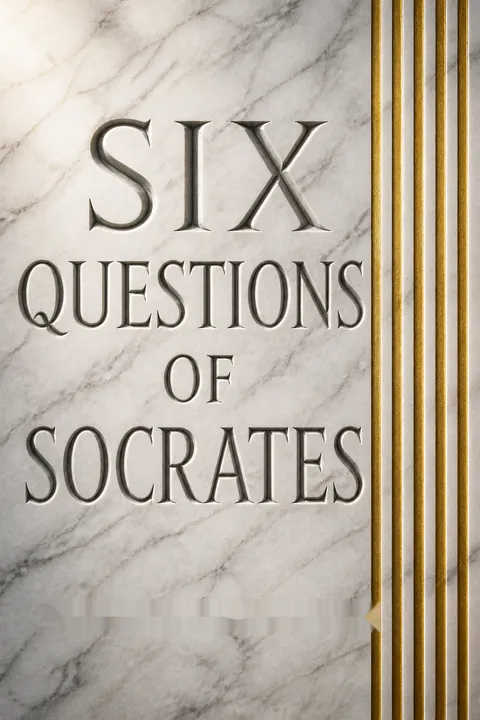


Key Takeaways
Use the six Socratic questions to turn moral ideals into tested ways of living
Start with questions. The book follows six inquiries associated with Socrates: What are virtue, moderation, courage, justice, piety, and goodness? In Athens, a participant argues that virtue has vanished because modern society no longer creates great public works or civic life. The group gradually reframes the issue: virtue is not a relic to admire, but a way of questioning convictions, discovering a higher purpose, and trying out better ways to live together.
Inquiry is practice. Socrates offers no final definitions. Phillips takes the questions to communities across the world, from prisons and homeless shelters to plazas and schools, because their answers gain meaning in concrete circumstances. The point is not to settle each question once and for all, but to let examination change how people act.
The method treats moral knowledge as something people build together, not merely receive from experts. That resembles deliberative democracy, where public reasoning can expose assumptions that private conviction leaves untouched. Its strength is inclusion: lived experience counts alongside formal learning. Its risk is that conversation alone can feel like progress while unequal institutions remain unchanged. The book is most persuasive when dialogue leads participants to consider consequences, responsibilities, and practical repair, rather than treating thoughtful discussion as a substitute for action.
Judge virtue by whether means and ends help people flourish together
Excellence is whole. The Greek term arete means excellence, broader than the modern idea of moral goodness. In the book's account of Socrates, justice, moderation, courage, piety, and goodness are distinct, but none can be missing without damaging the whole. A person cannot claim excellence by reaching a worthy goal through degrading means, or by pursuing private success at everyone else's expense.
Self and society connect. Navajo participants describe team excellence in basketball as coordinated play rather than individual glory. Yet the same norm of humility can make it harder for exceptional players to stand out and earn college scholarships. The example captures the tension: personal achievement can strengthen a community, but a community can also constrain individuals. Excellence asks how both can develop without one being sacrificed to the other.
This account resists two familiar shortcuts: judging character by private intentions alone, and judging it by outcomes alone. It instead asks whether methods and results support human flourishing. That resembles systems thinking, where an action is assessed by its effects across connected parts, not just its immediate payoff. The Navajo basketball example also prevents harmony from becoming an excuse for conformity. A community's shared good needs room for individual gifts, or collective excellence can quietly become a ceiling on talent.
Create harmony by restoring damaged relationships, not concealing discord
Harmony takes work. Navajo participants use hozho for a lived ideal of beauty, balance, and harmony among a person, family, community, nature, and the wider world. It is not a permanent condition: people create it through daily conduct, ceremony, art, and repair. A Navajo justice initiative uses community Peacemakers to bring offenders, harmed people, and families together to discuss the damage and agree on restitution. The aim is to restore relationships, not simply isolate the offender.
Silence can counterfeit peace. In Japan, participants debate Wa, or social harmony. Tact and restraint can protect relationships, but suppressing real problems can produce only a polished surface. Honest disagreement may disturb the room before making genuine cooperation possible. The book's comparison suggests that harmony is not the absence of tension. It is the capacity to face tension and work toward repair.
The idea resembles ecological resilience: a healthy system is not one that never changes, but one that can absorb disruption and reorganize without losing its vital relationships. Restorative justice applies a similar logic to harm by asking who was affected and what repair requires. Still, community processes are not automatically fair. The Chiapas dialogue shows how appeals to unanimity can silence dissenters. Harmony deserves trust only when participants can disagree without losing their place in the community.
Seek a contextual middle, not a reflexive compromise
The mean is not arithmetic. Muslim participants describe moderation as a middle way that balances extremes in conduct, consumption, and religious practice. Yet a midpoint is not automatically virtuous. In South Korea, activists challenge a government that calls obedience and repression necessary for social stability. Their argument is that an imposed balance can protect authority, not people. Moderation has to be judged by what it enables and whom it serves.
Look at the whole pattern. An American student describes tightly controlling her food for six days, then bingeing at a buffet. A peer points out that this is not moderation simply because restraint dominates the week; the pattern swings between extremes. Elsewhere, participants connect moderation to knowing what is enough, using resources responsibly, and adapting one's personal limits to circumstances. The middle must be discovered, not copied from a rulebook.
This is a useful correction to the idea that virtue always means splitting the difference. In ethics, a compromise can preserve an unjust arrangement just as easily as it can resolve a conflict. The Korean example makes power visible: a government may describe compliance as balance because that language legitimizes control. At the personal level, the eating story shows why isolated choices can mislead. A sound judgment considers the pattern, its consequences, and whether restraint is chosen freely.
Make justice answer to the injured, not just the rulebook
Law needs fair use. In a Mexico City plaza, participants describe justice as impossible when wealthy people can escape prosecution while ordinary people cannot get stolen property returned without paying bribes. A United Nations report cited in the book estimated that 95 percent of crimes in Mexico went unpunished. A fine constitution cannot deliver justice if officials apply its protections selectively. Rules matter, but so do accountability and the actual treatment of people harmed.
Listen to those excluded. In Chiapas, some Indigenous communities make decisions through extended discussion aimed at agreement. Yet opponents of joining an armed movement are expelled from their communities, revealing how a language of unity can conceal coercion. These stories complicate any simple formula, including equal treatment in every case. Justice must consider rights, history, needs, and consequences, while preventing those in power from defining dissent as a crime.
The distinction between fair procedure and just outcomes is central to institutional design. Consistent rules can still reproduce injustice when access to representation, protection, or remedy is unequal. Conversely, tailoring every decision to circumstance can invite favoritism unless clear safeguards exist. The book's examples point toward a double test: procedures must constrain arbitrary power, and affected people must have a meaningful route to challenge them. Neither neutral rules nor good intentions can substitute for accountability.
Protect the human future by giving people reasons to hope
Hope needs openings. In a maximum-security prison, inmates describe a college program that gave them a chance to understand their past actions and imagine a different future. When the program is canceled, they experience the decision as a loss of hope as well as education. The book cites a study reporting recidivism of 12.5 percent among inmates who earned four-year degrees, compared with 66 percent in the broader group studied. The figures are suggestive, not proof that education alone caused the difference.
Good reaches beyond comfort. Participants connect goodness to helping people secure the conditions for a dignified life, including education, safety, food, and a chance to participate in society. Hope is not mere optimism or absolution. It means a credible possibility of becoming wiser and contributing differently, paired with responsibility for people previously harmed.
The prison conversation makes hope concrete: it depends partly on whether institutions create routes toward learning, responsibility, and reintegration. The cited statistics invite caution because people who complete degrees may differ in motivation or circumstances from other prisoners. Even so, the comparison raises an important policy question: whether punishment improves public safety when it removes opportunities associated with change. Compassion is not the denial of harm. It can be a disciplined investment in reducing the conditions that make future harm more likely.
Call courage wise risk in service of a humane cause
Risk is not enough. After the September 11 attacks, participants debate whether firefighters entering the towers acted courageously if rescue was part of their training. They conclude that danger alone cannot define courage; purpose matters too. A Japanese schoolgirl questions the heroism of a fictional samurai who helps strangers partly because he hopes they will help him in return. Her classmates eventually agree that courage is not blind loyalty or spectacular fearlessness. It requires judgment about what is worth protecting.
Fear can clarify stakes. Navajo elders describe endurance through forced displacement and attempts to suppress their language and culture as a form of courage. Another participant argues that dissent can be courageous when it risks reputation or safety to challenge injustice. Across these examples, the key is not being unafraid. It is acting with care and foresight despite fear, for a cause that respects human life.
This definition separates courage from bravado, a distinction relevant to activism, military service, and everyday risk-taking. Moral purpose matters because harmful movements can demand discipline and sacrifice too. Yet claims about a worthy cause can be distorted by certainty, especially when dissent is treated as betrayal. Courage therefore needs an accompanying practice of scrutiny: examining likely consequences, listening to those who bear the costs, and remaining willing to revise one's judgment.
Give loyalty to examined commitments, never to authority alone
Piety means fidelity. The book explores piety in religious and civic settings, where participants connect it to reverence, duty, and commitment. Korean participants challenge a version of filial piety that demands unquestioning obedience from children and subordinates, especially when it reinforces male authority. Catholic participants confronting clerical abuse argue that devotion to a faith cannot mean shielding leaders from accountability.
Commitment becomes visible. After September 11, a Muslim family realizes that keeping to themselves is not enough to ease neighbors' fear. They organize a cookout and invite the community, turning religious concern for others into a practical act of welcome. The book's test for piety is therefore not a label or ritual alone. It is whether a commitment serves people, and whether its holder can question authority when authority betrays that purpose.
This approach preserves the moral force of loyalty while refusing to confuse it with obedience. In organizations, unquestioned allegiance can protect leaders at the expense of those they are meant to serve. Accountability does not necessarily weaken a community's deepest commitments; it can make them credible. The cookout also shows that trust is built through small, visible acts rather than declarations alone. A limitation is that people may disagree about what service requires, making open challenge and shared standards essential.
Keep public inquiry open, especially when consensus feels comfortable
Make questioning accessible. Phillips's Socrates Cafés bring philosophical discussion into cafés, schools, prisons, shelters, and public plazas. Participants choose a question, then examine its assumptions, clarify its key ideas, test examples, and consider competing views. A facilitator listens, makes space for quieter voices, and avoids steering the group toward a predetermined answer. The gathering need not end in agreement. It succeeds when participants leave with sharper questions and a more carefully considered view.
Democracy needs practice. The book presents ancient Athens as a society that once flourished through civic participation and experimentation, then weakened as citizens withdrew from shared public life. Its history is not a blueprint for copying Athens, but a warning that political structures alone cannot sustain an examined civic culture. Open inquiry lets people criticize themselves and their institutions before comfortable assumptions harden into unquestionable rules.
This format resembles a small-scale civic institution: it distributes speaking, makes assumptions public, and treats disagreement as material for thought rather than a contest to win. Its accessibility is a strength, particularly when people usually excluded from formal debate are invited to shape the question. But a circle is not automatically egalitarian. Differences in confidence, status, language, and safety can still govern who speaks. Careful facilitation matters, and dialogue gains force when connected to decisions and public accountability.
Analysis
The book's central move is to take virtue out of the dictionary and place it among people negotiating real conflicts. Its six questions are not six compartments. They are overlapping tests of whether personal conduct, social arrangements, and political power help people live with dignity. The Navajo account of hozho, Japanese arguments about Wa, Korean disputes over filial duty, and Mexican demands for justice do not yield one universal formula. Instead, they reveal recurring problems: harmony can become silence, moderation can become enforced obedience, loyalty can shelter abuse, and courage can serve destructive ends.
That contextual approach is a strength because it resists exporting one culture's moral vocabulary as a universal standard. It also carries a methodological risk. The author acknowledges that dialogues have been edited and sometimes composed from multiple encounters. Readers should therefore treat participants as situated interlocutors, not as definitive representatives of entire cultures. The Chiapas discussion is especially valuable here: it disrupts an idealized picture of unanimous Indigenous communities by showing dissent and exclusion within them.
The book's most durable contribution may be its insistence that moral judgment concerns both means and ends, and must remain revisable in light of consequences. This is close to a practical form of virtue ethics, but it is also civic theory: people learn what they value by debating and acting together. Dialogue is not a replacement for law, resources, or political power. A prisoner's hope cannot be sustained by conversation if education is removed; a community cannot repair injustice if officials remain unaccountable. The method works best as a bridge from reflection to institutional change.
The narrative's travel structure makes abstract ideas memorable by placing them in contested settings, from a prison classroom to a public plaza. Its invitation is demanding rather than comforting: keep asking what a virtue does, whom it serves, and what damage its misuse can cause. Excellence remains possible, but never as a settled possession. It depends on people and societies preserving the capacity to question, repair, and begin again.
Review Summary
"Six Questions of Socrates" explores philosophical inquiries through global dialogues. Readers appreciate its accessible approach to complex topics, praising Phillips' ability to engage diverse perspectives. Some find the discussions thought-provoking, while others criticize the lack of depth or challenging viewpoints. The book's format and writing style receive mixed reviews, with some enjoying the conversational tone and others finding it disjointed. Overall, it serves as an introductory text for those interested in applying Socratic questioning to modern issues, though its effectiveness varies among readers.
People Also Read





Glossary
Socrates Café
community philosophical dialogueA public, facilitated gathering in which participants choose a philosophical question and explore it together. The facilitator encourages careful listening, examples, clarification, and challenges to assumptions, without teaching a preferred answer or requiring consensus. Phillips presents it as a way to make philosophical inquiry accessible beyond classrooms and to strengthen participatory public life.
arete
human excellenceAn ancient Greek term often translated as virtue, but broader than moral goodness in the modern sense. In the book, arete means excellence across a person's life, including judgment, skill, courage, and civic conduct. Its underlying idea is that personal excellence cannot be separated from the health and flourishing of the community.
hozho
lived Navajo harmonyA Navajo ideal of beauty, balance, and harmony linking a person with family, community, nature, and the larger universe. It is not simply a natural state that can be taken for granted. People strive to create and restore it through conduct, relationships, ceremony, art, and responsibility toward the world around them.
Wa
Japanese social harmonyA Japanese concept of group harmony discussed in the book through debates about cooperation, tact, and disagreement. Protecting Wa can encourage empathy and restraint, but it can also be invoked to suppress criticism. Participants distinguish genuine harmony, which can withstand honest discussion, from a surface calm that conceals problems.
honne tatemae
private and public selvesA Japanese distinction between honne, a person's private feelings or views, and tatemae, the public stance shaped by social expectations. The book presents these not simply as truth versus lies, but as different forms of communication. Their ethical value depends partly on whether they protect consideration and trust or conceal problems that need to be addressed.
nalyeeh
harm-restoring processA Navajo process described in the book as part of community peacemaking. The person who caused harm discusses what happened and the effects on others, with affected people and family members involved in seeking restitution and repair. Its aim is to restore relationships and social harmony rather than treating punishment of the offender as the only response.
pious knowledge
knowledge serving humanityPhillips's term for knowledge used to support coexistence, community, and human dignity rather than the interests of one race, nation, class, or religion. It describes learning that builds understanding across differences and informs action. In the book's Socratic frame, such knowledge helps people examine how their choices affect others.
eudaimonia
human flourishingAn ancient Greek idea of well-being or fulfilled life. In the book's account of Socrates, good action should support both an individual's flourishing and the well-being of society. It is not merely pleasure or private success, but a broader condition shaped by how people live, choose, and treat one another.
FAQ
What's Six Questions of Socrates about?
- Exploration of Socratic Questions: The book follows Christopher Phillips as he travels the world, engaging people in dialogues centered around six fundamental questions posed by Socrates: What is virtue? What is moderation? What is justice? What is good? What is courage? What is piety?
- Cultural Perspectives: Phillips incorporates diverse cultural viewpoints, illustrating how different societies interpret these philosophical questions. This cross-cultural dialogue enriches the understanding of these concepts and demonstrates their relevance in contemporary life.
- Philosophy as a Living Practice: The book emphasizes that philosophy should not be confined to academic settings but should be a living, breathing practice that engages ordinary people in meaningful discussions about their lives and values.
Why should I read Six Questions of Socrates?
- Accessible Philosophy: Phillips presents complex philosophical ideas in an engaging and relatable manner, making them accessible to readers of all backgrounds. His conversational style invites readers to reflect on their own beliefs and values.
- Encourages Dialogue: The book promotes the idea of dialogue as a means of exploring philosophical questions, encouraging readers to engage in discussions with others. This approach fosters critical thinking and a deeper understanding of oneself and society.
- Cultural Insights: Readers gain insights into various cultures and their philosophical traditions, broadening their perspectives on universal human concerns. This exploration can inspire readers to think critically about their own cultural assumptions.
What are the key takeaways of Six Questions of Socrates?
- Importance of Inquiry: The book underscores the significance of asking questions and engaging in dialogue to explore the nature of human existence. Phillips illustrates that inquiry is essential for personal and societal growth.
- Interconnectedness of Virtues: Phillips argues that virtues such as justice, courage, and moderation are interconnected and must be understood in relation to one another. This holistic view encourages readers to consider how these virtues manifest in their lives.
- Philosophy in Action: The dialogues Phillips conducts demonstrate that philosophy can be a practical tool for addressing real-world issues. By applying philosophical inquiry to everyday life, individuals can cultivate a more examined and meaningful existence.
What are the best quotes from Six Questions of Socrates and what do they mean?
- “Virtue is questioning convictions.”: This quote encapsulates the essence of Socratic inquiry, suggesting that true virtue lies in the willingness to challenge one’s beliefs. It emphasizes the importance of self-reflection and critical thinking in the pursuit of a virtuous life.
- “When you have to start asking what virtue is, that’s a sure sign that you’ve stopped being virtuous.”: This statement highlights the idea that living virtuously should be intuitive and inherent. It suggests that when one must question the nature of virtue, it may indicate a disconnect from virtuous living.
- “Justice is equality—not just under the law, but in how we human beings see one another.”: This quote reflects the book’s exploration of justice as a broader concept that transcends legal definitions. It emphasizes the need for empathy and recognition of shared humanity in achieving true justice.
What are the six questions explored in Six Questions of Socrates?
- What is Virtue?: Phillips examines how different cultures define virtue, exploring its implications for personal and societal conduct. The dialogues reveal that virtue is often seen as a guiding principle for ethical behavior.
- What is Moderation?: The concept of moderation is explored through various cultural lenses, emphasizing its role in achieving balance in life. Phillips discusses how moderation can lead to greater happiness and fulfillment.
- What is Justice?: Justice is dissected as a multifaceted concept, with participants sharing their views on legal and moral justice. The dialogues highlight the complexities of justice in different societal contexts.
How does Christopher Phillips engage with participants in Six Questions of Socrates?
- Socratic Method: Phillips employs the Socratic method of questioning to stimulate dialogue and encourage participants to think critically about their beliefs. This approach fosters an environment of open inquiry and exploration.
- Cultural Context: He adapts his questions to fit the cultural backgrounds of his participants, ensuring that the discussions are relevant and meaningful. This cultural sensitivity enriches the dialogues and deepens the insights gained.
- Personal Stories: Participants share personal anecdotes and experiences related to the philosophical questions, making the discussions relatable and grounded in real-life situations. This storytelling aspect adds depth to the philosophical exploration.
How does Six Questions of Socrates relate to contemporary issues?
- Relevance of Philosophy: Phillips demonstrates that philosophical inquiry is not just an academic exercise but is vital for addressing contemporary social and ethical issues. The book encourages readers to apply philosophical thinking to their own lives and communities.
- Social Justice: The discussions often touch on themes of social justice, equity, and the moral responsibilities of individuals and societies. This focus on justice resonates with current global movements advocating for human rights and equality.
- Personal Growth: The book emphasizes the role of self-examination and critical thinking in personal development. Readers are encouraged to reflect on their values and beliefs, fostering a more examined and purposeful life.
What is the Socratic method as described in Six Questions of Socrates?
- Questioning Assumptions: The Socratic method involves asking probing questions to challenge assumptions and stimulate critical thinking.
- Encouraging Dialogue: It promotes open dialogue where participants can explore ideas collaboratively, rather than simply debating to win an argument.
- Fostering Self-Reflection: This method encourages individuals to reflect on their beliefs and values, leading to personal growth and deeper understanding.
How does Six Questions of Socrates address the concept of piety?
- Definition of Piety: Piety is explored as a blend of reverence, loyalty, and duty, particularly in the context of familial and societal relationships.
- Filial Piety: The book discusses the Confucian concept of filial piety, emphasizing the responsibilities children have toward their parents and the implications for modern society.
- Piety in Action: It illustrates how true piety involves actions that benefit others and contribute to the greater good, rather than mere adherence to tradition.
What role does courage play in Six Questions of Socrates?
- Everyday Courage: Courage is defined not just as heroic acts but as the ability to face daily challenges and adversities.
- Moral Courage: The book emphasizes the importance of moral courage, which involves standing up for one’s beliefs and values, even in the face of opposition.
- Courage in Dialogue: Engaging in philosophical discussions requires courage, as it often involves confronting uncomfortable truths and differing opinions.
How does Six Questions of Socrates encourage personal growth?
- Self-Examination: The book encourages readers to reflect on their beliefs and values, promoting self-awareness and personal development.
- Engagement with Others: By participating in dialogues, individuals can learn from others and expand their understanding of complex issues.
- Commitment to Virtue: It inspires readers to strive for virtues such as empathy, courage, and piety, which contribute to their growth as individuals and members of society.
What is the significance of the dialogues in Six Questions of Socrates?
- Catalysts for Change: The dialogues serve as catalysts for personal and societal change, illustrating the power of conversation in addressing important issues.
- Building Community: They foster a sense of community among participants, encouraging collaboration and mutual support in the pursuit of understanding.
- Philosophical Exploration: The dialogues exemplify the essence of philosophical exploration, where questions are more important than answers, and the journey of inquiry is valued.
Download PDF
Download EPUB
.epub digital book format is ideal for reading ebooks on phones, tablets, and e-readers.








