

Key Takeaways
Defend freedom by regulating harm, not enforcing someone else's virtue.
Morality is not law. Savage's governing claim is that the right to pursue happiness means adults should be free to choose pleasures others dislike, provided they do not harm unwilling people. He notes that the seven deadly sins were assembled over centuries, and do not appear as a fixed list in the Bible. Moral categories have histories; they are not self-evident instructions for government.
Coercion changes the case. In Genesis, the men of Sodom demand sexual access to Lot's visitors. Savage reads the offense as attempted group violence and a breach of hospitality, not consensual adult sex. That distinction anchors his argument: private indulgence is different from imposing it on someone else. Laws against assault, rape, and exploitation protect that boundary; laws that police harmless private choices enforce a preferred moral code.
The argument draws on the liberal harm principle: coercion and injury provide stronger grounds for law than disgust or religious disapproval. Its strength is that it asks whether a rule protects people or merely makes a majority more comfortable. The difficult question is what counts as harm. Drug markets, family obligations, and public health can create consequences beyond an individual's private experience. That complexity does not erase the distinction, but it demands evidence about who bears the costs, rather than treating the label of sin as evidence by itself.
Judge intimate choices by consent and honesty, not a universal script.
Agreement changes the meaning. David and Bridget, a religious Jewish couple with three children, had been married for ten years and swinging for four. They described their outside sexual encounters as something they chose together, with boundaries and quiet signals for checking in. Their central distinction was between sex concealed from a spouse and sex permitted within an agreed arrangement. Their story complicates the claim that every marriage must define fidelity in exactly the same way.
One model is not universal. Savage argues that couples should discuss desire and expectations more honestly, rather than assume lifelong monogamy is effortless or that any infidelity must end a marriage. But he does not claim every couple should swing. The couple's consent, trust, and communication explain why their arrangement works for them; they do not guarantee that the same arrangement would suit another relationship.
Relationship research and clinical practice often distinguish explicit agreements from assumptions that partners never discuss. The couple's example makes that distinction vivid: consent is not simply a one-time yes, but an ongoing understanding that can be revisited. At the same time, biological claims about humans being naturally nonmonogamous cannot settle a moral or relational question. People differ, and even a consensual arrangement can become painful if boundaries shift or one partner feels pressured. The useful lesson is negotiation, not a new rule for everyone.
Casinos sell suspense, while their mathematics keep the house ahead.
The thrill is the point. Savage begins as a Vegas snob, then warms to the city's spectacles. At the blackjack tables in Iowa, dealers teach him that a player can improve decisions but cannot remove the house advantage. He leaves with $710 after starting with $300, then returns with $3,000 and loses it all. The same game can deliver a rush or a painful lesson; neither outcome proves special skill.
Choose an exit before entering. The bartenders and dealers stress that players should decide in advance how much they can lose and when they will stop. Chasing an earlier loss turns a limited gamble into an open-ended one. Savage comes to see gambling less as a reliable route to money than as a purchasable dose of uncertainty, a break from predictable daily life.
Behavioral economics helps explain why the casino's sensory design matters: intermittent rewards and vivid displays of wins can make rare payoffs feel more common than they are. The book's contrast between the casino's glitter and its unfavorable odds is especially effective because the author experiences both the rush and the loss. Still, the desire for suspense is not a full account of gambling. For some people, the activity becomes compulsive and financially devastating, so safeguards and treatment matter alongside the defense of adult choice.
Tell the truth about drugs, or young people stop believing you.
Scare tactics lose credibility. Savage argues that marijuana policy should account for relative risk, rather than equate cannabis with every other illegal drug. He describes his own use as rare and criticizes drug education that tells children that any marijuana use leads to addiction, crime, or death. He cites studies and reports available at the time suggesting those warnings were exaggerated, and points to research questioning whether DARE programs reduced later drug use.
Honesty is safer than panic. The book's concern is not that young people should use drugs, but that demonstrably false claims can weaken trust in adults and make credible warnings about more dangerous substances easier to dismiss. Savage also argues that prohibition fuels criminal markets and punishment. His case is for truthful information and policy based on relative harms, not for pretending that drugs are risk-free.
This is an argument about risk communication as much as drug law. Public-health messages work best when they distinguish levels of danger and admit uncertainty; credibility is a resource that can be spent down by exaggeration. Yet truthful messaging alone does not determine the right legal policy. Age, impaired driving, dependence, and product regulation still require attention. The chapter's 2002 evidence and statistics belong to their period, so its durable insight is the method: compare harms honestly, update claims, and do not confuse a frightening slogan with prevention.
Treat rest as a human need, not a reward for finishing everything.
Downtime is necessary. Savage reframes sloth, traditionally understood as laziness or spiritual neglect, as a normal need for sleep, daydreaming, and time away from work. He cites labor figures for 2000 reporting that American workers averaged 49.5 working weeks a year, compared with fewer weeks in several other industrialized countries. The book also contrasts the roughly thirteen paid vacation days available to the average U.S. worker with more generous vacation allowances elsewhere.
A substitute is not a solution. Savage proposes that marijuana's altered sense of time can give an overworked person a brief, subjective feeling of rest. He presents this as a personal theory, not proof that cannabis replaces a real holiday. His larger point is that a culture that glorifies output can make ordinary recovery feel undeserved, even though bodies and attention need it.
The chapter anticipates a familiar problem in occupational health: individual coping strategies cannot repair a work system that leaves too little time for recovery. A brief escape may feel restorative, but it is not equivalent to predictable time off, secure employment, or control over one's schedule. Savage's provocative cannabis hypothesis is best read as a symptom of that shortage, not a prescription. Treating rest as infrastructure, rather than a luxury for people who have earned it, shifts attention from personal discipline to the conditions shaping daily life.
Defend body autonomy without pretending every appetite is consequence-free.
Acceptance is not denial. At a NAAFA gathering, Savage expects to find people celebrating food without shame. Instead, he sees intense disagreement over weight, health, and weight-loss surgery. Teresa and Shawn describe growing beyond 400 pounds, losing mobility, and choosing surgery despite hostility from some members. They say they wanted more freedom in daily life, not proof that they hated themselves.
The costs are real and varied. The book recounts medical complications, social stigma, and the movement's resistance to describing extreme obesity as unhealthy. It also notes that weight is influenced by more than simple willpower. Savage's position is that adults should be free to choose pleasure and accept its risks, but neither public shaming nor claims that every risk is imaginary help people make informed decisions. The book's obesity statistics describe its own period, not current prevalence.
The chapter is strongest when it refuses two easy stories: that body size is simply a moral failure, or that health consequences can be dismissed as prejudice. Weight stigma can damage care and dignity, while mobility limits and disease can be serious regardless of stigma. A humane approach needs both respect and accurate medical attention. The NAAFA conflict also shows how a movement built to protect people can become restrictive when it treats one account of identity as mandatory. Autonomy includes the freedom to make different choices.
Notice when the rich buy hardship that poor people cannot escape.
Deprivation becomes a luxury. To explore envy, Savage spends a week at a Malibu-area weight-loss spa that costs $3,200. Guests receive sparse meals, long hikes, and little control over their routines. Many are wealthy and accustomed to comfort. They pay to experience a managed version of hardship, then return to lives where money can restore their choices.
The contrast is the point. Savage arrives hoping to study affluent people enjoying privilege, but finds them purchasing temporary discomfort. He loses ten pounds and recognizes the privilege built into the experience: the guests can buy deprivation without being trapped in it. His phrase for the arrangement is conspicuous nonconsumption, a display of status through paying to abstain from ordinary comforts. The poor do not get to schedule the end of hardship.
The episode connects to sociological accounts of status signaling: distinction can come not only from owning more, but from demonstrating the ability to refuse comfort. The spa turns discipline into a premium product, complete with guides, meals, and an exit date. That is not the same as the insecurity of poverty, where deprivation is imposed and recovery may be unavailable. The comparison sharpens the book's critique of inequality, though one spa cannot represent every wealthy person's motives. Its revealing point is structural: money can make even hardship reversible.
Let queer pleasure stand on its own, without dressing it as social work.
Pride began as an antidote. Savage traces gay pride parades to a movement that challenged shame and helped people see openly gay lives in public. He then follows Kevin and Jake, a successful Los Angeles couple who attend a parade mainly to have fun and see friends, while initially describing the event as something done for gay youth. Their candor eventually reveals pleasure as a legitimate reason to gather.
Identity is not a moral guarantee. Savage worries that the slogan of pride can turn into a demand to praise everything associated with being gay. A person's sexuality does not tell others whether that person is kind, trustworthy, or safe. The parade can offer visibility and community without pretending every participant is exemplary or every event is political education. His critique targets compulsory virtue, not the original need to resist shame.
The distinction between dignity and moral perfection is valuable well beyond this example. A marginalized identity deserves protection without requiring its members to serve as flawless representatives. At the same time, public pride can remain politically meaningful where stigma and exclusion persist; the need for it is not uniform across places or generations. The sharper question is whether a community can celebrate pleasure and defend rights without claiming that either makes every individual virtuous. That distinction allows solidarity without turning identity into a substitute for ethics.
Enjoyment is not proof that a risky freedom is harmless to others.
The lesson comes from experience. Savage enters a Texas shooting range fearful of guns, takes a lesson, and discovers he is an unusually accurate shot. He enjoys the novelty and the praise. That pleasure complicates his certainty that guns should be prohibited, but it does not erase the harms he associates with widespread gun access, including accidental injury, suicide, and homicide.
Rights need careful boundaries. The chapter compares the Second Amendment debate with arguments about speech, drugs, and other liberties. Savage argues that gun owners who defend freedom should also defend civil liberties beyond gun ownership. His own response is not simple: he likes recreational shooting while believing that the social risks of firearms justify stronger restrictions. The story shows why a pleasurable experience can inform a moral judgment without settling the public-policy question.
This is an important stress test for the book's liberty argument. Private enjoyment does not by itself establish that an activity has only private consequences, especially when a tool can cause irreversible harm. A sound policy analysis separates the right to own, the manner of use, and the risks imposed on others, then asks whether restrictions are effective and proportionate. Savage's self-implication is more persuasive than a tidy claim of consistency: he admits the pleasure while confronting the externalities. The result is tension, not a ready-made answer.
Treat sex work as a safety problem, not a moral purity test.
Prohibition does not erase demand. In New York after September 11, Savage hires Emily, an independent escort who presents her work as a career rather than a temporary route through college. He also meets Brad, her boyfriend, who sells muscle-worship sessions to men. Their stories unsettle the familiar image of every sex worker as coerced or desperate, while not proving that exploitation is absent.
Reduce danger where possible. Savage argues that when prostitution is driven underground, workers may have less ability to seek police protection or insist on safer conditions. He cites examples from Edinburgh, Australia, and the Netherlands to support decriminalization or regulation as alternatives to pretending the industry can be eliminated. The book's closing return to Sodom reinforces its central distinction: consensual adult behavior is not equivalent to violence, coercion, or abuse of a guest.
A harm-reduction lens asks what legal arrangement gives workers the greatest practical safety, bargaining power, and access to help. That is more useful than treating moral disapproval as a policy outcome. But decriminalization alone cannot guarantee safe workplaces or eliminate coercion; labor protections, enforcement against violence, and support for people who want to leave also matter. The chapter's vivid individuals broaden the reader's picture of sex work, though anecdotes cannot represent the whole industry. The governing question remains concrete: which rules reduce harm for the people most exposed to it?
Analysis
This is a polemical travelogue organized around the seven deadly sins, but its deeper subject is who gets to define a legitimate life. Savage moves from Las Vegas tables to swingers, drug policy, a fat-acceptance gathering, an expensive weight-loss spa, a gay pride parade, a Texas gun range, and New York sex work. The journeys keep the argument embodied. He does not merely defend other people's pleasures; he tries them, misjudges them, sometimes enjoys them, and sometimes pays for them. The resulting voice is funny, combative, and unusually willing to expose its own contradictions.
The book's most durable contribution is its distinction between disapproved behavior and behavior that harms or coerces others. That framework makes its interpretation of Sodom, its defense of consensual adult sexuality, and its challenge to drug prohibition parts of one argument rather than disconnected provocations. Its strongest scenes also reveal how moral rhetoric can conceal selective standards: gambling becomes acceptable when profitable, while other private choices remain condemned.
The method has limits. The book relies heavily on personal encounters, selected interlocutors, and early-2000s figures. Its claims about cannabis, obesity, marriage, and human sexual evolution sometimes move faster than the evidence presented. A vivid example can expose a contradiction, but it cannot establish how common that contradiction is. Savage also directs much of his sharpest attention at conservative moralists, leaving less room for the ways that social norms, market incentives, and private power can cause harm without a law being involved.
Those limits do not undo the central challenge. A society cannot avoid making moral judgments, but it can ask whether a rule prevents injury or merely imposes conformity. The book is most persuasive when it asks for that distinction, and most debatable when it treats the answer as obvious. Its enduring value lies in making readers examine their own double standards, especially when the pleasure at issue is not their own.
Review Summary
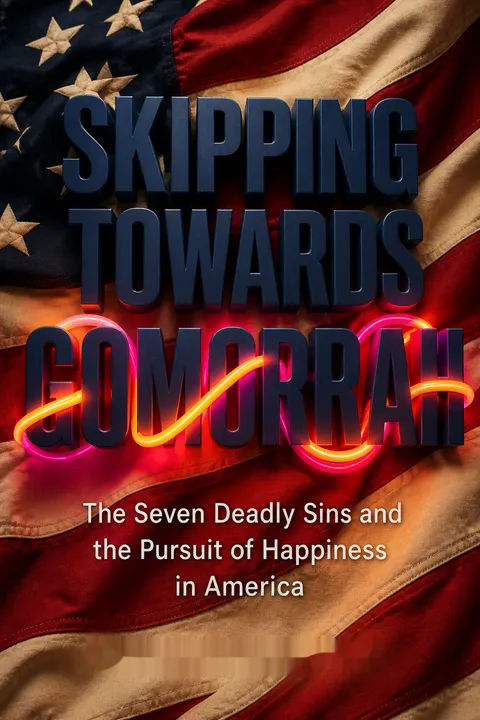
Skipping Towards Gomorrah explores the seven deadly sins in modern America, challenging conservative moralists' views. Savage's humorous and thought-provoking journey includes gambling, swinging, and fat acceptance conventions. While some readers found it entertaining and insightful, others felt it was repetitive or dated. The book argues for personal freedom and happiness pursuit, criticizing attempts to legislate morality. Savage's writing style and arguments resonated with many, though some disagreed with his perspectives on adultery and drug legalization.
People Also Read







Glossary
virtuecrats
Moralists seeking legal controlSavage's term for public figures who promote their own moral standards and seek to make them compulsory through laws or policy. It captures the book's central target: not people who choose a virtuous life for themselves, but people who use political power to restrict other adults' consensual choices.
playcouple
Consensually nonmonogamous coupleA term used in the swinging community for a couple who participate in sexual encounters with other couples while maintaining a relationship with each other. The word frames the practice as a shared arrangement or lifestyle, rather than as secret infidelity. Couples may set different boundaries, and participation does not require every couple to have intercourse with others.
Fat Admirer
Person attracted to larger peopleA person who is sexually or romantically attracted to fat people, often abbreviated as FA in the book. At the NAAFA convention Savage attends, some attendees assume he is an FA and therefore interested in dating larger women. The term describes an attraction, not a guarantee of respectful behavior or an endorsement of any particular relationship dynamic.
sperm competition syndrome
Proposed response to rival spermA term Savage cites from writing about swingers to describe a proposed evolutionary response in which a man's body may produce a more intense sexual response when he suspects his partner has recently had sex with another man. The book presents this as an explanation for some men's interest in swinging. It is a cited hypothesis, not a general rule about all men or couples.
MAD
Mutually assured overeatingSavage and his friend Tim use MAD, short for mutually assured destruction, to describe how they encourage each other to overeat when dining together. Each becomes more likely to order extra food or dessert because the other is doing so. The phrase turns a shared habit into a comic description of mutual influence and self-defeating behavior.
NAAFA
Fat-acceptance organizationThe National Association for the Advancement of Fat Acceptance, an organization that advocates for the rights and dignity of fat people. Savage attends its convention and encounters both political activism and social events. The book focuses especially on internal disagreements about health, weight-loss surgery, and whether members who choose surgery remain part of the movement.
About the Author
Other books by Dan Savage

Download PDF
Download EPUB
.epub digital book format is ideal for reading ebooks on phones, tablets, and e-readers.








