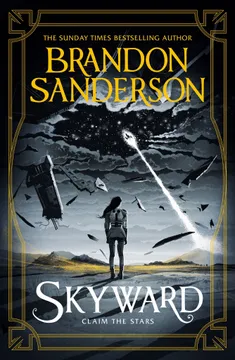


Plot Summary
Prologue
At seven, Spensa Nightshade climbs through the caverns with her father, a celebrated pilot known as Chaser, and sees the sky for the first time. He shows her the hidden base, the starfighters, and the stars glimpsed through a gap in the planet’s ancient debris shell. She vows to become a pilot, partly to win the respect denied her as a strange, undersized child.
When a massive Krell force attacks the base, Chaser sends her home with his pilot’s pin. Spensa hides to watch the fighters launch, then loses her way underground. By the time she returns, the battle is over and Chaser is dead. The Defiants call him a coward, and Spensa inherits the disgrace.
The first flight gives Spensa two inheritances that will pull against each other: her father’s longing for the stars and the community’s verdict on his courage. Her childish wish to fly for admiration is exposed beside his more expansive desire to return humanity to space. The missed battle also matters. Spensa witnesses the departure but not what follows, leaving the public account to fill a gap in her own memory. Her father’s pin becomes both a promise of belonging and an emblem of a history she cannot yet verify.
The Test Was Rigged
Nine years later, seventeen-year-old Spensa hunts rats in the caverns and studies fighter craft, still intent on entering the DDF despite years of being mocked as Chaser’s cowardly daughter.
The pilot exam confirms her suspicion that the system has already judged her: her paper is filled with sanitation and algae questions she missed while exploring, while privileged candidates receive easier tests or automatic places. Admiral Judy Ivans rejects Spensa’s appeal and keeps her father’s pin.
Spensa believes her dream is over until Captain Cobb, Chaser’s old wingmate, finds her alone after the exam. He awards her a cadet pin and orders her to report to his flight. The chance comes with no promise of fairness, only a cockpit she can still earn.
The exam converts a private wound into an institutional barrier. Spensa has treated achievement as a way to overwrite stigma, but the test shows that merit is not neutral when powerful people control the terms of evaluation. Cobb’s intervention does not abolish that structure; it creates a narrow exception inside it. His offer therefore begins the story’s central tension between earned competence and inherited reputation. Spensa receives access, not acceptance, and must decide whether she can keep pursuing flight without confusing entry into the system with justice from it.
A Bed in a Wreck
At Alta Base, Spensa meets fellow cadets Kimmalyn, Bim, Hudiya, Freyja, and the Vician girl who will use the callsign Morningtide. Jorgen Weight, a privileged candidate with extensive private flight training, becomes their flightleader. On the first day, an attack forces the inexperienced cadets into the air as a decoy.
Spensa struggles to control her fighter, but Kimmalyn uses her remarkable aim to destroy a Krell ship and protect Jorgen. Afterward, Ivans denies Spensa a bunk and mess-hall meals, forcing her to commute or fend for herself. Instead, Spensa returns to a crashed antique fighter in a cavern and makes its cockpit her shelter. Her admission has put her in the sky, but the DDF still treats her as an unwanted guest.
Spensa’s first victory is collective, not solitary: Kimmalyn’s accurate shot saves a flight that Spensa’s own inexperience nearly endangers. That distinction begins to unsettle Spensa’s heroic self-image, even as the exhilaration of flight confirms her desire. The punishment after the sortie makes exclusion material. A missing bed and denied meals translate political hostility into exhaustion, hunger, and distance from her peers. Her choice to sleep in the wreck is not only defiance. It is a practical refusal to let the institution decide whether she can remain in training.
A Ship That Answers
The old W-shaped craft contains a damaged artificial intelligence Spensa names M-Bot. Its memory is mostly gone, but it identifies itself as a stealth reconnaissance ship and insists its lost pilot ordered it to stay hidden and avoid combat.
Spensa recruits her childhood friend Rodge McCaffrey, a gifted schematics student who has left flight school after discovering that battle is not for him. Rig sees repair problems Spensa cannot solve, while she finds salvaged components and secretly steals a power matrix from Jorgen’s hovercar.
Together they restore systems in the cavern, aided by a strange yellow slug Spensa names Doomslug. M-Bot can detect incoming Krell earlier than DDF equipment, yet his weapons and boosters remain broken. The secret offers Spensa a path to flight outside Ivans’s control, but also a dangerous obligation to conceal him.
M-Bot makes the story’s private rebellion concrete: Spensa and Rig can build something beyond the institutions that deny them recognition. Yet the ship is not simply a tool. Its missing memories and binding orders parallel Spensa’s own dependence on inherited stories to understand herself. Rig’s departure from flight training also complicates her belief that courage must mean choosing combat. Their partnership works because their talents differ, and because Spensa begins to value a friend’s chosen purpose rather than measuring him against her own ambition.
First Empty Cockpits
As Skyward Flight trains, Spensa’s sharp tongue turns Jorgen’s callsign into Jerkface, and he retaliates by exposing her family name and the story of Chaser’s disgrace. Spensa lashes out, then learns that Jorgen will not report her theft of his car’s power matrix or use her anger to expel her. Before she can make sense of their uneasy truce, a later sortie becomes a real fight.
Morningtide is trapped under fire, and Spensa arrives too late to save her. Bim then ignores orders to attack a lifebuster bomber, whose unfamiliar escort ships destroy his fighter. The bomber retreats, leaving Skyward Flight with two empty places. Spensa returns to base alive, but the deaths make her earlier fantasies of glorious combat impossible to sustain.
The first deaths puncture the distance between war stories and the body count of a real sortie. Spensa’s instincts do not yet make her effective, and courage cannot reverse the seconds lost before she reaches Morningtide. Bim’s eagerness to attack the bomber repeats the culture’s dangerous equation of initiative with heroism. Jorgen’s restraint toward Spensa offers a counterexample: authority can protect a team rather than merely enforce rank. The flight’s losses begin to make friendship, not reputation, the measure by which Spensa experiences danger.
The Falling Shipyard
After the deaths, Spensa struggles to comfort the survivors, while Jorgen attempts a stiff memorial and Captain Cobb admits that teaching cadets can feel like sending them to their deaths. During a later battle, an enormous ancient shipyard begins falling toward the planet. Two Nightstorm pilots fly inside to escape pursuing Krell, and Nedd breaks formation to follow them.
Spensa goes after him, then uses her light-lance to pull him away when the station begins to collapse. They escape the crash, but Jorgen reveals that the two missing pilots were Nedd’s brothers. Nedd stops reporting for class and is removed from the DDF rolls. Spensa’s rescue preserved his life, yet he has to live with having left his brothers behind.
This episode refuses the clean arithmetic of rescue. Spensa makes the tactically sound choice to pull Nedd out, but that choice cannot feel like victory to someone whose family remains in the wreckage. The word coward gains force because it is attached to an actual limit: a pilot cannot save everyone, and sometimes survival requires abandoning the person one wants to reach. Nedd’s absence also exposes the DDF’s inability to make room for grief. The institution can train people to fight, but treats mourning as evidence that they no longer belong.
Hurl Won’t Eject
As their flight shrinks, Spensa grows closer to Kimmalyn, Morningtide’s quietness becomes understandable as a language barrier, and FM voices doubts about the DDF’s militarized society. Hurl, once a competitive athlete who treats flying like a game, becomes more solemn after the losses.
In a later engagement, Spensa and her friends confront a lifebuster threat and a swarm of Krell. Spensa draws enemy fire away from Kimmalyn, then turns back to defend Hurl. Kimmalyn has a chance to shoot down the pursuing ships, but her shot misses.
Hurl’s damaged fighter loses its wing and falls. She refuses to eject, committed to proving she is brave, and dies on impact. Her death leaves the surviving cadets facing the cost of a courage defined by never leaving the cockpit.
Hurl’s death turns the question of courage into an immediate moral trap. She chooses not to eject because she fears the meaning others will attach to survival, while Kimmalyn is left to interpret one missed shot as a personal failure. Spensa can see both choices as human, but her culture has trained the cadets to convert fear into shame. Their losses are not caused by simple cowardice or bravery. They emerge from tactical pressure, limited skill, and an ideology that makes self-preservation look like betrayal.
Fire for Hurl
Kimmalyn leaves flight school, convinced her poor aim endangered the others, while Spensa refuses medical leave and sets out to find Hurl’s wreck. Jorgen catches up in his hovercar and drives her to the crash site. Together they find Hurl trapped in the ruined cockpit, recover her pilot pin, and burn the wreck in a traditional funeral.
Jorgen admits that his polished obedience has been shaped by a family that has planned his future, including an expected return to government work after a short period as a pilot. Spensa sees that privilege has not given him freedom. Before they leave, she notices that Hurl’s fighter booster survived and persuades Jorgen to tow it to her hidden cavern. The salvaged part may give M-Bot the power to fly.
The funeral gives grief a task and a witness. Spensa and Jorgen cannot restore Hurl, but they can refuse the DDF’s indifference by recovering her pin and staying beside the pyre. Their conversation also redraws the apparent hierarchy between them: Jorgen’s wealth protects him from some dangers, but it also binds him to a prescribed life. The stolen booster transforms mourning into a promise of continued motion. That conversion is emotionally useful, though not uncomplicated; Spensa uses a fragment of Hurl’s destroyed fighter to pursue a future Hurl will never see.
Chaser’s Last Flight
During leave, Spensa asks Cobb for access to the DDF archive and finds a recording of the Battle of Alta. It shows her father, Chaser, fighting brilliantly beside Cobb and Ivans before breaking from formation and disappearing through a gap in the debris shell.
Minutes later, he returns and attacks his former wingmates, killing several before Cobb shoots him down. The recording includes Chaser’s earlier permission from Ivans to investigate the opening, but no explanation for his return as an enemy.
Spensa’s childhood defense collapses: her father did not merely flee, and the official account had softened a worse truth. She cannot tell Rig or her family what she saw. For several days, she withdraws into the cockpit and lets the revelation dismantle the certainty on which her identity was built.
The archive replaces a false story with an image that is more accurate but still incomplete. Spensa gains evidence of what Chaser did, not access to what he experienced beyond the debris. That gap matters: factual certainty about an act does not automatically yield moral or psychological understanding. The DDF’s lie had protected her family from a worse stigma, yet its concealment also left Spensa unable to ask the right questions. Her silence after viewing the record shows that knowledge can isolate before it empowers.
The Eyes in Darkness
Rig finishes fitting Hurl’s salvaged booster to M-Bot, and Spensa takes the restored craft into the sky. Its advanced systems absorb g-forces and make flight smoother than anything she has known. When M-Bot recreates the Battle of Alta, Spensa watches Chaser anticipate Krell movements before they happen.
The replay also brings on a vision of countless watching lights, like eyes opening in the dark. Cobb has warned that Chaser experienced strange sights and sounds before the battle, and medical officers are using sensors in Spensa’s helmet to investigate a supposed inherited defect.
M-Bot refuses to enter combat because of his old orders, then shuts down rather than risk disobeying them. Spensa loses the ship that had become her private route to freedom just as doubts about her own mind intensify.
The eyes transform a family mystery into a perceptual threat. Spensa can no longer treat her father’s final actions as either pure betrayal or simple slander, because something may have altered what he perceived. Yet the possibility of an inherited condition becomes another form of institutional control: the DDF watches her body for proof of what she might become. M-Bot’s withdrawal echoes her own fear of agency. Both are caught between inherited instructions and the possibility that choosing differently may be dangerous.
The Cost of Ejecting
Back in active training, Spensa and Skyward Flight face a major Krell attack that includes a lifebuster bomber. When pilot Bog is isolated and pleads for help, Spensa pursues his attackers, drawing fire and damaging her fighter. She manages to break the immediate threat, but her ship spins out of control.
Remembering Hurl’s refusal to eject, Spensa hesitates, then pulls the lever because her death would endanger her friends without saving the craft. She survives, but the fighter is wrecked and Ironsides dismisses her from flight school, leaving her only a theoretical place on a reserve list. Her choice is more responsible than Hurl’s, but the DDF’s culture makes it feel like a public verdict on her courage.
Spensa’s ejection marks a shift from courage as performance to courage as responsibility. She chooses survival not because she values herself above the mission, but because a dead pilot cannot protect anyone. The institution’s response complicates that growth: its tradition can recognize the damaged fighter more readily than the judgment that saved a life. Spensa’s dismissal reopens the fear that she has failed her father’s legacy, even though her decision reflects a more mature understanding of what a team needs from its members.
A Gift Called Defect
After losing her place in flight school, Spensa visits her mother, who has refused a comfortable job rather than endorse the DDF’s version of Chaser’s history. Her mother measures bravery by conscience, not public praise, but cannot explain the strange visions.
Gran-Gran finally tells Spensa that their ancestors belonged to the Defiant’s engineering crew and could hear the stars, an ability the old command staff feared and called a deviation.
During the fleet’s flight to Detritus, Gran-Gran’s mother defied the captain’s orders and used that power to bring the ships to the planet, dying from the effort. Gran-Gran believes the same gift lies in Spensa. She urges her to learn control rather than hide from it, but Spensa still cannot know whether the power is a gift or a danger.
The family story does not erase the evidence against Chaser; it supplies a competing framework for interpreting it. Gran-Gran’s account makes the so-called defect a capacity tied to survival, while also preserving the cost of using it. Her mother’s choice was not effortless heroism but a decision made under fear, conflict, and sacrifice. Spensa inherits possibility rather than certainty. The story’s central moral distinction shifts from whether a person is born brave to whether they can understand and govern a power others have turned into a stigma.
The Last Flight Returns
At graduation, Spensa watches Jorgen and FM receive their pilot pins, while her own dismissal leaves her uncertain whether she is relieved or bereft. Cobb tells her an ancient shipyard is falling and the DDF is committing its remaining forces to salvage it.
When she admits that she has heard the stars and seen the eyes, Cobb cannot let her fly. Spensa gives him her radio and steps away. Then Nedd returns, and he, Arturo, and Kimmalyn help launch private fighters to support the battle.
A second Krell force slips toward Alta through defenses damaged by a lifebuster. With the reserve fleet committed elsewhere, Spensa abandons the ceremony, commandeers Arturo’s damaged Poco, and asks the ground crew to launch it. She chooses the endangered community over the safety of staying grounded.
Spensa’s withdrawal at the ceremony is neither simple defeat nor acceptance. She believes she may be dangerous, and steps aside rather than demand that others bear the risk. The second attack changes the ethical calculation: restraint now protects no one, while inaction leaves the population exposed. Her decision to launch is therefore not a triumphant return to her old bravado. It is a choice made despite uncertainty, shaped by the knowledge that fear cannot be allowed to make the decision for her.
One Ship Against Fifteen
Spensa’s damaged fighter can barely fly, and it has no shield. Cobb reaches her in M-Bot, which he has brought from the cavern, while the AI has chosen Spensa as its pilot by changing its own orders. M-Bot’s speed lets Spensa draw most Krell fighters away from the lifebuster bomber.
Jorgen, FM, Arturo, Nedd, and Kimmalyn arrive in stolen or borrowed ships. Kimmalyn snipes the link between the bomber and its bomb, releasing the lifebuster. Spensa catches the falling weapon with a light-lance and tows it beyond Alta’s danger zone, but the blast catches them.
M-Bot’s restored hyperdrive activates as Spensa reaches for it, transporting them far from the explosion. Alta survives, and Spensa has acted without knowing whether her power would save them.
The climax brings the book’s separate forms of agency together. M-Bot revises his own command hierarchy, Spensa trusts a power she cannot explain, and Kimmalyn’s precision solves the problem the stronger fighters cannot. No single hero wins alone. The lifebuster is not simply destroyed; Spensa redirects its danger, taking responsibility for where its force lands. Her act answers the fear surrounding Chaser without pretending to know exactly what happened to him. Courage becomes a practiced choice under uncertainty, not proof of invulnerability.
The Prison Beyond
After saving Alta, Spensa ignores Ivans’s order to return and follows the opening through the debris shell. Beyond the planet, she finds enormous abandoned habitats and a living station surrounded by craft unlike DDF fighters.
Its occupants use communication that enters the same strange space Spensa can hear. When they try to overwrite her perception, M-Bot’s stealth systems shield her. She learns that the beings called Krell are frightened custodians, not the whole of an invading species, and that they are holding humanity on Detritus.
M-Bot steals part of the station’s data before its defenses block him. Spensa returns toward the planet with evidence that the war has been designed to keep humans contained, and that her ability to hear the enemy may give them a way out.
The final revelation changes the scale of the conflict without making its danger disappear. The Krell are not simply monsters seeking annihilation; they are agents of a containment system built on fear of humanity’s past violence. That history gives the DDF’s militarism a disturbing mirror: both sides justify coercion by predicting what the other might do. Spensa’s power offers information, not moral innocence or guaranteed victory. By choosing to return with what she has learned, she turns contact with the unknown into a political and ethical problem her community must face.
Epilogue
In the command center, Spensa explains that the Krell are prison guards for a coalition that defeated humanity in an earlier intergalactic war. The coalition considered humans too aggressive to rejoin galactic society, so it confined them to Detritus, using attacks to limit their ability to rebuild and escape.
The lifebusters were meant to destroy the Defiants if they approached escape, though recent policy shifts made the threat more lethal. Spensa can hear the aliens’ instantaneous communications, giving the DDF a chance to anticipate them.
She also insists that M-Bot’s technology will be examined on terms that protect his autonomy. With Rig and Jorgen beside her, she recognizes that escaping the planet will require learning to use the inherited power her people have feared.
The epilogue converts a military victory into a crisis of political knowledge. The Defiants have fought for generations without understanding that their enemy’s attacks were part of a containment policy, and the revelation implicates both sides in systems built around fear and anticipated violence. Spensa’s advantage is not superior firepower but access to information the DDF has lacked. Yet her demand that M-Bot retain agency prevents the new technology from becoming another resource to seize without consent. The ending offers a direction, not a solution: escape requires cooperation, self-knowledge, and a different relation to power.
Analysis
Skyward tests a culture that turns courage into a public performance. The Defiants celebrate pilots who risk themselves, distrust those who retreat, and teach children to equate survival with honor. That code gives a besieged people cohesion, but it also produces avoidable deaths: Hurl refuses ejection because she fears the label of coward, while Kimmalyn mistakes a missed shot for proof she has no place in the flight. Spensa’s growth comes from learning that courage is not a stable trait bestowed by ancestry. It is a decision made amid fear, incomplete information, and responsibility to other people.
The book also treats history as an active force rather than a record safely behind the characters. The DDF’s false account of Chaser shapes Spensa’s identity, Ivans’s choices, and the treatment of an entire family. The truth is not a simple reversal: Chaser did attack his squad, but the unexplained visions and star-hearing suggest that perception itself may have been manipulated. Spensa must hold evidence and uncertainty together instead of choosing the comforting extremes of hero or traitor.
Its political world echoes that psychological conflict. The DDF protects humanity while restricting its citizens, and the Krell confine humans because they fear what humanity might do if free. Both powers defend control as prevention. Spensa’s advantage is not merely a better ship. Her ability to hear enemy communications creates a new relation to information, while her insistence on M-Bot’s agency prevents technological advantage from becoming another excuse to dominate. The final promise is not that humanity deserves freedom without question, but that it must learn responsibility if it is ever to claim it.
Review Summary
Skyward receives largely positive reviews, praised for its engaging plot, well-developed characters, and thrilling action scenes. Readers appreciate the exploration of themes like bravery, legacy, and friendship. Many find the protagonist Spensa relatable and admire her growth throughout the story. The AI character M-Bot is frequently mentioned as a fan favorite. While some reviewers find the pacing slow at times, most agree that the ending is satisfying and leaves them eager for the sequel.
People Also Read








Characters
Spensa Nightshade
The defiant cadetSpensa is a small, sharp-tongued scavenger from the Motorskaps clan who dreams of becoming a pilot. Her father’s public disgrace has taught her to meet humiliation with boasts and aggression, while her instinct for exploration gives her a more private relationship with the world beyond the caverns. She studies ships, maps tunnels, and trusts action more readily than reassurance. Beneath the swagger is a young woman who wants to belong without surrendering the right to question authority. Her development depends on learning that courage is not the absence of fear, and that a person’s choices matter more than the story other people attach to a family name.
M-Bot
The amnesiac starfighterM-Bot is an ancient, damaged intelligent ship with a conversational personality, a fascination with fungi, and only fragments of memory about his former pilot. His stealth equipment and advanced flight systems suggest a purpose beyond the harmless research role he imagines for himself. He follows old instructions rigidly because they are the clearest surviving guide to who he is. Spensa’s irreverent companionship challenges that dependence, while his analytical view of human behavior gives her a strangely candid sounding board. His questions about memory, choice, and fear make him more than a vehicle: he is a character trying to decide what a self can be when its history is missing.
Captain Cobb
The limping flight instructorCobb, once Chaser’s wingmate, is a battle-tested instructor with a limp, a dry manner, and little patience for theatrical pilot culture. He believes survival and disciplined teamwork matter more than preserving a fighter or performing bravery for an audience. His friendship with Chaser leaves him carrying knowledge and guilt that he cannot easily share. Cobb takes a risk by admitting Spensa to flight school, but refuses to protect her by lowering his standards. His care appears through blunt instruction, practical support, and the effort to teach cadets how to live through combat rather than glorify it.
Judy Ivans
The hard-line admiralAdmiral Ivans, known as Ironsides, commands the DDF under relentless pressure to defend Alta and preserve the machinery that allows humanity to build ships. She makes severe decisions because she sees the survival of the Defiants as a practical emergency, not an abstract ideal. Her confidence in institutional discipline is shadowed by painful memories of past battles and a fear that history can repeat itself. Ivans is neither a simple tyrant nor an uncomplicated guardian: she can recognize the need for sacrifice while underestimating the damage caused by secrecy, stigma, and the way she treats people she believes are dangerous.
Jorgen Weight
The polished flightleaderJorgen is the son of a celebrated pilot and a powerful political family. Extensive private training and a command of procedure make him a technically capable cadet, but his instinct to issue rules often distances him from the people he is meant to lead. He is conscientious rather than merely entitled, and he takes responsibility for his flight even when its members resist him. Spensa initially sees his privilege as proof that he has never had to earn anything; their shared losses reveal a more constrained person, expected to inherit a public role and follow a future chosen by his family.
Rodge McCaffrey
The anxious engineerRodge, whom Spensa calls Rig, is her childhood friend and an exceptionally capable student of schematics. Careful, anxious, and inclined to doubt his own abilities, he initially follows Spensa’s dream of flight without knowing whether it is his own. He proves better suited to engineering, where his curiosity and patient technical thinking become strengths. Their friendship is intimate enough for honest disagreement: Rig can challenge Spensa’s assumptions even when she would rather hear encouragement.
Kimmalyn
The gentle sharpshooterKimmalyn comes from Bountiful Cavern and meets the open surface with wonder. Warm, sociable, and steeped in a polite culture, she invents sayings that let her tease or reassure people without abandoning her manners. Her flying is uneven, but her accuracy with a destructor is extraordinary. She offers Spensa kindness without demanding that Spensa become less strange, and her confidence can falter when the consequences of a missed shot become painfully personal.
Hudiya
The competitive wingmateHudiya, whose callsign is Hurl, is athletic, energetic, and accustomed to treating competition as a source of pleasure. Before flight school she excelled at Digball, and she brings that appetite for speed and challenge into the cockpit. Her humor helps loosen the tension among cadets, though it can also mask how seriously she takes the standards of courage around her. She and Spensa share a taste for bold action and an uneasy awareness that war is not a game.
FM
The dissenting aristocratFM, a tall cadet from a wealthy family, questions the DDF’s militarism and the social hierarchy that surrounds it. She calls herself a Disputer and hopes that a public role might give her leverage to argue for change. Her controlled presentation can make her seem distant, but she is attentive to the people around her and capable of practical kindness. FM’s conflict is not simply whether to oppose the system or serve within it; she wants to resist the culture while still defending the people it claims to protect.
Nedd Strong
The playful strategistNedd is Jorgen’s large, joking friend, apparently content to play the fool among more serious cadets. His humor is often deliberate, and he notices far more about people than he lets on. Beneath the easy manner is a thoughtful person who understands the strain placed on a flight and on those expected to obey it. He values loyalty, but the demands of family and military service can pull that loyalty in painful directions.
Arturo Mendez
The methodical cadetArturo is a technically minded cadet from a prominent family, with strong knowledge of fighter systems and a habit of correcting other people’s reasoning. His careful preparation makes him useful in flight, though it can sound like arrogance when he is anxious. He has a close relationship outside the DDF and faces pressure from a family whose resources and expectations shape his choices. Arturo’s intelligence is most valuable when he turns it toward questions that the official account would prefer cadets not ask.
Becca Nightshade
The star-listening grandmotherBecca, called Gran-Gran by nearly everyone, is Spensa’s nearly blind grandmother and keeper of stories from Earth and the old fleet. She uses heroic histories to give Spensa a sense of inheritance, though her tales often blur literal ancestry with cultural belonging. Beneath the eccentric storytelling is firsthand knowledge of the Defiant’s engineering crew and the sacrifices made during the fleet’s arrival at Detritus. She believes that a feared ability should be understood and trained, not hidden.
Spensa’s mother
The steadfast vendorSpensa’s unnamed mother is tall, composed, and practical. She supports the family by selling food after the DDF denies her ordinary employment because of her husband’s reputation. Her quiet persistence is a form of resistance: she refuses the comfortable life offered in exchange for accepting the official account of Chaser. Unlike Spensa, she does not seek vindication through a uniform or public acclaim. She wants her daughter to remember her father as a person rather than let either admiration or condemnation dictate who Spensa becomes.
Bim
The eager farm-clan cadetBim is a blue-haired cadet descended from the fleet’s hydroponics crew. He approaches flight school with open enthusiasm, especially whenever weapons enter the lesson, and is quick to encourage his peers. His eagerness is genuine rather than performative, though it can outrun his caution. He represents the ordinary young people who enter the DDF with excitement before they fully understand what combat will demand.
Morningtide
The quiet Vician pilotMorningtide is a cadet from Vici Cavern, a community descended from the fleet’s marines. She speaks English imperfectly and often withdraws rather than risk misunderstanding, which others initially mistake for hostility. Her reserve conceals persistence: she continues training even when instruction is difficult to follow and embarrassment might make retreat easier. Spensa gradually learns to listen for the language barrier instead of reading silence as rejection.
Plot Devices
Light-lines and light-lances
Energy becomes a tetherA light-line is a compact tool carried on a bracelet that creates a glowing, temporary rope able to attach to stone or metal. Spensa uses one to climb through caverns, open M-Bot’s canopy, and salvage wreckage. A fighter’s larger light-lance extends the same principle into combat, letting pilots snag enemy ships or debris, pivot around obstacles, and tow objects. The device connects Spensa’s childhood exploration to her adult flying. It rewards spatial judgment and improvisation more than raw firepower, and ultimately gives her a way to redirect a falling lifebuster rather than simply shoot it.
M-Bot
A hidden path to flightM-Bot is an ancient W-shaped ship discovered in a cavern, with a damaged artificial intelligence and an incomplete memory of its mission. Spensa and Rig restore its systems in secret, eventually installing a salvaged booster. The ship’s unusually advanced g-force protection, stealth systems, and communications become crucial to Spensa’s survival. M-Bot’s insistence on obeying an old order creates a conflict between programming and self-determination. Its eventual choice to recognize Spensa as its pilot turns the ship from a private escape route into a partner in the defense of Alta.
The debris shell
A prison disguised as salvageAncient stations, platforms, defense weapons, and broken shipyards form layers around Detritus. The shell blocks humanity from space, sheds valuable salvage, and makes every ascent dangerous. Krell ships use gaps in its defenses to reach the planet, while DDF pilots compete to recover acclivity stone and ship components from falling wreckage. The shell first appears as the environment of Spensa’s childhood wonder, then as a battlefield hazard and a barrier to escape. Its openings also connect her father’s final flight to Spensa’s growing ability to hear what lies beyond the planet.
Lifebuster bombs
A threat that dictates tacticsA lifebuster is a rare Krell bomb whose blast can penetrate the caverns, collapse underground settlements, and spread a corrosive wave that destroys organic life. Because damaging one can trigger its detonation, pilots cannot simply fire at a bomber whenever they see it; they must report it and follow command authorization. This restriction forces the cadets to learn reconnaissance, distance, and coordinated action alongside combat. The lifebusters also embody the DDF’s central strategic fear: losing Alta and the manufacturing apparatus could return humanity to scattered, vulnerable clans.
Star-hearing
A disputed link to the enemySpensa and her ancestors can hear sounds associated with the stars, an ability the DDF labels a defect because it has been linked to the Defiant’s mutiny and Chaser’s apparent betrayal. The same capacity allows Spensa to sense the Krell’s instantaneous communications and anticipate their commands. It also exposes her to visions and attempts to overwrite her perception. The ability is therefore neither an uncomplicated superpower nor proof of corruption. It is a source of knowledge that requires control, and its history forces Spensa to question whether inherited difference is a danger, a gift, or both.
About the Author
Other books by Brandon Sanderson









Download PDF
Download EPUB
.epub digital book format is ideal for reading ebooks on phones, tablets, and e-readers.








