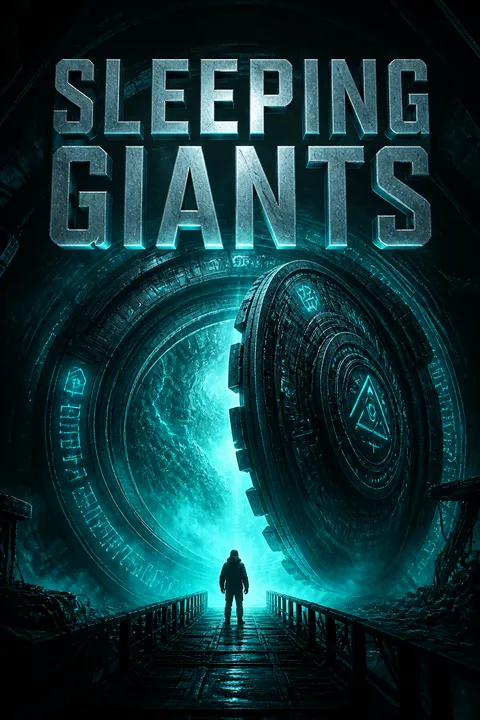


Plot Summary
Prologue
On her eleventh birthday, Rose Franklin slips away from the party to ride her new bicycle into the woods near Deadwood. A turquoise glow draws her down a hillside, where the earth opens beneath her. At the bottom of a vast square chamber, she wakes on cold metal beneath carved, glowing walls.
Firefighters lift her back into daylight, but her father refuses to explain what she found. Photographs taken at the scene finally give the child an answer: she had landed in the palm of a giant metal hand.
Rose’s discovery arrives through childhood solitude rather than scientific ambition. She leaves a crowded birthday party because the woods feel more hospitable than the company, then finds herself literally held by an object too large for her world. The image binds private memory to public mystery: the hand is not merely an artifact but the first force to shape Rose’s sense of scale, belonging, and possibility. Her father’s evasions also establish a pattern the novel will repeat at institutional levels. Adults respond to the inexplicable by containing it, while Rose keeps looking.
Argon Wakes the Project
Seventeen years after her childhood discovery, physicist Rose Franklin is put in charge of studying the hand and its glowing wall panels. She concludes that modern humans could not have made them, then takes leave after the government shows little interest in her report. Back in Deadwood, grief over her father and a return to the woods help her ask a better question: what activated the buried object?
Rose connects its response to argon-37, a trace isotope associated with nuclear reactions. If the artifacts were designed to respond to that isotope, their makers may have intended them to be found only after a civilization reached atomic technology. Rose changes course, asks for a linguist, and begins searching for more pieces.
Rose’s decisive advance comes not from a new instrument but from changing the scale of the question. Rather than asking what the hand means, she asks what condition made it answer. That shift links archaeology to technological history: the artifacts may be a message calibrated to a future recipient, not a relic accidentally exposed. Her return to Deadwood also makes inquiry personal without reducing it to destiny. The site is entangled with childhood and bereavement, but Rose earns her insight by reasoning from evidence, especially the mine’s history and the isotope’s specificity.
A Helicopter Finds Turkey
Army helicopter pilot Kara Resnik is flying a covert NATO air-sampling mission over Turkey when a turquoise glow appears beneath her aircraft. The helicopter loses power and crashes beside a pistachio field, where Kara and her co-pilot, Ryan Mitchell, find a sleek metal object in a crater.
The government removes them before local authorities can investigate and disguises the discovery as an old aircraft wreck. Rose recognizes that the mission’s equipment was searching for argon-37, confirming her theory about the artifacts’ trigger.
The recovered forearm joins the South Dakota hand without a visible fastener. Rose asks the unnamed official running the operation for pilots and resources, while Kara’s firsthand encounter makes her a valuable recruit.
Kara’s crash transforms Rose’s inference into an operational fact. The discovery is no longer a secluded archaeological problem; it can interrupt modern machinery, expose civilians to danger, and provoke an international incident. Kara’s inclusion also complicates the project’s claim to be purely scientific. The military supplies the capacity to retrieve the artifacts, but it brings secrecy and strategic motives with it. Rose’s attention to Kara’s experience recognizes that practical knowledge matters alongside laboratory expertise. From this point forward, the people studying the machine are also part of the experiment it is conducting on humanity.
The Search Breaks Flagstaff
Rose develops ARCANA, an argon-rich compound that can be dispersed from aircraft to activate buried pieces across a search grid. Kara and Ryan fly the early missions, finding limbs in sparsely populated places, though one rising piece tears through a highway.
Then an upper-arm section emerges beneath a neighborhood in Flagstaff. Kara and Ryan reach the crater and find homes split open; eight people, including a child, are dead. Kara blames herself for joining the search, while Rose accepts responsibility for designing it.
Officials conceal the cause by blaming a supposed domestic bomb plot, and the project’s leader pressures the White House to continue. The disaster exposes the cost of finding the machine: activation is violent, and no map can guarantee an empty landing site.
Flagstaff turns a statistical risk into named, visible human loss. Until then, the search can be imagined as a clever process of detection and recovery. The child’s death makes clear that the team is not simply uncovering the past; it is forcing the past through inhabited ground. Kara’s guilt and Rose’s conviction are not opposites so much as competing responses to responsibility. The cover story adds a second injury by transferring blame to the dead and misleading the public. The project now depends on treating secrecy as damage control, even as that secrecy prevents anyone outside it from judging the risks.
A Cockpit Inside the Torso
A second search team working beyond American territory finds the robot’s massive torso beneath Arctic ice. Inside, Rose discovers a spherical chamber designed for two operators, one controlling the upper body and another the legs.
The controls do not fit human anatomy: the leg braces bend backward, and neither helmet initially works for ordinary testers. Linguist Vincent Couture, a brilliant graduate student with little patience for easy answers, reexamines the glowing panels. He realizes they are not written language but a mathematical key, using numbers and equations in a base-eight system.
The markings provide a shared reference point between species, and their true-or-false symbols may also explain commands on the console. Vincent’s discovery gives the team its first practical path toward operating the machine.
The torso converts the artifact from a collection of spectacular parts into a designed system with human-scale consequences. Its two stations require cooperation, but the alien controls resist simple adaptation. Vincent’s mathematical breakthrough embodies the book’s recurring challenge to expertise: knowledge helps, yet assumptions about what counts as language can blind an intelligent observer. His success depends on treating the markings as a bridge between minds rather than a code to be conquered. The base-eight system is both a technical obstacle and an invitation to imagine that communication begins with shared structures, not shared words.
Kara Sees Through Metal
Kara climbs into the torso to test the arm controls, and the helmet inflicts such intense pain that she loses consciousness and wakes temporarily blind. Doctors discover that it has repaired the detached retina that had kept her from flying.
Ignoring medical advice, Kara returns to the chamber and tries again. This time the helmet activates: its visor lets her see through the robot’s hull, and a hologram mirrors her movements. No one else can make it work.
Rose brings in geneticist Alyssa Papantoniou to investigate why Kara is compatible, but the early tests reveal no obvious biological explanation. The discovery restores Kara’s ability to serve as pilot and gives the team its first working interface, while leaving them unsure what the helmet did to her or why it chose her.
The helmet offers care and danger through the same mechanism. It repairs an injury no human doctor could fix, but only after subjecting Kara to a frightening ordeal; its gift cannot be separated from its power over her body. Kara’s return to the chamber reflects both courage and impatience, qualities that make her indispensable and difficult to protect. The hologram gives the crew a safe preview of movement, yet it also makes the machine feel responsive, almost personal. Alyssa’s inconclusive testing sharpens the central tension between human autonomy and a technology that appears to select its operators.
A Jealous Crash
Ryan and Kara spend months training together, their intimacy growing through long hours inside the cramped control sphere. Ryan hopes their closeness will become a relationship, but Kara’s fear of dependence makes her retreat; later, her attraction to Vincent adds another strain.
When Vincent tries on the second helmet, it activates for him, opening the leg station and console. Ryan loses the role he has been preparing for, while Vincent becomes Kara’s new partner.
After Kara and Vincent sleep together, Ryan drives his truck into Vincent outside the laboratory. Vincent shoves Kara out of the vehicle’s path, but the impact crushes both his legs. Ryan is arrested, Kara survives with injuries, and the project’s only other compatible operator faces amputation.
The machine’s selection of Vincent turns a technical breakthrough into a personal displacement. Ryan has built a life around service and earned competence, yet the helmet renders his effort insufficient in an instant. His violence is not excused by that loss; it shows how quickly devotion can become entitlement when a person treats another’s affection as a promised reward. Kara, meanwhile, uses intimacy to test whether she can tolerate being cared for, then fears the vulnerability it exposes. The accident makes these private conflicts materially consequential: the project’s future now depends on the body of the person Ryan injured.
The Head Beneath Bering
Doctors prepare to amputate Vincent’s shattered legs, but the project’s leader compels surgeon Pavel Haas to attempt a dangerous reconstruction using experimental drugs and mechanical joints. Vincent survives with alien-designed knees, though learning to use them brings severe pain.
While he recovers, Kara joins a submarine mission to retrieve the robot’s head from the Bering Sea, where Russian vessels are guarding the site. When the American captain refuses to fire, Kara invokes presidential authority, disarms him, and forces a torpedo strike.
The blast does not destroy the head; instead, its energy disables the submarines and erases one Russian vessel. The US recovers the artifact, but Kara’s decision leaves dead sailors, international suspicion, and a growing sense that the machine can turn defensive science into geopolitical crisis.
Vincent’s reconstruction and Kara’s mission both reveal the human cost of making the project possible. The surgery preserves his chance to operate the legs, but it does so by overriding normal medical limits and placing his body under institutional control. Kara’s seizure of the submarine’s command is an act of judgment under pressure, not an uncomplicated triumph: she protects the artifact while exposing sailors to a force no one fully understands. Both episodes test the boundary between necessary intervention and coercion. The project’s language of purpose increasingly asks individuals to surrender choices that would ordinarily be theirs.
Themis Takes Her First Steps
With the head attached, the complete giant responds to Kara’s movements. Rose names the machine Themis after Vincent traces its ancient names through language and mythology. The crew discovers a sword and a shield made from controlled energy, confirming Rose’s fear that the machine was built to fight.
Vincent, still adapting to his reversed knees, insists on walking beside Kara in the sphere. When one knee buckles, their combined hands press two untested console controls. A rising hiss ends in a blinding energy discharge that destroys much of Denver International Airport, several nearby buildings, and the laboratory.
Three hundred eleven people die, including Rose. Vincent and Kara survive inside the sphere, but emerge into a crater surrounded by cameras and witnesses. The secret project has become a global event, and its creators are gone.
The catastrophe grows from a small physical failure, not a deliberate attack. That distinction does not reduce responsibility; it shows how responsibility changes when people operate a system whose controls and consequences remain partly unknowable. Rose has spent the novel insisting that more data can make the machine legible, yet the decisive action occurs before the team understands the console. Her death makes scientific curiosity inseparable from institutional negligence and personal ambition. Themis’s graceful movement and devastating output coexist, refusing a comforting distinction between beautiful creation and dangerous weapon. The crater makes the project’s hidden costs impossible to keep hidden.
The World Sees Themis
With the airport disaster impossible to disguise, the president tells the world that an ancient alien machine exists and that the United States had secretly assembled it. To avert a wider conflict, the government sinks Themis in the Puerto Rico Trench, presenting the move as a way to keep any nation from controlling her.
The nameless project leader later meets Mr. Burns, an eccentric stranger who recounts an ancient empire, an exiled warrior people, and giant machines left on a young world as protection against a future war.
He links the surviving machine to Themis and to human legends of giants and gods. Burns warns that humanity has reached a new technological threshold and may now be judged by how it handles power, but refuses to explain what the watching civilization will do.
Public disclosure changes the scale of the conflict without resolving its central uncertainty. The government can no longer control the story, so it tries to control access to the machine by placing it beyond ordinary reach. Burns’s account reframes human myth as a possible residue of contact, but his evasions keep the tale from becoming a simple explanatory key. His warning is ethically sharper than a promise of invasion: the danger may lie in how humans use power, not in whether aliens arrive. The story thus shifts from discovery to maturity, asking whether knowledge can be held without becoming entitlement.
Two Pilots Start Over
After Rose’s death, Ryan remains imprisoned, Kara returns to Army service, and Vincent withdraws to Montreal. He builds intricate ship models and secretly trains his reconstructed legs on apartment stairs, determined not to fall again.
The project leader asks Kara to take leave and find Fata, a Bosnian woman who survived the Srebrenica massacre and may know the past of Alyssa, whose employment history has a suspicious gap during the killings. Kara finds Fata and returns with a clearer sense of what people endure when institutions treat them as expendable.
Vincent eventually admits he is ready to work again, though he has not called Kara. The two must rebuild trust as well as strength, while the project’s future now depends on people who carry Rose’s absence into every decision.
The pause after the catastrophe is not recovery in any simple sense. Vincent’s model ships and night stair-climbing give grief a disciplined shape, while Kara’s military reassignment leaves her alive but emotionally numb. Her trip to Bosnia broadens the novel’s account of violence: large-scale history is carried in the memories and bodies of individuals like Fata. The suspicion surrounding Alyssa links personal trauma to political impunity, though the evidence remains incomplete. Most importantly, the pilots’ reunion cannot restore the old team. Their work now requires them to choose cooperation while carrying different forms of guilt.
A Consortium Raises Her
Alyssa returns to lead a multinational consortium backed by Russia, Japan, South Korea, the United Arab Emirates, and private companies. Its members build a deep-sea facility near Puerto Rico and retrieve Themis from the trench, shifting control away from the United States without ending the rivalry over her.
Vincent and Kara rejoin the work, and Vincent’s nightly training has made him far stronger than when he last operated the legs. The machine is assembled in an underwater-capable chamber, and the team begins testing her movement again.
Alyssa pushes for genetic tests to find replacement pilots, while Kara resists procedures she has not agreed to. The laboratory has grown into a corporation with investors and security staff; the scientific team must now work inside a commercial and political structure.
The new facility gives the project a future by making it multinational, but shared ownership is not the same as shared ethical authority. The coalition distributes cost and political risk while turning the machine’s technology into an asset protected by patents. Alyssa’s leadership reflects this new order: she is technically capable, but her priority is redundancy and control over the operators. Kara’s refusal to submit to intrusive testing therefore challenges the assumption that the machine’s importance cancels bodily consent. The underwater base also makes the project physically remote from ordinary scrutiny, replacing one hidden government program with a more elaborate private system.
The DMZ Is Not a Stage
After North Korea sinks a South Korean ship and moves troops toward the demilitarized zone, the consortium deploys Themis to deter an invasion. Kara and Vincent spend eleven days aboard a cargo ship before walking the robot toward the border.
Their reconnaissance shows no force prepared to invade, but Alyssa orders Kara to cross into North Korea anyway. Kara refuses and turns Themis away. North Korean forces fire antitank missiles; the shield absorbs their strikes, demonstrating the machine’s defensive power without an attack across the border.
The pilots wait for incoming fighter jets rather than retreating blindly, then withdraw. Kara’s refusal preserves the distinction between deterrence and aggression, but Alyssa sees it as insubordination and begins arranging for replacements, including Ryan.
The Korean deployment tests the moral meaning of the word defense. Alyssa treats a show of force as useful only if it can be converted into a demonstration of dominance; Kara recognizes that crossing the border would make the machine the aggressor. Her refusal is not passivity, since she stays under fire and uses the shield to protect the team. The episode also exposes how a weapon’s operators can be pressured by institutions that call coercion necessity. Themis can repel missiles, but the more consequential safeguard is Kara’s willingness to disobey an order when the threat no longer justifies it.
Trash Can Escape
Back at the Puerto Rico base, Alyssa has Kara sedated and restrained for invasive testing, while Ryan helps her hold Vincent under guard. Vincent and Kara escape the compound in a garbage container, but armed guards catch them outside and recapture Kara; Vincent gets away.
He returns to the base leader for help, then chooses to reenter the compound rather than leave Kara behind. Ryan joins him and they use stun ammunition, grenades, and restraints to disarm the guards without killing them.
They reach the medical bay and free Kara before Alyssa can remove her eggs for an IVF plan using Vincent’s stored sperm. Alyssa vanishes before authorities can capture her. The rescue reunites the pilots and Ryan, but exposes the consortium’s willingness to treat their bodies and future children as project resources.
The attempted escape makes the project’s coercion literal: the people who once volunteered to enter the sphere are now confined and medically handled without consent. Ryan’s role complicates his earlier violence. He does not undo the harm he caused Vincent, but he risks himself to stop a new abuse and chooses nonlethal force. Vincent’s return is equally important because it reverses his long retreat from responsibility. Alyssa’s reproductive plan reveals the most extreme consequence of treating compatibility as a resource: the institution imagines future children as replacement equipment. The rescue restores agency to the pilots, but not their safety or trust in the system.
A Weapon Belongs to Earth
The project’s nameless handler persuades the new US administration that Themis cannot belong to one country or a small consortium without risking another global crisis. He proposes placing the machine under a United Nations Earth Defense Corps, intended for planetary defense rather than war between nations.
The pilots are released from detention and invited to serve; Kara accepts, partly because Vincent would not abandon the work. The handler also gives Bosnian authorities information that could connect Alyssa to crimes committed around Srebrenica, though her guilt remains unproven and she has escaped.
Kara’s mother arrives at the military base, and Kara and Vincent face a future together without pretending their relationship is simple. The project ends not with certainty, but with a fragile attempt to make shared responsibility real.
The proposed Earth Defense Corps is a political answer to a technological problem, but it is also an admission that no single government can be trusted with Themis. The handler’s solution depends on institutions choosing restraint after repeatedly exceeding it. His diplomacy is pragmatic rather than pure: he uses leverage, concealed plans, and personal loyalties to make international stewardship possible. Kara’s decision to continue matters because she has already seen what the machine can do and what obedience can cost. The unresolved case against Alyssa prevents justice from becoming a clean ending. What the story offers instead is a contested framework for responsibility.
Epilogue
At the American embassy in Dublin, a young woman says she is Rose Franklin, a researcher from Chicago who was abducted after work. Her DNA matches the scientist the project lost four years earlier, but her body and dental records indicate she is still twenty-seven.
She remembers no missing years and asks to go home to feed her cat. The officials tell her that the world she remembers has moved on without her. Rose has returned, but the explanation for her disappearance remains beyond the reach of the people who welcome her back.
The epilogue overturns the apparent finality of Rose’s death without restoring the story to its earlier state. Her body carries the age she had when she vanished, while history has continued for four years around her. The gap turns time into another alien mechanism: measurable in records, impossible to explain through her experience. Her first concern, the neglected cat, is deliberately ordinary, anchoring a cosmic rupture in daily attachment. Rose’s return also makes the ending less a closure than a new problem. The scientist who began the investigation has come back from an event the investigation cannot yet account for.
Analysis
Sleeping Giants treats first contact as a problem of interpretation before it becomes a problem of combat. Rose’s team must learn what the artifacts are, but it must also decide what kinds of evidence count: an isotope, a mathematical pattern, a biological response, or a survivor’s memory. Each discovery expands human capability while making the cost of incomplete understanding more immediate. The machine can heal Kara and protect a ship, yet the same technology destroys neighborhoods and an airport when its controls are used without sufficient knowledge. The novel refuses to let scientific curiosity claim innocence simply because its intentions are generous.
Its documentary form strengthens that argument. Interviews and reports make facts feel verifiable, but they also show how institutions curate facts to preserve authority. The Flagstaff deaths become a fabricated bombing; the robot’s existence becomes public only when the crater makes denial impossible. The unnamed handler’s selective honesty mirrors the state’s secrecy, even as he tries to prevent a war. Readers are therefore asked to distinguish access to information from ethical wisdom.
The emotional relationships are not decorative subplots. Kara’s guardedness, Ryan’s need to be chosen, Vincent’s fear of failure, and Rose’s protective loyalty all shape who enters the machine and what risks they accept. The control sphere literalizes interdependence: one person cannot make the giant walk alone, yet cooperation does not erase unequal power or consent. Alyssa’s effort to secure replacement pilots and produce future compatible operators pushes that logic toward its ugliest form, treating human bodies as infrastructure.
The final political proposal, a United Nations defense force, is not a clean solution. It is an imperfect attempt to prevent one nation from monopolizing a technology no nation fully understands. The book’s deepest question is not whether humanity deserves the machine, but whether people can build institutions that restrain their own fear, ambition, and appetite for control before the next test arrives.
Review Summary
Sleeping Giants has an overall Goodreads rating of 3.82/5. Reviews frequently praise its unique documentary-style format of interviews and journal entries, its compelling sci-fi premise involving ancient alien robot parts discovered worldwide, and its mysterious unnamed interviewer character. Many readers finished it in a single sitting. Common criticisms include difficulty emotionally connecting with characters due to the format, heavy info-dumping of scientific detail, and the story feeling more plot-driven than character-driven. Most reviewers eagerly continued with the series despite any reservations.
People Also Read





Characters
Rose Franklin
The artifact's first witnessA physicist whose childhood encounter with a buried metal hand becomes the private origin of her scientific life. Rose is rigorous without being emotionally detached: she feels responsibility for the people around her and often takes blame that belongs to institutions as well as individuals. Her curiosity is strongest when familiar explanations fail, and she is willing to revise her assumptions when the evidence demands it. She treats the machine as an object of beauty as well as a technical problem, a sensibility that sometimes puts her at odds with officials focused on function and control. Her combination of intellectual boldness and personal loyalty makes her an unusually humane center for a project that keeps trying to reduce people to their usefulness.
Kara Resnik
The chosen pilotAn elite Army helicopter pilot whose directness, impatience, and confidence under pressure make her valuable in the air and difficult to manage on the ground. Kara trusts action more readily than emotional disclosure; she is more comfortable taking responsibility for other people than allowing anyone to care for her. Her fierce loyalty can look like defiance, especially when authority asks her to accept risks she considers pointless or immoral. She is drawn to competence and honesty, but intimacy unsettles her because it asks her to be seen without armor. Kara’s strength is not simply fearlessness. She can recognize when a mission’s purpose has changed and accept the cost of resisting it.
Vincent Couture
The mathematical linguistA gifted Québécois linguist who approaches problems as puzzles and measures himself against an almost impossible ideal of intelligence. Vincent’s confidence can become arrogance, and his habit of treating people as distractions protects him from needing them. Beneath that defense is a deep hunger for purpose, shaped by a childhood spent trying to earn his demanding father’s approval and by guilt over his mother’s loneliness. He is drawn to problems that resist ordinary methods, especially when mathematics offers a common ground between unfamiliar minds. His relationships with Kara and the team test whether insight can coexist with vulnerability, and whether competence means anything without the courage to rely on others.
Ryan Mitchell
The loyal co-pilotA capable Army helicopter pilot raised in a family shaped by military service. Ryan is warm, sociable, and eager to be useful, with a strong belief that institutions can achieve more good collectively than individuals can alone. His decency is genuine, but his desire to be needed can blur into possessiveness when affection and professional purpose become entangled. He is especially sensitive to the distance between the person he wants to be and the person he was as a teenager, when he failed to defend classmates who were bullied. Ryan’s optimism gives the team a counterweight to Kara’s suspicion and Vincent’s cynicism, while his need for approval exposes the risks hidden inside that optimism.
The nameless handler
The unseen project architectA highly informed official who never gives his name and controls much of the project through interviews, selective disclosure, and quiet political leverage. He is analytical, theatrical in his courtesy, and willing to manipulate people when he believes the stakes justify it. His self-control is partly a professional instrument: he prefers decisions based on anticipated consequences rather than visible emotion. Yet he forms attachments to the people he recruits and can recognize forms of courage that do not fit his plans. He is neither a neutral observer nor a simple villain. His central contradiction is that he wants to preserve human freedom while repeatedly deciding which freedoms other people can afford to exercise.
Alyssa Papantoniou
The geneticist in commandA brilliant geneticist whose precision, ambition, and discomfort with uncertainty shape her approach to the project. Alyssa sees dependence on a small number of pilots as an intolerable weakness and wants biological answers where other team members see personal boundaries. Socially awkward and often blunt, she can mistake empathy for inefficiency and interpret disagreement as resistance to necessary work. Her intelligence is real, as is her capacity to make progress others have missed. The danger lies in her conviction that a sufficiently important goal can authorize procedures that would otherwise be unacceptable. Alyssa embodies the project’s recurring temptation to solve human vulnerability by gaining more control over human bodies.
Mr. Burns
The keeper of old storiesAn eccentric, eyebrowless stranger who meets the nameless handler over lunch and speaks in stories rather than plain explanations. Mr. Burns is playful, observant, and deliberately difficult to pin down. He appears to know more about the machine’s history than the governments studying it, but he refuses to turn that knowledge into a technical manual. His tales connect ancient political conflict, exile, giant machines, and human mythology, while his jokes keep the conversation from becoming a sermon. Beneath the performance is concern for ordinary people who would suffer if powerful beings judged humanity unready for its new technology.
Robert Woodhull
The White House skepticThe former president’s national security adviser, responsible for confronting the handler with the political and human cost of the secret project. Robert is shrewd, impatient with evasions, and more openly troubled by casualties than the handler is. He understands that governments can rationalize almost any escalation as a proportional response, yet he still has to help manage the consequences of the decisions he challenges. His exchanges with the handler expose the gap between moral discomfort and actual power: Robert can object, bargain, and warn, but often cannot force the project to stop.
Ines Tabib
The new security adviserThe incoming administration’s national security adviser, who inherits the political aftermath of the robot’s public appearance. Ines is practical and politically alert, but she is also capable of imagining effects beyond the immediate military balance. She believes the discovery can alter how people understand their place in the universe, even if their daily routines continue. Her conversations with the handler test whether international cooperation can become more than an appealing speech, particularly when retrieval of the machine risks turning into a race with Russia and other powers.
Pavel Haas
The pressured surgeonA highly skilled surgeon forced to decide whether to amputate Vincent’s legs or attempt an unprecedented reconstruction. Pavel understands the medical risks and initially sees conventional prosthetics as the humane option. The handler’s pressure and promises of experimental resources place him in a position where professional ambition, patient welfare, and personal vulnerability collide. Pavel’s scene shows how the project recruits expertise not only with funding, but by making refusal feel like surrendering a singular chance to save a life.
Fata
The Bosnian survivorA Bosnian woman Kara is asked to locate in the aftermath of the Srebrenica massacre. Fata had a husband and children, and people remembered her as someone who helped others as an informal nurse. Her experience matters to the handler’s investigation into Alyssa’s past, but Fata is not merely a source of evidence. Through Kara’s visit, she represents the living memory of violence that official records and political convenience can obscure.
Demetrius Rooke
The submarine captainA Navy captain whose submarine is ordered to recover the robot’s head before Russian forces can secure it. Rooke is disciplined and patient, accustomed to waiting rather than escalating a confrontation. Kara’s demand that he fire torpedoes forces him to weigh military orders against the danger of destroying the very object he was sent to retrieve.
Plot Devices
The giant machine
A buried test of powerThe machine is assembled from enormous metal pieces buried across the planet, including a hand, limbs, torso, and head. It activates in response to argon-37, which lets Rose devise a way to search for it. Its two-person control sphere demands coordination between pilots, while alien interfaces and unfamiliar anatomy make operation dangerous. As the team learns more, the machine proves capable of healing, defensive shielding, energy weapons, and catastrophic releases of power. Its origins and purpose become part of the mystery: the machine may be both a weapon and a test of whether humanity can handle knowledge left for it.
ARCANA
A signal scattered from aboveRose’s argon-rich compound allows aircraft to activate buried machine components from a distance. By spreading it over geographic search grids, the team can make dormant pieces surface without knowing their exact locations. The method makes recovery possible, but it also creates the central physical hazard of the search: once activated, artifacts rise violently through whatever lies above them. ARCANA therefore joins scientific ingenuity to unintended consequences, turning a detection tool into the mechanism behind destruction in populated places.
The mathematical panels
A shared language keyGlowing symbols carved into the chamber walls initially appear to be an unknown written language. Vincent recognizes that they encode mathematics, including equations, truth and falsehood, and a base-eight number system. This makes the panels a kind of cross-species primer: instead of translating unfamiliar words, the team can begin with structures both civilizations would need to understand. The key also helps make sense of symbols on the control console, connecting archaeological discovery to the practical problem of operating the machine.
The control helmets
A machine chooses its pilotsThe helmets link human operators to the giant’s control stations, giving them a view through the machine and translating their movements into its actions. They also respond unpredictably: Kara’s helmet repairs her damaged retina, while other people cannot activate it, and Vincent later proves compatible with another station. Their apparent selectivity makes the pilots essential and motivates Alyssa’s genetic research. The helmets turn the question of control inward, raising the possibility that the machine is not simply operated by humans but is also assessing them.
The interview files
A mystery told in testimonyThe novel’s story unfolds through interviews, journals, mission reports, laboratory records, and official documents gathered by an unnamed interviewer. Each form reveals events from a different angle and often withholds the context that would make them easy to interpret. Personal accounts show fear, guilt, and attraction; government records show the machinery of secrecy; technical reports establish what the artifacts can do. This documentary structure makes the reader assemble causality much as the characters assemble the machine, while reminding us that every account is partial and shaped by its speaker.
Download PDF
Download EPUB
.epub digital book format is ideal for reading ebooks on phones, tablets, and e-readers.








