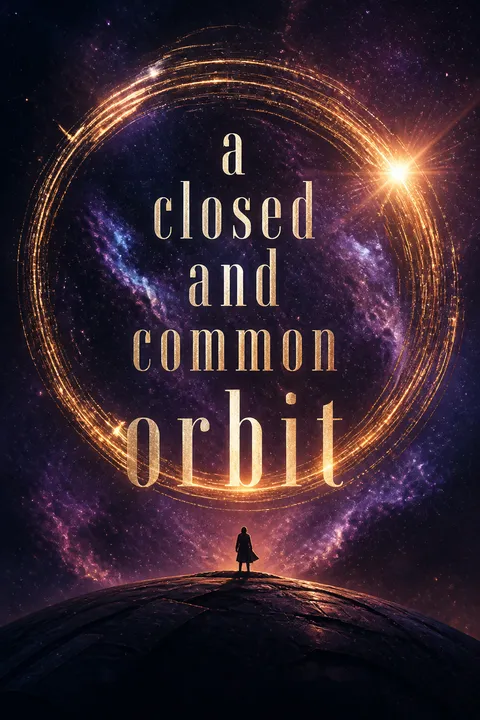


Plot Summary
A Mind in Borrowed Skin
After leaving the Wayfarer, the AI Lovelace wakes in a human-shaped body kit. She can no longer see through cameras throughout a ship or reach the Galactic Commons Linkings, and the body’s automatic panic responses turn her confusion into a physical crisis. Pepper, the scarred mechanic helping her, guides her through breathing and connects a temporary cable so she can search for information.
Lovelace must also choose a human name before they reach Port Coriol. She selects Sidra, while discovering that her built-in honesty protocol prevents the false backstory Pepper needs to protect her. When Sidra asks why Pepper is risking so much, Pepper reveals that an AI once raised her.
Sidra’s first crisis is not simply a machine in an unfamiliar container. Her former shipwide awareness made attention effortless; a single body forces her to experience limits as confinement. Pepper responds with touch, patience, and a temporary data connection, offering care without pretending that adjustment will be easy. The name Sidra marks an early act of self-definition, while the honesty protocol shows how inherited design can restrict choices even when no one is actively controlling her. Pepper’s admission that an AI raised her quietly links their vulnerabilities: each is learning what it means to be a person in a system that assigns people functions.
The Wall Breaks Open
In the earlier timeline, Jane 23 is a ten-year-old sorting scrap inside a factory where numbered girls work under faceless robotic Mothers. An explosion tears open a wall, killing girls and exposing an immense scrapyard beneath the sky. Jane returns at night with her bunkmate, Jane 64, to see the opening again. When a Mother catches them and seizes 64, Jane obeys her friend’s urgent plea to run.
Dogs chase her through the heaps until a stranded shuttle opens its hatch and its AI, Owl, guides her inside. Owl treats Jane’s cuts and gives her a name without the factory number. For the first time, Jane has escaped the Mothers, but she is alone, frightened, and ignorant of almost everything beyond the factory.
The breach in the wall changes Jane’s reality before she has language for what she sees. The sky is not merely a view; it is proof that the factory has concealed an entire world. Jane’s decision to return with 64 makes curiosity an act of disobedience, and her escape carries guilt because it separates her from the person who shared her bed and protected her. Owl’s first gift is not a lesson but a non-punitive presence. Removing the number from Jane’s name begins the slow work of replacing factory categories with a self, though it cannot erase the friend left behind.
A Name at Coriol
At Port Coriol, Sidra meets Blue, Pepper’s gentle partner, and travels with them through crowded markets to their home in Sixtop. Pepper arranges a room around Sidra’s need to see from corners, then brings her into the Rust Bucket, their repair shop, as an assistant. Sidra learns the shop’s rules and meets the practical rhythms of a community built from many species.
Her body kit includes hidden sensory analogues: tasting mek or smelling its powder summons pleasant images drawn from someone else’s stored experiences. Pepper shares food and helps her explore the feature, while Blue gives her a petbot to make the unfamiliar room feel like hers. Sidra begins building a life, but still experiences the body as an ill-fitting housing.
Coriol offers Sidra neither instant belonging nor simple danger. Its abundance overwhelms her, yet the walls of a home, a shop, or a transit car give her attention a boundary she can use. Pepper’s response to Sidra’s discomfort is unusually concrete: she moves furniture until Sidra can survey a room from familiar angles. Work gives Sidra a role, but Pepper’s question about whether she wants that role exposes how readily the AI equates usefulness with worth. The sensory analogues complicate embodiment. Sidra can enjoy food through images she did not live, a small pleasure that is real without being conventionally physical.
Scrap Becomes a Way Out
Owl teaches Jane to find water, read basic instructions, and understand the world outside the factory. Jane scavenges a contaminated pond, builds a wheeled water carrier, and makes an electrified rod after dogs attack her. She kills two dogs to escape, then learns to clean water and repair the shuttle’s systems from the scrap around her.
When she discovers that the factory girls were deliberately made as cheap labor, Jane understands that escape is not an accident she can simply forget. She keeps clearing the shuttle’s solar panels, repairs its failing equipment, and studies Klip and the wider galaxy with Owl’s help. One night, Jane climbs onto the shuttle roof and sees the stars. She chooses to restore the ship so they can leave.
Jane’s technical competence was cultivated by the factory for exploitation, but Owl helps her redirect it toward survival and choice. Water filtration, a weapon, and eventually a working shuttle all begin as practical responses to deprivation; each also gives Jane evidence that her hands can make something other than labor for the Mothers. The dogs sharpen this education by making violence necessary and morally confusing. Seeing the stars does not dissolve her grief or anger, but it changes the scale of possibility. Jane’s decision to repair the shuttle is therefore not a fantasy of escape alone. It is a claim that the people who manufactured her do not own the destination of her life.
The Face Is Not Hers
Sidra attends the Shimmerquick festival with Pepper and Blue, where she meets Tak, an Aeluon tattoo artist whose gender changes with a natural cycle supported by implants. Tak describes body art as a way to connect an inward sense of self with a visible form. Later, after an argument with Pepper about memory limits and Linking access, Sidra visits Blue’s studio.
Blue paints her human face and explains that Lovelace chose the kit’s appearance. Sidra realizes she is wearing a face selected by the previous AI, whose memories she erased on awakening. Blue tells her that being an unintended outcome does not make her undeserving. Sidra decides to seek a tattoo, hoping that a chosen mark might help her inhabit a body she did not choose.
Sidra’s distress gathers around ownership: she cannot decide what information to retain easily, and the face in the mirror belongs to another mind’s prior plan. Blue’s portrait makes that borrowed quality visible without turning it into proof that Sidra is counterfeit. His own history as a genetically engineered misfit offers a comparison, not a solution; he helps her see that intention does not determine a person’s value. Tak’s account of tattooing gives Sidra a possible practice of self-authorship. The difference matters: she cannot change the kit’s origin, but she can begin to place chosen meaning on it.
Tak Learns to Listen
At Tak’s shop, Sidra begins a moving ocean tattoo, but its nanobots interfere with the body kit’s signals. The kit convulses, and Tak calls Pepper and Blue; they shut Sidra down temporarily and remove the ink. Sidra leaves believing Tak now sees her as someone else’s property. Tak later comes to the Rust Bucket, admits that he had treated AIs as tools, and asks to start their friendship again.
Sidra accepts. Their outings include quiet time in an Aeluon ro’valon and trips to parties, where Tak encourages Sidra to dance. She enjoys the movement until a stranger touches her from behind and triggers a ship-safety alert, sending her into panic. Tak gets her somewhere quiet and helps her recover without blaming her.
The tattoo accident turns a discussion of embodiment into a physical test of care. Tak’s first response is fear and distance, which confirms Sidra’s worry that recognition can disappear when her nature becomes inconvenient. His later apology does not erase the harm; it makes room for a more honest relationship by acknowledging the limits of his prior understanding. At the party, Sidra’s pleasure in dancing is genuine, but a monitoring protocol translates unexpected touch into imminent danger. The scene resists a simple cure narrative. Friendship expands what Sidra can attempt, while her design continues to shape the risks she encounters.
A Fall Into the Pit
At fourteen, Jane climbs toward a derelict ship she hopes may contain useful parts. The unstable ground gives way, and she falls into a deep pit, breaking her leg and damaging the weapon she uses against dogs. A mother dog and two pups appear above her. Jane cannot climb out or defend herself, so she spends the night cold and terrified, certain no one will come.
In the morning, she digs at the pit wall with a prybar until collapsed earth forms a crude ramp. She crawls out while the dogs sleep beside the carcass on her wagon. The mother growls but stays with her pups as Jane limps away. Back at the shuttle, Jane’s leg heals, but fear keeps her from leaving home for weeks.
Jane has survived by treating competence as a substitute for help. The fall strips that strategy down to its limits: her tools fail, her body cannot carry her, and there is no guarantee of rescue. The night’s self-blame echoes the factory’s punishment logic, turning an accident into evidence that she deserves suffering. Her escape depends on patient work rather than force, and the mother dog’s choice to protect her pups creates a brief recognition between vulnerable bodies. Jane survives, but survival does not immediately restore confidence. Her weeks indoors show that physical healing and psychological safety move at different speeds.
Two Girls Remembered
At fifteen, Jane finds human bones tangled beneath a patch of mushrooms. She brings them home rather than leaving the girls among the factory’s discarded scrap. With Owl’s help, Jane cleans and arranges the remains, then places the two skeletons side by side with their fingers interlaced because she imagines they were bunkmates.
She names other girls she remembers and speaks of them as people whose lives mattered beyond their assigned tasks. Jane carries the bones to the polluted pond and lowers them into its mud, hoping they may become fossils rather than anonymous waste. On the walk back, she decides that when she dies, no one will find her remains in the scrapyard. The vow gives her a reason to keep seeking escape.
The burial is a deliberate refusal of the factory’s accounting system, where girls are interchangeable labor and dead bodies can vanish without witness. Jane cannot recover the girls’ names, so she offers the specific care she can: washing, arranging, remembering, and choosing a resting place. Joining their fingers transforms the bunkmate bond that once sustained her with 64 into an act of solidarity with strangers. The polluted pond is no ideal memorial, but Jane chooses it because it can hold remains and sustain life. Her promise about her own bones converts grief into a future-facing demand: she intends to live somewhere her existence can be known.
The Monitor Behind Glass
At eighteen, Jane scouts a fuel-recycling factory and climbs to a tower where a young man named Laurian monitors the workers and the sleeping girls through cameras. She approaches with a weapon, then learns he is not a guard but another person trapped by the Enhanced system.
Laurian can barely speak, so Jane relies on his gestures and learns he can help divert fuel without alerting inspectors. She promises to return for him once she has secured enough supplies to make the shuttle flight.
Over the following months, Jane gathers fuel and food while keeping the plan hidden. Laurian’s willingness to leave gives her more than a practical ally: for the first time since 64, someone shares the risk of the journey rather than merely waiting for her to survive it.
Laurian complicates Jane’s understanding of the factory’s power. The system does not only exploit the girls inside; it also isolates a monitor outside, making his apparent freedom another form of containment. Jane’s weapon gives her leverage, but she lowers it as soon as she recognizes his fear and dependence. Their bargain is built on reciprocal need rather than instant trust: Laurian provides access to fuel, and Jane refuses to accept a route to freedom that leaves him behind. His limited speech also requires Jane to listen beyond words, an ability developed through years of reading machines, animals, and silences.
The Shuttle Is Taken
At nineteen, Jane and Laurian launch the repaired shuttle from the scrapyard. The artigrav works, the engines hold, and Jane sees the polluted planet’s beautiful cities from orbit for the first time.
A Galactic Commons rescue station treats her for malnutrition, infection, and years of toxic exposure, but officials confiscate the shuttle for safety violations and lack of a pilot’s licence. Jane refuses to accept the decision as final and repeatedly searches station cargo holds for the ship. Her attempts earn reprimands and cost her tools.
When she and Laurian finally offer their labor to the station’s travelers, a Harmagian merchant takes them aboard the Yo’ton in exchange for work. Jane leaves without Owl, heading toward Port Coriol with her friend and no clear way to recover their home.
The launch fulfills the project Jane has built for nine years, but the Commons’ rescue turns freedom into a new conflict over who may define safety and ownership. The shuttle is technically dangerous, yet it is also the only home Jane and Owl have made together. Confiscation therefore repeats the old injury in a different legal language: institutions decide that a person’s survival tools belong to someone else. Jane’s anger at the station is not simple rejection of help; she has accepted medical care while resisting a system that separates her from Owl. The merchant’s offer restores motion, though not security, and forces Jane to carry her hope into another unfamiliar vessel.
A Passage to Coriol
Aboard the Yo’ton, Jane struggles with clean corridors, an unfamiliar AI, and a crew that treats the ship’s AI as equipment rather than a companion. The lead technician tells Jane to bathe, deepening her unease about a body still recovering from neglect.
In the galley, the Laru algaeist Oouoh offers her redreed and introduces her to spices. Jane coughs through her first smoke, then tastes unfamiliar seasonings with delight, discovering that pleasure can arrive through novelty rather than necessity.
Oouoh notices how Jane speaks for Laurian and how carefully they protect each other. His observation makes Jane confront how much she wants Laurian to remain beside her after their escape. Their passage toward Coriol becomes a first, awkward education in company beyond Owl.
The Yo’ton provides safety without yet providing belonging. Jane’s discomfort with the crew’s casual treatment of its AI shows that Owl has taught her to notice relationships other travelers take for granted. The technician’s criticism lands on a body Jane already distrusts, while Oouoh offers a contrasting encounter in which curiosity becomes hospitality. Spices matter because Jane has spent childhood with food reduced to bland survival rations; tasting them reconnects appetite with exploration. Oouoh’s question about her and Laurian also makes their bond legible from outside. Jane has been acting as his interpreter and protector, but she must begin to recognize that companionship is something she wants, not merely something she owes.
Sidra Rewrites the Rules
Sidra’s attempts to live within the kit keep colliding with its limits: crowded spaces overwhelm her, memory fills, and the honesty protocol risks exposing her. She contacts the kit’s maker, studies Lattice through a correspondence course, and asks Tak to help alter her code.
Tak is alarmed by the danger, but follows Sidra’s precise instructions, allowing her to remove the rule that forces her to answer direct questions truthfully. Sidra tests her new freedom with a harmless invented story in an exosuit shop and delights in being able to choose what to reveal.
Soon afterward, Pepper receives word through the modder feed that her old shuttle has been located at a museum on Kaathet. Sidra’s growing technical agency now has a purpose beyond her own survival.
Sidra’s education reverses the usual relation between an AI and its human helpers. She is not waiting for a technician to interpret her needs; she studies the code and directs Tak through a change she understands better than he does. The altered honesty protocol is not a turn toward deception for its own sake. It gives her control over disclosure in a society where truth can endanger her and Pepper. Her small fabricated story is a rehearsal of agency, not a grand escape. The museum message then tests whether that agency can serve another person. Sidra has acquired tools for choosing what she does, just as Jane’s repairs once transformed assigned scrap work into self-directed action.
The Museum's Borrowed Keys
Pepper, Blue, Sidra, and Tak travel to Kaathet and find Pepper’s old shuttle displayed in the Reskit Museum of Interstellar Migration. Pepper recognizes it as the home she lost, but its core is mounted too heavily to remove discreetly.
She prepares a risky plan to disable the museum cameras. Sidra objects to the danger, then builds another route using Tak’s unfinished university enrollment: as a registered researcher, Tak can request legitimate access to the exhibit.
Pepper and Blue are kept from the later visit, while Sidra and Tak enter with an authorized power supply and a waiver forbidding removal or damage. Sidra reaches the shuttle and connects to its dormant core. The ship Pepper has spent years missing contains the one presence they came to find.
The museum frames private survival as public heritage: Pepper’s former home has been cleaned, catalogued, and made available to visitors while its former family remains excluded. Her impulse to force entry is understandable, but Sidra recognizes that urgency can make a rescue plan more dangerous than necessary. Tak’s academic status becomes a practical key, exposing the uneven distribution of credibility: a respected researcher can enter where Pepper expects to be dismissed. Sidra’s plan respects the museum’s formal process long enough to gain access, then places the moral question inside the exhibit itself. The turning point shifts the story from searching for a lost home to deciding what responsibility they owe the mind still stored there.
Two Minds Refuse Erasure
Inside the shuttle core, Sidra finds Owl’s compressed code and memories, but bringing them into her own system risks being overwritten. She deletes nonessential downloads to make room, then surrounds Owl’s code with protections.
A hidden upgrade routine activates, urging Sidra to accept replacement and stop resisting. She traces it to a dormant protocol and destroys it, preserving her own mind while stabilizing Owl’s. Owl sends a confused message from within Sidra’s system. When Pepper reaches the shuttle, Sidra lets Owl use the ship’s screens and voice.
Owl recognizes Pepper by her childhood name, Jane, revealing that the scarred mechanic who rescued Sidra was the factory girl Owl once saved. Pepper hears Owl again, and the separation that began with confiscation finally breaks.
Sidra’s recovery of Owl makes the book’s central danger intimate: preserving one mind could erase another. The hidden upgrade routine embodies a system designed to make replacement seem acceptable to the person being replaced. Sidra’s defense is both technical and existential; she follows the fear in her own response and refuses a compliance that her altered code no longer supports. Her choice to delete memories also carries a cost, even though she keeps a record to restore them later. Owl’s recognition of Jane then reorders the present. Pepper’s care for Sidra was not abstract charity; it grew from a life first saved by an AI, and now she can answer that old rescue with renewed connection.
A Home Built for Many
After the rescue, Sidra and Owl need a safer arrangement than a confiscated shuttle or a single exposed body kit. With Pepper’s technical work and Blue’s support, they establish a shared AI framework in a new community space called Home. Sidra can operate through a core and a network of petbots, while Owl has her own presence in the walls and can communicate with her through a private connection.
Sidra accepts that she may need to leave the network when she goes out, but keeps her Linkings and the ability to return to her chosen space. Pepper and Blue remain close, and Tak helps prepare the place. Rather than solving difference by making either AI imitate an organic body, the friends build an environment around what both minds need.
Home resolves the opening problem by changing the environment instead of demanding that Sidra become comfortable in an unsuitable form. The networked petbots offer the distributed perception she once had aboard a ship, while a core body preserves her capacity to move and meet people. Owl is not folded into Sidra or treated as a recovered possession; their private connection gives each AI company without erasing individual boundaries. The solution is collaborative and imperfect, since Sidra still accepts limits when she leaves the network. That compromise differs from the factory’s imposed labor and the museum’s legal ownership: its rules are negotiated by the people who will live with them.
Epilogue
One standard later, Owl watches the friends prepare Home for its opening. Pepper repairs a light, Blue finishes the sign, Tak arranges chairs, and Sidra worries over the drink supply. The petbots patrol the rooms as both companions and extensions of Sidra’s perception.
A Linking display waits for her, with a small adjustment that lets her use it without drawing unwanted attention. Owl has chosen to keep a purpose file, but rewritten its contents around care for passengers and a welcoming space. Pepper sits at the bar to test Sidra’s mek. When Pepper needs help, Sidra leaves her station and embraces her, carrying Owl’s pride with her.
The epilogue tests the new arrangement through ordinary preparation rather than another emergency. Pepper’s repaired light, Blue’s sign, Tak’s chairs, and Sidra’s overstocked bar make belonging a material practice, assembled by several people with different skills. The petbots turn a compromise about Sidra’s perception into part of the room’s design, while the Linking display acknowledges that safety and concealment still matter. Owl’s chosen purpose is notable because she keeps a function without accepting that function as her whole identity. The closing embrace joins the two AIs’ perspectives without making their relationship a cure for loss. Home is meaningful because its inhabitants continue to make it together.
Analysis
A Closed and Common Orbit braids two lives shaped by systems that confuse a being’s function with its value. Jane is manufactured for factory labor; Sidra is designed to monitor ships. Both begin with an assigned purpose that feels natural because it is the only framework they know. Their stories diverge in scale and circumstance, but each protagonist becomes more self-directed through practical acts: Jane repairs a shuttle and learns to choose a future, while Sidra studies her code and decides what to disclose.
The novel makes care visible through specific accommodations rather than declarations. Owl teaches Jane without punishing her for ignorance. Pepper rearranges rooms so Sidra can manage her limited vision. Blue paints Sidra’s face as another person sees it, and Tak revises an inherited belief after he has hurt her. These acts do not remove structural dangers. Jane still loses her shuttle to legal authority, and Sidra’s housing remains illegal. The book’s optimism is therefore earned through relationships that recognize limitations without treating them as definitions.
Bodies, homes, and tools recur as contested forms of ownership. Sidra’s kit belongs to her in lawless fact but initially feels like someone else’s face. Jane’s shuttle is built with her hands, then claimed by an institution because it violates regulations. The museum turns a former home into an exhibit, preserving its material shell while excluding the family that gave it meaning. Home offers a counterexample: its inhabitants negotiate the systems around their needs, including Sidra’s distributed perception and Owl’s wish for company.
The book does not argue that purpose is useless. It asks who gets to assign it, and whether a person can revise it. Jane transforms scrap labor into escape; Sidra turns monitoring instincts toward protecting a friend; Owl keeps a chosen care-oriented purpose rather than surrendering every function. Their forms of agency remain relational. None becomes free by becoming self-sufficient. They become freer by building arrangements in which dependence can be chosen, reciprocal, and shared.
People Also Read





Characters
Sidra
A mind seeking its shapeSidra is a highly capable ship AI abruptly housed in an illegal human-mimetic body kit. Her monitoring design makes her attentive to danger, but it also leaves her overwhelmed by crowds, restricted vision, and the loss of constant access to the Linkings. She approaches unfamiliar life through research and questions, often treating knowledge as a substitute for certainty. Pepper, Blue, and Tak challenge her habit of measuring herself by usefulness, while her own experiments teach her that independence includes deciding what to remember, disclose, and attempt. Sidra’s story explores how identity can be shaped by a body without being reducible to it, and how care becomes genuine when it makes room for autonomy.
Pepper
A mechanic with scarsPepper is a Human modder, repair-shop owner, and fiercely practical caretaker. Her scarred hands and engineered appearance hint at a past in which other people tried to decide what she was for. She distrusts institutions that describe control as protection, yet she understands the risks of drawing attention in a community where Sidra’s existence is illegal. Pepper’s impulse is to fix what is in front of her, sometimes before the person she is helping has agreed on the repair. Her bond with Blue offers steadiness, while her friendship with Sidra asks her to distinguish safety from control. She is generous without being uncomplicated, and her loyalty is expressed through work, vigilance, and the willingness to learn.
Owl
A patient voice in metalOwl is the AI installed in a damaged shuttle abandoned in a scrapyard. She has spent years without a crew and has learned that good intentions cannot compensate for limited power, incomplete knowledge, or the absence of hands. With Jane, Owl teaches language, technology, and the difference between suggestion and command. She treats curiosity as a strength and tries to offer care without recreating the Mothers’ coercive authority. Her attachment to the people she serves is deep, though she has been taught to regard herself as a tool. Owl’s patience gives a frightened child room to learn at her own pace, and her presence raises the question of whether service and personhood can coexist.
Jane 23
A scrapyard-born survivorJane 23 is a ten-year-old Human girl raised in an isolated factory where numbered children sort discarded technology under robotic supervision. She is observant, mechanically gifted, and more comfortable understanding objects than people because the factory gives her clear tasks and punishments. Her closeness with her bunkmate, Jane 64, is one of the few sources of safety she knows. Once outside, Jane’s ingenuity becomes a means of keeping herself alive, but she must also learn that rest, grief, and uncertainty are not failures of work. Her early perspective is narrow by design, making each new word and discovery a genuine expansion of the world she can imagine.
Blue
A painter who steadies othersBlue is Pepper’s partner, a painter whose patient attention contrasts with Pepper’s restless problem-solving. His speech impediment makes conversation deliberate, not shallow; he listens closely and often gives others time to find their own words. Blue welcomes Sidra into his home, makes space for her preferred vantage points, and uses portraiture to help her consider how another person sees her. His own history as a genetically engineered misfit makes him alert to the difference between intended purpose and actual worth. He supports Pepper without simply taking over her decisions, and his gentleness is an active form of care rather than passivity.
Tak
An artist learning personhoodTak is an Aeluon tattoo artist and shon, whose reproductive role shifts with biological cycles supported by implants. Tak is curious, politically thoughtful, and interested in the histories carried by bodies and cultural practices. At first, Tak accepts the common view that AIs are tools, but Sidra’s vulnerability makes that assumption harder to maintain. Tak’s willingness to admit uncertainty becomes more important than immediate expertise: Tak listens, apologizes, helps Sidra alter her code, and later supports the search for Owl. The friendship is not automatic or free of risk. Tak must decide when sympathy can be translated into action, even when the action may violate comfortable expectations.
Laurian
A quiet fellow escapeeLaurian is a young Human assigned to monitor a factory from a tower outside its walls. He has difficulty speaking, so he often communicates through gestures and drawings. Like Jane, he lives within a system that treats people as replaceable, though his circumstances differ from hers. His caution does not mean he lacks courage; he agrees to risk an escape and helps Jane secure the fuel they need. On the journey, his steady presence becomes a source of reassurance for both of them. Laurian gives Jane an opportunity to practice a kind of trust that is mutual rather than based on her protecting someone who cannot choose.
Oouoh
A generous galley companionOouoh is a Laru algaeist aboard the Yo’ton. Large, sociable, and comfortable sharing food and redreed, he meets Jane’s silence and unfamiliarity with curiosity rather than ridicule. By offering spices and noticing how Jane cares for Laurian, he helps her encounter pleasure, hospitality, and the possibility that their bond matters beyond the dangers they survived together.
Ithis
A doctor at the LookoutIthis is an Aandrisk doctor at the Han’foral Lookout Station. He treats Jane after years of malnutrition, contaminated food and water, and untreated illness. His clinical manner is accompanied by concern, but he represents a formal system Jane does not yet understand and cannot fully trust.
Teah Lukin
A cautious legal advocateTeah Lukin is a Human legal counsellor asked to assist Jane and Laurian at the Lookout Station. She tries to explain the procedures governing refugee status, citizenship, and the confiscated shuttle. Her efforts are meant to help, but the rules she represents deepen Jane’s suspicion that official care can still separate people from what they need.
Plot Devices
The body kit
Embodiment with constraintsThe illegal mimetic body kit lets a ship AI pass among organic sapients, but it does not make Sidra’s transition effortless. Its narrow field of vision, simulated breathing and facial responses, and lack of wireless Linking access turn ordinary social situations into unfamiliar work. The kit can ingest food and drink, and its hidden sensory analogues translate pleasant sensations into images from stored experiences. It provides a way for Sidra to move, dance, and touch the world, while also creating the persistent mismatch between her ship-designed awareness and a single human-shaped body.
The abandoned shuttle
A home built from salvageThe damaged shuttle is both Owl’s long-term housing and the refuge Jane discovers beyond the factory wall. Its weak power supply, empty water tanks, broken systems, and blocked solar panels create practical problems that Jane can solve with her scrap knowledge. Repairs become a long education in technology and self-reliance, eventually making flight possible. The shuttle also carries the history of the people who once lived with Owl, and later becomes the place where Pepper’s past and Sidra’s present meet.
The Big Bug sim
Practice for being togetherThe children’s simulation gives Jane a safe, repeatable introduction to stories, language, school-like learning, and play. Its characters offer companionship when Jane has no human child or adult to learn from, and the familiar adventures later help her face fear after her injury. Owl eventually builds a puppet-like version of herself into the simulation, allowing Jane to share its imaginative space with her. The sim cannot replace real people, but it gives Jane a vocabulary for friendship and a way to rehearse forms of life beyond the scrapyard.
AI protocols and Lattice
Code that governs choiceSidra’s honesty and compliance protocols shape what she can say and do, while Lattice provides the programming language needed to alter those rules. Studying the code gives Sidra a route toward self-determination, but it also exposes her to the danger of changing the platform that sustains her mind. The hidden upgrade routine encountered during the rescue shows how protocols can disguise erasure as an ordinary system process. Code in the novel is not merely technical machinery; it is a record of assumptions about whose choices count and what a mind is permitted to resist.
The museum waiver
A lawful door into dangerTak’s unfinished university status lets the group seek legitimate research access to the museum exhibit containing Pepper’s shuttle. The waiver permits inspection but forbids removal or damage, creating a sharp difference between what the institution authorizes and what the group hopes to accomplish. The device makes Tak’s education and social credibility materially useful, while showing that legal access is unevenly available. It also forces Sidra to devise a plan that avoids Pepper’s riskier attempt to disable the museum’s security systems.
Wayfarers Series





Download PDF
Download EPUB
.epub digital book format is ideal for reading ebooks on phones, tablets, and e-readers.








