

Plot Summary
Prologue
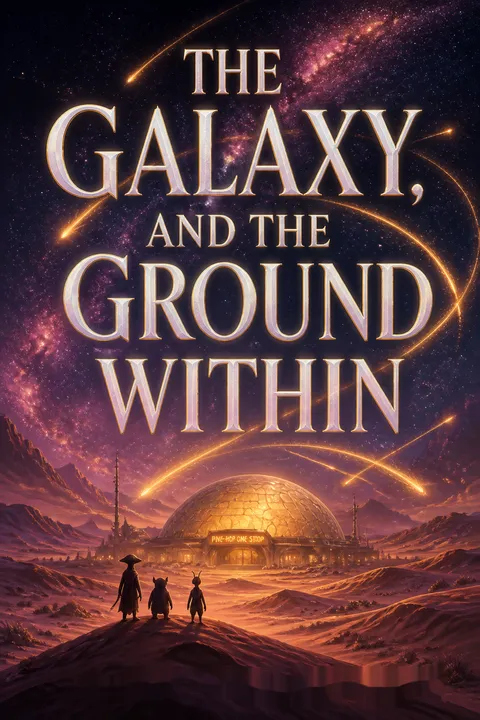
Gora is an unremarkable planet made indispensable by its position between busy wormhole routes. The Five-Hop One-Stop, a small multispecies rest stop, is run by Ouloo, a meticulous Laru host, and her adolescent child, Tupo.
On the morning three travelers are due, a cooperative notice warns that routine satellite maintenance may briefly interrupt power. It sounds like the kind of inconvenience a transit hub is built to absorb. Instead, the maintenance will trigger a failure that strands everyone on the ground.
The opening turns infrastructure into a quiet promise: Gora matters because people trust its routes, schedules, and shared systems to keep working. The notice is ordinary enough to be ignored, which makes the coming disaster feel less like an invasion than a failure of the routines that hold a crowded society together. The Five-Hop also establishes hospitality as practical labor. Ouloo has built her business around anticipating strangers’ needs, so the crisis will test not only technology but the limits of one host’s ability to care for everyone.
The Five-Hop’s Unlikely Guests
Ouloo begins the day trying to get Tupo washed and ready for guests, while the child would rather sleep among spilled snacks. Their scheduled visitors include Pei, an Aeluon cargo captain on leave; Roveg, a Quelin sim designer traveling toward a tightly controlled appointment; and Speaker, an Akarak pilot whose arrival makes Ouloo uneasy.
Speaker lives inside a mech suit because her body cannot breathe the oxygen-rich air of most public spaces. Pei’s military-marked shuttle hints at work near the Rosk border, while Roveg’s stripped shell and missing honorific mark him as an exile. Each has come to Gora for a brief stop, expecting privacy and onward travel. None expects to share a crisis with the others.
The travelers arrive carrying social histories that are visible before they are understood: Roveg’s damaged shell, Pei’s weapons, and Speaker’s suit invite assumptions. The novel makes these first impressions concrete rather than treating prejudice as a distant political problem. Ouloo’s discomfort is mixed with genuine effort, while Tupo’s curiosity is less polished but more direct. Their arrival gathers people who are accustomed to moving past one another, then places them within the same small habitat. Gora’s transit function becomes a narrative trapdoor: temporary proximity will require strangers to revise judgments they have relied on for safety.
A Sky Full of Wreckage
While the guests explore the Five-Hop, satellites begin breaking apart above Gora. White trails turn to fire, then the debris thickens until Speaker recognizes shattered solar panels among the falling objects. She fears for Tracker, her twin sister, who remains aboard their ship in orbit.
Pei and Speaker hurry with Ouloo to the local communications tower, where Pei connects her scrib so they can hear an emergency broadcast. The Transit Authority orders everyone into reinforced shelter and bans launches.
A later update explains that a hardware failure during routine satellite adjustments caused a cascade collision, damaging most of Gora’s network. Communications, solar power, and travel schedules fail together, leaving the travelers grounded without knowing when the sky will be safe.
The disaster does not select its victims by character or merit. It interrupts several ordinary lives at once, exposing how much safety depends on systems no individual can repair alone. The satellites are not merely scenery falling from the sky: they carry communication and power, so their failure turns distant machinery into a shared local vulnerability. Speaker’s fear for Tracker gives the spectacle an intimate focus, while the broadcast’s calm administrative language struggles to contain an event still unfolding. The scene begins the book’s central test: whether people accustomed to managing their own risks can accept dependence on strangers.
Shelter Becomes a Commons
Once the guests return to their shuttles, Speaker cannot settle. She inventories the skills and medical needs of everyone at the Five-Hop, looking for ways they might help if the emergency worsens.
Roveg initially sees little reason to prepare beyond the Transit Authority’s instructions, but he calculates that the delay could cost him his place in a distant tunnel queue and force him to buy extra fuel. Ouloo, upset that her home has become a shelter, sets out snacks and tries to hide the guests’ view of the burning sky with a blanket canopy.
At the gathering, Pei helps her tie it securely. The food brings the travelers into conversation, but Speaker’s methane needs exclude her from the shared dishes, revealing how easily a well-meant welcome can miss its guest.
The gathering is a small act of civic improvisation. Ouloo cannot restore power or clear orbit, but she can make a place for people to sit, eat, and look away from danger. Pei’s practical help turns hosting into shared work rather than a performance by the proprietor alone. Yet Speaker’s inability to eat the food exposes the difference between hospitality as intention and hospitality as knowledge. Her skills inventory likewise shifts the group from passive waiting toward mutual responsibility. Their responses diverge, but the crisis begins to give those differences a useful shape: caution, comfort, and preparation become complementary rather than competing needs.
The Tower Cannot Reach
Speaker asks Roveg to modify Ouloo’s local tower so she can contact the ship she shares with Tracker. Tupo assists with the controls and displays a surprising grasp of the communications system, but even after Roveg rewires and reboots the equipment, the connection fails.
While they work, Speaker explains that Akaraks link their ships during an annual exchange called rakree, sharing supplies without requiring repayment. She and Tracker serve their community by helping other Akarak ships navigate the wider galaxy.
Roveg recognizes the familiar burden of exile and explains that he was expelled from Quelin society for the political stories he created as a young sim designer. Later, Tupo gives him a tour of a museum devoted mostly to Goran rocks, where Roveg discovers a Quelin poem stone among the child’s exhibits.
The failed repair matters because it cannot be solved by goodwill or technical competence alone. Roveg can improve the tower, but the missing satellite layer remains beyond his reach. The conversation instead produces a different kind of access. Speaker explains a culture organized around reciprocal sharing, while Roveg identifies the political cost of refusing a sanctioned communal story. Tupo’s museum offers an unexpectedly generous bridge: rocks and discarded objects become a record of lives passing through an otherwise barren world. The poem stone also gives Roveg a tangible link to his language and history, though that connection carries private pain as well as pleasure.
Pei Learns Her Body
Pei retreats to the bathhouse, where the steam gives her room to confront the relationship she hides with Ashby, a Human tunneler. She wants to stop pretending he is absent from her life, but fears that public knowledge would cost her military contracts and divide her crew.
Later, Speaker plays music for Tupo and the others. Pei explains that her implant lets her identify sounds but cannot make music meaningful to her; instead, she teaches the group an Aeluon dance built around visible movement and vibrations underfoot.
A memory of her childhood creche interrupts her steps. Back in her shuttle, Pei runs a reproductive scan and discovers that she has begun shimmering, producing a single egg with only a short window for fertilization. She has long assumed this would never happen to her.
Pei’s body interrupts a question she has postponed: what does she want when custom and career no longer supply an automatic answer? Her private relationship with Ashby has already made her wary of choices that require her to split her life into hidden compartments. The dance gives that conflict a physical form, as Pei can lead others through movement even though music itself remains inaccessible to her. The scan then changes the stakes without resolving the choice. A social expectation arrives as a bodily fact, but the fact does not dictate what Pei must do. Her anxiety grows from the space between capacity and consent.
Breakfast Across the Divide
Roveg sends Speaker a carefully researched breakfast suited to her diet, then invites her to eat from inside her suit aboard his shuttle. They share unfamiliar fruits and talk about the planet each has or has lost.
Roveg describes the grounding comfort of returning to Vemereng, even though he has been exiled from it for fifteen standards. Speaker explains that Akaraks have no living homeland to return to: Harmagian colonization stripped their planet, and the Galactic Commons repeatedly failed to provide them a viable home.
Roveg’s meal gives Speaker a rare experience of being considered before she has to explain herself. Separately, Pei asks Ouloo for help finding an Aeluon creche. Ouloo locates one on Ethiris, but the travel and stay would consume Pei’s leave and cost her the chance to see Ashby.
Food becomes a form of attention rather than a symbolic cure. Roveg researches what Speaker can safely eat, then makes space for her to participate without pretending that their bodies are interchangeable. Their discussion of home distinguishes exile from dispossession: Roveg remembers a world he can still visit only under legal restraint, while Speaker’s people lack a world they can reclaim. Pei’s creche option presents a different kind of threshold. Institutions are ready to make her reproductive choice possible, but the schedule forces her to weigh that obligation against a life she has built with Ashby. Practical logistics sharpen emotional truth.
Borders Enter the Garden
As the stranded group drinks Ouloo’s strong private liquor, Pei asks why Speaker seems wary of her. Speaker admits that Pei’s work supporting military operations makes her uncomfortable, then questions the Aeluon presence at the Rosk border.
Pei defends the settlers and the military response to Rosk attacks; Speaker condemns the killing but argues that the Galactic Commons’ own history of taking worlds cannot be separated from present expansion. Roveg tries to keep the argument from hardening into a fight.
Ouloo admits she knows little about the political histories involved, but she can see that all three have been harmed by systems that call themselves orderly. Her attempt to offer dessert cannot settle the dispute. Tupo slips away, distressed by the adults fighting, and later tries to bring cake to Speaker’s shuttle.
The disagreement refuses the comfort of a clean moral division. Pei’s work protects people facing actual violence, while Speaker’s critique asks whether protection can become another justification for taking territory. Neither woman accepts the other’s frame, and the conflict is intensified by their unequal access to lived experience. Ouloo does not pretend to arbitrate history she barely knows; her uncertainty becomes a more honest response than a borrowed political certainty. Tupo’s retreat shows that adult arguments have costs beyond their speakers. The child is trying to understand a world where care, force, and belonging are entangled, not simply choosing sides.
Cake at the Airlock
Speaker returns to her shuttle and finds Tupo collapsed on the floor beside two pieces of cake. The child has entered without a protective suit and cannot breathe the methane atmosphere inside.
Speaker carries Tupo to Pei’s shuttle, where Pei starts the medical equipment and tries to fit a breathing mask over the Laru’s long, furry face. Because the mask will not seal, Speaker uses pipe sealant to hold it in place; the improvised airflow eventually opens Tupo’s nostrils and restores breathing.
Ouloo identifies the episode as olotohen, a defensive shutdown that Laru children can enter under extreme stress or environmental danger. The group finds medical guidance, but the condition requires a trained practitioner, and the child must be monitored until help arrives.
Tupo’s mistake grows directly from affection and poor understanding, not malice. The child wants to give Speaker a kindness and crosses an environmental boundary whose danger is invisible to them. The rescue forces the adults to translate care into material action: Pei supplies the medical space, Speaker adapts the mask, and Ouloo identifies the child’s condition. Their improvised success is meaningful but limited. They can restore breathing, yet cannot safely perform the neurological procedure needed to end olotohen. The scene tests the difference between being willing to help and being qualified to help, while showing how cooperation can bridge that gap.
A Sister Finds the Signal
As the group watches Tupo’s scans, Ouloo struggles to remain beside the bed, while Pei and Speaker take turns monitoring the child. Their conversations expose what each has risked losing: Roveg left four sons when he chose truth over obedience, and Pei has kept Ashby hidden because she fears the cost of being open.
Speaker insists that Pei’s reluctance to fertilize her egg is reason enough. When Speaker returns to her shuttle for food and air, Tracker finally reaches her through the temporary orbital network.
Speaker asks her sister to contact the Transit Authority, and Tracker gets emergency help through. Dr Miriyam arrives from a nearby dome and uses imubots to bring Tupo out of the shutdown. Tupo wakes, vomits, and reaches for Ouloo, who embraces the child as the others stand watch.
The long wait turns private disclosures into a form of care, but it does not make the danger abstract. Roveg’s estrangement from his sons and Pei’s concealed relationship clarify why each fears a choice that could close off part of a life. Speaker does not decide for Pei; she removes the demand that Pei justify her own refusal. Meanwhile, Tracker’s call converts sisterly concern into an essential link in the rescue chain. The arrival of a trained doctor completes what the stranded group could only begin. Tupo’s recovery belongs to collective effort, not to a single hero, and Ouloo’s embrace restores the personal center of the emergency.
Gifts Beneath a Clear Sky
When the Transit Authority finally clears Gora’s settled regions for launch, each traveler receives a departure slot. Tupo organizes a small farewell party in the garden, with homemade pudding and decorations assembled less carefully than Ouloo’s.
The child gives Pei an unpolished stone for its bright, durable beauty, and gives Speaker a crystal to take to Tracker. Tupo also returns the Quelin poem stone to Roveg, having realized that keeping it would make the museum a thief. Roveg accepts it as both an artifact and a personal gift.
The group lies in the grass beneath the cleared dome and uses Roveg’s star map to find distant home systems. Then the shuttles lift away. Gora returns to traffic, but the strangers leave with new obligations and choices to face.
The farewell gives each relationship a material form. Tupo’s gifts are not grand, but they show that the child has listened: the stone reflects Pei, the crystal connects Speaker to Tracker, and the returned poem corrects an earlier act of unthinking possession. Looking for home systems overhead makes distance visible without pretending it can be erased. The all-clear restores movement, yet departure is not a return to the unchanged lives the travelers left. Each has acquired knowledge that alters what can be ignored. Tupo’s party also reverses the opening pattern: the child who resisted hosting now makes a gathering of their own.
Epilogue
Pei chooses to continue toward Ashby rather than the creche, accepting that the egg will not be fertilized and deciding she can explain the choice to him in person. She also asks Harmagian official Kalsu to arrange a legitimate cultural-simulation contract for Roveg.
The sponsorship secures him a temporary permit to visit Vemereng and attend his sons’ coming-of-age ceremony, though he must remain under escort. Later, Roveg sends Speaker a sim of Flower Lake, the first time she and Tracker experience a world without the barrier of their suits.
They intend to share it with other Akaraks. Months later, Ouloo plants Akarak vegetables in a sealed methane terrarium at the Five-Hop, turning the welcome she could not offer through food into something living.
The resolutions do not make the characters’ systems fair. Pei’s choice honors her desire but leaves her to navigate the social consequences; Roveg gains access to his sons through a contract and surveillance rather than forgiveness from the state. Speaker’s sim cannot return a lost planet, but it makes an inaccessible sensation shareable. Ouloo’s terrarium likewise cannot recreate Akarak home, yet it changes hospitality from an abstract wish into a durable practice. Each ending offers a limited repair, not a total cure. The book’s hope rests in people using what they have to make another person’s life more possible.
Analysis
The novel stages an ethical problem at the scale of a small transit stop. Its characters cannot solve the Galactic Commons’ political history while sheltering at the Five-Hop, but the satellite failure makes their dependence on shared systems impossible to ignore. Power, communication, safe air, medical training, and travel permissions all come from infrastructures that are collective in effect, even when individuals experience them as routine services. The disaster is therefore not just a plot mechanism. It exposes how fragile autonomy becomes when the systems beneath it fail.
The book also distinguishes kinds of exclusion rather than flattening them into a single hardship. Speaker’s suit is an access technology, a breathing barrier, and a visible reminder of a history in which her people were displaced and then denied a home. Roveg’s exile is enforced by a state that treats dissent as cultural danger. Pei’s conflict is not a legal ban but the pressure of tradition, reputation, and work. Their experiences do not become interchangeable simply because they share a dome. Their arguments matter precisely because care cannot require them to agree about the structures they inhabit.
The story’s most intimate challenge is the demand that people justify what they want. Pei believes a feeling must have a cause before it can count as a reason. Speaker’s response, grounded in her own refusal of a medical intervention, offers a sharper principle: bodily consent does not need to pass an intellectual examination. That principle does not make Pei’s later choice easy or erase its consequences. It allows her to choose without pretending that uncertainty is evidence of failure.
Across the book, care is a practice of adaptation. Pei helps build a canopy; Roveg researches food; Speaker modifies a breathing mask; Tracker finds a signal; Ouloo changes what her garden can grow. These acts are small beside colonization or war, yet they refuse the idea that only large institutions can create meaningful change. The ending offers no repaired galaxy. It offers people learning how to make room for one another without claiming that room is enough.
People Also Read







Characters
Ouloo
The determined ground hostOuloo is a Laru who runs the Five-Hop One-Stop with her child, Tupo. She believes welcome is made from particulars: appropriate air, useful facilities, thoughtful food, and a place for a traveler to rest. Her care can become overmanagement, especially when she worries that a guest is unhappy or a child is not meeting expectations. Still, her instinct is to notice what others need and adjust her home around them. Ouloo’s outlook is shaped by a desire to connect Laru with other species rather than preserve a narrow boundary between them. Her attention to daily work makes her a practical caretaker, not an abstract idealist.
Tupo
The restless young curatorTupo is Ouloo’s adolescent Laru child, still moving through the long, awkward transition between childhood and adulthood. They are curious about alien bodies, travel, food, violence, and anything else an adult might consider private or unsuitable. Tupo can be inattentive to chores and rules, but their enthusiasm for rocks, museums, and new people reveals a patient streak beneath the mischief. Their uneven growth makes them uncomfortable in their body and unsure of what their future should hold. Tupo’s questions are often blunt because they have not yet learned which assumptions other people carry. They are eager to understand the galaxy, even when they misunderstand its dangers.
Speaker
The Akarak bridge-builderSpeaker is an Akarak pilot and translator who helps her people acquire supplies and navigate contact with other species. She lives inside a mech suit in oxygen-rich environments because her species needs methane, and because limited use of her legs makes the suit essential for moving through public spaces. A practiced reader of language and social cues, Speaker often shapes her behavior to keep others comfortable and secure cooperation. She is close to her twin, Tracker, and is devoted to the mutual aid practiced aboard Akarak ships. Her confidence in conversation coexists with a guardedness born from her people’s history of colonization and abandonment.
Roveg
The exiled Quelin artistRoveg is a Quelin sim designer whose work gives travelers carefully made environments in which to rest. He is observant, sociable, and deeply attached to art, food, and the subtleties of language. His exile from Quelin territory has left him without the honorifics and status his culture ordinarily grants, but it has not made him cynical about connection. Roveg values questioning and cultural exchange, even when those commitments have cost him dearly. He can be anxious about practical matters and evasive about pain, often reaching for a meal, a joke, or a carefully arranged room when he cannot speak plainly. His generosity is deliberate, not effortless.
Pei
The Aeluon cargo captainPei is an Aeluon captain who carries supplies through dangerous regions, including the Rosk border. Competent, direct, and accustomed to responsibility, she is used to making fast decisions for her ship and crew. Her implant lets her process sound as information, but music does not reach her as an emotional language; she understands rhythm through sight and vibration instead. Pei has built a life around professional reliability, yet her private relationship with Ashby challenges the secrecy demanded by her culture’s norms. She tends to analyze feelings as if they must be explained before they can be trusted. Her care for others is real, though she can be impatient with experiences she has not personally faced.
Tracker
Speaker’s searching twinTracker is Speaker’s twin and closest companion aboard their ship. She specializes in locating Akarak vessels that deliberately avoid detection, a technical skill that complements Speaker’s work with people and language. Tracker is less eager than her sister to leave the ship and has a chronic lung condition that requires medication. Her affection often appears through practical, unspoken gestures, while her humor gives Speaker room to relax. The twins rely on one another without needing to make their bond explicit, though distance forces each to recognize how much worry the other carries.
Ashby
Pei’s Human partnerAshby is a Human tunneler and the person with whom Pei has maintained a long, private relationship. He is not present at the Five-Hop, but the secrecy surrounding him shapes Pei’s choices and her fear of what openness could cost. His willingness to respect Aeluon customs matters to Pei, who does not want her relationship treated as a demand that she abandon her culture. Their time together offers her a rare space of trust, while their hidden status leaves her questioning how long affection can remain separated from the rest of her life.
Dr. Miriyam
The arriving emergency doctorDr. Miriyam is a Human physician from the Exodan ship Ratri. She arrives in an exosuit and treats Tupo with calm concentration, while being frank about the limits of her experience. Her manner is brisk rather than ceremonious, and she gives the stranded group clear tasks instead of asking them to trust her confidence alone. The doctor’s presence shows how specialized training can turn improvised care into competent treatment, while her directness helps the frightened adults understand what is happening.
Kalsu Reb Lometton
The resourceful Harmagian officialKalsu is a Harmagian official in the Galactic Commons’ border administration and one of Pei’s professional contacts. She is perceptive, politically experienced, and intrigued by complicated problems that can be addressed through legitimate channels. Her warmth toward Pei sits alongside a sharp eye for whether a request is improper. Kalsu represents the possibility that bureaucracy can sometimes be redirected toward humane ends by someone who understands how its rules work.
Plot Devices
Gora’s satellite cascade
The stranded-shelter engineA hardware failure during a routine satellite adjustment triggers collisions throughout Gora’s orbital network. The wreckage interrupts communication, threatens the planet’s surface, disrupts solar power, and prevents ships from launching. This single mechanical failure keeps the central cast together long enough for their separate conflicts to become shared concerns. It also prevents easy rescue: the characters can provide local aid, but must wait for orbital cleanup and restored communications before safe travel resumes.
The Five-Hop One-Stop
A forced meeting placeOuloo’s small habitat dome is designed to serve travelers with varied bodies and customs during their layovers. When the satellite disaster grounds its visitors, its gardens, bathhouse, office, museum, and shuttles become the limited world in which the characters must cooperate. The setting makes cross-species differences visible in daily tasks, such as eating, communicating, breathing, and moving through a room. Its modest scale turns hospitality from a general virtue into a series of concrete choices.
Akarak environmental suits
A barrier with two meaningsAkaraks use protective mech suits when traveling through environments that cannot support their methane-based respiration. Speaker’s suit also compensates for her limited use of her legs, allowing her to move through public spaces. Other species often mistake the equipment for a weapon or an attempt to appear larger, while Speaker explains its practical necessity. The suit both enables her work as a cultural bridge and marks the physical and historical barriers separating Akaraks from the broader galaxy.
Species-specific sim technology
A world made shareableSimulations reproduce sensory environments through brain maps tailored to the nervous systems of different species. Roveg discovers that designers have not built a usable map for Akaraks, leaving Speaker outside a form of entertainment most people take for granted. His profession later lets him create an experience of a planet’s open air, ground, and water for Speaker and Tracker. The technology cannot restore a real homeland, but it can let them encounter sensations their suits and ships have kept from them.
Aeluon shimmer
A choice with a deadlineAn Aeluon’s shimmer signals a rare reproductive window during which an egg can be fertilized. Pei’s first shimmer arrives unexpectedly while she is on leave, and her body scan makes the opportunity unmistakable. A traditional creche offers a familiar path, but taking it would consume the time she hoped to spend with Ashby. The device turns a cultural expectation into an immediate personal decision, while leaving Pei free to distinguish bodily capacity from obligation.
Wayfarers Series






Download PDF
Download EPUB
.epub digital book format is ideal for reading ebooks on phones, tablets, and e-readers.








