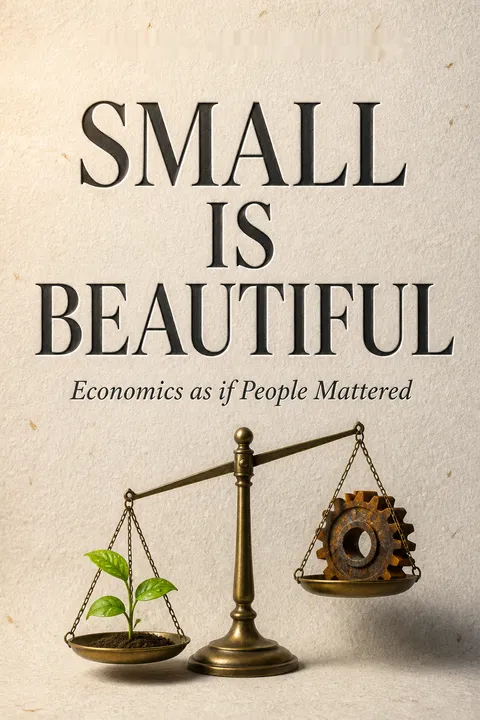


Key Takeaways
Stop calling production solved while industry spends down nature's inheritance
Growth can consume its base. Schumacher argues that an economy may produce more goods while weakening the conditions that make production possible. He calls nature's unmade, irreplaceable resources natural capital, including fossil fuels, living ecosystems, and nature's capacity to absorb pollution. Treating these as income hides the fact that using them up is not the same as earning a renewable return. A business that sold its machinery to inflate this year's profits would not be considered healthy; an economy that depletes soils and fuels deserves the same scrutiny.
Success has three foundations. The industrial system also spends down nature's tolerance for disruption and what Schumacher calls the human substance: people's dignity, health, and capacity to work meaningfully. Its startling successes, he warns, can create damage rather than prove the underlying system sound.
The accounting metaphor remains powerful because it asks a practical question: what assets are being consumed to produce today's income? Modern economic accounts can record output while giving incomplete visibility to depleted ecosystems or weakened communities. Yet the categories should not be collapsed into one score. Soil loss, climate risk, and alienating work require different measures and remedies. Schumacher's larger point is strongest when treated as a demand for fuller accounting, not as a claim that every form of industrial production is inherently destructive.
Judge prosperity by permanence, not by how fast consumption expands
Growth needs a stopping rule. Schumacher calls for an economics of permanence: economic arrangements should be judged by whether they can continue without exhausting their material and social foundations. He challenges the promise that universal prosperity will automatically create peace. In his 1966 comparison, populations he classified as rich made up about 31 percent of the world and used 87 percent of its fuel. Their per-person use was roughly fourteen times that of the poor. His projections toward 2000 were exploratory calculations, not predictions, but they sharpened the equity question: whose consumption drives resource demand?
More is not always better. Schumacher argues that a society organized around limitless acquisition has no built-in idea of enough. Expanding needs can increase dependence on scarce resources, intensify competition, and make peace more fragile.
The distinction between reducing poverty and endlessly expanding consumption is essential. A fairer world need not require every society to copy the most resource-intensive lifestyles; it does require access to food, energy, housing, and opportunity. Schumacher's historical figures are not current measurements, and his argument should not be mistaken for a precise forecast. Its durable contribution is the question of scale and distribution: growth for whom, using what, and with what consequences for others?
Treat economic verdicts as partial, not as moral permission
Profit is one criterion. Schumacher says that an activity is called economic when it earns adequate monetary profit for those undertaking it. That judgment can be useful, but it is not a complete verdict on social value. Markets register what buyers and sellers exchange, while often overlooking pollution, unpaid contributions, long-term consequences, or qualities that cannot readily be priced. A cleaner method of production may therefore appear less profitable than one that shifts its costs onto the public.
Look beyond the calculation. Schumacher calls the wider inquiry meta-economics: examining the assumptions about human purpose and the natural world that economics takes for granted. He also distinguishes primary goods from manufactured goods and services, and renewable resources from non-renewable ones. These differences matter before prices are compared, because replacing a finite resource is not equivalent to replacing a product made from it.
This is a critique of treating a useful tool as a complete moral philosophy. Cost-benefit analysis can expose trade-offs, but assigning a price to a forest or a person's health does not make every consequence commensurable. The practical challenge is to combine economic information with standards that cannot be reduced to a single price, such as rights, ecological limits, and public health. Schumacher's argument is not that calculation should disappear, but that decisions need more than the market's narrow field of view.
Choose technology that enlarges human agency instead of erasing it
Technology embodies choices. Schumacher rejects the assumption that progress means ever-larger machines, faster production, and fewer workers. He asks technology to meet three tests: ordinary people can afford it, it works at a manageable scale, and it leaves room for human skill and creativity. A hand tool can extend a craftsperson's ability; a machine that takes over the essential skilled task can turn the person into an attendant. The difference is not simply how modern the equipment looks, but what it enables people to do.
Design for human limits. Schumacher calls the desired alternative technology with a human face. It should use scientific knowledge without concentrating power or making workers redundant by default. Small-scale application also limits the damage any single mistake can cause, especially when knowledge of long-term effects is incomplete.
The distinction between tools that augment skill and systems that displace it is relevant to debates about automation. Productivity gains can free people from dangerous or exhausting tasks, but they do not automatically produce meaningful work or distribute the gains fairly. The design question is therefore institutional as well as technical: who controls the machinery, who benefits, and what new capabilities does it build? Schumacher's preference for smallness is a useful corrective, though some technologies require coordination and scale to serve people well.
Make work a source of skill, fellowship, and useful goods
Work is more than a cost. In Buddhist economics, Schumacher reconsiders economic life through the Buddhist idea of Right Livelihood. Work has three purposes: it lets people develop their abilities, cooperate with others, and produce what is needed. Treating labor only as a cost to eliminate misses those human purposes. Schumacher contrasts a craft tool, which supports a worker's skill, with machinery that takes over the skilled part and leaves the worker serving the machine.
Aim for sufficiency. Buddhist economics seeks human wellbeing with less consumption, rather than maximum consumption from maximum productive effort. Schumacher illustrates the idea with clothing: comfort and appearance matter, but wasteful production and needless complexity do not. He also favors local production for local needs where practical, because dependence on distant supply chains can increase resource use and vulnerability.
This view makes work quality part of economic performance, rather than a side issue to address after output rises. It also challenges the familiar assumption that leisure is simply the absence of work. However, meaningful work cannot be imposed as a moral duty while ignoring low wages, unsafe conditions, or care responsibilities. Schumacher's claim is most persuasive when it supports workers' choice, skill, and voice, not when it romanticizes labor or assumes one cultural model of a good life.
Develop villages through local capacity, not imported city-sized blueprints
Development must reach people. Schumacher describes a dual economy as two sharply separated ways of life within one country: a modern, often urban sector alongside a much larger rural and small-town population with few opportunities. When investment concentrates in major cities, it can weaken local production and draw job seekers into cities that cannot employ them. Schumacher calls the resulting cycle mutual poisoning: struggling rural areas send people toward cities, while city-centered development further drains the countryside.
Build the foundations first. For Schumacher, development depends on education, organization, and discipline across society, not merely on imported equipment or funding. He argues that aid should strengthen people's ability to solve local problems. Knowledge, training, and locally useful technical help can support self-reliance more effectively than projects that require skills, supplies, and institutions unavailable in the communities they are meant to help.
The focus on where people live makes development policy more concrete than national averages alone. A project can raise measured output and still bypass most households or disrupt local livelihoods. This is a strong case for evaluating who gains access to jobs, knowledge, and infrastructure. Local capacity should not become an excuse for governments to withdraw support, however. Communities need resources and public services as well as agency, and local institutions themselves can reproduce unequal power.
Create affordable workplaces before maximizing output per worker
Jobs change what people can build. Schumacher's intermediate technology is technology between very simple local methods and the highly capital-intensive systems of rich economies. Its purpose is to create productive, affordable workplaces suited to places with many workers and little capital. He illustrates the gap with symbolic costs per workplace of £1, £100, and £1,000. The middle level, he argues, could be more productive than the simplest methods yet accessible to local entrepreneurs and maintainable with local skills.
Employment is not a side effect. Schumacher cites Puerto Rico, where factory development added about 5,000 jobs a year from 1952 to 1962, while the annual increase in the labor force was estimated at around 40,000. His point is that output per worker cannot be the only measure where many people lack work. He urges regional development and production for local needs, rather than relying only on large urban factories or exports.
The central insight is that technology choice shapes how many people can participate in production, not just how much each worker produces. This reframes employment as productive capacity and social inclusion, rather than a cost to minimize. Yet labor-intensive methods are not automatically fair, safe, or efficient, and local production cannot supply every good. The useful test is comparative: which mix of technologies creates durable work while meeting quality, safety, and environmental needs?
Manage land for health, beauty, and renewal, not yield alone
Land is a living system. Schumacher draws on accounts of past civilizations whose land use depleted forests, grasslands, wildlife, or topsoil. He argues that fertile soil depends on complex living processes, so farming cannot simply be treated as factory production with a different location. The land provides food and materials, but it also supports ecosystems and shapes the places where people live.
Set broader goals. Schumacher proposes health, beauty, and permanence as guiding aims for land use, with productivity following within those limits. He favors practices such as returning nutrients to the soil, diversifying crops, and using local resources rather than imposing uniform industrial methods. He also criticizes the assumption that farmers should leave the land simply because large-scale production can reduce money costs, while rural communities lose livelihoods and cities absorb the displaced population.
The chapter makes an important distinction between farming as extraction and farming as stewardship of a living system. Yield is essential, but yield alone cannot describe soil condition, landscape quality, or the stability of rural communities. The challenge is to avoid turning beauty into a substitute for food security or farmer income. A sound land policy has to hold these aims together, using evidence about ecological effects while recognizing that agricultural choices are also shaped by ownership, prices, and public support.
Use forecasts to explore futures, never to pretend they are fixed
A forecast is not a plan. Schumacher separates forecasts, which estimate what may happen, from plans, which state what people with power intend to do. He also distinguishes both from feasibility studies, which test what follows if specified assumptions hold. A computer can calculate those consequences precisely without proving that its assumptions will come true. Treating a conditional calculation as a prediction creates false confidence.
Make uncertainty visible. Long-term decisions still require looking ahead, especially when they involve finite resources or infrastructure that is hard to reverse. Schumacher recommends testing plausible assumptions and studying the direction they imply, rather than presenting a single precise future as certain. Human choices can change events, so judgment about the present and its limits matters more than elaborate forecasts that conceal uncertainty.
This is a valuable lesson in epistemic humility: numerical precision is not the same as reliable knowledge. Scenario analysis can reveal consequences that intuition misses, but its usefulness depends on openly stating assumptions and updating them when conditions change. Schumacher sometimes understates the value of formal modeling, which can compare complex alternatives systematically. His caution still applies: models should inform accountable decisions, not claim authority over futures that remain partly shaped by human choice.
Break large institutions into accountable, self-governing human-scale units
Keep initiative near the work. Schumacher's quasi-firm is a relatively independent unit within a larger organization. His principles include leaving tasks with the lowest capable level, judging units by a small number of clear standards, tracking each unit's financial position, taking worker motivation seriously, and using guidance between vague encouragement and rigid orders. Together, these ideas aim to preserve both coordination and local initiative.
Ownership can serve wider purposes. At Scott Bader, founder Ernest Bader transferred ownership of his company to a worker commonwealth in 1951, completing the transfer in 1963. The organization limited pay differences, shared some profits with workers, and gave some to outside causes. Schumacher presents it as evidence that collective ownership and social aims can coexist with commercial success, not as proof that one arrangement suits every business.
The organizational argument avoids a false choice between a remote command center and disconnected local units. Clear responsibilities can make decentralized authority more than a slogan, while transparent accounts help people see the consequences of decisions. The Scott Bader case is compelling as a demonstration of possibility, but one successful firm cannot establish that its model transfers unchanged to every industry. The broader lesson is to design governance around scale, accountability, and the people who do the work.
Analysis
Small Is Beautiful is a moral argument about economics disguised as a sequence of practical disputes. Schumacher asks what economic reasoning leaves out: nature's capacity to regenerate, the human value of work, and the power of institutions to shape character. His recurring move is to expose a category error. A price is mistaken for value, output for wellbeing, technical capacity for wisdom, and large-scale coordination for inevitable progress. Against those substitutions, he proposes permanence, appropriate technology, local development, and organizations that keep responsibility close to action.
The book's force comes from linking household-scale choices to the architecture of the economy. Intermediate technology is not merely a tool kit for poor countries; it challenges the premise that labor-saving efficiency is always desirable. Buddhist economics is not an argument against material comfort; it asks whether consumption serves human purposes or becomes the purpose itself. The account of Scott Bader gives the institutional argument a concrete test: ownership and management can be organized around more than returns to outside shareholders.
The text also needs historical reading. Its fuel projections and nuclear warnings belong to the 1970s debate, not to current energy data. Its broad skepticism toward growth can blur the difference between wasteful expansion and improvements that reduce deprivation. The claim that women generally do not need outside employment reflects a dated and restrictive assumption, not a necessary implication of valuing care or meaningful work. Likewise, local production cannot replace every form of specialization or trade.
These limits do not erase the central challenge. Schumacher demands that economic success be judged against the human and ecological conditions it consumes or creates. His most useful legacy is not a universal blueprint for smallness, but a discipline of asking what scale, technology, ownership, and measure of success fit the actual task. The question is not whether growth is good or bad in the abstract. It is whether a particular form of growth leaves people and the living world more capable of continuing.
Review Summary
Small is Beautiful presents a critique of modern economics, advocating for human-centered approaches and sustainable practices. Reviewers appreciate Schumacher's insights on consumerism, technology, and environmental concerns, finding them still relevant today. The book challenges conventional economic thinking, emphasizing the importance of ethics, local economies, and meaningful work. While some readers find it thought-provoking and visionary, others criticize it as outdated, preachy, or lacking in academic rigor. Despite mixed opinions, many readers value Schumacher's alternative perspective on economics and societal progress.
People Also Read







Glossary
Natural capital
Nature's productive inheritanceThe resources and ecological functions that people did not create but depend on for production and life. Schumacher includes fossil fuels, living nature, fertile land, and nature's capacity to absorb disruption. Treating these as income rather than capital hides depletion: using them up can make current output look successful while weakening the basis for future production.
Economics of permanence
Economics designed to endureSchumacher's standard for judging economic arrangements by whether they can continue over time without exhausting essential resources or damaging human and social life. It rejects unlimited material growth as a universal aim in a finite environment. Growth can be appropriate when directed toward a bounded purpose, but permanence requires attention to resource renewal, human wellbeing, and restraint.
Meta-economics
Economics' underlying assumptionsThe inquiry into the prior assumptions that shape economic reasoning. Schumacher divides it broadly into views about human beings and views about the natural world. These assumptions affect what economics counts as a resource, a cost, or a desirable outcome. Studying them helps reveal why a market judgment may be too narrow to guide a whole society.
Buddhist economics
Economics oriented toward liberationSchumacher's account of economic life viewed through Buddhist principles, especially Right Livelihood. It treats work as a way to develop abilities, cooperate with others, and produce needed goods. Rather than maximizing consumption, it seeks human wellbeing with modest use of resources, simplicity, and non-violence. It distinguishes wealth from attachment to wealth.
Intermediate technology
Affordable, locally usable technologyTechnology positioned between basic traditional methods and the capital-intensive systems of advanced industry. Schumacher proposes it for communities with abundant labor and limited capital. It should be productive, relatively simple to maintain, suited to local skills and materials, and affordable enough to create many workplaces. It is a new design direction, not merely a return to obsolete tools.
Dual economy
Separated modern and traditional sectorsA national economy divided between a relatively modern, often urban sector and a much larger population whose rural or small-town livelihoods have limited access to investment and employment. Schumacher argues that growth concentrated in the modern sector can intensify inequality, unemployment, and migration instead of gradually absorbing everyone into stable work.
Quasi-firm
Semi-autonomous organizational unitA unit within a large organization that operates with meaningful local responsibility and some freedom to make decisions. Schumacher uses the term for a way to preserve initiative and accountability without abandoning coordination across the whole institution. A quasi-firm can have its own performance measures and financial accounts while remaining part of a larger structure.
Principle of Subsidiary Function
Keep decisions at capable lower levelsA rule for organizations that assigns a task to the smallest or lowest-level unit capable of carrying it out satisfactorily. Higher authorities should support rather than absorb the functions of lower units. Removing a responsibility from a lower level requires justification that the unit cannot perform it adequately and that a higher level can do better.
Principle of Vindication
Intervene only by clear exceptionA principle for central oversight that protects subsidiary units from arbitrary interference. The center sets a small number of clear standards and intervenes when a defined exception occurs, rather than monitoring every action through a long list of criteria. Schumacher argues that excessive accountability measures can suppress the local initiative they are meant to supervise.
Principle of Identification
Track each unit's financial substanceThe requirement that each semi-autonomous unit have accounts that show not only its current profit or loss but also its accumulated financial position. Schumacher argues that a separate balance sheet helps a unit understand how its decisions affect its resources over time. Success should create greater scope, while losses should remain visible rather than disappearing into the parent organization's accounts.
Principle of Motivation
Design around human motivesThe principle that organizational structure must take seriously why people work and what makes their effort worthwhile. Pay matters, but Schumacher argues that large organizations often neglect purpose, participation, challenge, and satisfaction. Systems that treat work only as a necessary burden can weaken cooperation and make motivation harder to sustain.
Principle of the Middle Axiom
Guide without dictatingA method for central leaders to encourage change without relying only on exhortation or issuing rigid instructions. A middle axiom establishes a clear expectation while leaving lower units room to solve practical problems themselves. Schumacher's example is a standard that requires managers to explain and document each exception, prompting action without centralizing every decision.
FAQ
What's Small is Beautiful about?
- Human-Centric Economics: Small is Beautiful by Ernst F. Schumacher critiques modern economic systems that prioritize material wealth over human well-being, advocating for an approach that respects human dignity and the environment.
- Critique of Industrialization: Schumacher discusses the dangers of industrialization and the misconception that the "problem of production" has been solved, emphasizing the need to recognize and preserve natural capital.
- Sustainable Practices: The book promotes sustainable practices and technologies that align with ecological principles, advocating for small-scale, localized economies that support community and environmental health.
Why should I read Small is Beautiful?
- Timely Economic Insights: The book offers critical insights into the limitations of current economic practices, relevant to today's sustainability and environmental discussions.
- Philosophical Depth: It provides a philosophical framework connecting economics with ethics and spirituality, urging readers to consider the moral implications of their economic choices.
- Practical Solutions: Schumacher presents practical solutions for creating a more humane and sustainable economy, valuable for policymakers, business leaders, and individuals interested in social change.
What are the key takeaways of Small is Beautiful?
- Human-Centric Approach: Economics should serve people, prioritizing human needs and ecological balance over mere profit.
- Critique of Growth Paradigm: Challenges the notion of unlimited economic growth, advocating for a focus on quality of life rather than quantity of consumption.
- Importance of Local Economies: Promotes small-scale, localized economies that are more sustainable and resilient, guided by "the economics of permanence."
What are the best quotes from Small is Beautiful and what do they mean?
- "The most obvious facts are most easily forgotten.": Highlights society's tendency to overlook fundamental truths about human nature and the environment in favor of economic growth.
- "We are remodelling the Alhambra with a steam-shovel.": Illustrates the destructive approach of modern industrial practices, calling for a more thoughtful engagement with the environment.
- "Earth provides enough to satisfy every man's need, but not for every man's greed.": Critiques materialism and consumerism, reminding us to prioritize needs over wants and live within ecological limits.
How does Small is Beautiful address the issue of production?
- Production vs. Consumption: Emphasizes producing what is truly needed for human well-being, rather than solely increasing production.
- Natural Capital: Highlights the importance of conserving natural resources, warning against treating them as expendable income.
- Sustainable Practices: Advocates for production methods that respect ecological limits and promote long-term viability.
What is Schumacher's view on technology in Small is Beautiful?
- Technology as a Double-Edged Sword: Views technology as beneficial or harmful, depending on its application, advocating for "technology with a human face."
- Critique of Large-Scale Technology: Criticizes industrial technology for alienating workers and degrading the environment, promoting "the economics of permanence."
- Advocacy for Appropriate Technology: Promotes small-scale, decentralized, and environmentally friendly technology that empowers communities.
What is "intermediate technology" as defined in Small is Beautiful?
- Definition of Intermediate Technology: A form of technology more advanced than primitive methods but simpler and more accessible than high-tech solutions.
- Focus on Human Labor: Utilizes human skills and labor effectively, promoting productivity and creativity among workers.
- Sustainability and Decentralization: Supports decentralized production systems, helping communities become self-sufficient and resilient.
How does Schumacher critique modern industrial society in Small is Beautiful?
- Societal Disconnection: Argues that modern industrial society alienates individuals from meaningful work and community.
- Environmental Degradation: Highlights ecological damage caused by large-scale industrial practices, calling for sustainable approaches.
- Need for a New Lifestyle: Emphasizes developing a lifestyle aligned with human nature and ecological balance.
How does Small is Beautiful address the issue of poverty?
- Critique of Traditional Aid: Argues that traditional aid often fails to address poverty's root causes, advocating for empowering people through appropriate technology.
- Production by the Masses: Emphasizes mobilizing local resources and labor to alleviate poverty, rather than relying on mass production.
- Sustainable Development: Advocates for practices that consider ecological and social dimensions, leading to lasting change.
How does Small is Beautiful suggest we change our economic values?
- Shift from Materialism: Calls for moving away from materialistic values, focusing on human well-being and ecological sustainability.
- Integration of Ethics in Economics: Emphasizes incorporating ethical considerations into economic decision-making for the greater good.
- Community and Cooperation: Advocates for fostering community and cooperation over competition and individualism.
What is the concept of "economics of permanence" in Small is Beautiful?
- Definition of Economics of Permanence: An economic approach prioritizing sustainability and long-term ecological health over short-term profits.
- Critique of Conventional Economics: Critiques the focus on growth and consumption without regard for ecological limits.
- Practical Applications: Outlines sustainable agriculture, appropriate technology, and local economies as practices for a humane future.
How does Small is Beautiful relate to current environmental issues?
- Relevance to Modern Crises: Insights are increasingly relevant in the context of climate change and resource depletion.
- Call for Action: Serves as a call to action for prioritizing sustainability and ecological health.
- Framework for Sustainable Development: Provides a framework balancing economic growth with environmental stewardship.
Download PDF
Download EPUB
.epub digital book format is ideal for reading ebooks on phones, tablets, and e-readers.








