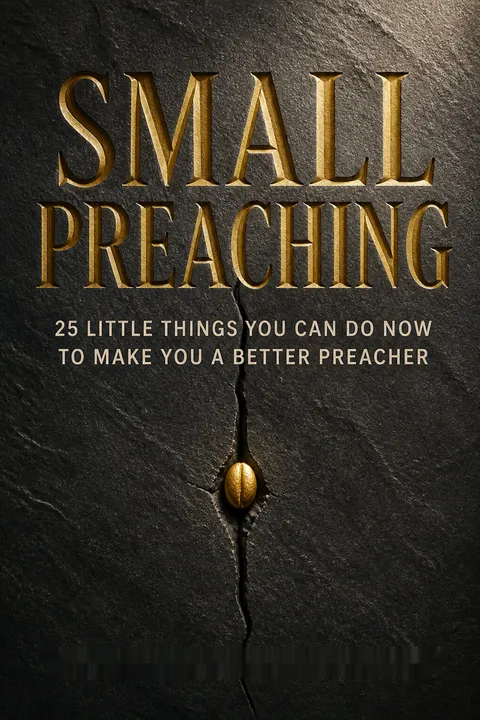


Key Takeaways
Treat each sermon as one layer in a lifelong work of formation.
Play the long game. Pennington calls his method small preaching: practical adjustments made steadily, rather than a grand overhaul of a preacher's entire approach. His image is encaustic painting, an ancient art that builds an image from layers of heated, pigmented wax. A preacher may deliver more than two hundred sermons in five years, each contributing a different shade to a congregation's understanding. No single sermon has to carry the whole picture.
Release the demand for perfection. A difficult or disappointing sermon can still contribute something worthwhile. Like golf, preaching is not a sequence of flawless shots. Pennington's point is not to excuse careless work, but to replace paralyzing self-judgment with faithful practice and gradual improvement.
The layered image changes the unit of evaluation. A sermon can be judged not only by whether it succeeds as a standalone performance, but also by what it contributes to a sustained pattern of teaching and care. That is a useful corrective to the pressure to make every Sunday feel definitive. Still, the long view should not become a reason to dismiss immediate harm or confusion. Durable formation depends on honest attention to how particular sermons land, as well as patience with the limits of any single message.
Receive praise with gratitude, and give criticism time before believing it.
Avoid both traps. Praise can encourage a preacher, but treating it as proof of personal worth makes approval addictive. Criticism can expose a real weakness, but reacting in anger or accepting every judgment uncritically gives it too much power. Pennington recommends receiving compliments plainly, with thanks, rather than pretending not to need encouragement.
Make room to think. When criticism arrives, pause before responding. Examine its source, wording, and substance as if turning an object in the light. Some feedback can be discarded; some contains a useful truth beneath an unfair delivery. Ask what can improve, what cannot change, and why the comment stings. If needed, test your interpretation with trusted people.
This approach treats feedback as information to interpret, not a verdict on identity. That distinction makes it possible to learn without becoming submissive to the loudest person in the room. It also recognizes that praise and criticism are both relational events: receiving either graciously can strengthen trust. The method has a practical limit, however. A preacher should not use reflection as a way to postpone responding to serious concerns. Discernment requires both emotional space and a willingness to act when the evidence is clear.
Invite trusted preachers into your weekly preparation.
Work in company. Pennington's Band of Brothers Preaching means a close, regular circle of preachers who prepare together. They might discuss the same biblical passage, trade research and illustrations, or plan a shared series for their separate congregations. In Pennington's own network, weekly conversations surfaced interpretive insights and useful sermon ideas that one preacher might not have found alone.
Keep the work your own. Collaboration is not permission to copy another person's sermon. It is a way to benefit from collective study while shaping a message for one's own congregation and voice. If meeting locally is impractical, the group can meet online. The essential ingredients are trust, regularity, shared purpose, and a commitment to strengthen one another rather than compete.
This is a model of professional learning that values both individual craft and shared expertise. A peer group can reveal blind spots, reduce isolation, and help a preacher test an interpretation before presenting it publicly. Its benefit depends on the group's habits: people need room to disagree, and the most experienced member should not automatically dominate. The warning against copying matters too. Shared preparation works best when it improves the preacher's judgment, rather than turning sermons into interchangeable products.
Lead like a conductor: listen deeply before directing the congregation.
Prepare, listen, lead. Pennington compares a pastor to an orchestra conductor. The conductor studies the score and the musicians' parts, listens closely to how they fit together, then offers a coherent interpretation. The pastor likewise prepares through biblical study and life among people, listens to the congregation, and helps its varied members move toward a shared purpose.
Measure leadership by what it enables. A conductor does not play every instrument. A pastor's work is not limited to delivering a sermon, either. Preaching is one visible way of equipping people to serve and contribute. The goal is not a congregation that simply echoes the preacher, but a community whose different gifts can work together with direction and coherence.
The conductor metaphor makes listening an essential leadership skill, not a soft alternative to authority. It also shifts attention from the leader's performance to the community's capacity to act. The comparison is strongest when leadership genuinely coordinates a range of voices. It becomes less helpful if it implies that the pastor alone supplies the vision or decides whose contribution belongs. A healthy ensemble depends on reciprocal listening: the leader interprets, but the musicians also shape what can be heard.
Witness to grace instead of treating hearers as defendants.
Invite rather than prosecute. Missionary E. Stanley Jones concluded that arguing Christianity's case was less persuasive than bearing witness to the grace he had experienced. Pennington does not reject reasoning or explanation. He argues that arguments alone do not produce faith, and that the preacher's posture matters: a witness stands beside hearers and points toward what has been seen, while a prosecutor treats them as opponents to defeat.
Choose the right mode. Pennington distinguishes preaching, which proclaims biblical truth to invite and exhort, from teaching, which explains complex ideas in greater detail. Sermons can contain careful reasoning, but issues that need extended questions and clarification may be better handled in a dialogical teaching setting. The two modes share content while serving different immediate purposes.
The witness image protects the preacher from confusing conviction with victory in debate. It also takes seriously the difference between communicating a truth and controlling how another person receives it. The distinction between preaching and teaching offers a practical way to avoid cramming every theological question into a sermon. These modes still overlap, and a sermon can explain as well as exhort. The useful test is not whether a message contains argument, but whether its form serves the response it seeks.
Write the sermon to discover what you actually mean.
Use writing as thought. Pennington argues that a full manuscript can clarify a preacher's ideas even when the manuscript is not used in the pulpit. Writing does not merely display a finished thought; choosing words and arranging sentences helps form and test the thought itself.
Alternate broad planning with small sessions. He compares sermon writing to sculpture: first block out the overall shape, then chip away at sections and sentences. He also recommends snack writing, gathering observations throughout the week before drafting in a concentrated session. His routine includes revisiting the passage, keeping a note file for questions and ideas, consulting commentaries, and drafting before editing. Other writers and preachers can contribute insights, provided the preacher transforms the material and does not pass off another person's work as their own.
The writing process described here distributes difficult thinking across time. That can reduce the pressure to invent a finished sermon in a single sitting and gives early ideas room to develop. The distinction between drafting and shaping is especially useful: a rough manuscript can be a laboratory, not a promise to say every sentence aloud. Borrowing from others is also a realistic account of creative work. Its ethical boundary is clear: influence can be acknowledged and transformed; plagiarism conceals dependence.
Let deep study produce a clear sermon, not a crowded one.
Keep most of the iceberg underwater. Pennington's Iceberg Preaching describes a sermon whose visible message is simple and clear because it rests on a much larger body of study and experience. The hearers should not have to absorb every source, scholarly debate, or supporting detail the preacher encountered.
Edit for the listener. This requires cutting material, even material the preacher especially likes. Pennington calls this killing one's darlings: removing clever lines, illustrations, or side arguments when they obstruct the sermon. A manuscript with eighteen points may leave listeners with none. The aim is not thin content, but a small number of well-developed ideas, supported by depth that gives them weight without overwhelming the message.
The iceberg is a strong model of expertise made accessible. It distinguishes simplicity from superficiality: clarity can be the result of extensive work, not its opposite. The editorial challenge is that compression can also erase needed context or flatten genuine disagreement. A preacher has to ask not merely what can be cut, but what a listener needs in order to understand the claim fairly. The standard is hospitable clarity, not brevity for its own sake.
Build sermons around tension, prediction, and resolution.
Give listeners a path through the idea. Pennington describes a sermon as a story with a setting, rising tension, a high point, resolution, and following action. The preacher introduces an issue, makes its stakes felt, shows how the biblical text addresses it, and applies that resolution to present life. This structure can work with narrative passages and with letters or other forms of Scripture.
Make hearers predict. Thoughtful questions invite people to guess what a text or argument will do next. Pennington draws on learning research discussed by James Lang: predicting encourages learners to connect new material with what they already know. He offers examples such as pausing during a biblical story to ask what might happen, or inviting listeners to anticipate the next move in an argument.
Tension gives attention a reason to stay. Prediction also makes listeners active participants in interpretation, rather than recipients of a stream of finished conclusions. Together, these techniques can make abstract teaching easier to follow because the audience has a question to carry through the message. The form must remain faithful to the text, though. Not every passage resolves its tension neatly, and forcing a tidy plot can oversimplify grief, ambiguity, or disagreement that the Scripture itself leaves open.
Earn attention early, then make the ending carry the sermon’s point.
Design the opening. Pennington argues that the first minute matters because listeners quickly decide whether a message seems relevant and understandable. He recommends preparing the opening words, starting without avoidable delays, and using a thoughtful question or an intriguing, personal, or humorous entry when appropriate.
Land the message. The ending deserves the same care. A preacher should not drift into a weak conclusion, introduce a fresh argument at the last moment, or disguise a recap as prayer. Instead, return to the sermon’s central idea, apply it to actual circumstances, and end with an inviting note. Pennington also urges preachers to be present and wholehearted in delivery. A sermon is a live, shared act, not just a text read aloud.
An intentional opening and ending create a frame that helps listeners recognize what matters. The advice is especially useful because preparation often focuses on the body of a sermon while the moments most likely to shape its memory are left to improvisation. Attention, however, is not a prize to win at any cost. A striking opening should serve the text rather than become a performance trick, and a hopeful ending should not conceal a difficult message that requires honest engagement.
Let the text's genre and the occasion determine your preaching mode.
Use Scripture according to its form. Pennington questions the assumption that every biblical passage should be preached through in the same verse-by-verse way. Psalms are prayers and songs; Proverbs often works through memorable sayings; Galatians repeats a central argument with force. Each can teach, but its structure may call for a different approach. Sequential exposition, or lectio continua, is valuable, but not the only faithful method.
Use calendars deliberately. The church calendar can rehearse the story of Jesus through seasons such as Advent, Lent, Easter, and Pentecost. Cultural observances can also offer occasions for biblical reflection, but pastors should weigh local traditions, competing commitments, and the mixed experiences in a congregation. Special Sundays need not displace regular preaching, and a prayer or reading may mark an occasion without making it the sermon topic.
This is an argument for interpretive fit rather than a rejection of exposition. A text's genre shapes what it is doing, so the form of a sermon can either illuminate that work or obscure it. Calendar choices similarly shape communal memory, but they are never neutral: honoring one event can marginalize another or interrupt a series. The practical strength of this approach is intentionality. Pastors can explain why they choose a particular mode or occasion, helping congregations see the reasoning rather than assume the choice is arbitrary.
At weddings and funerals, guide people through the moment instead of taking it over.
Serve the occasion. Pennington compares a pastor at a wedding or funeral to a good tour guide: knowledgeable, attentive, and focused on helping others see what matters. At a wedding, the pastor can frame the ceremony as a celebration of love and commitment, drawing on the couple's particular story without turning the event into a long lecture about marriage.
Give grief room. At a funeral, the pastor helps people remember the deceased, name the disorientation of loss, and consider the value of life. The message can acknowledge imperfection without pretending that the person was flawless. In both settings, the task is not to say everything the audience needs to hear. It is to accompany people through a significant transition with words proportionate to the occasion.
The guide metaphor correctly places pastoral speech inside the event rather than above it. At weddings and funerals, listeners may be carrying strong emotions, unfamiliar beliefs, or complicated histories with the people being honored. Restraint can therefore be a form of care: the preacher does not need to turn every gathering into a comprehensive lesson. The challenge is to avoid mistaking brevity for simplicity. A few carefully chosen words may still need to make room for sorrow, conflict, or joy that cannot be reduced to a formula.
Ask others to examine your sermons, and revise without demanding perfection.
Make evaluation routine. Pennington warns that preaching does not improve automatically. He suggests feedback from pastoral colleagues, trusted preachers at other churches, or a small group of congregants with varied perspectives. A simple form can ask what helped, what was unclear, and where listeners lost the thread. Regular feedback gives the preacher specific material to consider rather than leaving improvement to guesswork.
Expect the creative dip. Pennington describes a familiar arc: an idea first seems promising, then difficult, then bad enough to make the creator feel inadequate. Continued work can bring a more realistic sense that the result may be worthwhile. A Saturday-night conviction that a sermon is failing may be part of this process, not proof that the preacher should quit or start over.
Evaluation makes craft accountable to the people a sermon is meant to serve. A diverse group can expose different kinds of confusion that the preacher cannot detect alone. The group needs clear boundaries, though: feedback should address the message, not become an open invitation for every preference to govern the pulpit. The creative cycle also gives discouragement a name without romanticizing it. Sometimes a sermon really does need major revision. Feedback and persistence help distinguish a difficult stage of work from a genuine problem.
Analysis
Small Preaching is not a complete system for sermon construction. It is a collection of practical interventions for the moments when craft, character, and congregational responsibility meet. Its central wager is that improvement is more likely to come from repeatable adjustments than from a dramatic reinvention of the preacher. That premise gives the book its coherence: receiving feedback, writing in stages, trimming drafts, collaborating with peers, and designing openings are all modest actions that can change the quality of a recurring public practice.
The book's most consequential distinction is between preparation that remains invisible and communication that feels clear. Manuscripting, research, and repeated revision build a reservoir of understanding; the preacher then filters rather than displays it. This vision avoids two common errors, mistaking complexity for rigor and mistaking simplicity for shallowness. It also makes preaching an ethical act of selection. What gets omitted can matter as much as what is said, especially when listeners have limited time and different experiences.
Pennington's strongest metaphors do more than decorate advice. The conductor shifts leadership from personal prominence to coordinated participation. The witness shifts persuasion from winning to truthful presence. The iceberg links public clarity to private depth. Each metaphor corrects a temptation built into the role: self-display, adversarial certainty, or information dumping.
The counsel is most useful when treated as adaptable rather than universal. A sermon can invite, explain, narrate, or commemorate, and the right shape depends on the text, occasion, and congregation. Likewise, feedback can improve judgment but cannot replace it. The book's lasting contribution is a craft ethic: work carefully, listen closely, borrow gratefully, and remain willing to revise. Better preaching is not guaranteed by any one technique. It is built through sustained attention to how words serve people.
Review Summary
Small Preaching by Jonathan T. Pennington receives high praise from readers for its practical, concise advice on improving preaching skills. Reviewers appreciate the book's short chapters filled with wisdom, memorable analogies, and actionable tips. Many found it encouraging and useful for both new and experienced preachers. While some disagreed with certain points, most valued the book's focus on small, incremental changes to enhance preaching effectiveness. Readers particularly highlighted chapters on handling criticism, sermon preparation, and delivery techniques. Overall, it's viewed as an excellent resource for preachers seeking to refine their craft.
People Also Read









Glossary
Small preaching
Incremental craft improvementA practical approach to improving preaching through modest, intentional changes repeated over time. Rather than promising that a sweeping overhaul will transform a preacher, it focuses on specific habits in personal conduct, preparation, and delivery that can accumulate into more effective ministry.
Encaustic preaching
Sermons as accumulated layersA metaphor for viewing each sermon as one layer in a preacher's long work with a congregation. Like an encaustic painting built from layers of pigmented wax, a congregation is formed over time through many messages. The metaphor relieves pressure on any single sermon to communicate everything.
Band of Brothers Preaching
Collaborative sermon preparationA regular, close-knit practice in which preachers prepare alongside other preachers. Members may study the same passages, share resources, and discuss sermon ideas while retaining responsibility for their own messages. The approach aims to provide encouragement, accountability, and collective insight without endorsing plagiarism.
Iceberg Preaching
Clear message, hidden depthA model of preaching in which a simple, accessible sermon rests on extensive knowledge and experience that remain mostly beneath the surface. The preacher studies deeply but filters the material, offering listeners a clear message rather than displaying every detail encountered in preparation.
Rhythm of Education
Three stages of learningA model of learning that moves through Romance, Precision, and Generalization. Learners first become curious about a subject, then develop more exact understanding, and finally connect that understanding to wider questions and life. In preaching, these stages can guide a message from interest through explanation to application.
Jigsaw Puzzle
Associative sermon structureA sermon approach for complex subjects that presents several ideas or perspectives before showing how they fit together. Rather than forcing every topic into a simple linear argument, the preacher frames the issue, examines distinct pieces, and helps listeners form a larger picture.
lectio continua
Sequential biblical expositionA practice of preaching through a biblical book or passage in sequence. Pennington recognizes its value as a common approach to exposition while arguing that different biblical genres may call for other methods, such as topical treatment or a shorter sequence that preserves a text's rhetorical force.
TSS
A creative-work discouragement stagePennington's abbreviation for the feeling that a sermon is bad, often experienced during preparation. He places it within a six-stage account of creative work: early enthusiasm, difficulty, discouragement about the work, self-doubt, renewed possibility, and a finished result that may be worthwhile. The feeling is not by itself proof of failure.
sub-creators
Creators working from existing materialA term Pennington uses for human makers whose creativity differs from creation out of nothing. Sermons combine ideas, texts, metaphors, and insights received from others. The concept supports learning from existing work while distinguishing transformative, acknowledged influence from plagiarism.
About the Author

Download PDF
Download EPUB
.epub digital book format is ideal for reading ebooks on phones, tablets, and e-readers.








