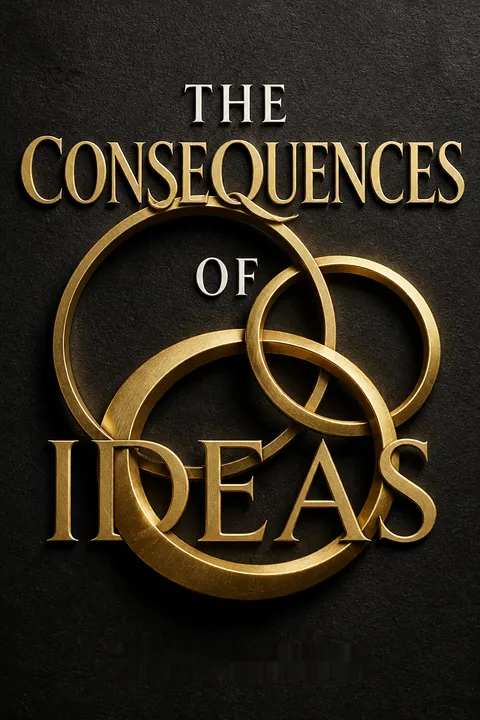


Key Takeaways
Treat ideas as civilization's infrastructure, not academic decoration
Ideas have consequences. Sproul opens with a German philosophy professor who, after opposing the Nazis, lost his wife and nearly all his children. In America, the refugee was reduced to sweeping hospital grounds. The contrast frames philosophy as more than a classroom pursuit: regimes fear ideas because beliefs about truth, human worth, and power can challenge the order they impose.
Assumptions become institutions. Everyday inventions also begin as ideas, while laws and customs often rest on principles people no longer examine. Philosophy asks what those principles are, whether they are true, and what follows if they are wrong. The point is not to admire abstraction for its own sake. It is to notice that untested assumptions can quietly govern public life.
The opening story makes intellectual history tangible: a claim about truth can become a political threat, while a theory of human dignity can shape law and institutions. This resembles social epistemology, the study of how communities decide whose knowledge counts. A society does not merely hold ideas; it builds rules around them. Yet the story also cautions against treating every persecuted thinker as necessarily correct. The professor's fate shows the power of ideas, not their truth. That distinction makes scrutiny, rather than reverence for intellectuals, the practical lesson.
Trace the hidden order behind change, diversity, and apparent chaos
The earliest question was what is real. Greek thinkers searched for an archē, the basic source or principle that could explain the world's many forms. Thales proposed water, partly because it appears as liquid, vapor, and ice, and is indispensable to life. Heraclitus emphasized continual change, while Parmenides argued that genuine being cannot simply become what it was not. Their clash posed a durable problem: how can a world contain both change and stability?
Truth needs more than opinion. Sophists such as Protagoras treated human perception as the measure of reality, making truth and morality dependent on the observer or society. Socrates resisted this slide by questioning assumptions and demanding careful definitions. His method begins by admitting uncertainty, then testing claims through dialogue. For Sproul, the search for order matters because a culture that abandons truth risks abandoning shared standards of justice.
The one-and-many problem remains recognizable in modern science: diverse observations are useful only if some pattern can connect them. Models seek that pattern, but they can also mistake a useful simplification for ultimate reality. Socratic questioning offers a corrective because it asks what a claim means before asking whether it persuades. The caution is that agreement on definitions does not settle every moral dispute. People may share terms such as justice while disagreeing about its application. The method improves inquiry; it does not guarantee consensus.
Learn to distinguish Plato's ideal forms from Aristotle's embodied causes
Plato looks beyond appearances. In his cave story, prisoners mistake shadows on a wall for reality because they have never seen the objects casting them. Education is the difficult movement from familiar appearances toward deeper truth. Plato calls the enduring realities behind particular objects Ideas or Forms: individual chairs differ, but each can be recognized as a chair because it reflects an ideal form.
Aristotle brings form into things. He rejects a separate realm of Forms and understands an object as matter organized by its form. To explain change, he identifies four causes: what a thing is, what it is made from, what brings it about, and what purpose it serves. For a statue, these are its design, marble, sculptor, and intended use. His logic also insists that a thing cannot be itself and not itself in the same respect.
The contrast still matters in debates about whether categories are discovered in the world or imposed by human minds. Plato highlights ideals that help people criticize imperfect institutions; Aristotle highlights how close attention to actual things can correct abstract theory. Modern research often needs both moves: it proposes general models, then tests them against particular cases. Neither perspective is sufficient alone. Ideals can become detached from lived reality, while attention to particulars can miss the larger structure that makes comparison and explanation possible.
Join faith and reason without confusing distinction with separation
Augustine treats knowledge as illuminated. He argues that the senses can mislead, but self-awareness and mathematical truths offer firmer ground. Even a person who makes a mistake must exist to make it. Augustine also holds that knowledge depends on revelation, understood broadly as the light that makes truth available. He describes evil not as a substance in its own right but as a corruption or absence of good, and connects human wrongdoing to the misuse of free will.
Aquinas makes room for two kinds of inquiry. Nature and grace are distinct, but he argues they are not enemies: reason can investigate the created world, while Scripture reveals truths that nature cannot supply. Aquinas offers arguments from motion, causation, necessary existence, degrees of goodness, and order to support belief in God. Sproul stresses that this natural knowledge is real but incomplete, and that distinguishing faith from reason need not divide them.
This synthesis resists two common shortcuts: treating religious belief as immune to reasoning, or assuming that scientific explanation makes theological questions irrelevant. The distinction between different kinds of evidence is useful across disciplines, where methods suited to one question may fail on another. Still, the arguments for God depend on premises about causation, explanation, and the possibility of an infinite regress. Readers can appreciate Aquinas's demand for coherent reasoning while examining those premises rather than assuming that either the conclusion or its rejection follows automatically.
Test how your theory of knowledge limits what you can claim
Modern philosophy asks what can be known. Descartes searches for certainty by doubting anything that might be mistaken, including sense experience. He finds one foothold: doubting itself requires a thinker. Locke counters the idea of innate knowledge with the tabula rasa, the view that the mind begins without ideas and gains them through sensation and reflection. He distinguishes qualities he considers part of objects, such as shape, from qualities such as color that depend on perception.
Hume exposes a difficult gap. We observe events occurring together, but never directly perceive the necessary connection we call causation. Habit leads people to expect one event after another. Kant accepts that knowledge begins in experience, yet argues that the mind organizes experience through built-in forms such as space, time, and causality. He limits knowledge to appearances, not things as they are independently of perception.
This sequence anticipates a central problem in cognitive science: perception is neither a transparent copy of the world nor a free invention. The mind selects, organizes, and interprets sensory input. That insight supports humility about what observation alone can establish, but it does not imply that all accounts are equally reliable. Prediction, replication, and correction by other observers help distinguish strong models from weak ones. The unresolved tension is productive: knowledge is shaped by the knower, yet inquiry can still improve through methods that expose error.
Read political systems through their assumptions about rights, labor, and power
Locke grounds government in natural rights. He argues that civil law should answer to a higher moral standard, not merely reflect public opinion or the ruler's wishes. People form a government by agreement to protect life and property, surrendering some freedom while retaining protections against arbitrary power. In this account, majority rule still needs limits if it is to avoid becoming tyranny.
Marx starts from work and ownership. He argues that economic arrangements shape law, religion, and social ideas. Under industrial capitalism, workers sell their labor while owners control the tools and products. Marx calls the resulting separation alienation: workers become estranged from their work, their creative capacities, and one another. He predicts that class conflict will end capitalism. Sproul disputes this prediction and the labor theory of value, arguing that market exchange and rising productivity complicate Marx's account.
Locke and Marx illuminate different dimensions of power. Legal protections can restrain government, while ownership and workplace organization shape what options people can realistically exercise. Contemporary political economy often studies both formal rights and material bargaining power, rather than assuming one cancels the other. Marx's analysis remains useful as a lens on who controls production, but its predictions should be tested against actual institutions. Likewise, appeals to property rights need to address how rights are defined, distributed, and enforced. Neither framework is a neutral description of society.
Choose passionately, but do not mistake sincerity for truth
Kierkegaard makes commitment personal. He describes three possible ways of living: the aesthetic life seeks sensation and escape from boredom; the ethical life follows general rules; the religious life involves a passionate commitment to God. His account of Abraham's ordeal asks whether faith can demand an act that seems to conflict with ordinary moral duty. He attacks nominal Christianity for turning belief into a social label instead of a lived decision.
Later existentialists reject fixed human purpose. Nietzsche sees Christian morality as suppressing strength and calls for a revaluation of inherited values. Sartre argues that, without a creator's design, people must shape their identities through choices and bear responsibility for them. In his play about people trapped together after death, their mutual scrutiny becomes a form of torment. Sproul questions whether inward conviction alone can distinguish truth from sincere error.
Existentialism captures an important feature of moral life: people cannot outsource every decision to custom, institutions, or abstract rules. Kierkegaard's emphasis on inward commitment can expose the emptiness of merely inherited identity. But sincerity is not a reliable truth test; people can be deeply committed to incompatible beliefs. Sartre's freedom also raises a practical question: if individuals create values, what grounds obligations to others? The strongest reading treats existential commitment as a demand for responsibility, not as proof that personal conviction makes a belief true.
Separate scientific observations from the metaphysical stories built around them
Darwin explains change through selection. Individuals within a species vary, organisms produce more offspring than can survive, and environmental pressures affect which traits are passed on. Sproul uses the changing balance of pale and dark moths near industrial Manchester to illustrate natural selection: soot darkened tree trunks, helping darker moths blend in; when pollution declined, pale moths gained an advantage again. He distinguishes such changes within a group from the broader claim that new species arise from other species.
Freud offers a psychological account of religion. He argues that people make threatening natural forces more manageable by imagining them as personal powers, and that religion also answers fears of death and guilt. Sproul challenges this reduction, asking whether belief in God is fully explained by psychological need. Across both cases, he insists that evidence about processes and theories about ultimate meaning are not identical claims.
The distinction between observation and interpretation is essential in science and psychology. A documented change in moth populations supports an account of selection in that setting; it does not, by itself, settle every question about life's history or purpose. Likewise, identifying emotional functions of religious belief does not establish that its claims are false. Yet metaphysical questions should not be used to dismiss empirical findings. Keeping explanatory levels separate allows evidence to constrain theories without pretending that scientific description answers every question of meaning.
Ask what ultimate purpose makes practical success worth pursuing
Practical aims still need a standard. Sproul recounts asking a progressive-school principal what kind of person the curriculum was meant to produce. The principal could explain the purpose of each classroom activity, but could not say what ultimate purpose determined those choices. The story challenges a purely pragmatic approach, in which a method is judged by whether it works without asking what it is meant to achieve.
Sproul's conclusion is a choice of foundations. He argues that modern skepticism, especially Kant's limits on metaphysical knowledge, leaves reason unable to connect the natural world with transcendent truth. He favors a renewed synthesis associated with Thomas Aquinas, in which inquiry into nature and religious revelation can belong to a coherent account of reality. The book's final challenge is to examine the deepest assumptions behind decisions, education, science, and public life.
The principal's answer exposes a genuine problem in goal-directed systems: efficiency cannot select the goals it efficiently serves. That applies to schools, companies, and public agencies, where measurable targets can displace harder questions about human flourishing. Still, the choice between Kant and Aquinas is not the only possible map of modern thought. Pragmatists, naturalists, and pluralists offer competing accounts of how values can be justified. The useful demand is broader than the book's preferred conclusion: make the ultimate standard explicit, then ask who gets to define it and how it can be challenged.
Analysis
Sproul's book is best read as an argument-driven guide to intellectual history, not a neutral encyclopedia. Its narrative begins with the ancient search for what makes reality one and ordered, follows the struggle over reason, experience, and human freedom, then closes by defending a Christian metaphysical synthesis. Biographical episodes, from Socrates's execution to the German refugee sweeping a hospital driveway, make abstract debates feel consequential. The organizing claim is that ideas do not remain in the seminar room: they shape moral norms, political institutions, accounts of human dignity, and beliefs about what counts as knowledge.
The book's strength is its insistence that philosophical positions carry hidden premises. Hume's account of causation, Marx's account of labor, and Sartre's account of freedom are not merely technical arguments; each changes what a person can reasonably claim about reality or responsibility. Readers gain a useful habit of asking what a theory assumes and what follows if that assumption is accepted. The compressed history also makes difficult distinctions accessible, especially Plato's and Aristotle's accounts of form, or the difference between Locke's empiricism and Kant's synthesis.
Its limitation is that the story is selective and openly confessional. Thinkers are often arranged as stations in a contest between Christian theism and skepticism, so their views can appear more unified, and their historical contexts less complex, than specialist scholarship would allow. Darwin and Freud, in particular, are presented largely as challenges to theological interpretation rather than as fields with extensive internal debates. The final choice between Kant and Aquinas is rhetorically effective, but it narrows a landscape that includes other realist, pragmatist, and naturalist approaches.
That selectivity does not erase the book's value. It clarifies the author's central invitation: do not inherit a worldview without asking what its account of truth, nature, and human purpose commits you to. The history becomes useful when readers treat Sproul's conclusions as arguments to evaluate, not merely positions to adopt or reject.
Review Summary
The Consequences of Ideas by R.C. Sproul receives mixed reviews averaging 4.18/5 stars. Readers praise Sproul's clear writing style and accessible overview of Western philosophy from ancient Greeks to modern thinkers like Freud and Sartre. Many find it excellent for beginners, though some criticize it as too simplistic for advanced readers or too complex for complete novices. A common complaint is that despite the title, Sproul inadequately addresses how philosophical ideas actually influenced society and culture. The book's Christian perspective is appreciated by some but seen as limiting by others. Several note it works well as an introductory text or homeschool curriculum.
People Also Read

Glossary
archē
first principle of realityA Greek term meaning beginning, root, or ruling principle. The early Greek philosophers used it to ask what basic reality explains the many things people encounter. Thales proposed water; other thinkers proposed air, an indefinite source, or principles beyond physical matter.
logos
ordering principleIn Heraclitus's philosophy, the logos is the universal rational principle that orders a changing world. It explains how continual change can still exhibit pattern and unity. Sproul notes its later use in Christian theology, while cautioning that the Christian meaning is not identical to the Greek philosophical one.
Theory of Ideas
reality beyond appearancesPlato's account that enduring Ideas or Forms are more fundamental than changing physical objects. Particular things are imperfect instances of these ideal realities. The theory explains how people can recognize a shared kind, such as chairness, despite encountering many different chairs.
Four Causes
four explanations of a thingAristotle's framework for explaining an object or change through its form, its material, the agent that produces it, and its purpose. For a statue, these would be the design, the marble, the sculptor, and the intended use. The framework treats explanation as broader than identifying a single preceding event.
unmoved mover
ultimate source of motionAristotle's proposed ultimate cause of motion and change. Because a chain of movers cannot regress without end, he argues that there must be an eternal, immutable source that is not itself moved. Sproul emphasizes that Aristotle's conception is an impersonal principle, not the personal creator described by Christian theology.
tabula rasa
mind without innate ideasLocke's image of the mind at birth as a blank tablet. Knowledge is acquired through sensation and reflection rather than being present as a set of innate ideas. The mind actively combines and compares simple ideas to form more complex ones.
Primary and secondary qualities
object traits and sensed effectsLocke's distinction between qualities he considers inherent in objects and qualities that arise through their effects on perceivers. Shape, number, and motion count as primary qualities; color, taste, sound, and odor are secondary. The distinction is intended to explain how perception can connect a mind to an external world.
phenomenal and noumenal worlds
appearances and things in themselvesKant's distinction between the world as humans experience it and reality considered independently of human experience. Knowledge concerns phenomena, which the mind organizes through forms such as space and time. Noumenal things, including God and things in themselves, cannot be directly known through theoretical reason.
categorical imperative
universal moral requirementKant's principle that moral action should follow a rule that could consistently be adopted as a universal law. It expresses the idea that ethical obligations are not merely personal preferences or convenient strategies. Sproul connects Kant's moral philosophy to his argument that justice ultimately requires God and a future state.
dialectical materialism
history driven by economic conflictMarx's view that material and economic relations, rather than the development of ideas alone, drive historical change. Conflicts between social classes arise from control of production and labor. Marx expected these conflicts to culminate in a revolution that would end private ownership of productive resources.
Three stages of life
aesthetic, ethical, religious lifeKierkegaard's account of three possible ways of living. The aesthetic stage pursues experience and pleasure, the ethical stage submits to general moral rules, and the religious stage involves personal commitment to God. The stages describe choices of existence, not simply chronological phases.
will to power
drive toward strength and expansionNietzsche's account of a fundamental force in life that seeks growth, influence, and the exercise of strength. He contrasts it with the idea that organisms merely strive to survive. Nietzsche uses the concept to criticize Christian morality, which he sees as restraining powerful individuals in favor of security and conformity.
Existence precedes essence
people define themselves through choicesSartre's thesis that human beings have no predetermined purpose or fixed nature supplied by a creator. They first exist, then shape their identities through choices and actions. This freedom carries responsibility because each person must decide what to become without relying on an externally assigned essence.
natural selection
environment favors some inherited traitsDarwin's account of how inherited variation and environmental pressures influence which organisms survive and reproduce. Individuals with traits suited to local conditions are more likely to pass those traits on. Sproul uses the changing color balance of moths near Manchester to illustrate selection in response to environmental change.
ataraxia
tranquility of the soulA Greek term for peace of mind or freedom from disturbance, sought by Stoics and Epicureans. Stoics pursue it through accepting what lies beyond personal control, while Epicureans seek a moderate life that avoids unnecessary pain and intense desires that can produce frustration or boredom.
About the Author
Other books by R.C. Sproul
Download PDF
Download EPUB
.epub digital book format is ideal for reading ebooks on phones, tablets, and e-readers.








