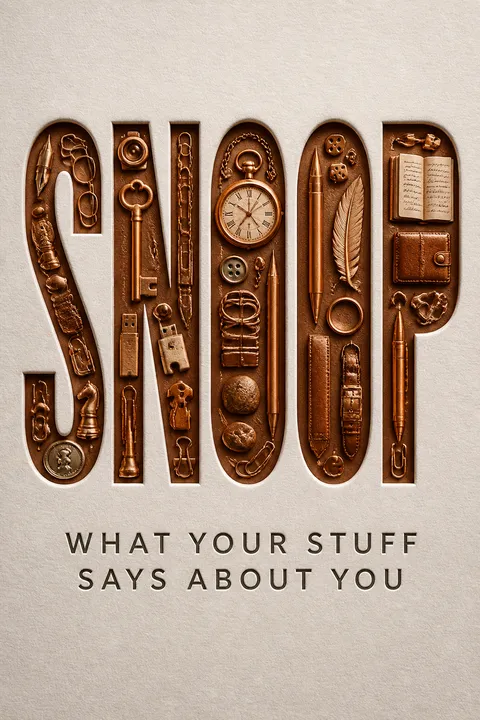


Key Takeaways
Read a room as a trail of choices, not a codebook of objects
Stuff leaves a portrait. Psychologist Sam Gosling once examined a small package of bathroom items belonging to someone he had never met. A hairbrush, skin cream, music CD, and photograph of a sink helped him infer the owner’s sex, ethnicity, and sexual orientation. Most guesses were right, but the point is not that any one object reveals a person. It is that ordinary surroundings accumulate clues worth testing, not verdicts worth announcing.
Three routes connect people and places. Identity claims are objects chosen to express who someone is, to others or to themselves. Feeling regulators are things used to influence mood or focus, such as music or family photographs. Behavioral residue is the trace left by repeated actions, such as papers accumulating where someone works. One object can serve more than one purpose, and its meaning depends on how it got there.
The book turns a familiar social impulse into a disciplined form of observation. Its useful shift is from asking what an object means to asking what actions, motives, and contexts could have placed it there. That is close to good field research: an observation becomes valuable when competing explanations remain visible. The method also carries an ethical warning. A person’s home is not a public diagnostic instrument, and an accurate inference is not automatically permission to make it. Curiosity works best when it leads to respectful questions, not confident claims about someone who has not chosen to explain themselves.
Use personality dimensions as coordinates, not boxes
Five broad dimensions. The Big Five model groups personality into openness, conscientiousness, extraversion, agreeableness, and neuroticism. Everyone has a degree of each; people are not sorted into one exclusive type. Each dimension also contains narrower facets. Someone may be curious and imaginative yet not especially emotionally expressive, so a broad label should begin an inquiry, not end it.
Knowing takes depth. Personality researcher Dan McAdams distinguishes traits from personal concerns, such as roles, goals, and values, and from identity, the evolving story a person uses to make sense of past, present, and future. Gosling’s colleague Jack seemed easier to understand once his stories repeatedly revealed a theme of overcoming doubt. Traits offer a quick sketch; goals and life themes explain why an individual’s version of a trait is distinctive.
The distinction between dimensions and types protects against a common error: mistaking a useful summary for a complete explanation. A label such as conscientious can describe a pattern, but it cannot tell whether someone’s orderliness comes from ambition, anxiety, habit, or a workplace requirement. The layered account also resembles narrative approaches to identity, where the meaning of an action depends on the story around it. Still, life stories are interpretations, not transparent records. A recurring theme may illuminate a person’s self-understanding without proving that the past unfolded exactly as the story now suggests.
Trust converging clues more than any single striking object
Trace the object’s history. Gosling calls his cross-checking method the Belgian Solution: establish who is responsible for a clue, consider what caused it to appear, and compare it with other evidence. A seagull mobile in a colleague’s office could suggest a personal interest, but it might be a gift, a leftover, or standard office décor. Without checking ownership and context, even a plausible interpretation can be wrong.
Build a case gradually. The mobile’s prominent placement suggested it mattered. Other details, including the calm atmosphere of the office, supported the possibility that it helped its owner feel settled. When Gosling asked, she said it reminded her of a happy trip to Stockholm and stayed because she liked having it near her. The clue opened a conversation; it did not supply a complete biography.
This is a practical form of triangulation: confidence rises when independent observations point in the same direction. It also resembles causal reasoning, because the question is not merely what is present but what chain of events produced it. That discipline helps counter confirmation bias, the tendency to notice evidence that fits an early guess. Yet converging clues are not always independent. A person’s books, posters, and online profile may all reflect one carefully managed image. Cross-checking is strongest when evidence comes from different settings and has different routes into the environment.
Choose evidence that matches the trait you want to judge
Different places reveal different things. A bedroom may be informative about openness and conscientiousness, while a music collection is better for interests and values than for dependability. Personal websites in Gosling’s research offered useful impressions across all five major traits. The right question is not whether a setting reveals personality in general, but which traits it reveals well.
Repeated actions leave better traces. Behavioral residue is most useful when it reflects a pattern, not an isolated event. One alphabetized bookshelf proves little about someone’s organization; consistently maintaining orderly books, files, and belongings is stronger evidence. Researchers who recorded brief samples of people’s everyday lives found that behavior and language patterns tended to recur across days. Even speech habits can carry clues, though subtle word-use patterns often require systematic measurement rather than intuition.
This is the book’s most important safeguard against overgeneralization: evidence is trait-specific. In measurement terms, a clue should have demonstrated validity for the attribute being judged, not merely feel psychologically plausible. The same caution applies to contemporary digital traces. A playlist may reflect a mood, a platform’s recommendation system, or a social audience, as well as enduring taste. Repetition and context help distinguish these possibilities. The approach is not to distrust every clue, but to ask what a particular clue can reasonably support, and what it cannot.
Treat polished signals as weaker evidence than accumulated habits
Some clues are easy to stage. A person can display a political symbol or arrange books for visitors. It is harder to manufacture years of repeated behavior, such as a well-used hobby collection or a reliably maintained filing system. The novel character Charles Highway tries to tailor his room and conversation to impress a date, but the book’s research suggests that extensive false impressions are difficult to sustain across a person’s whole environment.
Compare public and private. Gosling sorts clues by how much control people have over them and how visible they are. A website or office display may be carefully chosen; the neglected plant or disorder inside a drawer may be less deliberate. In research on personal websites, observers’ impressions aligned more with owners’ descriptions of their actual selves than their ideal selves. People may want to be known, even while managing how they appear.
The contrast between curated presentation and accumulated routine echoes a broader distinction between declared preferences and revealed behavior. Neither is automatically more truthful: a carefully chosen symbol may sincerely express a central value, while an untidy desk may reflect workload or shared space. The better inference comes from asking what the setting makes easy to control and what incentives shape its presentation. This matters especially online, where content is both highly curated and socially entangled. A profile can reveal identity, but it can also reveal the audience the owner imagines.
Use stereotypes as provisional guesses, then replace them with evidence
Shortcuts can carry information. Stereotypes help people interpret incomplete evidence, and some reflect real group averages. Robert Levine’s comparison of 31 countries used walking speed, clock accuracy, and how long it took to buy a stamp to estimate pace of life. Switzerland, Ireland, and Germany ranked fastest; Mexico, Indonesia, and Brazil ranked slowest. Such results can inform a cautious first guess about cultural norms, not predict an individual’s behavior.
A true average can still mislead. Students formed stereotypes about music fans, and some matched measured differences. Rock fans, for example, differed from religious-music fans on several traits and preferences. Other assumptions were not supported. In Gosling’s dog research, a pit bull expected to be aggressive was less aggressive than a Labrador with a documented history of biting. Group patterns are starting points; direct evidence about the individual should take priority.
The useful distinction is between describing a population tendency and assigning it to a particular person. Base rates can improve a forecast when information is sparse, but they become unfair when treated as destiny or used to deny someone an opportunity. The book’s own examples show why both cautions matter: some stereotypes track measured differences, while others merely feel convincing. A sound practice keeps the uncertainty attached to the guess and updates it when individual evidence arrives. This is especially important when the cost of a mistaken judgment falls on the person being judged.
Audit your judgments: vivid cues can be irrelevant or wrong
Separate cue from conclusion. Egon Brunswik’s lens model explains that good judgments rely on cues genuinely related to a trait and avoid cues that are not. In a study of job interviews, observers treated talking and gesturing as signs of work motivation, but those behaviors did not predict motivation in that sample. Formal clothing did, and leaning forward was another useful clue that interviewers often overlooked.
Common sense needs testing. Bedroom judges wrongly treated tidy, comfortable rooms as evidence of agreeableness, even though those features did not predict that trait. First impressions can also anchor later interpretations, while one unusual object can distract from the larger pattern. A practical check is to ask: Is this clue actually linked to the trait? Could something else explain it? What evidence would change the initial impression?
The lens model makes an essential distinction between consensus and accuracy. Several observers can agree because they share the same cultural assumptions, not because they have detected a valid signal. This insight is useful well beyond room reading, including hiring and performance evaluation, where confidence can outrun evidence. The model also invites calibration: judgments can improve when predictors are tested against outcomes instead of repeated by tradition. The caution is that a cue’s validity is context-dependent. Formal clothing may signal preparation in one setting and be irrelevant in another.
Design spaces around the feelings and rituals they must support
Places carry emotional history. Builder and designer Chris Travis created the Truehome workshop to uncover the psychological needs beneath a client’s stated preferences. A couple fought over whether their new house should include a basement. Exploration revealed that the wife’s fear of enclosed spaces was linked to childhood trauma. The design instead provided shallow, accessible storage and abundant windows, while giving her husband a porch that met his need for a personal retreat.
Small rituals matter. Travis designed rooms around what occupants wanted to feel and do, such as companionship over breakfast or privacy in a bedroom. Gosling’s own refrigerator, stocked with orderly rows of drinks and backup supplies, made sense when he connected it to childhood memories of abundance at his grandmother’s home. A space can express personality, but it can also meet needs people have not yet put into words.
The design lesson is that environments are not merely backdrops; they can reduce friction, cue habits, and shape how people relate. Treating a home as part of a relationship system can reveal practical solutions where moral judgments about a partner’s clutter or preferences have failed. The strongest version of this idea is collaborative: occupants test whether a proposed space actually feels supportive. The risk is overconfident interpretation, especially when designers assign psychological meaning to objects or memories. A useful design hypothesis should open discussion, not become a diagnosis imposed on the people who live there.
Analysis
Snoop’s central claim is both vivid and methodologically demanding: everyday environments preserve evidence of personality, but the evidence is probabilistic, context-bound, and unevenly distributed. A desk can reveal routine more clearly than a brief interview, while a music collection can expose interests without reliably disclosing conscientiousness. The book’s lasting contribution is therefore not a decoder ring for objects. It is a way to ask better questions about provenance, repetition, control, and validity.
That method is especially strong when it distinguishes what people intend to communicate from what their repeated behavior leaves behind. It also improves on casual intuition by comparing impressions with measured traits, friends’ reports, or patterns across settings. The result is a practical lesson in calibration: a clue should change confidence by an amount proportionate to its reliability, rather than trigger a fixed conclusion.
The approach also has limits. Many examples come from specific contexts, including student bedrooms, offices, and young adults’ music tastes. Cultural norms, economic resources, shared households, disability, and workplace rules can all shape a space independently of personality. A sparse room might reflect preference, limited means, or restrictions; a full bookshelf might belong to a previous occupant. The book repeatedly acknowledges these alternative causes, though its lively portraits can make the resulting inferences feel more certain than the evidence warrants.
The most responsible use of snooping is thus as a generator of questions, not a substitute for conversation. It can help someone notice a mismatch, identify a possible value, or choose a more relevant question. It cannot grant transparent access to another person’s inner life. That distinction preserves the book’s central insight while preventing its appeal from becoming a license to stereotype, invade privacy, or mistake a compelling story for a verified one.
Review Summary
Snoop received mixed reviews, with ratings ranging from 1 to 5 stars. Readers found the premise intriguing but criticized the dry, academic writing style and repetitive content. Some appreciated the psychological insights and research on personality traits, while others felt the book lacked practical snooping advice. Many noted the dated references to technology and social media. Overall, reviewers found the book's concepts interesting but thought it could have been condensed into a shorter format.
People Also Read





Glossary
Snoopology
Reading personality through surroundingsGosling’s informal name for the study and practice of inferring personality from people’s environments, possessions, and everyday traces. It treats objects and settings as evidence to investigate, not as symbols with fixed meanings. The approach combines observation with psychological research about how people express, regulate, and enact their personalities.
Identity claims
Signals about who someone isObjects or displays people use to express an identity. Other-directed identity claims are meant to shape how other people see the owner, while self-directed claims reinforce the owner’s own sense of self. A photograph, award, poster, or personal keepsake can serve either purpose, depending partly on its placement and audience.
Feeling regulators
Tools for shaping moodObjects or features of an environment that people use to influence their feelings, attention, or level of stimulation. Music, photographs, lighting, and familiar keepsakes may help someone relax, focus, remember, or feel connected. These items can also communicate personality, but their immediate function may be emotional regulation rather than self-presentation.
Behavioral residue
Traces left by repeated actionsPhysical evidence produced by people’s everyday behavior, including the consequences of actions they take or fail to take. A consistently organized workspace may reflect repeated habits, whereas a single tidy shelf proves little. Residue can also suggest planned future behavior, such as supplies arranged for an intended activity.
Belgian Solution
Cross-check clues systematicallyGosling’s name for a method of interpreting environmental evidence by checking who is responsible for a clue, what caused it to appear, and whether other clues support the same inference. Rather than assigning a fixed meaning to one object, the observer builds a cautious case from patterns across settings and information of known and uncertain origin.
Big Five
Five broad personality dimensionsA widely used personality framework organizing individual differences into openness, conscientiousness, extraversion, agreeableness, and neuroticism. Each person has a level on every dimension, rather than belonging to one exclusive personality type. The dimensions are broad and contain narrower facets, so they summarize patterns without capturing every individual difference.
Brunswik's lens model
Test how cues support judgmentsA model for studying how people infer something they cannot observe directly from cues they can observe. Accurate judgment requires using cues that genuinely relate to the target and avoiding cues that do not. The model also reveals two common errors: overlooking valid information and relying on invalid information.
Over-Claiming Questionnaire (OCQ)
Measures exaggerated familiarity claimsA method developed by Del Paulhus that assesses overclaiming by asking people to rate their familiarity with a list containing both real and invented names or concepts. Claiming familiarity with nonexistent items can indicate a tendency to inflate one’s knowledge. The book distinguishes deliberate impression management from positively biased self-descriptions people sincerely believe.
Truehome workshop
Design homes around psychological needsChris Travis’s approach to home design, which explores the emotional associations, values, routines, and identity needs behind clients’ preferences. Instead of asking only what features a person likes, the process investigates why they matter, then uses that understanding to shape rooms and layouts that support the occupants’ well-being and relationships.
FAQ
What's Snoop: What Your Stuff Says About You about?
- Explores personality through possessions: The book delves into how our belongings can reveal insights into our personalities, values, and behaviors.
- Focus on snooping: Introduces "snoopology," the study of learning about others by examining their environments.
- Scientific basis: Grounded in psychological research, including studies on the Big Five personality traits and their manifestation in living spaces.
Why should I read Snoop: What Your Stuff Says About You?
- Understand yourself and others: Gain insights into how belongings reflect personality and how to interpret others' possessions.
- Engaging and relatable: Filled with engaging stories and relatable examples, making complex concepts accessible.
- Practical insights: Offers advice on becoming a better "snooper," useful in social situations and personal relationships.
What are the key takeaways of Snoop: What Your Stuff Says About You?
- Identity claims: People use possessions to signal how they wish to be perceived, like books or art indicating interests.
- Feeling regulators: Items can help manage emotions and create desired atmospheres, like a cozy blanket for comfort.
- Behavioral residue: Physical traces left by actions provide insights into habits and personality traits.
What is the Big Five personality model mentioned in Snoop: What Your Stuff Says About You?
- Five core traits: Includes Openness, Conscientiousness, Extraversion, Agreeableness, and Neuroticism (OCEAN).
- Influence on behavior: Traits influence interactions and perceptions, like high extraversion linked to sociability.
- Application in snooping: Helps interpret possessions and behaviors, aiding in accurate personality judgments.
What is "snoopology" as defined in Snoop: What Your Stuff Says About You?
- Study of personality through snooping: Examining belongings to gain insights into personalities.
- Practical application: Teaches how to apply snoopology in everyday life, enhancing social skills.
- Research-based approach: Grounded in scientific research, providing a framework for interpreting possessions.
How does Snoop: What Your Stuff Says About You define "behavioral residue"?
- Definition of behavioral residue: Physical traces left by actions in environments, like clutter or organization.
- Revealing personality traits: Provides insights into traits like conscientiousness or creativity.
- Difficult to manipulate: Often an inadvertent reflection of true selves, making it a reliable personality indicator.
What methods does Sam Gosling use in Snoop: What Your Stuff Says About You?
- Snooping Studies: Participants evaluated personal spaces to assess personality traits.
- Blob Analysis: Compares accuracy of personality impressions across different domains.
- Comparative Analysis: Highlights how various environments yield different insights into character.
How does Snoop: What Your Stuff Says About You address the concept of identity claims?
- Definition of Identity Claims: Deliberate signals sent through possessions and environments.
- Public vs. Private Identity Claims: Public claims are easily manipulated, private ones are more revealing.
- Impact on Perception: Significantly influences how others perceive us, aiding in self-presentation management.
What role do stereotypes play in Snoop: What Your Stuff Says About You?
- Stereotypes as Shortcuts: Serve as mental shortcuts for understanding others.
- Validity of Stereotypes: Some contain truth, aligning with observable behaviors.
- Caution Against Overreliance: Warns against relying solely on stereotypes, emphasizing individual differences.
What are some practical tips for becoming a better snooper from Snoop: What Your Stuff Says About You?
- Observe carefully: Pay attention to details in environments, looking for patterns.
- Ask questions: Use observations to spark conversations and reveal more about identity.
- Consider context: Context matters, like travel souvenirs indicating adventure or a phase.
What insights does Snoop: What Your Stuff Says About You provide about personal spaces?
- Personal Spaces Reflect Personality: Spaces reveal values, interests, and emotional states.
- Clues to Personality Traits: Specific clues indicate traits like openness or conscientiousness.
- Environmental Influence on Behavior: Environments shape behaviors and interactions.
What are the best quotes from Snoop: What Your Stuff Says About You and what do they mean?
- "An animal resting or passing by leaves crushed grass, footprints, and perhaps droppings, but a human occupying a room for one night prints his character, his biography, his recent history, and sometimes his future plans and hopes.": Emphasizes how environments reflect identities and experiences.
- "The goal of my décor-decoding research and the work of scientists who study the nature of personality itself is to create portraits of people based on the clues they leave.": Highlights the purpose of snoopology—understanding through environmental clues.
- "When you first meet someone, you don’t notice that you’re forming an impression by integrating information.": Underscores the unconscious nature of forming impressions based on possessions and surroundings.
Download PDF
Download EPUB
.epub digital book format is ideal for reading ebooks on phones, tablets, and e-readers.








