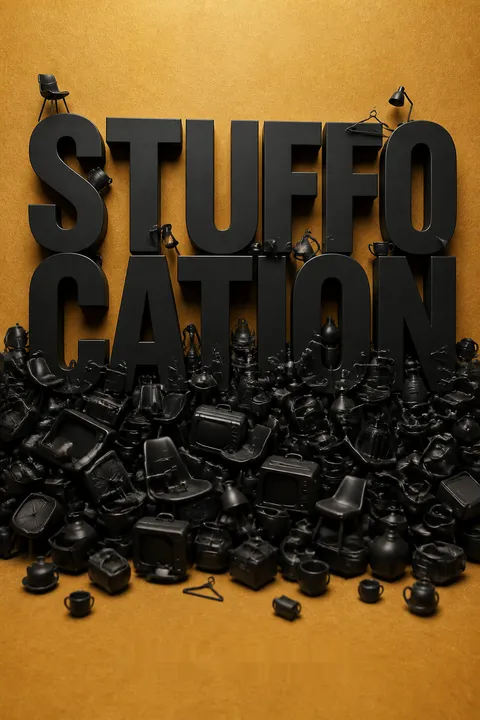


Key Takeaways
Pack your possessions away and discover what your daily life actually needs
Try a practical test. Ryan Nicodemus had a well-paid job, a house, expensive clothes, and the feeling that his life was somehow wrong. He and his friend Joshua Fields Millburn packed nearly everything he owned into boxes and bags. For 21 days, he retrieved items only when he needed them. By day ten, he stopped unpacking. A toothbrush, work clothes, and a few kitchen items mattered. Much of the rest had been bought, stored, and forgotten.
Name the pressure. Wallman calls the strain of being burdened by possessions, their upkeep, and the pressure to acquire more “Stuffocation.” Nicodemus sold, donated, or gave away what remained packed. The point is not to live without objects, but to test whether they support a life or merely occupy it.
The experiment turns a vague feeling of excess into observable evidence: what gets used, what stays boxed, and what feels costly to manage. Behavioral research on the endowment effect suggests that ownership itself can make people overvalue things, so temporarily separating from possessions may clarify preferences better than asking, “Do I want this?” The test is also unusually accessible because it does not require an immediate commitment to a new identity. Its limitation is that one person’s essentials depend on health, work, family, and income, so the useful outcome is a personal inventory, not a universal quota.
Recognize how advertising turned abundance into a reason to want more
A system was designed. In the 1920s, US factories and farms could produce far more than people were buying. Some leaders saw the answer as producing less; others argued that people should consume more. Advertising executive Earnest Elmo Calkins proposed selling not only useful products, but style and novelty. A working car could be made to feel outdated by a newer design. Credit could help people buy before they had saved.
Prosperity had costs. The model helped spread washing machines, cars, and other goods that raised living standards. But it also normalized replacement before necessity. “Progressive obsolescence,” the period’s term for encouraging people to discard and replace usable goods, became part of business practice. Materialism was productive in an age of scarcity, yet its success helped create today’s overload.
This history is stronger than a simple accusation that advertising manufactures false needs. It shows how firms, governments, and consumers adapted to a genuine mismatch between production and demand, with real gains in comfort and access. The complication is that the same system can deliver useful innovation and cultivate dissatisfaction at once. That makes the remedy less straightforward than condemning marketing: durable design, repair, and business models that reward continued use would change incentives without denying the material progress that made daily life safer and easier for many.
Read cultural forecasts as maps, not promises, and watch ideas spread
Change has a pattern. In Iowa, farmers adopted hybrid corn seed at different speeds, even though it could raise yields by about 20 percent. A study found that adoption began with a few experimental farmers, spread through neighbors, then reached the wider community. The cumulative pattern formed an S-shaped curve: slow beginnings, rapid growth, and eventual saturation.
Use the present carefully. Everett Rogers called his model the “Diffusion of Innovations.” Wallman uses it to examine how new lifestyles might spread. A forecast is not a guaranteed fact; it is a map built from evidence about past trends and present conditions. Adoption depends on whether an idea seems better, understandable, testable, visible, and supported by communication networks and change agents. Farmers took an average of nine years to adopt the new seed, despite its advantages.
The model gives readers a useful antidote to both trend hype and fatalism. Instead of asking whether an idea is popular now, it asks who is trying it, what makes it credible, and whether others can see its benefits. This resembles diffusion in public health, where trust and peer demonstration can matter as much as technical quality. Still, an S-curve describes a recurring pattern, not a law that guarantees every innovation succeeds. Culture, power, and access can block adoption even when a proposal appears superior.
Treat clutter as a stress signal, not merely a housekeeping failure
Homes reveal the burden. A UCLA research team studied 32 middle-class families in Los Angeles, documenting daily life and counting visible possessions. In the smallest home, researchers counted 2,260 items in the living room and two bedrooms alone. Across the families, garages were often so full that cars could not fit.
Stress showed an association. In a related study, psychologists Darby Saxbe and Rena Repetti compared home-tour descriptions with saliva samples from adults in 30 families. Women who described their homes as chaotic or cluttered tended to show a less healthy daily cortisol pattern, associated with difficulty managing stress. The researchers did not establish that clutter caused the stress. Stress could also make tidying harder, or both could reinforce each other.
The important shift is from moral judgment to environmental design. A cluttered room can impose repeated small demands: noticing objects, moving them, and remembering unfinished tasks. That resembles cognitive-load theory, which studies how limited attention is consumed by competing information. The evidence deserves careful limits, however: the sample was small and geographically specific, and the cortisol finding was correlational, with a gender difference in the reported results. Clutter is not automatically harmful for everyone. A person’s own sense of control and comfort remains essential context.
Use minimalism as a reversible experiment, not a contest in counting possessions
Start without a dramatic exit. Tammy Strobel first resisted her partner’s suggestion that they move to a smaller home. She agreed to clear their unused second bedroom as a trial. After six months, they found they could manage without the room, sold possessions, moved into a one-bedroom flat, and reduced their expenses. Strobel later counted her possessions at 69, but the number was a personal benchmark, not the essential achievement.
Simple is not always easy. Some minimalists turn counting into a status game. Meanwhile, living close to nature can mean hard physical work and practical risk. Thoreau, an emblem of simple living, left his cabin after a little over two years. The practical lesson is to remove what does not serve you, not to imitate an extreme lifestyle or win a contest in having less.
Reversible trials reduce the psychological cost of change. In decision science, a small experiment can generate better information than prolonged speculation, especially when people have trouble predicting how a different routine will feel. But downsizing is not equally available to everyone: disability, caregiving, housing costs, and job location can constrain choice. Counting can also reproduce the status competition minimalism opposes. Its value lies in freeing time, money, or attention for a chosen purpose, not in making the lowest number into a new badge of success.
Choose enough work to protect time for the life you value
Redefine success locally. David Roberts and his wife saw a friend pursuing an intense career so he could retire early. They considered similar promotions and higher incomes, then decided the added stress and lost family time were not worth it. Roberts called their alternative the “medium chill”: working and earning, but declining the automatic push toward more status and consumption.
Keep the useful parts. The idea is not to abandon work or modern comforts. It is to ask whether the next raise or title improves the life it is supposed to support. Roberts valued reading with his children, seeing friends, and having unhurried time. The book presents this as an appealing personal choice, while noting that there was not strong evidence it was becoming a mass movement.
The medium chill makes “enough” a decision rather than a number imposed by peers. That connects to research on work-life boundaries: time is not merely a reward after achievement, because relationships and recovery need regular space to exist. Yet the freedom to turn down advancement is unevenly distributed. Low wages, debt, and precarious employment can make extra work compulsory rather than aspirational. The principle is therefore more powerful when applied both personally and institutionally: people need room to choose a slower pace, not just permission to want one.
Spend on experiences because they become memory, identity, and connection
Compare doing with having. Psychologists Tom Gilovich and Leaf van Boven studied whether purchases made for experiences produce more happiness than purchases made primarily to own an object. Their findings favored experiences. The book explains several reasons: people can reinterpret imperfect trips more positively, adapt quickly to new possessions, and compare experiences less neatly than products. Experiences also become part of a person’s story and often involve other people.
Choose by intention. A television can be bought as a status object or as a way to enjoy films with friends. A trip can be remembered as a shared adventure rather than measured against someone else’s destination. The distinction depends partly on why a purchase is made. The point is not that every experience is superior, but that money often brings more lasting value when it buys something to do rather than another thing to store.
This argument links happiness to autobiographical memory: people often make sense of who they are through events and relationships, not through an inventory of possessions. It also explains why shared activities can create social value beyond personal enjoyment. The claim still needs boundaries. Experiences can be expensive, inaccessible, or environmentally damaging, and not every object is disposable pleasure; tools, books, and well-made furniture can support meaningful lives. A useful test is whether a purchase is likely to deepen participation, connection, or skill, rather than simply refresh the thrill of ownership.
Share experiences for status without letting FOMO dictate your life
Visibility changes status. In smaller communities, people knew how neighbors spent their time as well as what they owned. Urban anonymity made possessions easier to display than activities. Social media reverses part of that shift: friends can see a concert, trip, race, or dinner almost as it happens. Experiences become a kind of social currency because they provide stories and signal identity.
Comparison has a new channel. The book calls the resulting worry “fear of missing out,” or FOMO. It cites surveys in which about four in ten people aged 18 to 34 in the United States and United Kingdom said they sometimes worried they were missing out. Online sharing can make experience more visible, but it can also turn leisure into another competition over who is doing the most exciting things.
Social media does not simply replace material status with a healthier alternative. It changes what gets compared, making events and access more legible while potentially intensifying the pressure to perform an interesting life. This is a subtle extension of the book’s thesis: experiences can be both intrinsically rewarding and strategically displayed. A practical distinction is whether sharing follows an enjoyable event or whether the imagined audience begins to determine the event itself. When the audience leads, experientialism risks becoming consumerism in a more photogenic form.
Build businesses around memorable use, not disposable ownership
Sell participation, not just products. The “experience economy” describes businesses that design memorable, engaging encounters rather than only providing goods or routine services. Secret Cinema, for example, turned film screenings into immersive events where audiences entered a recreated world. Companies also make ownership less necessary: Zipcar offers car access, Spotify offers music streaming, and Airbnb connects travelers with homes.
Objects still matter. Experientialists are not necessarily anti-market or anti-stuff. A climber or surfer may buy specialized equipment because it enables the activity. Graham Hill’s compact apartment also shows how design can make fewer objects work harder. The larger opportunity is to sell access, repair, sharing, and better use, while reducing clutter and waste. A memorable encounter should not be an excuse to sell people more things they do not need.
The business argument is strongest when experience changes the value proposition rather than serving as elaborate packaging for the same volume of consumption. Access models can increase utilization of underused goods, while durable products and repair reduce replacement pressure. Yet not every shared service is automatically sustainable, and spectacular events may carry substantial resource costs. Firms need to examine lifecycle impacts, labor conditions, and who can afford participation. Otherwise, the experience economy risks making status more expensive without solving the material and environmental pressures that gave it appeal.
Measure social progress by lived wellbeing, not GDP alone
A useful measure became a proxy. Simon Kuznets and his team developed US national income accounts during the Great Depression, giving officials a clearer picture of economic activity. GDP helped track production and income, but it does not directly measure health, security, relationships, leisure, or environmental quality. The book argues that a number built to describe the economy gradually became a stand-in for how well society was doing.
Add human outcomes. France began measuring wellbeing alongside economic performance in 2010, followed by the United Kingdom in 2011. One tool discussed is the Personal Wellbeing Index, which asks people to rate areas such as health, relationships, safety, and future security. Such measures are imperfect, but they can help governments identify needs that GDP misses. The deeper principle is that public priorities follow the measures used to judge success.
Metrics are not neutral mirrors. When institutions reward what can be counted easily, uncounted goods such as care, leisure, and ecological stability can become politically invisible. A wellbeing dashboard can correct that bias, especially if it combines subjective reports with material and environmental indicators. Still, self-reported happiness is affected by mood, expectations, and culture, while a single wellbeing score can conceal inequality between groups. The stronger design is plural: retain GDP as an economic measure, but prevent it from pretending to be a complete account of human progress.
Let emerging consumers meet their needs before prescribing less consumption
Abundance is not universal. The book warns that Western discomfort with excess should not be mistaken for a global stage everyone has already reached. Hundreds of millions of people in emerging economies were gaining access to cars, phones, washing machines, and other goods for the first time. In China, industrial growth had already created overproduction pressures, while advertising and government policy encouraged greater spending.
Expect values to change unevenly. Wallman notes that Chinese living standards rose sharply from 1990 to 2010 without a corresponding rise in reported happiness, and that luxury experiences were growing faster than personal luxury goods. He forecasts that new middle classes may turn toward experiences after material needs are met. The practical implication is to distinguish basic access from status-driven excess, rather than treating every new purchase as waste.
This global qualification is essential to the book’s ethics. A critique of overconsumption in wealthy societies should not become a demand that poorer populations remain materially deprived. Environmental limits make the distinction urgent: access to sanitation, safe housing, and reliable appliances is not equivalent to buying replacements for status. The forecast that rising prosperity leads toward experiential values is plausible but not guaranteed; political institutions and advertising can reinforce material competition. A fair transition must reduce luxury waste while preserving pathways to material security.
Analysis
Stuffocation is best understood as a collision between inherited appetites and an engineered environment of abundance. Human attention and desire adapt slowly, while industrial production, marketing, and status competition can multiply objects at speed. The result is not simply messy homes. It is a social system in which the promise of prosperity becomes a permanent demand for more, even after the original needs have been met.
The book’s central move is to distinguish rejecting objects from rejecting the idea that objects should organize a life. Minimalism, simple living, and the medium chill are useful experiments, but each has limits as a universal program. Experientialism offers a positive alternative because experiences can create memory, identity, and social connection without requiring accumulation as their main output. Yet this alternative is not inherently virtuous: travel can be resource-intensive, online sharing can intensify comparison, and branded experiences can simply repackage consumption.
The most durable insight is therefore not “buy experiences instead of things” as a rigid rule. It is to assess purchases by the quality of life they enable, the demands they impose, and the people they connect or exclude. That test can apply to personal spending, product design, urban policy, and public measures of progress. GDP remains useful for economic activity, but cannot stand in for wellbeing. Likewise, a wellbeing score cannot replace material security or ecological accounting.
The argument is also historically grounded. Consumerism helped deliver genuine improvements in health, comfort, and opportunity. A responsible successor cannot romanticize scarcity or prescribe austerity to people who still lack necessities. It must preserve useful material gains while loosening status from sheer ownership. That makes the transition less a moral conversion than a redesign of incentives: reward durability, access, repair, shared activity, and time well spent. The promise of experientialism rests on whether institutions can make those choices practical, visible, and fair, not merely fashionable.
Review Summary
Stuffocation received mixed reviews. Many readers found it thought-provoking, praising its examination of materialism and the shift towards valuing experiences over possessions. Some appreciated the historical context and case studies provided. However, critics felt the book was repetitive, overly long, and focused too narrowly on affluent populations. Several reviewers noted that while the core message was compelling, the proposed solution of "experientialism" had its own flaws and potential pitfalls. Overall, readers appreciated the book's insights but had mixed feelings about its execution and conclusions.
People Also Read




Glossary
Stuffocation
Overload from possessionsWallman’s term for the feeling of being burdened or stifled by too many possessions, the work of managing them, and the pressure to acquire more. It describes both a personal experience, such as clutter and stress at home, and a wider cultural condition in which material abundance no longer reliably produces satisfaction.
Diffusion of Innovations
How new ideas spreadEverett Rogers’s model for understanding how an innovation moves through a community. Adoption typically begins with a small number of experimenters, spreads through social networks, accelerates as more people accept it, and then slows as the potential audience is reached. The model helps analyze adoption and make cautious forecasts, rather than treating the future as certain.
progressive obsolescence
Encouraged product replacementA consumer-engineering idea discussed in the book: persuade people to replace goods before they stop functioning. Businesses can encourage this by changing products’ style or model year, making last year’s usable item seem outdated. The approach helped stimulate demand in an era of overproduction, but also normalized waste and continuous purchasing.
Law of Unintended Consequences
Actions produce unforeseen effectsA principle associated with sociologist Robert Merton: purposeful actions can produce outcomes their actors did not intend. Wallman uses it to explain how attempts to create demand, promote products, or control information can have wider effects, including cultural changes that no individual decision-maker planned.
medium chill
Choosing enough over moreA lifestyle described by writer David Roberts in which people continue working and participating in ordinary modern life, but do not automatically pursue higher salaries, titles, or consumption. The choice centers on having enough while protecting time for relationships, rest, and activities that matter. It is less a rejection of work than a refusal to make constant advancement the measure of success.
experientialism
Prioritizing experience over ownershipWallman’s name for a value system in which people seek happiness, identity, and status more through activities and encounters than through accumulating material possessions. Experientialists may still own useful or high-quality objects, especially when those objects support activities. The emphasis shifts from having more to doing, sharing, and remembering.
experience economy
Businesses staging memorable encountersA term popularized by business consultants B. Joseph Pine II and James H. Gilmore for economic activity that designs engaging, memorable experiences, rather than offering only products or routine services. Examples in the book range from immersive film events to businesses that provide access to cars, music, or accommodation without requiring full ownership.
Fear of missing out
Anxiety about absent experiencesOften abbreviated as FOMO, this is the worry that other people are enjoying valuable events or experiences that one is missing. Wallman connects social media to its spread: online updates make other people’s activities unusually visible, turning leisure into a new arena for comparison and status competition.
Personal Wellbeing Index
Ratings across life domainsA questionnaire discussed in the book that asks people to rate satisfaction with areas such as living standards, health, achievement, relationships, safety, community belonging, and future security. Its purpose is to help assess personal wellbeing across several dimensions, not to rank people against one another, since individuals use rating scales differently.
Center on Everyday Lives of Families
Study of family life at homeA University of California, Los Angeles research project that documented the homes and routines of 32 middle-class families. Researchers used photographs, observations, interviews, and home videos to study everyday life and material possessions. The project provided the evidence for Wallman’s discussion of household clutter, while its small and localized sample limits broad generalizations.
To Do or to Have? That Is the Question
Study comparing purchase happinessA 2003 study by psychologists Tom Gilovich and Leaf van Boven examining whether experiential purchases tend to make people happier than material purchases. The distinction depends on the buyer’s intention: purchasing something mainly to do or experience something differs from purchasing primarily to own an object. The study is central to the book’s case for experiential spending.
Download PDF
Download EPUB
.epub digital book format is ideal for reading ebooks on phones, tablets, and e-readers.








