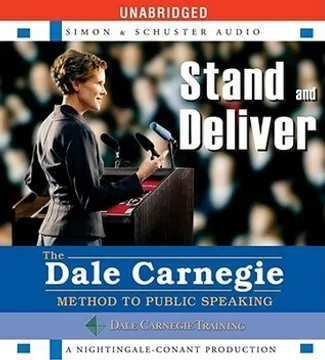


Key Takeaways
Build one clear idea around what your listeners already care about
Start with their world. A speech is not a monologue with an audience nearby. Carnegie compares good speaking to conversation: the speaker notices attention, silence, laughter, and discomfort, then adjusts. Listeners are more likely to care when a subject connects to their own concerns, not merely the speaker’s expertise. A talk about forests, for instance, becomes more immediate when it shows how timber scarcity could affect a listener’s business or household costs.
Give the idea shape. Choose one central point and develop it with supporting details, rather than cramming in every fact you know. A useful pattern is to identify a problem, explain a solution, and return to that solution at the end. The audience should be able to tell what the talk is about and why it matters to them.
What's striking is the book's insistence that audience attention is not a reward for the speaker's effort. It is evidence about whether the message is connecting. That makes listening part of speaking, not a courtesy after the presentation. The audience-first principle also disciplines content: each detail must earn its place by advancing the central idea. There is a limit, though. Appealing to self-interest should not mean reducing every public issue to personal gain. A strong talk can begin with what listeners recognize, then help them see wider consequences.
Prepare far more material than you use, then cut to one theme
Build knowledge before slides. The book recommends beginning preparation 10 days to two weeks ahead. In a first 20-minute session, write at least 50 questions about the subject, quickly and without trying to answer them. In later sessions, answer from what you already know before turning to outside research. This surfaces useful knowledge and exposes gaps.
Edit for the room. Carnegie advised speakers to know vastly more than they present. That surplus is not a license to lecture; it gives the speaker confidence to choose the most relevant points. Rehearse aloud, test timing, and revise. Do not memorize the full speech or write it as an essay to read. A working outline and a clear grasp of the material allow the speaker to sound present rather than recited.
The question-first method is valuable because it turns preparation into inquiry instead of premature polishing. It can also reveal that a seemingly simple topic contains unresolved questions, which is better discovered at a desk than at a lectern. The deeper distinction is between preparation and display: research should make the speaker more selective, not more crowded. The suggested timeline may not fit every assignment, but the underlying sequence travels well: generate questions, draw on existing knowledge, verify what is missing, then rehearse the chosen argument.
Make vocal emphasis, pace, and silence carry the meaning
Treat delivery as content. In speech, emphasis changes interpretation. Stressing one word rather than another can make the same sentence sound doubtful, forceful, or dramatic. A flat tone strips away those distinctions, while deliberate changes in pitch and speed help listeners hear what matters. The book uses Abraham Lincoln’s speaking rhythm as an example: he moved quickly through less important words and lingered on the phrase he wanted remembered.
Rehearse the sound. Read key passages aloud and try different stresses, tempos, and pauses. A large figure can sound ordinary when rushed or substantial when given space. Silence can also let an important point land. These choices should feel conversational, not theatrical. The aim is not to decorate the words, but to make their intended meaning audible.
This section treats voice as a tool for directing attention, a useful correction to the belief that good content speaks for itself. Listeners cannot reread a sentence in real time, so vocal cues help them identify emphasis and structure. The risk is overacting: a speaker who stresses everything communicates that nothing is especially important. Restraint matters. A few meaningful variations are more legible than constant volume changes, and pauses work best when they give the audience a real moment to process rather than signal manufactured drama.
Sound like yourself, but make each audience feel individually addressed
Build an honest speaking style. The book contrasts Dale Carnegie’s neighborly manner with Earl Nightingale’s resonant, authoritative voice. Neither needed to imitate the other. Effective speakers notice their natural strengths, study people they admire, and adapt useful techniques without borrowing someone else’s whole identity. They also resist both self-promotion and apologetic self-deprecation.
Make the connection specific. Russell Conwell gave the same talk thousands of times, but learned about each town and its people before speaking. Those local details made a familiar message feel addressed to that particular audience. Franklin Roosevelt used a related approach on radio, imagining one listener rather than an impersonal crowd. Eye contact, a relevant introduction, and language suited to the room reinforce that sense of personal attention.
Authenticity and adaptation are not opposites. A speaker can retain a recognizable character while changing examples, vocabulary, and emphasis to fit the people present. That is closer to hospitality than performance: the host remains themselves but pays attention to the guest. The imagined single listener can be a useful focus, provided that person does not become a stereotype standing in for a diverse room. Specificity creates connection, but genuine attention to the actual audience is what keeps the technique from becoming formula.
Practice your way through fear instead of waiting to feel fearless
Expect nerves, not perfection. The book argues that many speakers fear being less than flawless more than they fear an ordinary mistake. Anxiety may bring a racing heart, dry throat, or blank mind, but its presence does not prove that a speaker is incapable. Eleanor Roosevelt dreaded public speaking before becoming a major speaker; a physician in Carnegie’s course went from leaving a banquet rather than speaking to accepting invitations after practicing.
Turn preparation into action. Build confidence through repeated speaking, thorough command of the subject, and a strong reason to communicate. Before presenting, trust the preparation rather than judging every sentence as it happens. Choose one delivery priority, such as posture or clear pacing. If a talk falters, recover with the next useful action instead of treating one difficult moment as a verdict on the speaker’s ability.
The strongest practical claim here is that confidence can follow behavior rather than precede it. Repeated practice gives a speaker evidence that a feared situation is survivable and makes the task more familiar. That is a more useful target than waiting for anxiety to disappear completely. Still, stage fright varies, and practice does not guarantee that every physical symptom will vanish. The book is most persuasive when it treats nerves as manageable rather than shameful. Its anecdotes illustrate possibility, not a timetable that every speaker should expect to match.
Use personal stories to make abstract claims emotionally legible
Give ideas a human scale. A retirement toast that lists financial achievements may tell listeners facts, but a story about how a friend acquired an embarrassing basketball nickname gives them a scene to picture. Stories about other people can make a point vivid; carefully chosen self-revelation can create a deeper bond. The Earl of Spencer’s account of private family time with Princess Diana made a public eulogy feel intimate because it showed a personal relationship, not only a public image.
Keep the story in service. A personal account should connect clearly to the talk’s theme and suit the setting. The speaker need not disclose everything. The useful test is whether the story helps listeners understand the idea or the speaker’s stake in it. A story that draws attention but leads nowhere is entertainment without an argument.
Stories do more than make information memorable. They show what an idea costs, changes, or feels like in a life, which gives an audience a way to interpret it. Self-disclosure can also create reciprocity: a speaker's willingness to be seen as human invites attention and trust. But vulnerability is not automatically persuasive or appropriate. A personal account can shift emotional labor onto listeners or overwhelm the subject. Selection matters as much as candor. The most effective story reveals enough to illuminate the point, without demanding that the audience admire the teller.
Let humor reveal humanity, not distract from your point
Choose a comic style that fits. The book distinguishes a joke, which depends on a climactic turn, from an anecdote, which can be humorous throughout and adjusted to the audience. A story about the speaker’s own small mistake is often safer than mockery because it makes the speaker the target. Jack Benny’s comic persona, for example, made a pause over a robber’s demand funny by exposing his character’s comical indecision.
Test before using. Humor should relate to the talk, suit the occasion, and be rehearsed for timing. Avoid jokes that rely on traits people cannot change or that could make an audience feel targeted. If a line falls flat, a calm acknowledgment can sometimes recover the moment. If the speaker is unsure whether material is appropriate, leave it out. A failed joke can weaken trust faster than a missing joke.
Humor can lower social distance, but it also carries risk because laughter is shared judgment. Self-directed humor gives the audience permission to relax without asking anyone else to absorb the cost. The book's practical rule is therefore more than a safety measure: it makes the speaker's fallibility part of the connection. Still, self-deprecation can become a performance of insecurity if overused. Humor works best as a brief change in emotional temperature, not as proof that the speaker is likable or as a substitute for a clear argument.
Persuade by earning trust and connecting action to real desires
Make credibility visible. Audiences are more likely to act when they believe the speaker is sincere, qualified, and prepared for objections. Personal experience can ground a message in something the speaker has actually lived, while relevant evidence supports it. But earnest delivery alone cannot establish truth. In one Carnegie classroom story, a salesman’s confident claim that wood ash could produce blue grass persuaded some listeners despite being implausible. The example shows how easily conviction can be mistaken for proof.
Start from the listener’s motives. The book highlights gain, protection from loss, and the wish to earn admiration. A father warning a teenager about distant health damage may miss the concerns that matter now; a message connected to athletic performance or social standing may be more relevant. Ethical persuasion identifies a genuine benefit, not an invented fear or false promise.
This is the book's most important ethical tension. Understanding what moves an audience can make communication more useful, but it can also make a speaker more effective at exploiting insecurity. The blue-grass story supplies an internal warning: emotional certainty can make a claim feel true without making it true. Credibility should therefore come from honest limits, sound evidence, and motives that genuinely serve listeners. Persuasion is strongest when people can recognize why a proposal matters and still retain enough information to judge it for themselves.
Repeat, connect, and contrast ideas to make them easier to remember
Give the central point more than one route. The book describes repetition as a way to make an idea recognizable, association as linking it to something familiar, and contrast as making its differences easier to see. A speaker might restate a claim in fresh language, connect it to a shared experience, or show two options side by side. In the book’s laboratory example, executives see a modest facility before a more capable proposal; the comparison makes the trade-off clearer than the preferred option alone.
Use these tools with care. Repetition can become tedious if each return adds nothing. Association can create a persuasive feeling without proving a connection. Contrast can make a middle option look poor simply by placing it beside an artificially weak alternative. The techniques work best when each comparison is fair and each repetition advances understanding.
These devices explain why structure and presentation affect judgment, not just memory. A comparison supplies a reference point; without one, people may struggle to evaluate scale or consequence. Yet the same mechanism can distort choice. An unfair baseline makes a favored option appear reasonable by design, while repetition can substitute familiarity for evidence. The book's advice becomes more robust when paired with transparent framing: show why the examples are comparable, name what the comparison leaves out, and repeat the idea because it matters, not merely because repetition can make it feel accepted.
Turn a personal lesson into one clear request and one benefit
Use a compact action path. The Magic Formula is the book’s short persuasive structure: recount a relevant personal experience, ask listeners for one specific action, then explain one meaningful benefit of taking it. The story creates context and emotional engagement; the request translates that engagement into something concrete. The benefit gives listeners a reason to act. In the book’s example, Christopher Reeve described his experience with paralysis while asking legislators to support funding for research, rather than making a sweeping appeal to fix every health-care problem.
Keep the request small enough to see. A listener should know what to do without decoding an abstract slogan. The personal story should take most of the time, while the action and benefit are concise. A story that does not lead naturally to the request feels like a detour, and a benefit that is exaggerated damages trust.
The formula works by joining identification to agency. A personal experience gives the issue a human face, while a bounded request makes participation feel possible. This is especially useful when a speaker has little time and cannot build a long chain of argument. The constraint is also its strength: one action and one benefit force prioritization. The speaker must resist promising that a small action will solve a large problem. A clear request is not necessarily an easy one, and listeners deserve an accurate account of its likely effect.
Design your opening and ending as the speech's strongest moments
Earn attention immediately. The book recommends planning the opening in advance and beginning with something that creates curiosity, stakes, or recognition. Martin Luther King Jr.’s opening to his address at the Lincoln Memorial linked the occasion to emancipation, then sharply named the unfinished problem. The lesson is not to imitate his language, but to begin where the audience has a reason to listen. Avoid opening with a joke that has not earned its place or an apology that teaches listeners to doubt the speaker.
Finish with purpose. Plan the ending just as carefully. Briefly gather the main point, make a clear call to action when appropriate, and leave listeners with a final idea that fits the talk. Do not introduce a new argument, ramble, or use self-deprecation as an exit. A strong close gives the presentation shape and a sense of completion.
Openings and endings are memory landmarks. The opening tells listeners how to interpret what follows, while the ending helps them decide what to carry away. That makes them more than decorative bookends. Curiosity is useful only when the answer pays off, and a call to action is useful only when the preceding argument supports it. The emphasis on planning is sound, but polish should not become rigidity. A speaker who listens to the room may need to adjust the route while preserving the destination.
Treat questions, setbacks, and logistics as part of the performance
Listen before answering. In a question period, let the person finish, make eye contact, and restate the question in your own words so the room can follow. Keep the answer concise and address the whole audience, not just the questioner. A loaded question can be reframed into the underlying issue; a question outside the speaker’s knowledge can receive an honest admission and a promise to follow up. If one person dominates, interrupt tactfully and give others a chance.
Plan for the room you will actually use. Check the sound system, sightlines, slides, and backup materials before speaking. Leave time for questions and for the prepared close. If technology fails or a talk goes badly, pause and take the next useful step rather than apologizing repeatedly. Preparation should make the speaker adaptable, not dependent on a perfect script or flawless equipment.
A live presentation is a social event, not a recording, so its quality is partly revealed when the plan meets an unscripted question or a technical problem. Listening demonstrates respect and can uncover the concern beneath a confrontational phrasing. Reframing is helpful when it clarifies, but evasive reframing can make a speaker look unwilling to answer. Likewise, technical preparation reduces avoidable friction but cannot remove uncertainty. Poise is not pretending nothing went wrong; it is responding clearly without allowing one disruption to consume the room.
Analysis
The book’s most durable insight is that public speaking is not primarily a performance of eloquence. It is a designed relationship between speaker and listener. Preparation gives the speaker command of the subject, but selection makes the subject usable; delivery makes meaning audible, while stories and audience awareness make it personally relevant. Its examples, from Roosevelt speaking to a single imagined radio listener to Churchill addressing a threatened nation, show that scale does not eliminate the need for human connection.
The framework also exposes a tension between persuasion and manipulation. The text argues that enthusiasm, repetition, and emotional motives can quiet resistance. That is an accurate description of rhetorical power, but it is not by itself a standard for responsible use. The salesman who persuaded classmates with an implausible claim about blue grass makes the problem vivid: conviction can be mistaken for evidence. A contemporary speaker should treat trust as a duty to inform, not merely as a lever for compliance. That means making uncertainty visible, using fair comparisons, and stating benefits in proportion to the evidence.
Some advice is best understood as practical coaching rather than settled science. The book's broad claims about fear, attention, and how audiences respond cannot be applied uniformly to every person or setting. Yet its emphasis on rehearsal, concise organization, and attention to listeners remains useful across formats, including meetings and remote presentations. Its older advice about avoiding presentation software altogether is less persuasive as a universal rule. The underlying warning is stronger: visual aids should support the speaker's thought, not replace it.
Taken together, the book offers a craft discipline: know the material, know the room, make one point matter, and end by giving listeners somewhere to go. Its greatest contribution is not a promise that anyone can become instantly fearless or persuasive. It is a repeatable way to make public speaking less mysterious and more accountable to the people hearing it.
Review Summary
Reviews for Stand and Deliver reflect an overall positive reception, with readers praising its practical, actionable public speaking tips rooted in Carnegie's timeless principles. Many appreciate the modern updates making the content relevant today, highlighting advice on overcoming stage fright, engaging audiences, humor, and authentic delivery. The audiobook format received mixed feedback, with some finding the short sessions and musical interludes disruptive. Critics noted occasional redundancy and common-sense content for experienced speakers. Nonetheless, most readers recommend it for beginners and seasoned speakers alike, emphasizing its value in building confidence and communication skills.
Glossary
Magic Formula
Story, request, benefitA short persuasive structure for talks intended to prompt action. The speaker first shares a relevant personal experience, then asks the audience to take one specific action, and finally explains one benefit of taking it. The personal story establishes context, while the focused request keeps the audience from being overwhelmed by a broad or abstract appeal.
Law of Extension
Change through repeated experienceA term the book uses for learning that develops through a series of similar experiences. Repeated incidents gradually contribute to a change in behavior or understanding. In the Magic Formula, a speaker can describe this pattern to explain how a lesson emerged over time rather than from one dramatic turning point.
Law of Effect
Change through one eventA term the book uses for learning prompted by one especially powerful experience. Unlike the Law of Extension, which involves a sequence of similar incidents, the Law of Effect describes a single event that changes a person's conduct or outlook. The book uses the distinction to help speakers shape the personal story at the center of a short persuasive talk.
ethos
The speaker's persuasive characterIn the book, ethos means the persuasive impression created by a speaker's character, including verbal and nonverbal behavior. It includes the audience's sense of the speaker's credibility and personal presence. The discussion warns that slides can weaken this connection when the speaker reads from them or stops engaging directly with listeners.
prominence
An issue's audience importanceThe degree of importance an audience assigns to a particular issue. A prominent issue may already be familiar and provoke informed skepticism, so the speaker needs strong, well-supported reasons. If the issue is less prominent, listeners may be more open to broader context. Understanding prominence helps a speaker choose relevant evidence and anticipate resistance.
About the Author
Other books by Dale Carnegie







Download PDF
Download EPUB
.epub digital book format is ideal for reading ebooks on phones, tablets, and e-readers.








