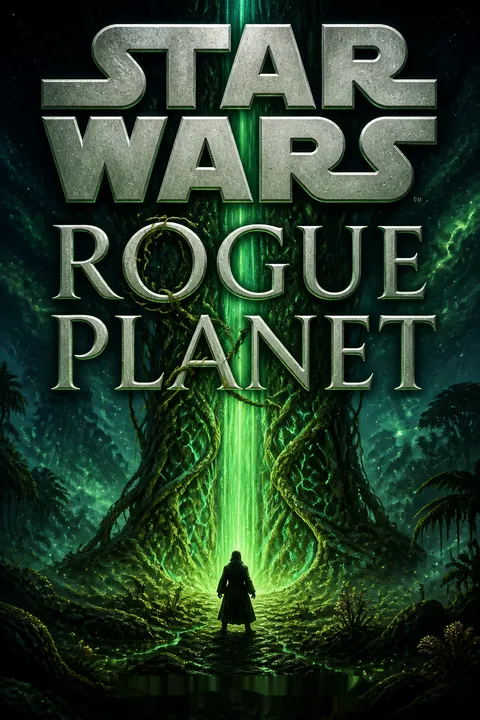


Plot Summary
The Garbage Pit Ambush
Twelve-year-old Anakin Skywalker slips away from Jedi training to race wings through Coruscant’s garbage-launch shafts, chasing the danger and victory he cannot find in the Temple. A Blood Carver racer needles him about his years as a slave, then reveals a three-bladed knife and drives Anakin into the pit before the race has properly begun.
Obi-Wan Kenobi arrives too late to stop the attack and leaps after his apprentice in ill-fitting wings. Anakin survives the fall, but the Blood Carver knocks him into the poisonous froth above the garbage worms. Obi-Wan cuts the attacker’s wings, and he and Anakin combine their remaining fuel to escape the worms and climb back through the shields.
The race turns Anakin’s appetite for risk into a concrete danger, but the assault also exposes how easily his history can be used against him. The Blood Carver’s taunt reaches past the Jedi identity Anakin is trying to inhabit and reopens the wound of leaving his enslaved mother behind. Obi-Wan’s rescue, meanwhile, is not a clean lesson imposed from above: he has to enter the same peril and trust Anakin’s quick thinking to survive. Their bond is built through mutual dependence, even as the boy’s concealment and the Master’s delayed arrival show how little either understands the threat around them.
A Mission Instead of Exile
After the rescue, Mace Windu questions Anakin about his disobedience, while Obi-Wan recognizes that his own need for certainty has narrowed his ability to guide the boy. Anakin admits that he seeks dangerous sensations to outrun pain and confusion, not simply to win. The Jedi Knight Thracia Cho Leem interrupts the hearing, argues that the Council is mistaking a difficult childhood for a settled failure, and urges the Masters to give Anakin meaningful work.
She also asks them to find her former apprentice, Vergere, who has been missing for a year on a distant mission. The Council assigns Obi-Wan to investigate, and Anakin is allowed to accompany him. Instead of dismissal, the boy receives a chance to learn beyond the Temple.
The hearing reframes discipline as a relationship rather than a sentence. Mace demands that Anakin name his error, while Obi-Wan discovers that the boy’s recklessness mirrors his own former impatience. Thracia’s intervention matters because she refuses to treat adolescent volatility as evidence of permanent moral defect. Yet the mission is not merely a reward: the disappearance of Vergere and the reported danger to Jedi make it consequential. Anakin’s request for something real meets the Council’s need to investigate a possible threat, placing his personal hunger for purpose inside a larger responsibility he has not yet learned to carry.
Tarkin Buys a Future
On Coruscant, military officer Wilhuff Tarkin recruits ship designer Raith Sienar for a secret expedition to locate Zonama Sekot, a hidden world rumored to build exceptionally fast spacecraft.
Tarkin wants influence in the changing Republic and imagines a new military order; Sienar wants access to an engineering marvel that could transform his fortunes. He shows Tarkin plans for a vast battle station, then discovers that Tarkin knows about Sienar’s concealed tracking devices in retrofitted freighters.
Under pressure, Sienar gives him the code for the Jedi auxiliary ship carrying Obi-Wan and Anakin. Tarkin places Sienar in command of a small squadron of former Trade Federation vessels and assigns the Blood Carver, Ke Daiv, to the mission, while both men conceal their own agendas.
The political subplot gives the expedition a second engine: curiosity about Zonama Sekot is already entangled with the desire to control what its technology might enable. Sienar’s museum of failed machines suggests a designer who studies limits, but his ambition draws him into Tarkin’s more coercive vision. Tarkin, by contrast, treats friendship as a temporary instrument and the Republic’s transition as an opening for private power. Their partnership is unstable from the outset. The tracking code links this distant world to the Jedi mission before either side understands the consequences, making technological ingenuity a tool of surveillance as well as discovery.
The Living World Appears
Obi-Wan and Anakin leave Coruscant aboard the Star Sea Flower, a fast cargo vessel piloted by the eccentric Priapulin Charza Kwinn. His ship is a damp ecosystem of small creatures that serve, feed, and reproduce together, unsettling Anakin’s assumptions about what makes a family.
Charza explains that Jedi Knight Vergere found Zonama Sekot, a jungle-covered planet beyond Republic territory, but sent only a brief and troubling report before going silent.
The ship reaches the system’s spectacular double-star display and descends toward the northern plateau. A guarded local woman grants them a short stay, then sends them south to meet Gann, a Ferroan guide. Gann explains that visitors must prove themselves before they can earn one of Sekot’s ships.
Charza’s ship quietly prepares the Jedi for a world where cooperation crosses familiar boundaries. Anakin sees the food-kin’s relationship with their enormous host as both intimate and disturbing, while Obi-Wan encourages him to observe before judging. That tension will recur on Zonama Sekot, where life itself participates in building homes and ships. The planet’s secrecy is not just a puzzle for outsiders: its residents control the conditions under which visitors may learn anything. Vergere’s silence creates the mission’s central absence, while the inhabitants’ insistence on tests turns a search for information into a demand that the Jedi enter local customs on their terms.
Fifteen Seeds Choose
At Middle Distance, the settlement’s layered homes cling to a canyon of immense living boras. Sheekla Farrs leads Obi-Wan and Anakin through a formal client ceremony, where each meets the seed-partners that may become a spacecraft.
A torrent of thorn-covered spheres buries the pair; afterward, three cling to Obi-Wan, while twelve attach themselves to Anakin, an extraordinary choosing that leaves the local guides uncertain. The Magister, the settlement’s elusive leader, requires the Jedi to meet him before shipmaking can proceed.
His house seems to contain two identical daughters, and his presence feels more like a convincing projection than an ordinary man. He nevertheless accepts them as clients. One daughter, the real Jabitha, later explains that the boras and their seeds are living partners in a carefully guarded craft.
The choosing makes Anakin’s unusual affinity visible to the settlement, but it also gives him a responsibility he initially reads as a prize. The seed-partners are not inert materials; their attachment implies reciprocal dependence, even before he understands its demands. Obi-Wan’s smaller group offers a counterpoint to Anakin’s abundance, and the difference sharpens the Master’s concern that the boy may confuse exceptional capacity with entitlement. The Magister’s apparent duplications further unsettle the Jedi’s usual reliance on perception. Their acceptance is real, but their access to the truth remains limited, and the ceremony binds them to a community whose beliefs and history they do not yet understand.
A Ship Forged in Fire
Jabitha Farrs accompanies the Jedi through the settlement’s living landscape and explains how boras shape new growth through heat, lightning, and skilled intervention. In the factory valley, forger Vagno places all fifteen seed-partners beneath heaps of plant material and ignites the mass with lightning gathered by the boras.
The seeds survive, transform into broad living plates, and pass to the shapers. Vidge’s team joins them with engines, a hyperdrive, and an organoform circuit, while the vast Jentari carry the growing structure down the valley.
Anakin and Obi-Wan guide the design from within its frames. During the process, the joined seeds transmit a fragment of Vergere’s message: she left with mysterious Far Outsiders to prevent further destruction and investigate them.
The ship’s creation makes engineering a collaboration among people, organisms, machines, and the clients who will live with the result. Anakin’s excitement is justified by genuine participation, but the forging also forces him to experience the seeds’ fear rather than treat them as equipment. Their transformation is neither effortless nor entirely under human control. Vergere’s message connects this intimate process to the wider danger: she chose to leave the planet because understanding the Far Outsiders might matter more than her own safety. The craft is therefore born amid competing obligations, joining Anakin’s dream of flight to a mystery that the Jedi can no longer treat as a distant rumor.
The First Flight Is Stolen
While the Sekotan craft receives its final fittings, Sienar sends Ke Daiv to pose as a wealthy client and buy a ship. The Blood Carver’s seed-partners reject him, and he returns without the prize. His failure does not end the threat: as Tarkin’s forces approach, Ke Daiv attacks the settlement and reaches the Jedi’s new vessel.
Laser fire wounds Obi-Wan and scatters the workers; Ke Daiv carries the injured Anakin aboard and forces Jabitha inside as leverage. The ship is ready but low on fuel, so Anakin must pilot it away rather than risk an immediate fight. In flight, the integrated seed-partners deliver Vergere’s fuller warning: the Far Outsiders know nothing of the Force, and she went with them to divert their attack from Zonama Sekot.
Ke Daiv’s rejection turns the seed-partners’ choice into a sharp contrast with the transactional logic of Sienar’s plan. He has been sent to acquire a living vessel as though wealth could substitute for mutual recognition; when that fails, force becomes his fallback. Anakin’s first flight is consequently not a triumphal test but a coercive escape, with Jabitha’s safety and Obi-Wan’s condition restricting his choices. Vergere’s message expands the stakes at precisely the moment Anakin is least able to pause and absorb them. Her decision to leave reframes absence as deliberate sacrifice, and identifies an enemy beyond the political rivalries the Jedi expected to encounter.
The Magister’s Ruined Mountain
Ke Daiv orders Anakin to find fuel at the Magister’s mountain, but the palace Anakin remembers has been reduced to rubble beneath a landslide. As Jabitha searches for her father, Ke Daiv admits that he was disgraced after accidentally killing the son he had been assigned to protect. Anakin recognizes the burden of shame, yet the Blood Carver continues to threaten them.
When Ke Daiv attacks, Anakin draws on years of buried humiliation and overwhelms him with the Force, leaving him gravely injured. Anakin refuses to celebrate the victory and begs Jabitha to help him keep Ke Daiv alive. Instead, he enters the collapsing ruins with her, where they find the Magister’s signet and learn that the man was already dead.
The confrontation is a crisis of moral method, not simply a test of strength. Anakin can protect Jabitha by unleashing a power that exceeds his control, but he immediately recognizes that survival does not make the act harmless. Ke Daiv’s history complicates the easy division between villain and victim: he is dangerous, yet his disgrace is built around an accidental failure and a life organized by punishment. Anakin’s plea to save him shows that compassion remains active even when anger has taken command. The ruined palace then gives physical form to a second collapse, exposing the distance between the Magister’s authority and the actual fate of the person who supposedly governs the settlers.
Sekot Names Itself
Inside the failing palace, Anakin encounters an image that identifies itself as Sekot, a newly awakened mind distributed through the planet’s living organisms. Sekot explains that the Magister guided it and helped build defenses against the Far Outsiders, but died during their earlier attack.
Believing its creator’s doctrine that all action must serve good, Sekot used weapons that killed; Vergere instead persuaded the outsiders to leave. Before Anakin can make sense of this, Tarkin’s troops land and seize him, leaving Jabitha behind.
Tarkin wants the boy to keep the living ship functioning, while Sienar examines it as valuable technology. The fleet commander has meanwhile displaced Sienar, whose attempts to control the droids have exposed how little authority he truly holds.
Sekot’s account challenges both the Magister’s certainty and Anakin’s emerging belief that power can be made safe by good intentions. The planet is neither an all-knowing force nor an innocent tool: it is a young consciousness that has learned through pain, error, and the consequences of violence. Vergere’s persuasion offers a different form of defense from the weapons Sekot helped create. Tarkin’s capture of Anakin turns that philosophical question into an immediate material one. He treats the boy as a living component of the ship, while Sienar treats the ship as a specimen. Both reproduce, in polished political form, the coercion Anakin and Sekot recognize from their own histories.
Obi-Wan Boards the Mine Ship
Obi-Wan reaches the mountain with Shappa Farrs, while Charza Kwinn pursues the invaders in the Star Sea Flower. Shappa confirms that Vergere left with the Far Outsiders after helping end their first assault, but the second invasion is already spreading sky mines and starfighters across the planet. Tarkin takes command of the larger force and orders an attack.
Charza then bores into the mine ship carrying Anakin, and Obi-Wan cuts his way into its hangar with Qui-Gon’s lightsaber. Anakin refuses to help Tarkin, and he and Obi-Wan escape aboard the Sekotan craft as Charza’s charge ruptures the bay. The damaged mine ship collides with Tarkin’s command vessel and explodes, giving the Jedi a narrow path toward the planet.
The rescue joins three kinds of loyalty that the invasion has tried to separate. Shappa risks his own ship because he trusts Obi-Wan; Charza uses a practical, improvised weapon rather than waiting for official permission; and Anakin resists cooperation despite Tarkin’s control of his immediate circumstances. Obi-Wan’s return matters not because it erases the boy’s ordeal but because it restores a relationship in which Anakin can act without being treated as equipment. Tarkin’s command vessel survives the initial collision, so the rescue does not end the danger. Instead, it changes the balance briefly and forces the Jedi to flee into a battle already spreading over the planet.
Zonama Leaves Its Orbit
The rescued Jedi learn from their ship that Sekot is coordinating its scattered living defenses and preparing to flee. Tarkin’s starfighters and sky mines press in from above, while Sekotan craft seize or ram the attackers. The Jedi dive through the factory valley as enormous engine structures rise from beneath the planet’s surface.
Their ship reaches space through a gap blasted open by a failing engine, but Tarkin’s fire wounds its living hull. Across the planet, Sekot ignites its engines and pushes Zonama Sekot out of its orbit, scattering the invading fleet and breaking the Jedi’s connection to the planetwide mind. The damaged craft carries Obi-Wan and Anakin into hyperspace. They escape, but the ship’s injuries leave it dying.
Sekot’s escape is both a strategic refusal and a test of collective agency. The planet does not defeat Tarkin by matching his fleet ship for ship; it changes the conditions of the conflict by moving the world itself. That choice is powerful but costly, and the failed engine shows that survival is not a frictionless miracle. Anakin’s partnership with the ship lets him navigate the escape, while Obi-Wan contributes caution and a wider view of the battle. Their roles have shifted from Master rescuing apprentice to two pilots and witnesses acting together. Yet the departure severs their contact with Sekot, leaving victory entangled with uncertainty about the world and everyone still aboard it.
A Ship Dies at Seline
Obi-Wan steers the damaged ship toward the remote outpost Seline, where it can no longer recover. Anakin names the vessel Jabitha, preserving the name of the friend he had to leave behind, and grieves as the ship’s color fades in the cold hangar. Thracia Cho Leem arrives with Obi-Wan to counsel him after his ordeal.
She senses that the boy is still being judged, but treats self-knowledge, rather than raw strength or obedience, as the work ahead. The Jedi have no news of Zonama Sekot or its people. Anakin’s trial has not resolved into balance; he must return to training carrying both the consequences of his anger and the loss of a living companion.
The ship’s death prevents the adventure from ending as a simple reward for courage. Anakin receives the extraordinary craft he wanted, but only briefly, and the loss makes attachment a lived experience rather than a lesson stated by the Council. Naming the vessel Jabitha preserves a bond while also admitting that neither the ship nor the girl belongs to him. Thracia’s counseling offers no quick absolution for the violence on the mountain. Instead, it directs Anakin toward the harder task of understanding what happened inside him. The ending leaves growth possible but incomplete, matching a young character whose capacities have outrun his ability to govern them.
Epilogue
The Coda closes the adventure without restoring what was lost. No more Sekotan ships are made, and the surviving craft eventually perish. Tarkin and Sienar bring their damaged force home; Tarkin claims the battle-station concept as his own, while Sienar privately doubts the wisdom of such concentrated power.
Charza and his shipmates survive, and later Charza turns to piracy to feed them. A legend spreads of Zonama Sekot as a wandering world. Thracia leaves the Jedi Order, while Obi-Wan continues training Anakin, whose future remains unsettled.
The Coda denies the reader a neat return to the status quo. The living technology that seemed to promise a new relationship between craft and pilot vanishes from the known world, while its military lesson is immediately appropriated by Tarkin as a design for centralized force. Sienar’s refusal to claim the idea marks a rare limit to his ambition, though it does not undo his part in the expedition. Charza’s later turn to piracy shows how political change can narrow the choices of those who once served the Republic. Anakin’s unresolved future, paired with Thracia’s departure and Obi-Wan’s continuing responsibility, makes the ending a pause in development rather than a completed redemption.
Analysis
Rogue Planet places a coming-of-age story inside a struggle over who has the right to use living systems. Anakin wants speed, mastery, and a freedom that feels personal; Tarkin and Sienar seek a technology that can expand political and military power. The contrast is not that the child is innocent and the adults are simply corrupt. Anakin, too, discovers that anger can make him powerful, and must face the harm done when he cannot govern it. The adults’ failure is different: they convert uncertainty into a reason for control, treating a planet and its inhabitants as assets before understanding them.
Zonama Sekot’s living craft complicate the familiar division between tool and partner. A ship must be chosen, shaped, and cared for, so its speed cannot be separated from reciprocal obligation. The seed-partners do not merely reward Anakin’s talent; they require him to attend to another life. That makes the craft a countermodel to Tarkin’s fleet, whose droids, mines, and captured technology are valuable precisely because they can be directed from above. Yet the novel avoids presenting organic life as automatically good. Sekot itself makes weapons and kills under the Magister’s influence, learning that benevolent certainty can produce violence as surely as ambition can.
The Jedi’s central problem is therefore epistemic as well as ethical. Obi-Wan cannot fully interpret the planet, the Magister, or the danger through familiar doctrine, and Anakin’s early intuitions are vivid but unreliable. The story values attention, dialogue across difference, and self-knowledge, without pretending that any of them guarantees safety. Vergere’s choice to persuade the Far Outsiders rather than destroy them offers one alternative, while the planet’s eventual flight shows that withdrawal can also be an act of resistance.
The ending withholds a simple victory. Zonama Sekot escapes, but its ships die, Anakin loses a companion, and the political actors carry home new designs for greater force. The adventure changes the characters without resolving their futures. Its lasting question is not whether power can be acquired, but whether those who wield it can recognize the lives and obligations hidden inside what they call a resource.
Review Summary
Rogue Planet receives mixed reviews, with ratings ranging from 1 to 5 stars. Many readers appreciate the exploration of Obi-Wan and Anakin's early relationship, praising Bear's characterization. However, some find the plot slow and confusing, particularly in the latter half. The book's connections to the New Jedi Order series and its unique worldbuilding are noted positively. Criticisms include pacing issues, inconsistencies with later Star Wars canon, and underdeveloped side characters. Overall, readers consider it an interesting but flawed addition to the Star Wars Expanded Universe.
People Also Read
Characters
Anakin Skywalker
Restless Jedi apprenticeAnakin is a gifted twelve-year-old Padawan who was freed from slavery on Tatooine and is now learning under Obi-Wan Kenobi. He is mechanically inventive, fearless in a contest, and hungry for speed and independence. Those strengths are tangled with fear, impatience, and a deep attachment to his absent mother. He often tests the people he loves, partly to discover whether they will remain beside him. His talent for sensing the Force is unusually powerful, but his emotional intensity makes self-command difficult. Anakin’s story asks how a child can carry extraordinary ability without mistaking intensity for wisdom, or pain for a reliable guide.
Obi-Wan Kenobi
Anakin’s steadying MasterObi-Wan is Anakin’s Jedi Master, a disciplined and capable Knight who inherited the responsibility of training him from Qui-Gon Jinn. He prefers order, careful preparation, and clear duties, which makes Anakin’s improvisation both exasperating and instructive. Beneath his composure lies a fear of failing the boy and a lingering grief for his own Master. Obi-Wan’s teaching is not simply a matter of correcting Anakin; the apprentice forces him to revisit the adventurous, uncertain child he once was. His challenge is to guide without trying to control every outcome, and to trust Anakin without abandoning judgment.
Raith Sienar
Ambitious ship designerRaith Sienar is a wealthy engineer and spacecraft designer whose talent is matched by a collector’s fascination with failed machines. He values elegance, technical ingenuity, and the freedom to work beyond conventional contracts. Tarkin’s invitation promises access to a living technology that could remake Sienar’s career, but it also places him inside a political scheme he does not control. Sienar is not innocent of manipulation: he keeps secrets, plants trackers, and makes private calculations. Yet he is more cautious about concentrated military power than Tarkin, and his understanding of machines repeatedly exposes the danger of treating them as obedient tools.
Wilhuff Tarkin
Strategist seeking commandTarkin is a calculating Republic officer who sees political upheaval as an opening to build influence and reshape military power. He recruits Sienar for his engineering expertise, then uses surveillance and pressure to keep the designer inside the expedition. Tarkin is socially polished, but his manner conceals a hard belief that authority belongs to those willing to seize it. He regards alliances as temporary and the lives of individuals as subordinate to strategic outcomes. His confidence makes him effective, while his certainty about force blinds him to the possibility that a living world might resist on terms his fleet cannot predict.
Ke Daiv
Disgraced Blood CarverKe Daiv is a Blood Carver warrior assigned to Tarkin’s expedition after failing to kill Obi-Wan and Anakin. He is trained in violence and carries the rigid obligations of a culture that places great weight on honor, family, and ritual. His disgrace stems from an accidental death while he was protecting someone entrusted to him, leaving him determined to recover standing through service. Ke Daiv’s discipline does not make him harmless; he is willing to threaten others when he believes duty requires it. His conflict with Anakin exposes two very different lives shaped by shame and the search for a way beyond it.
Jabitha Farrs
Curious daughter of the MagisterJabitha is the young daughter of the Magister and a member of the Zonama Sekot community. She is curious, direct, and more willing than many adults to explain the living processes that sustain her home. Her familiarity with the boras, seed-partners, and settlement customs gives the Jedi a human connection to a world otherwise guarded by ritual and secrecy. Jabitha is also protective of her family and wary of outsiders who ask questions about the planet’s past. Her bond with Anakin offers him companionship from someone near his own age, while her presence reminds him that the choices made by adults and armies endanger ordinary lives.
Vergere
Missing Jedi investigatorVergere is a Jedi Knight and former apprentice of Thracia Cho Leem, sent to investigate reports of an unknown species near Zonama Sekot. She is intelligent, self-reliant, and prepared to act beyond the comfort of familiar Jedi structures when a situation demands it. The story reaches her largely through reports and a message embedded in the living seed-partners, but her decisions shape the mission from afar. Vergere’s ability to meet unfamiliar beings without assuming that force is the only answer makes her an important contrast to the military leaders searching for the planet.
Charza Kwinn
Priapulin pilot and allyCharza Kwinn is a Priapulin pilot and longtime auxiliary to the Jedi. He travels in the Star Sea Flower, a ship maintained by a complex community of small living companions. Charza is devoted to peace, yet his intelligence and skill make him a resourceful guide through dangerous regions. His unusual relationship with his shipmates challenges Anakin’s assumptions about care, family, and dependence. Charza’s hospitality gives the Jedi a safe passage toward Zonama Sekot, and his practical knowledge later proves as valuable as his loyalty.
Thracia Cho Leem
Unconventional Jedi mentorThracia Cho Leem is a Jedi Knight, former mentor to Vergere, and an experienced trainer with a deep interest in how children grow. She has lived beyond the Temple’s routines and brings a worldly perspective to Anakin’s disciplinary hearing. Rather than excuse his choices, she argues that he needs responsibility and honest guidance, not a premature verdict on his character. Thracia is sharp, irreverent, and unusually attentive to the emotional lives of young Jedi. Her approach challenges Obi-Wan to remember that uncertainty is part of development, while holding Anakin to the consequences of involving others in danger.
The Magister
Guardian of Sekot’s secretsThe Magister is the elusive leader and spiritual authority of the Zonama Sekot settlers. He oversees the customs that govern visiting clients and the community’s relationship with the living boras. His authority is closely bound to the settlers’ founding beliefs, and his distance from ordinary life makes him difficult for Obi-Wan and Anakin to understand. The Magister’s influence reaches beyond the ceremonies and decisions made in his presence; people look to him to interpret the planet’s nature and the settlement’s future.
Shappa Farrs
One-armed ship architectShappa Farrs is a gifted and eccentric architect who designs the living spacecraft built on Zonama Sekot. He has lost an arm while working near the dangerous shaping process, but injury has not dulled his enthusiasm for ambitious designs. Shappa’s artistic imagination makes him unusually receptive to the creative partnership between clients and seed-partners. He is married to Sheekla and willing to question local procedures when they obstruct necessary action. Among the settlers, he offers Obi-Wan a practical ally and a less rigid perspective on the Magister’s authority.
Gann
Ferroan client guideGann is a Ferroan guide who introduces Obi-Wan and Anakin to Middle Distance and its client customs. He believes strongly in tradition and in the Magister’s authority, and his caution reflects a community that has learned to protect its secrets. Gann is not hostile to the Jedi, but he is reluctant to share information that could threaten the settlement’s stability. As the danger grows, his distress reveals how deeply he depends on familiar rules when events exceed his experience.
Sheekla Farrs
Grower and ritual guideSheekla Farrs is a grower, a daughter of the settlement’s founders, and Shappa’s wife. She guides clients through the choosing ceremonies and understands how the seed-partners connect the community to Sekot. She is practical and warm toward the living organisms in her care, yet guarded about the settlement’s painful history. Sheekla’s confidence in local custom does not prevent her from adjusting ritual when the needs of the seed-partners require it.
Mace Windu
Jedi Council disciplinarianMace Windu is a senior Jedi Master who presides over Anakin’s disciplinary hearing. He combines rigorous expectations with a playful, probing intelligence, and he expects both Anakin and Obi-Wan to examine their own motives. Mace recognizes the seriousness of the boy’s choices without reducing him to them. His willingness to assign the mission shows that the Council sees responsibility, not punishment alone, as a possible path toward growth.
Qui-Gon Jinn
Obi-Wan’s remembered MasterQui-Gon Jinn was Obi-Wan’s Jedi Master and the person who recognized Anakin’s potential on Tatooine. Though absent from the present action, his teachings and example shape both men’s choices. Obi-Wan remembers him as unpredictable and perceptive, while Anakin carries the memory of being given a life beyond slavery. Their recollections help each character interpret uncertainty, even as Obi-Wan struggles to distinguish the influence of Qui-Gon’s teachings from the wish to hear his voice again.
Yoda
Jedi elder and counselorYoda is a senior Jedi Master who has spoken privately with Obi-Wan about the responsibility of training Anakin. His warning emphasizes that the boy’s promise and fear make him an unusually difficult apprentice. Although he is not present for the mission, his judgment lingers in Obi-Wan’s thoughts.
Captain Kett
Sienar’s wary commanderCaptain Kett serves aboard Sienar’s expeditionary flagship and carries the habits of a Trade Federation officer. He values procedure, military reputation, and the possibility of an honorable career under the incoming Republic order. His caution makes him a useful observer of Sienar’s growing distrust of Tarkin.
Vagno
Boisterous seed forgerVagno is a blunt, energetic forger who oversees the fiery transformation of the Jedi’s seed-partners. He treats the dangerous work as a craft governed by skill and tradition, reassuring clients while demanding that they respect the process.
Vidge
Master of living formsVidge leads the shapers who prepare the forged seed-plates and join them to the ship’s mechanical components. His gloomy manner masks exacting expertise. He warns the Jedi that their guidance is necessary for the craft to develop properly.
Plot Devices
Sekotan seed-partners
Living ships need partnersThe seed-partners are living organisms that bond with prospective clients and can be forged, shaped, and joined into a spacecraft. Their choice is not a simple purchase: a client must be accepted, and the resulting craft depends on continued attention while it is young. Anakin’s unusually large group makes the Jedi’s ship exceptional and gives him a direct channel to the craft’s developing awareness. Through the seeds, the story connects engineering to mutual dependence, while making the creation of a fast ship inseparable from its makers’ risks and needs.
The Force and Anakin’s trial
Power tests self-commandAnakin’s sensitivity to the Force gives him intuition about coming danger and extraordinary power under pressure, but it does not automatically provide judgment. His desire to escape pain through speed and sensation repeatedly narrows his awareness. The trial on Zonama Sekot forces him to confront what happens when anger becomes a source of strength, and whether good intentions can control its consequences. Obi-Wan’s contrasting discipline provides a second model, though the Master must also learn when trust is more useful than supervision.
Vergere’s seed message
Memory travels through living craftVergere leaves information inside the seed-partners, allowing the message to reach later Jedi through the very organisms used to make their ship. The first fragment raises questions about her disappearance; the fuller transmission explains that she encountered the Far Outsiders and chose to accompany them. Its delivery is delayed until Anakin is piloting under threat, so crucial knowledge arrives when he has little room to reflect. The device joins the missing Jedi’s investigation to the craft’s living network and makes the seeds witnesses as well as builders.
Sekot’s planetwide life
A world acts as oneThe boras, seed-partners, Jentari, and other organisms form an interconnected living system that the settlers have learned to work with. Their relationships provide homes, manufacture, communication, and eventually defense. The system initially appears to the Jedi as an ecological and cultural wonder, but clues in the planet’s scars and the Magister’s evasions point to a violent past. The revelation that Sekot possesses a developing mind changes the meaning of these connections and makes the planet an active participant in the conflict.
Tracking and sky mines
Surveillance becomes invasionSienar’s covert trackers allow Tarkin’s forces to follow the Jedi’s auxiliary ship to Zonama Sekot. Once there, the fleet uses sky mines and droid starfighters to trap vessels and attack the planet. The mines transform the sky into a shifting barrier that constrains the Jedi’s routes and gives Tarkin an advantage without requiring him to understand the world he is attacking. Their presence also exposes the gap between the expedition’s stated purpose and its coercive military methods.

Download PDF
Download EPUB
.epub digital book format is ideal for reading ebooks on phones, tablets, and e-readers.








