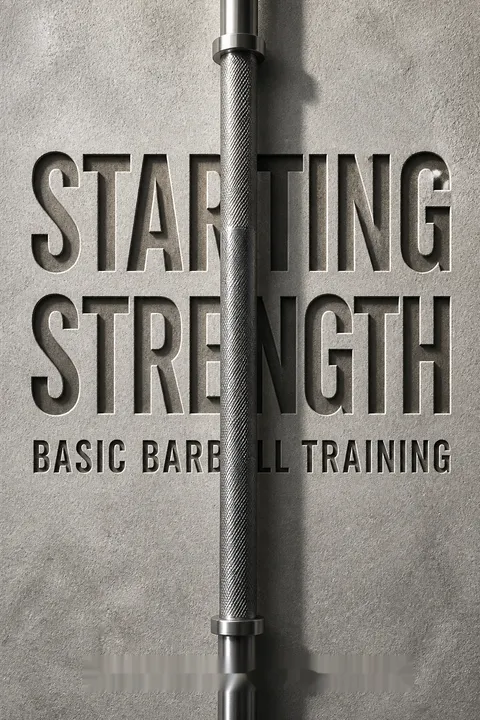


Key Takeaways
Build general strength with barbells before chasing specialized fitness.
Strength is the foundation. Rippetoe treats strength as more than a sport-specific quality: it helps people meet the physical demands of work, daily life, and athletic movement. His practical answer is progressive barbell training, especially the squat, press, deadlift, bench press, and power clean. These multi-joint lifts train several muscle groups and the coordination needed to move a load, rather than isolating body parts on machines.
Train the whole movement. The book argues that strength carries over best when training uses movement patterns that resemble how the body applies force. Barbells also load the skeleton, while their open path requires the lifter to control balance. The claim that barbell lifts are the best tool for everyone is broader than the evidence here can establish, but the case for them as an efficient foundation is clear.
The useful distinction is between general capacity and sport skill. A stronger athlete has more force available, but strength alone does not teach timing, tactics, or the exact movement of a sport. This fits the broader principle of transfer: training can build a physical resource, while practice teaches how to spend it. Barbells are especially effective when the goal is measurable loading across a large range of motion. Machines can still have a place for rehabilitation, accessibility, or targeted work, so the choice need not be ideological.
Keep the bar over mid-foot, and let your body solve the angles.
Balance guides technique. In the book’s model, gravity pulls the bar straight down, so the efficient path against gravity is vertical. For standing lifts, keeping the bar over the mid-foot helps the lifter-barbell system remain balanced. If the bar drifts forward or backward, the body must spend effort correcting the resulting leverage instead of directing it toward the lift.
Use a simple target. Rippetoe calls the imagined vertical track above the mid-foot the Master Cue. Rather than consciously adjusting every joint, the lifter focuses on keeping the bar in that track; the body organizes its knees, hips, and back around the task. Individual limb and torso proportions change how the lift looks, so the desired result matters more than copying another lifter’s silhouette.
This is a motor-learning strategy as much as a mechanics lesson. Skilled movement often improves when attention is directed toward an external effect, such as where an object should travel, rather than toward a long list of body-part instructions. That can reduce cognitive clutter under load. Still, the mid-foot model is a useful coaching guide, not a complete biomechanical description of every lift or every body. Video, coaching, and pain-free movement remain important checks, especially when anthropometry or injury changes the available positions.
Squat deep enough to recruit the hips, not just the knees.
Depth changes the exercise. The book defines a full squat by the hip joint descending below the top of the kneecap. Its preferred low-bar squat uses a moderately wide stance, toes turned out, and knees tracking in line with the feet. This position lets the glutes, hamstrings, and adductors contribute to hip extension, which Rippetoe calls hip drive. A shallow squat, in his analysis, shifts more work toward the quadriceps and omits much of that hip contribution.
Stay tight through the bottom. The controlled descent stretches working muscles before the upward drive, creating a stretch reflex that can assist the change of direction. The book presents full squats as beneficial for knee stability, but that safety claim should not be treated as universal. Depth, load, and stance need to suit the lifter’s body and health.
The strongest insight is that range of motion is not a cosmetic detail: it determines which positions and tissues receive training. Consistent depth also makes progress easier to compare over time. The caution is equally important. The book’s confident claims about knee protection and injury causes simplify a complex subject. Pain, prior surgery, mobility limits, and individual structure can all change what is appropriate. A repeatable, controlled range is more useful than forcing a prescribed depth at any cost.
Deadlift from a braced back, with straight arms and a patient start.
Set position before force. The book teaches a conventional deadlift setup in stages: place the bar over mid-foot, grip it just outside the legs, bring the shins to the bar without rolling it forward, and brace the back before pulling. The arms stay straight because their job is to connect the bar to the torso, not curl the load. The bar should travel close to the legs, and each repetition should begin from a settled stop rather than bouncing off the floor.
Pulling costs recovery. The deadlift trains the back, hips, grip, and legs, but heavy sets can be demanding. Rippetoe recommends one hard work set for novice deadlifts rather than several heavy sets across. He emphasizes maintaining a firm, anatomically controlled back position; a coach or clinician can help adapt the movement when pain or injury makes that position difficult.
The setup sequence turns a complicated pull into a repeatable checklist, which is valuable because the deadlift begins in its hardest position. Resetting each rep also makes technique easier to inspect than bouncing repetitions together. The book’s language sometimes presents one back position as universally safe, although spinal loading and tolerance vary. The general lesson is stronger than any rigid posture rule: create a stable, repeatable position, load it progressively, and do not mistake pain for a cue to simply try harder.
Press overhead for whole-body force; bench for heavier upper-body strength.
Two presses, two jobs. The standing press links the bar in the hands to the feet through the trunk, hips, and legs, which must stabilize the body while the shoulders and arms push overhead. The bench press allows more weight, but the bench supports the upper back, so it trains a shorter force chain. The book uses both: the press for standing stability and overhead strength, the bench for heavier upper-body work.
Keep the shoulders balanced. Rippetoe argues that bench-only training can overemphasize the front of the shoulder and recommends balancing bench work with overhead pressing. For the press, the bar finishes above the shoulder joints, with the elbows locked and shoulders actively supporting the load. For the bench, the lifter keeps the upper back tight, lowers the bar to the chest, and presses along a repeatable path.
The comparison helps clarify why one exercise cannot stand in for every athletic demand. The press trains force transfer while standing; the bench permits high upper-body loading in a supported position. That makes their complementarity plausible, though a simple one-for-one prescription is not a universal injury-prevention rule. Shoulder health also depends on training history, total workload, technique, and individual tolerance. The practical value lies in avoiding a program that treats a bigger bench number as the only measure of upper-body strength.
Treat the power clean as a jump, not an arm lift.
Power requires speed. The book defines power as work done per unit of time: producing force quickly matters as well as producing force at all. A deadlift can be slow and still succeed; a power clean must accelerate the bar enough for the lifter to catch it on the shoulders. Rippetoe therefore presents the clean as an explosive lift that develops the ability to express strength quickly.
Learn the catch first. The teaching sequence begins with the bar in the hands, then practices the jump and shoulder catch before adding the pull from the floor. The elbows stay straight until the explosive leg-and-hip drive is complete, then rotate forward to receive the bar on the shoulders. The book’s central coaching point is to build speed through the lift, not to curl or row the bar upward.
The clean makes the difference between strength and power visible: force capacity is necessary, but the timing of force determines whether the bar reaches the catch. This connects well with motor learning, where a complex skill is often taught by isolating its crucial phases and then recombining them. The tradeoff is technical demand. A clean is less suitable for unsupervised beginners with pain, limited mobility, or no appropriate equipment. Strength training can still be productive without Olympic-style lifts.
Progress by adding manageable weight, not by collecting exercises.
Adaptation follows the challenge. Rippetoe’s Novice Effect describes how an untrained person can gain strength quickly because even modest training is a new stress. The program uses this by asking novices to add a small amount of weight to the main lifts whenever they complete the prescribed work. In the sample schedule, trainees lift three days per week, squat each workout, alternate the press and bench press, and alternate the deadlift and power clean after the clean is introduced.
Small jumps last longer. The book suggests larger early increases for some lifts and trainees, then smaller increments as progress slows. The exact amount depends on the person and lift; missed repetitions signal that the increase may have been too large or recovery insufficient. The goal is not to add weight at any cost, but to keep the challenge repeatable.
This approach turns training into a feedback system: complete the task, increase the demand slightly, and observe whether the body adapts. That is more informative than changing exercises whenever progress feels slow. It also reflects diminishing returns: a beginner’s rapid gains cannot be assumed to continue indefinitely. Linear increases are a starting strategy, not a law of physiology. When recovery, technique, or life circumstances limit progress, holding steady or changing the plan can be wiser than forcing the next increment.
Use warm-ups to rehearse, then rest enough to finish every work set.
Warm up with the lift. The book gives warm-ups two jobs: raise tissue temperature and practice the movement before heavy loading. A few sets with the empty bar, followed by gradually heavier sets, let the lifter refine technique without exhausting the muscles. Warm-up loads should prepare the work, not become a second workout. The book criticizes pyramid routines that accumulate many tiring repetitions before the heaviest set.
Protect the work sets. A work set is the heaviest prescribed training set; sets across are multiple work sets performed at the same weight. Rippetoe favors sets of five for learning and novice strength work, often with three work sets for squats and presses, while prescribing one hard set for the novice deadlift. Rest long enough between sets to complete the plan rather than turning strength training into a race.
The distinction between preparation and productive work is easy to lose in a gym, where fatigue can feel like proof of effort. A warm-up is useful only if it improves readiness without stealing capacity from the task it precedes. The fixed five-rep format also supports consistent practice, though no single repetition range is ideal for every goal or trainee. The deeper principle is to match volume, intensity, and rest to the adaptation being pursued, then record what actually happened.
Eat and recover enough to support the training stress you prescribe.
Training needs resources. The book treats food and recovery as part of the program, not as optional extras. It recommends adequate protein, regular meals, and enough calories to support hard training, especially for underweight novices seeking muscle gain. It describes milk as a convenient way to add calories and protein, and gives a broad protein target of about one gram per pound of bodyweight per day. Those are the author’s recommendations, not requirements for every person.
Bodyweight is individual. Rippetoe argues that skinny trainees may need to gain weight, while heavier trainees can improve strength and body composition without immediate weight loss. He also describes changing food intake as rapid early gains slow. The useful principle is to monitor performance, bodyweight, and health together rather than imposing one diet or physique target on every lifter.
The book is right that adaptation is constrained by recovery: the training stimulus cannot be separated from sleep, food, and the ability to return ready. Its specific calorie and milk advice is more prescriptive than current individualized nutrition practice supports. Energy needs differ with body size, age, activity, medical conditions, and goals; lactose intolerance and other dietary constraints matter too. A measured surplus may help someone underweight, while forced weight gain is unnecessary for many others. Tracking trends is more defensible than obeying a single food rule.
Choose assistance work only when it strengthens a specific weak link.
The main lifts come first. Rippetoe sorts assistance exercises into partial versions of a lift, variations of a lift, and ancillary movements that strengthen supporting muscles. Examples include rack pulls for part of the deadlift, front squats as a squat variation, and chin-ups for upper-back and arm strength. He includes chin-ups early, but warns that extra work should not interfere with progress on the squat, press, bench, deadlift, or clean.
More is not automatically better. Partial lifts can target a sticking point or add stress when a trainee is experienced enough to manage it. They are not substitutes for the full movements, which train a wider range of positions and coordination. The book’s practical test is simple: if an added exercise does not support progress on the principal lifts, leave it out.
This is a strong antidote to exercise accumulation as a proxy for expertise. Assistance work is most useful when it answers a defined problem, such as grip limiting a pull or upper-back strength limiting a lift. It is less useful when it merely makes a session longer or more entertaining. The limitation is that a trainee may misidentify the weak link, especially without coaching or a training log. A small, deliberate addition is easier to evaluate than a wholesale redesign.
Scale the bar to the trainee, and never improvise bench-press safety.
Equipment and load must fit. The book argues that barbell training can be adjusted to a person’s capacity, including children, by using lighter bars and small weight increments. It cites a 1994 comparison reporting 0.0012 injuries per 100 participation hours for weightlifting and 6.2 for soccer. That historical comparison supports the possibility of supervised training, but it does not prove that every program or setting is safe.
Use real safeguards. Rippetoe emphasizes competent instruction, controlled technique, and appropriate racks. For bench pressing alone, he recommends a power rack with safety pins rather than heavy attempts without protection. He rejects the thumbless bench grip because it leaves the bar less secure. Squats also require suitable spotting or a properly arranged rack. The broader lesson is to make the equipment and supervision match the risk.
The emphasis on scalability is persuasive: a bar can be made lighter, while many field-sport collisions cannot be adjusted in the same way. But a single injury-rate comparison from 1994 should not be treated as a current, universal risk estimate. Outcomes depend on supervision, program design, and how injuries are counted. Safety is not a property of a piece of equipment alone; it emerges from the person, the task, and the environment. The book’s concrete reminders about bench safeties and secure grips remain especially valuable.
Analysis
Starting Strength is both a technical manual and an argument about what strength training should prioritize. Its organizing idea is unusually coherent: select a small group of barbell lifts, explain their mechanics through balance and leverage, teach them with detailed progressions, then make training stress increase in a way the trainee can recover from. The squat is the book’s centerpiece, while the deadlift, presses, and power clean extend the same logic across pulling, pushing, and explosive movement.
The book’s greatest strength is its insistence on operational definitions. A squat needs a consistent depth; a bench repetition needs a repeatable touch point; a deadlift begins from a settled bar. These standards turn lifting from a collection of impressions into something a trainee can record, compare, and improve. Its emphasis on simple external cues also recognizes that a lifter cannot consciously micromanage every joint during a heavy movement.
Its weakness is the same quality turned too far. Rippetoe often presents one preferred technique as the mechanically correct solution and treats competing practices as error. Some principles, such as consistent range of motion and progressive loading, generalize well. Others, particularly categorical claims about injury prevention, exercise machines, shoulder risk, or the safety of a specific squat style, need more qualification than the book gives them. Bodies vary, medical histories matter, and training goals are not identical.
The most durable reading is therefore not blind adoption of every cue or claim. It is the method: learn a few demanding movements, use a consistent standard, add load in small recoverable steps, and treat technique as a skill that deserves practice. The book offers a particularly concrete entry point for novices, but its own logic supports adaptation when pain, mobility, equipment, or athletic priorities require it. Strength is foundational, not a substitute for every other form of preparation.
Review Summary
Starting Strength is highly regarded as a comprehensive guide to barbell training, focusing on five fundamental exercises. Readers praise its detailed explanations of biomechanics and proper form, though some find it overly technical. The book's no-nonsense approach and emphasis on strength over aesthetics are appreciated. Many report significant strength gains following the program. Critics note the controversial dietary advice and occasionally insensitive tone. Despite these issues, most consider it an invaluable resource for both beginners and experienced lifters seeking to improve their technique and overall strength.
People Also Read



Glossary
Posterior chain
Hip-extending musclesRippetoe uses this term for the muscles that contribute to hip extension, especially the hamstrings, gluteal muscles, and adductors. In the squat and deadlift, these muscles help extend the hips and transmit force through the trunk. The book emphasizes training them together through compound movements rather than treating them as isolated body parts.
Hip drive
Active hip extensionHip drive describes the deliberate contribution of the hip extensors as a lifter rises from the bottom of a squat. The book cues the lifter to raise the hips while maintaining a stable torso angle, engaging the glutes, hamstrings, and adductors. It is a movement instruction, not a separate exercise.
Master Cue
Keep the bar balancedThe Master Cue is the instruction to keep the barbell traveling in a vertical path over the mid-foot during standing lifts. Rippetoe argues that this external target helps the lifter organize the joints and torso without trying to consciously manage every angle. It is presented as a useful technique cue for squats, pulls, and presses.
Valsalva maneuver
Bracing with held breathThe Valsalva maneuver is holding the breath against a closed glottis while contracting the trunk muscles. In the book’s lifting method, this increases pressure in the chest and abdomen and helps brace the torso under load. It is taught as a brief, effort-specific technique, especially during heavy repetitions, not as continuous breath-holding.
Novice Effect
Rapid early strength gainsThe Novice Effect is Rippetoe’s name for the rapid strength improvement many previously untrained people experience when they begin resistance training. Because modest loads are initially a new stress, a novice can often recover and adapt quickly enough to add weight at frequent intervals. The effect diminishes as the trainee becomes stronger and more accustomed to training.
Work set
Heaviest planned setA work set is one of the heaviest sets prescribed for an exercise in a workout. In the book’s novice programming, these sets provide the main training stress, while lighter sets beforehand serve as warm-ups and technique practice. The distinction helps prevent warm-up work from exhausting the lifter before the intended training sets.
Sets across
Repeated sets at one loadSets across are multiple work sets performed with the same weight. For example, three sets of five at one load are sets across. Rippetoe uses this format for several novice lifts because it provides repeated practice and a measurable amount of work. He distinguishes it from the deadlift, for which his novice program generally uses one hard work set.
FAQ
What's Starting Strength: Basic Barbell Training about?
- Focus on Barbell Training: The book by Mark Rippetoe is a comprehensive guide to barbell training, emphasizing foundational lifts like the squat, press, deadlift, bench press, and power clean.
- Strength Training Philosophy: It argues that physical strength is crucial for overall well-being, stating that a stronger person is generally happier and healthier.
- Practical Instruction: Detailed instructions are provided for each lift, making it suitable for both beginners and experienced lifters.
Why should I read Starting Strength: Basic Barbell Training?
- Expert Guidance: Written by a seasoned strength coach, the book offers insights based on years of experience in teaching barbell training.
- Comprehensive Approach: It covers not just the "how" but also the "why" behind each exercise, helping readers understand the mechanics and benefits of strength training.
- Improves Overall Fitness: By focusing on compound movements, the book helps readers build functional strength that translates to better performance in sports and daily activities.
What are the key takeaways of Starting Strength: Basic Barbell Training?
- Importance of Technique: Proper form is crucial for safety and effectiveness, with an emphasis on correct execution to prevent injuries.
- Progressive Overload Principle: Gradually increasing weights is essential for stimulating strength gains, a fundamental concept in strength training.
- Full-Range Movements: Emphasizes the significance of full-range-of-motion exercises to maximize muscle engagement and strength development.
What are the best quotes from Starting Strength: Basic Barbell Training and what do they mean?
- "Exercise is that stimulus...": This quote emphasizes the necessity of physical activity to maintain health and function, suggesting exercise is a fundamental requirement for well-being.
- "Barbells allow weight to be moved...": Highlights the natural biomechanics of lifting with barbells, reinforcing the idea that barbell training is optimal for strength development.
- "If you are not getting stronger...": Underscores the necessity of tracking progress and ensuring workouts are effective in promoting strength gains.
How does Starting Strength: Basic Barbell Training define the deadlift?
- Basic Definition: The deadlift involves pulling a barbell from the ground to a standing position, primarily using the legs and back.
- Mechanics of the Lift: Emphasizes keeping the bar close to the body and maintaining a rigid back throughout the lift.
- Common Errors: Identifies errors like allowing the back to round or the bar to drift forward, which can lead to inefficiency and injury.
What is the significance of the Valsalva maneuver in Starting Strength: Basic Barbell Training?
- Spinal Stability: Increases intra-abdominal pressure, providing support for the spine during heavy lifts.
- Breathing Technique: Lifters are advised to take a big breath and hold it before lifting, as "air is support" for the spine.
- Injury Prevention: Helps prevent blackouts and maintain blood flow to the brain during intense exertion, making it essential for serious lifters.
How does Starting Strength: Basic Barbell Training recommend structuring a training program?
- Linear Progression: Advocates for increasing weight every workout until the lifter can no longer complete the prescribed reps.
- Workout Frequency: Suggests training three times a week, alternating between different lifts to allow for recovery while promoting strength gains.
- Warm-Up Sets: Emphasizes proper warm-up sets to prepare the body for heavier work, reducing the risk of injury.
What are the common mistakes to avoid in strength training according to Starting Strength: Basic Barbell Training?
- Poor Technique: Improper form can lead to injuries and ineffective workouts, making it essential to learn correct movement patterns.
- Inadequate Recovery: Not allowing enough time for recovery can hinder progress and lead to overtraining.
- Ignoring Nutrition: Failing to eat adequately to support training can stall progress, as nutrition plays a critical role in recovery and muscle growth.
How does Starting Strength: Basic Barbell Training address nutrition and recovery?
- Nutrition Guidance: Emphasizes the importance of proper nutrition to support strength training, suggesting adequate caloric intake for recovery and muscle growth.
- Recovery Importance: Highlights the need for rest and recovery between workouts, advising lifters to listen to their bodies and adjust training intensity accordingly.
- Hydration: Stresses the significance of staying hydrated, as it plays a crucial role in overall performance and recovery.
What equipment does Mark Rippetoe recommend for barbell training in Starting Strength: Basic Barbell Training?
- Barbell and Plates: Advocates for using a standard Olympic barbell and weight plates, essential for the lifts covered in the book.
- Weightlifting Shoes: Recommends investing in weightlifting shoes for stability and support during lifts.
- Chalk and Belts: Discusses the use of chalk for grip and a weightlifting belt for spinal support during heavy lifts.
How can I apply the principles from Starting Strength: Basic Barbell Training to my training?
- Focus on Form: Mastering proper technique before increasing weights is crucial to prevent injuries and ensure effective training.
- Progressive Overload: Gradually increasing weights is essential for strength gains, challenging the body and stimulating muscle growth.
- Consistency is Key: Regular training and adherence to the program will yield the best results, emphasizing commitment to the training regimen.
How does Starting Strength: Basic Barbell Training cater to different populations, such as kids or older adults?
- Safe for Youth: Argues that weight training is safe for children and beneficial for their development.
- Adaptable for Older Adults: Notes that strength training can be scaled to accommodate older adults, improving their strength and overall health.
- Focus on Technique: Emphasizes learning proper technique for all trainees to ensure safety and effectiveness in workouts.
Download PDF
Download EPUB
.epub digital book format is ideal for reading ebooks on phones, tablets, and e-readers.








