

Key Takeaways
Own broad markets cheaply instead of betting on the next winner
A lesson earned slowly. Taylor Larimore traces his investing philosophy through decades of mistakes. His family suffered during the Great Depression after his grandfather’s investment trust failed. Later, Larimore’s stock club lagged the market, his stock picks disappointed, and newsletters that promised winning funds or market forecasts failed to deliver. Even swapping underperforming funds for recent winners led him to buy high and sell low.
The change in approach. Reading John Bogle and Burton Malkiel in 1994 persuaded Larimore to stop searching for exceptional picks and own broad markets instead. The book’s case is not that markets are safe or predictable. It is that ordinary investors can improve their odds by declining expensive contests they are unlikely to win.
The personal history gives the strategy its real argument: not a clever prediction, but a disciplined response to repeated failed predictions. This resembles a broader principle in decision science: when a task is too complex to forecast reliably, a robust rule can outperform elaborate judgment. The advice also challenges an industry that often presents complexity as a service. Still, a simple portfolio does not solve every financial problem. Saving enough, managing debt, and choosing suitable insurance remain separate decisions.
Build around three funds: total U.S. stocks, international stocks, and bonds
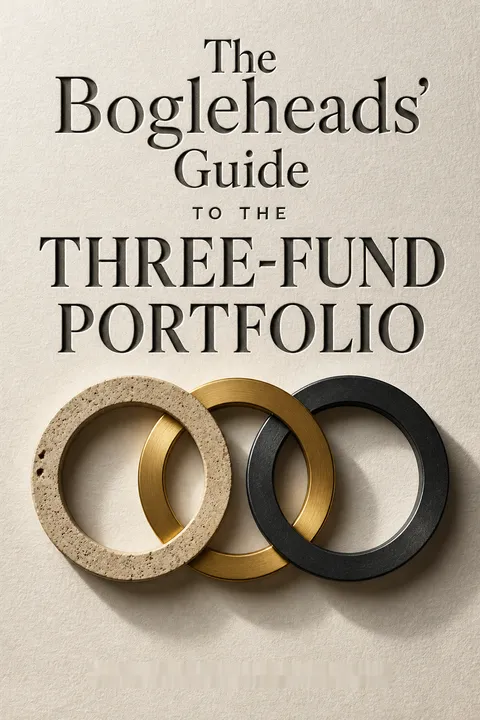
Three broad building blocks. The Three-Fund Portfolio combines a total U.S. stock market index fund, a total international stock market index fund, and a total U.S. bond market index fund. Each fund holds a broad range of securities within its market, rather than relying on a manager to select a small group of likely winners. Larimore describes the three funds as holding more than 17,000 securities when the book was written.
Choose the proportions. The funds do different jobs: stocks provide exposure to company growth, while bonds can reduce portfolio volatility. The investor chooses the stock-bond mix according to goals, time horizon, finances, and ability to tolerate losses. The book’s central claim is that this compact structure can deliver broad diversification without a crowded lineup of specialized funds.
The strategy is simple in construction, not simplistic in logic. A total-market fund uses the market’s collective pricing to determine which securities receive more weight, avoiding the need to forecast individual companies. This makes the portfolio a practical expression of humility: it does not claim to know which businesses will lead. Its limits matter, though. Broad diversification cannot prevent market-wide losses, and a U.S. bond fund does not diversify away every risk in a person’s finances.
Treat winning streaks as evidence of luck, not a repeatable edge
Yesterday’s winner can stumble. Larimore’s repeated search for top-performing funds taught him that recent success is a poor reason to buy. He describes Bill Miller’s Legg Mason fund, which beat the S&P 500 for 15 consecutive years, then ranked near the bottom of its category over the following 15 years. The book connects this reversal to reversion to the mean: unusually strong or weak results tend to move closer to average over time.
The odds favor broad exposure. The 2017 SPIVA scorecard reported that, over the previous 15 years, 83.7% of large-cap managers and more than 90% of mid-cap and small-cap managers trailed their benchmarks. The lesson is not that no manager can outperform, but that identifying repeatable skill in advance is difficult.
The fund example makes survivorship bias visible: investors hear about the celebrated streak, while failed funds may be merged, closed, or forgotten. That creates a distorted picture of how easy it is to select a winner. The book’s evidence supports skepticism about performance chasing, not a claim that active management can never succeed. Some managers do outperform for stretches. The hard question is whether their skill can be identified beforehand, after costs, rather than explained convincingly in hindsight.
Cut recurring investment costs before chasing another fraction of return
Small fees compound against you. Fund expenses, trading costs, and advice fees reduce what investors keep year after year. A cost comparison in the book, based on a 2014 study, estimated total annual expenses of 2.27% for actively managed funds and 0.06% for index funds. These figures are historical estimates, not universal rates, but they illustrate how a seemingly small annual difference can grow.
The long view changes the math. The book estimates that investing $25,000 for 30 years at a 6% annual return while paying a 1% yearly fee would forfeit more than $35,500 in gains. Indexing does not guarantee a particular return. It does make it easier to avoid paying for stock selection that may not improve results.
Costs are unusually actionable because investors can often know them in advance, unlike future returns. This creates an asymmetry: a fee is a dependable deduction, while the promised outperformance that supposedly justifies it is uncertain. The compounding example gives that asymmetry a human scale. Yet cost should not be the only measure of value. A qualified, conflict-free adviser may help with taxes, retirement withdrawals, or behavior in a downturn. The relevant comparison is the service received against its full cost.
Choose a stock-bond mix you can hold through a 50% fall
Allocation sets the ride. The book presents asset allocation, especially the stock-bond balance, as a major determinant of a portfolio’s risk and expected return. Historical figures for 1926 to 2015 show the tradeoff: a 100% stock portfolio averaged 10.1% annually but had a worst single-year return of minus 43.1%. A 60% stock, 40% bond portfolio averaged 8.7%, with a worst year of minus 26.6%.
Averages hide painful stretches. In the 2008 bear market, the U.S. total stock fund fell 50.9% and took 37 months to recover its previous value. Larimore offers age in bonds as a rough starting point, not a rule. The right allocation is one an investor can maintain through losses, given their goals and resources.
The most useful risk measure here is not a chart’s volatility statistic, but the investor’s likely behavior when the account balance drops sharply. A theoretically higher-return allocation is no advantage if fear causes a sale at depressed prices. At the same time, comfort alone cannot set the plan: too little stock exposure may make long-term goals harder to fund. Allocation must reconcile emotional capacity with financial need, and historical worst years cannot define the worst future year.
Treat international stocks as diversification, not a bet on tomorrow’s leader
No country leads forever. The book recommends that U.S. investors consider putting about 20% of their stock allocation in international equities. That is a share of the stock portion, not 20% of the whole portfolio. Larimore presents it as a compromise: John Bogle was comfortable with no international stocks but suggested limiting them to 20% of equities, while a Vanguard study supported at least that amount.
Past returns cannot settle the debate. From 1994 to the period discussed in the book, the S&P 500 rose much more than the EAFE index of international stocks. Bogle acknowledged that U.S. leadership might continue, or that performance might shift. The point is not to forecast which region wins next, but to decide whether exposure beyond one country fits the investor’s plan.
International exposure is the portfolio’s clearest allocation dispute, and the disagreement is instructive: sound investors can accept the same evidence yet choose different weights. Diversification spreads dependence across economies, but it does not guarantee lower volatility in every period or protection from currency and political risks. The book’s proposed 20% is a reasoned compromise, not a uniquely correct answer. Investors should distinguish a deliberate diversification choice from a tactical bet based on recent U.S. or overseas performance.
Rebalance against your target when markets tempt you to panic or chase
A rule interrupts emotion. Rebalancing means adjusting holdings when market movements push a portfolio away from its chosen stock-bond mix. In a bull market, rising stocks can make an investor feel that more stock exposure is safe. In a bear market, falling prices can make selling feel urgent. A predetermined allocation helps prevent either mood from rewriting the plan.
Use contributions as a lever. The book suggests considering a rebalance when the stock allocation drifts beyond roughly 5% to 10% of its target. Investors can direct new contributions toward the underweight fund, or make exchanges where appropriate. During a downturn, restoring the target may mean buying stocks after they have fallen. In taxable accounts, selling appreciated holdings can create a tax bill, so the method matters.
Rebalancing is valuable partly because it replaces a forecast with a maintenance rule. It can also counter two familiar biases: chasing what has risen and avoiding what has fallen. But it is not a magic return enhancer, and frequent trading can add taxes and costs. A tolerance band helps avoid needless adjustments. Using new contributions first is often a cleaner way to restore balance, though withdrawal needs and account types can change the practical choice.
Place assets with taxes in mind before selling appreciated holdings
Account location matters. The book favors placing broad stock funds in taxable accounts when necessary because they tend to distribute fewer taxable gains than actively traded funds. It generally places bond funds in tax-advantaged accounts, where interest is not taxed annually. If those accounts are full, it notes that a tax-exempt bond fund may suit some taxable investors, depending on their tax bracket and state.
Avoid an expensive cleanup. Selling appreciated investments in a taxable account can trigger capital-gains taxes, so switching portfolios deserves a calculation before any sale. In retirement accounts, changing funds generally does not create the same immediate tax bill. The book also advises taking an available employer match and choosing between traditional and Roth accounts with attention to current and expected future tax rates. Tax rules change, so details require current verification.
Tax efficiency is not an afterthought; it is part of the return an investor actually keeps. The distinction between choosing a fund and choosing its account location is easy to miss, especially when a portfolio spans workplace plans and taxable accounts. The book is strongest when it warns against treating simplification as an excuse to sell everything immediately. Its specific tax limits and rules are tied to its publication era, so the durable lesson is to consider taxes before trading, not to rely on dated thresholds.
Keep the plan simple enough for you and your heirs to maintain
Complexity creates failure points. Larimore describes a new investor who held 90 overlapping securities and thought the main problem was tracking them. In fact, the portfolio was costly and hard to understand, while a few broad funds could provide wider exposure. More holdings can mean more paperwork, rebalancing decisions, tax complications, and chances to abandon a sound plan.
Make the plan usable. Larimore says his own three-fund portfolio takes about an hour a year to manage, including checking accounts and reviewing allocations. He also values the fact that a caregiver or heir could understand it. Investors whose workplace plans lack the three funds can consider suitable low-cost index options, or a target-date fund whose underlying allocation fits their needs.
Simplicity is a form of risk control because a portfolio must be understandable enough to survive ordinary life: illness, distraction, market panic, or a change in who manages the money. That benefit extends beyond returns to household resilience. Still, fewer funds do not automatically mean a better plan. A target-date fund or a professional adviser can be more useful for some people, provided the costs and allocation are clear. The test is whether the arrangement is durable and comprehensible, not whether it has exactly three holdings.
Analysis
The book’s deepest contribution is not the number three. It is a shift in what counts as investment competence. Instead of proving cleverness by selecting securities, the investor builds a portfolio that captures broad market returns, limits avoidable costs, and reduces opportunities for self-inflicted damage. Larimore’s autobiographical account makes this an earned conviction rather than an abstract slogan: stock tips, performance rankings, newsletters, and market forecasts each offered an appealing shortcut, but none gave him a reliable edge.
The argument is strongest when it separates controllable inputs from unknowable outcomes. Fees, diversification, allocation, and trading behavior can be managed; next year’s winning country or fund manager cannot be known with confidence. This also explains why the strategy’s behavioral benefits matter. A portfolio that an investor understands may be easier to hold during a severe decline than one assembled from a string of fashionable bets.
The evidence requires careful framing. The book’s expense ratios, tax rules, fund statistics, and performance comparisons reflect data available around 2017 and 2018. They should not be treated as current quotations or as proof that index funds outperform in every period. Market-cap-weighted funds still bear equity-market risk, and the proposed international allocation is a judgment rather than a settled law. Nor does a three-fund portfolio specify how much to save, how to handle debt, or how to plan for every withdrawal and tax situation.
The strategy is therefore best understood as a robust default for long-term investors, not a universal prescription or a guarantee. Its central discipline is to accept that market returns are uncertain while refusing to pay heavily for the illusion of control. A simple portfolio succeeds only when its allocation suits the investor and the investor can stay with it.
Review Summary
The Bogleheads' Guide to the Three-Fund Portfolio receives mixed reviews. Many praise its simplicity and effectiveness for beginner investors, highlighting the merits of passive index fund investing. Critics argue it lacks depth, reads like a Vanguard sales pitch, and contains excessive testimonials. Readers appreciate the book's concise explanation of the three-fund strategy but note that much of the information is available online for free. Some find it too US-centric and wish for more comparative analysis. Overall, it's seen as a quick, informative read for those new to the Bogleheads' philosophy.
People Also Read







Glossary
Three-Fund Portfolio
Three broad index fundsA portfolio built from a total U.S. stock market index fund, a total international stock market index fund, and a total U.S. bond market index fund. The investor selects the proportions according to goals, time horizon, finances, and tolerance for losses. Its purpose is broad market exposure with relatively low cost and limited maintenance.
Total Market Index Fund
Broad market exposureA mutual fund or exchange-traded fund designed to hold nearly all investable securities in a defined market category, rather than selecting a narrow set of companies. In this book, total market funds cover U.S. stocks, international stocks, or U.S. bonds. Holding a broad market reduces dependence on any one company, sector, or fund manager.
Reversion to the Mean
Extreme results move toward averageThe tendency for unusually strong or weak performance to become less extreme over time. In the book, this idea explains why a fund that recently ranked near the top may later perform closer to, or below, its category average. It cautions investors against assuming that past winners will continue to outperform.
Asset bloat
Fund growth strains investingA problem that can arise when a popular actively managed fund attracts so much new money that the manager has difficulty investing it without disrupting the strategy. Large trades can move security prices, transaction costs may rise, and suitable investment opportunities may become harder to find. The book argues that broad total-market index funds are less vulnerable to this problem.
Index front running
Trading ahead of index changesTrading that anticipates purchases or sales an index fund must make when a security enters or leaves its benchmark. Other traders may buy before the fund’s required purchase or sell before its required sale, moving prices against the index fund. The book argues that a total-market fund is less exposed because it generally continues to hold a security as it shifts between market categories.
Tracking error
Fund return differs from benchmarkThe difference between a fund’s return and the return of its chosen benchmark index. An index fund aims to keep this gap small. A large or persistent difference can make an investor’s results diverge from the market they intended to own, and may tempt them to switch strategies.
Style drift
Fund strays from stated styleA change in a fund’s actual investment characteristics relative to its stated focus, such as a shift from small-company stocks toward larger companies or from value stocks toward growth stocks. The book argues that total-market funds reduce this concern by holding securities across styles within their broad market category.
SPIVA Scorecard
Active fund benchmark comparisonA recurring report from S&P Dow Jones Indices comparing actively managed funds with relevant index benchmarks. The book cites its year-end 2017 results to show that large majorities of U.S. stock fund managers underperformed their benchmarks over the previous 15 years. The scorecard also accounts for funds that merged or closed, which helps expose survivorship bias.
Cost Matters Hypothesis
Costs reduce investor returnsJohn Bogle’s principle that an investor’s net return is the market’s gross return minus the costs of investing. Because investors collectively own the market, active investors as a group cannot all outperform it before costs; their higher expenses reduce what they keep. Low-cost indexing seeks to preserve more of the market return for investors.
FAQ
What's "The Bogleheads' Guide to the Three-Fund Portfolio" about?
- Simple Investment Strategy: The book by Taylor Larimore explains how a simple portfolio of three total market index funds can outperform most investors with less risk.
- Focus on Index Funds: It emphasizes the use of low-cost index funds to achieve broad market exposure and diversification.
- Investment Philosophy: The book is rooted in the Boglehead investment philosophy, which advocates for simplicity, low costs, and long-term investing.
- Educational Resource: It serves as a guide for both novice and experienced investors looking to streamline their investment strategy.
Why should I read "The Bogleheads' Guide to the Three-Fund Portfolio"?
- Proven Strategy: The book presents a strategy that has historically outperformed most actively managed funds.
- Simplicity and Efficiency: It offers a straightforward approach to investing that reduces complexity and maintenance.
- Expert Endorsements: The strategy is endorsed by financial experts and is based on the principles of John C. Bogle, the founder of Vanguard.
- Financial Literacy: Reading the book can enhance your understanding of investment principles and improve your financial literacy.
What are the key takeaways of "The Bogleheads' Guide to the Three-Fund Portfolio"?
- Three-Fund Portfolio: The core strategy involves investing in three total market index funds: U.S. stocks, international stocks, and U.S. bonds.
- Low Costs Matter: Keeping investment costs low is crucial for maximizing returns over the long term.
- Diversification Benefits: The three-fund approach provides broad diversification, reducing risk and increasing the likelihood of achieving investment goals.
- Stay the Course: The book emphasizes the importance of maintaining your investment strategy through market ups and downs.
What are the best quotes from "The Bogleheads' Guide to the Three-Fund Portfolio" and what do they mean?
- "Simplicity is the master key to financial success." This quote underscores the book's central theme that a simple investment strategy can be more effective than complex ones.
- "Stay the course." This mantra, repeated throughout the book, highlights the importance of sticking to your investment plan despite market volatility.
- "You get to keep exactly what you don’t pay for." This emphasizes the impact of low costs on investment returns, a core principle of the Boglehead philosophy.
- "The majesty of simplicity." This phrase captures the elegance and effectiveness of the three-fund portfolio approach.
How does the Three-Fund Portfolio work?
- Three Funds: The portfolio consists of a U.S. Total Stock Market Index Fund, a Total International Stock Index Fund, and a Total Bond Market Index Fund.
- Diversification: These funds provide exposure to thousands of securities, offering broad diversification across different asset classes and geographies.
- Low Maintenance: The simplicity of the portfolio means it requires minimal management and rebalancing.
- Cost Efficiency: By using low-cost index funds, investors can minimize fees and maximize their net returns.
What is the Boglehead Investment Philosophy?
- Long-Term Focus: The philosophy emphasizes long-term investing rather than short-term speculation.
- Cost Awareness: It stresses the importance of keeping investment costs low to enhance returns.
- Diversification: The philosophy advocates for broad diversification to reduce risk.
- Simplicity and Discipline: Investors are encouraged to maintain a simple investment strategy and stay disciplined through market fluctuations.
Why are low-cost index funds recommended in the book?
- Cost Efficiency: Index funds typically have lower expense ratios compared to actively managed funds, which can significantly impact long-term returns.
- Market Performance: Index funds aim to match the performance of the market, which historically outperforms most actively managed funds.
- Reduced Risk: By investing in a broad market index, investors reduce the risk associated with individual stock selection.
- Simplicity: Index funds simplify the investment process, making it easier for investors to manage their portfolios.
What are the benefits of the Three-Fund Portfolio?
- Broad Diversification: The portfolio provides exposure to a wide range of asset classes and geographies, reducing risk.
- Simplicity: With only three funds, the portfolio is easy to manage and rebalance.
- Cost Savings: The use of low-cost index funds minimizes fees, enhancing net returns.
- Consistent Performance: The portfolio is designed to deliver consistent, market-matching returns over the long term.
How does the book address market volatility?
- Stay the Course: The book advises investors to maintain their investment strategy during market ups and downs.
- Rebalancing: It suggests rebalancing the portfolio periodically to maintain the desired asset allocation.
- Long-Term Perspective: Investors are encouraged to focus on long-term goals rather than short-term market fluctuations.
- Emotional Discipline: The book emphasizes the importance of avoiding emotional reactions to market changes.
What role does asset allocation play in the Three-Fund Portfolio?
- Risk Management: Asset allocation determines the balance between stocks and bonds, which affects the portfolio's risk and return profile.
- Customization: Investors can adjust the allocation based on their risk tolerance, investment goals, and time horizon.
- Rebalancing Needs: The book discusses the importance of rebalancing to maintain the desired asset allocation over time.
- Impact on Returns: The allocation between asset classes is a key determinant of the portfolio's overall performance.
How does the book suggest handling taxes in the Three-Fund Portfolio?
- Tax Efficiency: The book highlights the tax efficiency of index funds, which tend to have lower turnover and fewer taxable events.
- Account Types: It discusses the benefits of using tax-advantaged accounts, such as IRAs and 401(k)s, to minimize tax liabilities.
- Tax-Loss Harvesting: The book suggests strategies like tax-loss harvesting to offset gains and reduce taxable income.
- Qualified Dividends: It explains the tax advantages of qualified dividends, which are taxed at a lower rate.
What are the common misconceptions about investing that the book addresses?
- Complexity Equals Success: The book challenges the notion that complex investment strategies are superior, advocating for simplicity instead.
- Market Timing: It dispels the myth that investors can consistently time the market to achieve better returns.
- High Fees Justify Better Performance: The book argues that higher fees do not necessarily lead to better investment outcomes.
- Active Management Superiority: It provides evidence that passive index investing often outperforms active management over the long term.
About the Author
Other books by Taylor Larimore


Download PDF
Download EPUB
.epub digital book format is ideal for reading ebooks on phones, tablets, and e-readers.








