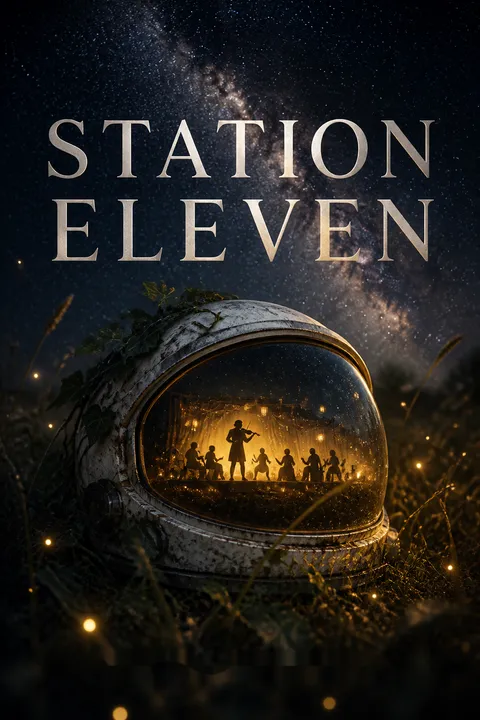


Plot Summary
A King Falls in Snow
During a Toronto performance of King Lear, actor Arthur Leander falters, loses his place, and collapses beneath falling stage snow. Jeevan Chaudhary, a former paparazzo now training as a paramedic, climbs onto the stage and performs CPR, but Arthur dies. While the theater empties, Jeevan comforts eight-year-old Kirsten Raymonde, one of the child actors, and recognizes how badly he wants work that matters.
Outside, a friend from the hospital, Hua, warns that a fast-moving flu has overwhelmed Toronto General and is spreading through the city. Jeevan buys water, food, and medicine, then pushes his supplies through the storm to his wheelchair-using brother, Frank. The sudden epidemic turns a theater death into the first night of a new world.
The stage makes a public death look briefly like part of a performance, until Jeevan steps across the boundary between watching and acting. His choice matters twice: he cannot save Arthur, but he discovers a vocation in the attempt, then uses the same impulse to take Hua's warning seriously. The snow links theatrical artifice to the real storm outside, while the crowd's retreat into gossip and routine shows how quickly attention can become a form of evasion. Kirsten's first encounter with catastrophe is mediated by a stranger's practical kindness, an early model of care that survives the institutions around them.
The City Goes Dark
Jeevan seals Frank's apartment against the flu and listens as broadcasts dwindle, traffic locks solid, and electricity and running water fail. The brothers ration their stockpile while Frank keeps writing a memoir for a client who is almost certainly dead.
With food running low and the building growing dangerous, Frank decides he will not leave his wheelchair behind or make Jeevan carry him through the city. He takes sleeping pills, leaving Jeevan to walk out alone. Following the frozen lakeshore, Jeevan encounters a handful of survivors, then continues south through empty towns and abandoned houses.
He eventually settles in a small community, trains under a local doctor, and becomes the person neighbors seek when injuries need treating. He marries Daria and builds a family in the diminished world.
The brothers' apartment is both shelter and a shrinking model of the old social order: supplies remain only because unseen labor once replenished them. Frank's writing preserves a work obligation after its audience and employer have vanished, while Jeevan's repeated practical improvisations turn fear into service. Their separation is not a heroic escape but a painful negotiation with bodily limits and love. Years later, Jeevan's medical work answers the vocation first awakened at Arthur's death, though without hospitals or anesthesia it means accepting that care cannot restore the protections civilization once made ordinary.
Miranda Draws Another World
Years before the pandemic, Miranda Carroll leaves her controlling, increasingly cruel boyfriend, Pablo, and begins a relationship with actor Arthur Leander, whom she first met through their shared island home. She marries Arthur and moves into his glamorous Hollywood life, but her private work on a graphic novel, Station Eleven, remains the truest expression of herself.
At an anniversary dinner, she sees Arthur's attention turning toward his costar, Elizabeth Colton, and understands that their marriage has already ended emotionally. Miranda later returns to Toronto, rebuilds her career in shipping, and keeps drawing in hotel rooms.
When she and Arthur meet again, eleven years after their divorce, she gives him printed copies of her comics. Her imagined space station, with its damaged home and trapped inhabitants, becomes a small inheritance neither of them can yet understand.
Miranda's art is not an escape from reality so much as a method of making a life she can inhabit. The Undersea, whose people wait for a lost home, anticipates her own struggle to distinguish attachment from entrapment: Pablo's apartment, Arthur's celebrity household, and even a successful career can each become a world someone else has arranged. Her return to independent work is a quiet act of authorship, not a simple rejection of intimacy. The comics gain emotional force because they are made privately, before anyone knows they will outlast the culture that dismissed them as an eccentric side project.
Arthur's Last Unfinished Plans
In the weeks before the outbreak, Miranda visits Arthur in Toronto after learning that his father has died. He admits that his published letters to an old friend expose parts of his private life, then listens as Kirsten, a child actor, talks about the comics. Miranda sends Arthur a clouded-glass paperweight; he passes it to Tanya, the theater's child wrangler, who will give it to Kirsten after his death.
On his final day, Arthur plans to move near his son, Tyler, in Jerusalem, and offers to clear Tanya's student debt. He phones Tyler, hears him explain the Station Eleven story, and tries to bridge their distance. Arthur goes onstage exhausted and full of regret. His death, already witnessed by Jeevan, leaves his plans unfinished.
Arthur's celebrity has made him visible to millions while leaving the intimate work of friendship and fatherhood repeatedly postponed. His late attempts to help Tanya and reconnect with Tyler are sincere, but the timing exposes the limits of good intentions when affection is treated as something that can always be resumed later. The paperweight travels through this network of imperfect relationships, carrying beauty without practical value and surviving where reputation cannot. By giving Kirsten the comics, Arthur unknowingly connects his final performance to Miranda's private imagination and to a future audience that will preserve both.
The Airport Keeps Watch
Arthur's longtime friend Clark Thompson boards a flight to Toronto with Elizabeth Colton and her son Tyler, but the plane diverts to Severn City Airport as the Georgia Flu spreads. The passengers expect rescue; instead, flights stop, broadcasts cease, and most people leave or die.
Those who remain share food, hunt, and make the terminal a settlement. Clark begins collecting objects from the vanished world, founding a Museum of Civilization in the airport lounge. Elizabeth keeps a runway clear, convinced the stranded will be rescued, while Tyler grows preoccupied with religious explanations for the pandemic.
In the second year, Elizabeth and Tyler depart with a group of religious wanderers. Clark cannot stop them. The museum becomes his answer to loss: he gives the dead and their vanished world a place to be remembered.
The airport begins as a space built for temporary passage, which makes its conversion into a home an especially sharp measure of historical rupture. Clark's museum transforms objects once treated as disposable into evidence of the human systems that made them: manufacture, transport, and shared knowledge. Elizabeth's hope protects her from despair but narrows into a certainty her son can inherit. Clark's failure to intervene is not indifference; it reflects the exhaustion of people who can barely preserve their own lives, let alone rescue one another from grief or belief.
The Prophet's Graveyard
Twenty years after the collapse, Kirsten travels with the Traveling Symphony, a company of actors and musicians moving between small settlements with Shakespeare and orchestral music. In St. Deborah by the Water, she expects to find her friends Charlie and Jeremy, who stayed there with their baby.
Instead, the town is guarded, the people avoid questions, and markers bearing the family's names stand over empty ground. A midwife warns that a prophet has taken control and that Charlie and Jeremy fled after resisting him.
After a performance, the prophet preaches that the flu was divine judgment and demands that the Symphony leave Alexandra behind as a future bride. The Conductor leads the company out. A twelve-year-old girl, Eleanor, secretly hides in a caravan, escaping the prophet's planned marriage.
The grave markers reveal how power in this settlement works through control of memory as well as bodies: the town can declare its escapees dead and make that fiction socially binding. The prophet's sermon recasts mass death as proof of moral selection, turning survivors' fear into obedience and outsiders into enemies. The Symphony's performance briefly creates a public space where people can gather without submitting to his story, but its refusal to surrender Alexandra makes art a practical risk. Eleanor's escape forces the company to abandon its customary neutrality and accept responsibility for someone vulnerable.
The Symphony Splinters
Eleanor tells the Symphony that Charlie and Jeremy hoped to reach the Museum of Civilization at Severn City Airport, so the company turns south. The prophet's followers pursue them. During a night watch, Kirsten and August hear a disturbance but find no trace of Dieter or Sayid; soon the clarinet also disappears.
The company searches, then follows its separation protocol toward the airport rather than risk everyone in the forest. Unknown to Kirsten and August, the clarinet wakes bound among the captors, escapes, and reaches the Symphony with a warning.
She has learned that the prophet's men intend to force a trade for Eleanor. The Conductor changes course, but Kirsten and August are away fishing when the caravans leave. They return to an empty road with no sure way to follow.
The disappearances fracture more than a traveling troupe: they attack the relationships that have made the Symphony a home. Its protocol is a hard-won form of collective trust, allowing the group to move rather than letting panic endanger everyone. Yet the same discipline leaves Kirsten and August behind, showing that survival systems can protect a community while painfully separating individuals. The clarinet's escape is an act of skilled resistance, and her warning gives the Conductor a chance to protect the larger group. Information, not strength alone, determines who can move safely through this world.
Two Travelers Find the Trail
Kirsten and August continue south alone, carrying supplies through overgrown streets and sleeping in abandoned yards. They find a remarkably untouched house, where the dead family's rooms, a child's Starship Enterprise toy, and a stack of old magazines make the past feel briefly inhabited.
One magazine shows Miranda Carroll, while a symbol Kirsten recognizes on a survivor's scar resembles an airplane. At a roadside station, Finn confirms that Charlie and Jeremy left St. Deborah and that the prophet's people are dangerous.
He has no account of where the family went, but points the travelers toward Severn City. As they approach, Kirsten and August hear that the Prophet's group may be following them. The airport remains their only destination, though the Symphony has vanished from the route.
The untouched house reverses the usual scavenging encounter: instead of a storehouse stripped for use, it confronts the travelers with a family's preserved intimacy and the unanswered question of how its members died. The child's toy and Miranda's image link personal memory to public history without restoring either world. Kirsten's ability to read the scar as an airplane shows how objects and marks become a new kind of map. Their journey depends on treating fragments seriously, while accepting that evidence rarely provides the whole story.
The Prophet Is Tyler
Near Severn City, Kirsten and August rescue Sayid from the prophet's armed followers, but learn that Dieter died in captivity and the clarinet escaped. The surviving attackers want Eleanor returned to the Prophet, whom they call her rightful owner.
Kirsten and August later hide as the Prophet's party catches up. He recognizes Kirsten from the Shakespeare performance and holds her at gunpoint. The Prophet is Tyler, Arthur's son, who left the airport years earlier with Elizabeth and grew into the leader of a violent religious group.
A young follower, shaken by what he has done in the Prophet's name, shoots Tyler and then kills himself. The Symphony's scouts arrive moments later. In Tyler's Bible, Kirsten finds a torn page from Miranda's comic, a final link between the Prophet and the family he abandoned.
Tyler's transformation is the novel's most devastating inheritance: a child who once sought meaning in catastrophe grows into someone who makes catastrophe serve his authority. The Prophet's theology turns vulnerability into a hierarchy of the pure and impure, allowing coercion to masquerade as cosmic necessity. His follower's refusal comes too late to undo the violence and ends in another death, so the climax offers no clean moral victory. The comic page complicates judgment by returning Tyler to the private world of his parents and his childhood, not to excuse him, but to show what his chosen identity has buried.
A Lit Town Beyond
Kirsten, August, and the injured Sayid reach Severn City Airport, where Charlie, Jeremy, and their daughter Annabel are among the residents. Kirsten grieves Dieter and has another knife tattoo added to mark the man she killed.
Clark welcomes her into the Museum of Civilization and recognizes the connection between the Prophet, Elizabeth's son, and Arthur's legacy. The Symphony arrives later, bringing music back to the settlement. Clark gives Kirsten a view from the air traffic control tower: a distant town glowing with electric lights.
The Symphony prepares to travel toward it, and Kirsten entrusts Clark with one of her precious comics. After they depart, Clark recognizes a scene in Miranda's work drawn from an old Hollywood dinner party. The world has not returned, but its separate communities are beginning to connect.
The reunion does not undo loss: Kirsten reaches her friends without Dieter, and the new tattoo records violence rather than converting it into triumph. Yet the airport joins several kinds of preservation, Clark's museum, the Symphony's living performance, and Miranda's imagined world. The distant electric lights matter not as a promise to recreate the past but as evidence that human knowledge and cooperation can reappear in altered forms. Clark's recognition of the dinner party folds private memory into art, while the departing caravans turn remembrance toward curiosity about other communities.
Analysis
Station Eleven treats civilization not as a permanent achievement but as a dense arrangement of human labor, memory, and mutual dependence. The Georgia Flu destroys the visible systems first, hospitals, transport, electricity, and communication, but the novel's deeper concern is what survives when those systems no longer tell people what to do. Jeevan discovers usefulness through emergency care; Clark turns preservation into a vocation; Kirsten and the Symphony make performance part of communal life. These are not equivalent forms of rebuilding. One treats wounds, one guards evidence, and one creates shared attention, yet each resists the idea that survival is merely staying alive.
The novel also distinguishes memory from history. Kirsten's childhood recollections are fragmentary, while Clark remembers a world whose devices have become almost mythical to the young. Miranda's comics sit between those conditions: made before the collapse, they become both an artifact and a tool for interpreting it. The Prophet's use of religious certainty and the airport's museum show two competing ways to explain catastrophe. One converts survival into proof of moral superiority; the other preserves evidence while admitting that it cannot explain why some lived and others died. The book is suspicious of stories that make suffering seem deserved.
Its interwoven lives make intimacy a form of historical connection. Arthur's neglect of relationships, Miranda's independent art, Tyler's search for meaning, and Clark's belated recognition of his own passivity all reveal how people can be surrounded by others yet fail to truly attend to them. After the collapse, attention becomes practical: staying with a frightened child, sharing knowledge, remembering the dead, or carrying a comic across dangerous miles. The ending offers neither a return to modernity nor a guarantee of safety. A distant electric grid matters because it suggests possibility, not restoration. The novel's hope is therefore disciplined: people cannot recover everything, but they can make beauty, community, and knowledge matter again.
Review Summary
Station Eleven is a post-apocalyptic novel that has deeply impacted readers with its haunting portrayal of a world devastated by a pandemic. Many praise Mandel's beautiful prose, intricate character connections, and exploration of art's importance in survival. The non-linear narrative and focus on human resilience rather than the apocalypse itself sets it apart from typical dystopian fiction. While some found it slow-paced or disjointed, most readers were captivated by its themes of memory, loss, and hope. The novel's ability to make readers appreciate life's simple pleasures is frequently noted.
People Also Read






Characters
Kirsten Raymonde
The knife-bearing actressKirsten is a child actor in the Toronto production of King Lear when the Georgia Flu begins, and later a central performer in the Traveling Symphony. She remembers little of her childhood before the collapse, but holds tightly to the comics Arthur gave her and the paperweight she received after his death. Acting gives her a form of presence that the dangerous road rarely permits; knives give her a means of surviving it. She is observant, guarded, and capable of tenderness, though grief often reaches her first as anger or action. Her attachment to the Symphony comes from more than shared work: it is the closest thing she has to family and a stable home.
Jeevan Chaudhary
The reluctant first responderJeevan begins as a former photographer and paparazzo searching for work that feels useful. When Arthur collapses onstage, Jeevan is the audience member who climbs up to perform CPR, and the failed rescue clarifies what he wants from his life. He is anxious, imaginative, and prone to overthinking, but crisis makes him act: he believes Hua's warning, gathers supplies, and later walks out into an unfamiliar world. His instinct is to help even when he cannot control the outcome. That impulse shapes his relationships with Frank, the survivors he meets, and the settlement where he eventually becomes a healer.
Arthur Leander
The actor seeking homeArthur is a celebrated actor from a small British Columbia island who spends much of his life moving between places and identities. His fame brings attention but not ease; he remains preoccupied with the childhood home he escaped and the people he has failed to keep close. His marriages, friendship with Clark, and distance from his son Tyler reveal a man capable of real affection who often mistakes later intentions for present care. Acting gives him a temporary structure in which to inhabit other lives, while his private letters and Miranda's comics preserve versions of himself that his public image cannot.
Miranda Carroll
The artist in transitMiranda is an artist who supports herself through work in the shipping industry while quietly building the graphic-novel world of Station Eleven. Her calm at the office contrasts with the instability of her relationships and the demands of celebrity life. She is private, disciplined, and more independent than she first believes; drawing gives her a space that belongs to her alone. Her relationship with Arthur links her to a public world she never fully inhabits, while her work registers questions of exile, home, and waiting. The comics she creates outlast the conditions in which she made them.
Clark Thompson
The airport's memory keeperClark is Arthur's oldest friend, a British organizational psychologist whose professional life revolves around helping executives change their behavior. He is perceptive about others but slow to notice when his own routines have become a kind of sleepwalking. Stranded at Severn City Airport, he turns his attention to the objects of the former world and becomes the curator of a museum. His habits of observation and classification become acts of care: he makes a place where people can ask what was lost without pretending it can be restored. His friendship with Arthur remains a source of affection, regret, and insight.
Frank Chaudhary
Jeevan's steadfast brotherFrank is Jeevan's older brother, a wheelchair user and former war correspondent who now writes memoirs for clients. His steadiness contrasts with Jeevan's restlessness, and his work gives him a way to maintain order as the world outside becomes incomprehensible. Frank understands the risks of leaving their apartment more clearly than his brother does, but his pragmatism is also shaped by physical limits and memories of war. He and Jeevan share a childhood history that becomes especially important when they face the epidemic together.
Tyler Leander
Arthur's distant sonTyler is Arthur and Elizabeth's son, a thoughtful child whose life is divided between distant parents and a world changing faster than adults can explain. He reads early and finds comfort in books, including religious writing. In the airport, he tries to make the catastrophe intelligible by searching for reasons and moral patterns. That impulse reflects both a child's need for order and the danger of adults leaving difficult questions unanswered. His inheritance includes Arthur's absence, Elizabeth's faith, and the comics that connect him to Miranda's imagination.
Elizabeth Colton
The hopeful motherElizabeth is an actor and Tyler's mother, often described through her beauty and gentle manner. She possesses an optimism that helps her endure uncertainty, but her need to believe events have a purpose can harden into certainty. At the airport, she tries to keep hope alive by imagining rescue and maintaining a runway. Her relationship with Arthur is complicated by his fame, his choices, and their shared responsibility for Tyler. She is not simply naïve: faith gives her a structure for living through loss, even when that structure strains her judgment.
August
The thoughtful violinistAugust is the Traveling Symphony's second violinist, a careful observer who has recently begun acting and secretly writes poetry. He and Kirsten are close friends, bound by years of travel and a clear agreement to keep their relationship platonic. August is drawn to the lost world's traces, especially television and books, and often imagines alternative lives through parallel universes. His reflective nature does not make him passive; he can act decisively when danger comes. He represents both the desire to understand the past and the possibility of choosing a life rooted in companionship.
The Conductor
The Symphony's leaderThe Conductor leads the Traveling Symphony, a community she helped assemble from musicians and actors in the years after the collapse. She balances artistic purpose with practical decisions about routes, supplies, and safety. Her authority rests less on spectacle than on experience and the trust of people who depend on one another. She prefers not to interfere in the settlements the Symphony visits, but she recognizes when neutrality would mean abandoning someone to coercion. Her leadership is a daily negotiation between protecting the group and preserving the reasons they travel.
Sayid
The actor with a sharp edgeSayid is an actor in the Traveling Symphony and Kirsten's former partner. He is witty, proud, and quick to challenge people he distrusts, especially those who hide violence behind pious language. His relationship with Kirsten retains tenderness beneath their bickering, and his loyalty to the Symphony is tested by the dangers on the road. Sayid's humor is not detachment so much as a defense against a world that repeatedly asks him to accept cruelty as inevitable.
Dieter
The actor who remembersDieter is an older actor in the Traveling Symphony who remembers the pre-collapse world clearly and longs for the sounds and comforts that vanished with it. He is a close friend to Kirsten and a steady presence in the company, often arguing with her about art, tattoos, and what makes survival meaningful. His attachment to Shakespeare comes from the recognition that people have used the same stories through very different kinds of hardship. Beneath his teasing manner is a deep awareness of what memory costs.
Charlie Harrison
The Symphony's cellistCharlie is a cellist and one of Kirsten's closest friends in the Symphony. She once stayed behind in St. Deborah by the Water with her partner, Jeremy, and their baby, hoping to build a life there. Her love of music and motherhood are bound to the practical choices of settlement and travel. Charlie is warm but not untouched by the strange pressures of the post-collapse world; she knows that a safe home can become dangerous, and that leaving may be the only way to protect a family.
Jeremy Leung
Charlie's musician partnerJeremy is a musician, Charlie's partner, and the father of their daughter Annabel. He shares the Symphony's habits of travel and performance, but also the responsibilities of building a family in a precarious world. His choices are closely tied to Charlie's and shaped by the need to find safety rather than permanence. Jeremy is a quiet example of how the Symphony's performers are not only artists: they are parents, partners, and people who must decide when a settlement has ceased to be home.
Eleanor
The runaway childEleanor is twelve when she secretly hides in a Traveling Symphony caravan. Orphaned and living under the Prophet's rule, she faces a forced marriage and risks everything to escape. She is wary, frightened, and careful with what she tells strangers, but she carries crucial knowledge of the Prophet's history and the airport settlement. Her presence forces the Symphony to reconsider its policy of staying out of local conflicts. Eleanor's decision to run is a small act of self-preservation in a community that has tried to make her future someone else's property.
The Prophet
The preacher of the lightThe Prophet is a charismatic leader who travels with armed followers and explains the Georgia Flu as divine judgment. He turns survival into a claim of moral superiority, using visions and religious language to establish obedience in the settlements he enters. His calm manner makes his threats more unsettling, because he presents coercion as part of an ordained plan. The Prophet seeks control over people as well as their weapons, and his rhetoric gives followers permission to treat dissent as proof of corruption.
The Clarinet
The resourceful musicianA member of the Traveling Symphony, the Clarinet is both a musician and a capable hunter. She dislikes the company's reliance on Shakespeare, preferring the possibility of creating art that speaks directly to the age she lives in. Her private wish to write a play remains unfinished, but her practical skills become vital when she is separated from the Symphony. She is observant, self-reliant, and less willing than some of her companions to accept inherited traditions without question.
Hua
The hospital warningHua is Jeevan's friend and a physician working in a Toronto hospital. His firsthand account of the Georgia Flu's speed and spread gives Jeevan credible warning before the city understands the scale of the crisis. Hua is direct and careful with his words, which makes his alarm all the more persuasive.
Daria
Jeevan's later partnerDaria is one of the founders of the settlement where Jeevan eventually makes a life. She becomes his wife and shares the work of building a family and community in a world without the old infrastructure. Her presence marks the possibility of intimacy and stability after years of fear.
Tanya
The child actors' wranglerTanya looks after the child actors in the King Lear production and is an important adult presence for Kirsten on the night Arthur dies. She gives Kirsten the glass paperweight, a gift that becomes one of the few objects the girl carries from the former world.
Plot Devices
Station Eleven comics
Art across generationsMiranda's handmade graphic novels imagine a damaged space station and a community divided between those who remain in deep space and those who long to return to Earth. Arthur gives copies to Tyler and Kirsten, making the comics a private connection between people whose lives otherwise diverge. Kirsten carries them for years, while their images and ideas help her interpret the post-collapse world. The comics also preserve Miranda's work and connect the airport, the Prophet, and Clark's memories of the former world. Their importance comes not from predicting events exactly, but from offering a language for exile, damaged homes, and the longing to return.
The glass paperweight
A portable memoryA lump of glass containing a cloudy miniature storm passes from Clark to Miranda, then through Arthur and Tanya to Kirsten. It has no practical use, which makes it an emblem of the value people assign to beauty and personal history even when survival depends on carrying only essentials. Kirsten keeps it in her small backpack beside water, knives, and the comics. Its physical weight is slight, but its emotional weight connects the night of Arthur's death to a future in which nearly every other object from that world has disappeared.
The Traveling Symphony
Art as living infrastructureThe Traveling Symphony moves between settlements with horse-drawn caravans, performing orchestral music and Shakespeare. It gives communities a rare occasion to gather for something beyond food, security, and labor, while giving its members a shared home and purpose. Its motto insists that mere survival is not enough, but the troupe must continually test that belief against practical dangers. The Symphony's routines, instruments, plays, and separation protocol are both cultural inheritance and survival tools. It carries art through a landscape where the old structures that once supported public life have vanished.
The Museum of Civilization
Objects become testimonyClark's airport museum gathers phones, laptops, shoes, newspapers, and other artifacts from the former world. Items that once seemed ordinary become evidence of the people, labor, and networks that made modern life possible. The museum also gives Clark a vocation after the collapse and allows younger residents to ask about technologies they have never seen working. Its collections do not restore the lost world; they make its scale and fragility imaginable. As newspapers and the Symphony arrive, the museum becomes a point of contact between memory and the communities beginning to form beyond the airport.
Airplanes and flight
A measure of distanceBefore the collapse, airplanes make distant cities and continents feel reachable; afterward, grounded aircraft become shelters, storage spaces, landmarks, and graveside reminders. Kirsten's childhood memory of seeing a city from the air and Dieter's recurring dream of a plane returning express different forms of longing for the lost world. At Severn City Airport, the airplanes preserve a past that younger residents can barely imagine. The late sighting of electric lights beyond the settlement expands the horizon again, suggesting that human communities may be separated yet not entirely unreachable.
FAQ
Synopsis & Basic Details
What is Station Eleven about?
- Post-apocalyptic survival story: The novel follows a group of survivors, primarily members of the Traveling Symphony, as they navigate a world devastated by a flu pandemic, exploring themes of memory, art, and the human spirit.
- Interwoven timelines: The narrative jumps between the pre-pandemic world, focusing on the life of actor Arthur Leander, and the post-pandemic world, following the journeys of characters like Kirsten and Jeevan.
- Exploration of human connection: The story examines how people find meaning and connection in the face of loss and societal collapse, emphasizing the importance of art, relationships, and shared experiences.
Why should I read Station Eleven?
- Thought-provoking themes: The novel delves into profound questions about the nature of civilization, the importance of art, and the human need for connection, making it a compelling read for those who enjoy introspective stories.
- Unique narrative structure: The non-linear timeline and interwoven character arcs create a rich and engaging reading experience, revealing connections and patterns that deepen the story's impact.
- Beautifully written prose: Emily St. John Mandel's lyrical writing style and evocative descriptions create a vivid and immersive world, making the story both haunting and beautiful.
What is the background of Station Eleven?
- Fictional pandemic: The story is set against the backdrop of a fictional pandemic, the Georgia Flu, which rapidly decimates the world's population, leading to the collapse of modern civilization.
- Technological collapse: The pandemic causes a breakdown of technology, including electricity, communication networks, and transportation systems, forcing survivors to adapt to a pre-industrial way of life.
- Cultural and societal shifts: The novel explores the ways in which culture, art, and human relationships are transformed in the aftermath of the collapse, highlighting the enduring need for meaning and connection.
What are the most memorable quotes in Station Eleven?
- "Survival is insufficient": This quote, the motto of the Traveling Symphony, encapsulates the novel's central theme that human life requires more than just basic survival, emphasizing the importance of art, culture, and connection.
- "I stood looking over my damaged home and tried to forget the sweetness of life on Earth": This line from the Dr. Eleven comics reflects the characters' struggle to reconcile their memories of the past with the harsh realities of the present.
- "What was lost in the collapse: almost everything, almost everyone, but there is still such beauty": This quote highlights the novel's exploration of both loss and hope, acknowledging the devastation of the pandemic while also recognizing the enduring beauty of the human spirit.
What writing style, narrative choices, and literary techniques does Emily St. John Mandel use?
- Non-linear narrative: Mandel employs a non-linear structure, interweaving timelines and perspectives to create a complex and layered story, revealing connections and patterns that deepen the reader's understanding.
- Third-person limited perspective: The narrative shifts between the perspectives of various characters, allowing readers to experience the story through different lenses, while maintaining a sense of intimacy and emotional depth.
- Evocative and lyrical prose: Mandel's writing style is characterized by its evocative descriptions, sensory details, and lyrical language, creating a vivid and immersive reading experience that is both haunting and beautiful.
Hidden Details & Subtle Connections
What are some minor details that add significant meaning?
- The paperweight: The glass paperweight with a storm cloud inside, given to Kirsten by Tanya, becomes a recurring symbol of the past and the beauty that can be found even in the midst of chaos, connecting Kirsten to the pre-collapse world.
- The "This webpage is not available" message: The recurring image of this message on a computer screen in Traverse City highlights the loss of the internet and the longing for connection to the past, emphasizing the fragility of technology.
- The lowercase "t" symbol: The symbol spray-painted on boarded-up buildings in St. Deborah by the Water, later revealed to be a stylized airplane, foreshadows the prophet's origins and the importance of the past in shaping the present.
What are some subtle foreshadowing and callbacks?
- Arthur's "The wren goes to't" line: Arthur's misspoken line from King Lear foreshadows his death and the chaotic events that follow, highlighting the fragility of life and the unpredictable nature of fate.
- The mention of the SARS epidemic: Hua's reference to the SARS epidemic in his conversation with Jeevan foreshadows the severity of the Georgia Flu, creating a sense of unease and impending doom.
- The recurring image of snow: The snow falling on stage during Arthur's death and the snowstorm outside the theater create a visual echo that connects the pre- and post-collapse worlds, emphasizing the cyclical nature of time and memory.
What are some unexpected character connections?
- Miranda and Kirsten's shared connection to Arthur: The fact that both Miranda and Kirsten were connected to Arthur Leander, albeit in different ways, highlights the interconnectedness of lives and the enduring impact of a single individual.
- Jeevan and Miranda's brief encounter: The brief encounter between Jeevan and Miranda in Los Angeles, where he takes a photo of her, creates a subtle connection between their lives, foreshadowing their later roles in the story.
- The prophet's connection to the airport: The revelation that the prophet is from the Severn City Airport creates a sense of unease and foreshadows the Symphony's eventual arrival there, highlighting the cyclical nature of the story.
Who are the most significant supporting characters?
- Frank Chaudhary: Jeevan's brother, a journalist who becomes a symbol of the pre-collapse world and its values, his presence highlights the importance of memory and the struggle to find meaning in a changed world.
- Hua: Jeevan's friend and a doctor, his warning about the Georgia Flu sets the plot in motion, and his fear and exhaustion underscore the severity of the pandemic.
- Elizabeth Colton: Arthur's second wife and Tyler's mother, her presence in the story highlights the complexities of relationships and the enduring impact of the past on the present.
Psychological, Emotional, & Relational Analysis
What are some unspoken motivations of the characters?
- Arthur's desire for meaning: Arthur's pursuit of fame and success is driven by a deeper desire for meaning and connection, which he ultimately seeks through his relationships and his art.
- Kirsten's need for connection: Kirsten's obsession with the Dr. Eleven comics and her search for information about Arthur reveal her longing for connection to the past and a sense of belonging in the present.
- Clark's desire for order: Clark's creation of the Museum of Civilization is driven by a need to impose order and meaning on a chaotic world, reflecting his desire to preserve the past and make sense of the present.
What psychological complexities do the characters exhibit?
- Jeevan's anxiety and search for purpose: Jeevan's anxiety attacks and his constant search for a meaningful career reflect his struggle to find his place in the world, both before and after the collapse.
- Miranda's internal conflict: Miranda's internal conflict between her artistic aspirations and her corporate job highlights the tension between creativity and conformity, and her struggle to find her own path.
- The prophet's fanaticism and insecurity: The prophet's rigid ideology and his need for control reveal his deep-seated insecurities and his desire for power, highlighting the dangers of unchecked belief.
What are the major emotional turning points?
- Arthur's death: Arthur's sudden death on stage serves as a catalyst for the novel's events, triggering a chain reaction that leads to the collapse of civilization and the characters' subsequent journeys.
- Jeevan's decision to become a paramedic: Jeevan's decision to become a paramedic after witnessing Arthur's death marks a turning point in his life, as he finds a sense of purpose and meaning in helping others.
- Kirsten's discovery of the grave markers: Kirsten's discovery of the grave markers with Charlie and Jeremy's names is a major emotional turning point, highlighting the loss and uncertainty that pervade the post-collapse world.
How do relationship dynamics evolve?
- Arthur and Miranda's complex relationship: The relationship between Arthur and Miranda is marked by both love and conflict, reflecting the complexities of human connection and the challenges of maintaining relationships in the face of fame and ambition.
- Kirsten and August's platonic bond: The platonic friendship between Kirsten and August provides a source of stability and support in a chaotic world, highlighting the importance of companionship and shared experiences.
- The Symphony's familial dynamic: The relationships within the Traveling Symphony evolve over time, reflecting the challenges and rewards of living and working together in a close-knit community, highlighting the importance of shared purpose and mutual support.
Interpretation & Debate
Which parts of the story remain ambiguous or open-ended?
- The nature of the Undersea: The Undersea in the Dr. Eleven comics remains ambiguous, leaving the reader to wonder about its true nature and its connection to the post-collapse world.
- The prophet's origins and motivations: The prophet's origins and motivations remain somewhat mysterious, leaving the reader to question the nature of his power and the validity of his beliefs.
- The fate of the characters: The ending of the novel leaves the fates of some characters open-ended, allowing readers to imagine their future and the possibilities of the new world.
What are some debatable, controversial scenes or moments in Station Eleven?
- The prophet's actions and beliefs: The prophet's actions and beliefs are controversial, raising questions about the nature of faith, power, and the potential for religious extremism in a post-apocalyptic world.
- The morality of survival: The novel raises questions about the morality of survival, forcing readers to consider the difficult choices that characters must make in order to survive in a world without laws or order.
- The role of art and culture: The novel's emphasis on the importance of art and culture is debatable, prompting readers to consider whether these things are truly essential for human survival or simply a luxury.
Station Eleven Ending Explained: How It Ends & What It Means
- The discovery of the town with electricity: The discovery of the town with electricity at the end of the novel offers a glimmer of hope, suggesting that civilization may be able to rebuild and that the world is not entirely lost.
- The enduring power of art and connection: The novel's ending emphasizes the enduring power of art, memory, and human connection, suggesting that these things are essential for survival and for finding meaning in a changed world.
- The cyclical nature of history: The ending of the novel suggests that history is cyclical, with the possibility of both progress and regression, and that the lessons of the past must be remembered in order to build a better future.
About the Author
Other books by Emily St. John Mandel
Download PDF
Download EPUB
.epub digital book format is ideal for reading ebooks on phones, tablets, and e-readers.








