

Key Takeaways
Treat strategy as a response to people who can disrupt your plan
Conflict changes the task. A plan assumes events will follow an orderly sequence. Strategy begins when other people can frustrate that sequence because their interests differ. It means connecting aims, methods, and available resources while adapting as conditions change. That is why strategy applies to war, politics, business, and other contested settings, but not to every routine task.
Pressure invites a response. In the Exodus story, Moses escalates threats against Pharaoh, who repeatedly signals compliance and then reverses course. The episode illustrates how coercion depends on what a target believes and values, not just on the force available. Yet the story also makes a poor test of strategy: divine intervention shapes Pharaoh's choices, obscuring how much ordinary human judgment explains the outcome.
What's important here is the shift from planning as prediction to strategy as interaction. A plan can be excellent on paper and still fail when another person reacts differently than expected. This connects to game theory, which studies choices that depend on what others are likely to do. The useful caution is that not every disagreement is a strategic contest. Treating routine cooperation as a duel can create the conflict it claims to manage.
Read the opponent's assumptions before choosing force, deception, or retreat
Social intelligence matters. Frans de Waal's observations of chimpanzees at Arnhem Zoo recorded power struggles involving alliances, grooming, and shifting support. Luit gained ground against the dominant male Yeroen partly by recruiting Nikkie. Fighting was limited, and often reflected a change in social relationships rather than causing it. The lesson is that strategic ability grows from understanding who trusts whom and how others may combine.
Cunning is situational. The Greek term mētis means a practical intelligence that anticipates consequences, reads people, and adapts under uncertainty. Sun Tzu applies a similar logic to war, emphasizing information, surprise, and the ability to unsettle an opponent. David's sling illustrates the risk: it worked through speed and surprise, but depended on a single shot and the Philistines accepting the result.
Coalition-building resembles network strategy: an actor's influence depends not only on personal strength but also on ties among other participants. The chimpanzee example makes that social structure visible without romanticizing it. Deception, however, is a fragile asset. Once opponents expect a trick, they adjust, and a reputation for lying can undermine truthful communication too. Practical intelligence therefore includes knowing when guile creates an advantage and when it destroys credibility.
Use force to serve political aims, and stop before overreach
War resists control. Clausewitz's “remarkable trinity” describes the interaction of political purpose, chance, and the violence and emotion unleashed by war. His related term friction names the delays, confusion, and small failures that make real operations harder than plans suggest. These forces explain why battlefield success cannot be assumed to deliver the intended political result.
Choose the kind of struggle. A strategy of annihilation seeks to destroy the enemy's fighting power; a strategy of exhaustion wears resistance down through time and pressure. In 1812, Russia traded territory for time as Napoleon's army advanced. By Borodino, French forces had lost about a third of their original strength, yet the Russian army survived. Napoleon took Moscow but could not force peace, then had to retreat.
This is a powerful corrective to victory measured by territory taken or opponents killed. In modern risk management, a successful operation is judged against its intended outcome and its downstream costs, not by activity alone. The same discipline applies here: identify a stopping condition before momentum turns into overreach. The limitation is that exhaustion can be politically costly and slow. It is not automatically humane, especially when civilians bear the pressure.
Build coalitions that turn battlefield gains into durable political outcomes
Allies add obligations. Athens gained strength through its Delian League, but its demands on allies also generated resentment and instability. During the Peloponnesian War crisis, disputes involving smaller powers helped draw Athens and Sparta toward conflict. A coalition is not simply extra force: its members bring separate interests, expectations, and the possibility of defection.
Resistance needs partners. In May 1940, Britain faced defeat in France and debate over whether to seek terms. Churchill chose to continue fighting without knowing whether the United States would enter the war. He worked to keep Britain in the struggle and cultivate American support. The later coalition with the United States and Soviet Union changed the balance. Military skill mattered, but so did the political work of bringing allies into the fight.
Coalitions are a form of power because they change what each side can credibly do. They also create coordination problems familiar from collective action: members may agree on a threat but disagree about costs, goals, and acceptable compromises. The strategic task is therefore not merely to assemble supporters, but to maintain enough shared purpose for them to act together. That can require concessions, and those concessions may weaken the clarity of the original aim.
Give underdogs leverage through organized pressure, not moral appeal alone
Nonviolence can coerce. Gandhi's 240-mile Salt March challenged British control of salt production and taxation. The campaign did not win its immediate demand, but it drew attention to the injustice and helped establish the Indian National Congress as a political alternative. Its leverage came from public participation and the difficulty of suppressing protest without looking oppressive.
Organization makes pressure last. In Montgomery, Alabama, Black residents boycotted buses after Rosa Parks was arrested. Black riders made up as much as three-quarters of the bus company's customers, creating economic pressure. In Birmingham, organizers combined demonstrations with pressure on downtown businesses, while police brutality amplified public scrutiny. These campaigns depended on local institutions, discipline, and clear targets, not on the assumption that opponents would simply become kinder.
Nonviolent action is strategically interesting because it converts an imbalance in physical force into political and economic costs. Its moral credibility can attract observers, but it also depends on organization, endurance, and an opponent vulnerable to public pressure. The method is not universal: a regime willing to use extreme repression may not be embarrassed into compromise. Ethical commitment and strategic feasibility must therefore be assessed together, especially when followers face the risks.
Build feedback into plans before reality forces a costly reset
Planning can become a trap. Frederick Taylor sought a single most efficient method for each task, dividing thinking from doing and treating workers as components to be managed. Later, corporate planners tried to extend this confidence into elaborate long-range systems. Ansoff's models sought to account for a company's whole environment; Robert McNamara brought quantitative analysis into the Pentagon. Both approaches could organize information, but neither could control political complexity or guarantee sound decisions.
Adaptation is a capability. John Boyd's OODA loop describes observation, orientation, decision, and action as a cycle that repeats because each action changes the situation. It favors rapid learning over rigid execution. General Electric eventually abandoned its elaborate strategic planning process after managers complained that its thick reports were detached from changing conditions.
The contrast is not between planning and improvisation, but between plans that learn and plans that demand obedience. Organizational learning research similarly emphasizes feedback from people closest to the work, where small failures become visible before they spread. Yet decentralization is not a cure by itself. Local actors can lack the wider view, while central leaders can suppress useful information. Effective adaptation requires both shared intent and permission to revise the method.
Audit the stories your actions make believable
Frames shape what counts. A frame is an interpretive lens that makes some facts seem central and others peripheral. Gramsci's concept of hegemony describes rule sustained partly by accepted ideas and everyday assumptions, not force alone. Walter Lippmann likewise argued that people respond to mental pictures of events, not to a complete view of reality. Political actors therefore compete over what a situation means as well as what happened.
Conduct tests the message. During the Iraq and Afghanistan campaigns, American military superiority did not ensure that local populations trusted the intervention. Civilian harm and official misreadings could contradict the story being told about security and reform. In such conflicts, each action communicates. A polished narrative cannot erase what people experience, and audiences may interpret the same event in ways its authors did not intend.
This insight connects communication strategy to institutional legitimacy. A message gains force when it fits observable conduct and the audience's lived experience; otherwise, repetition can make it look more manipulative, not more credible. Frames are powerful but not magic. People bring prior beliefs, local loyalties, and competing sources of information. The practical test is not whether a slogan sounds compelling to its authors, but whether the actions surrounding it make the claim believable.
Model human motives as social and bounded, not perfectly rational
Models are not portraits. Game theory clarifies situations where each person's best move depends on what others may do. In the prisoner's dilemma, two isolated suspects each have reason to confess, although both would fare better if they cooperated. But experiments with bargaining games show that people often reject unfair offers, even at a personal cost. Fairness, reputation, and expectations about future relationships change the calculation.
Reason has limits. Herbert Simon's bounded rationality describes decision-making under limited information, time, and mental capacity. Research on System 1 and System 2 distinguishes fast, intuitive judgments from slower, deliberate reasoning. Neither operates alone: intuition can rapidly use experience, while deliberation can test assumptions, but it can also rationalize a preferred answer.
The key value of formal models is disciplined comparison, not the claim that every person calculates like an economist. Behavioral research adds social context: trust and fairness can be strategic assets, not mere sentiment. It also warns against assuming that a clever model predicts behavior across cultures or settings. Before applying a model, the analyst must ask which motives, norms, and constraints actually shape the people involved.
Write strategy as a revisable story from present constraints toward change
A strategic script is a future-oriented account of how current action might move a developing situation toward a more desirable next state. It must persuade participants that the path is plausible, while anticipating how opponents, allies, and chance could alter it. The script is not a fixed plan with a guaranteed ending. It gives action direction while leaving room to revise.
Pericles illustrates the risk. He persuaded Athenians to avoid a land battle and rely on their naval strength, expecting a long war to weaken Sparta. The strategy had a coherent political logic, but plague and domestic pressure disrupted its assumptions. Freedman's broader conclusion is that no leader can master every relevant factor. Good strategy identifies the pressing problem, aligns people around a credible next move, and adjusts when reality changes.
The script metaphor can improve strategy when it makes assumptions visible. A useful account names the current conditions, the next move, the response it expects, and the signs that would show the argument is failing. This resembles scenario planning, which prepares decision-makers for several plausible futures rather than betting everything on one forecast. The danger is narrative delusion: a coherent story can feel true simply because its parts fit together.
Analysis
Freedman's history is less a search for the perfect strategic formula than an account of why such formulas repeatedly disappoint. Across chimpanzee coalitions, Greek deception, Napoleonic battle, revolutionary movements, nuclear deterrence, and corporate planning, strategy appears when actors depend on one another but cannot control one another. Its recurring tools are not merely force or calculation. They include coalition-building, persuasion, timing, interpretation, and the management of expectations.
The book's deepest tension is between strategy as an attempt to shape events and strategy as a story that cannot govern them. Centralized plans promise coherence, but they suppress local knowledge and underestimate friction. Pure improvisation preserves responsiveness, but can lose direction, discipline, and political purpose. The most useful synthesis is neither command from above nor faith in spontaneous adaptation: it is a revisable direction, shared widely enough to coordinate action and open enough to absorb evidence.
The historical sweep also carries a methodological risk. Similar patterns recur, but they do not make chimpanzee coalition behavior equivalent to nuclear bargaining or an insurgency equivalent to a market rivalry. Context determines what counts as leverage, what costs are tolerable, and whether persuasion can substitute for coercion. The strongest comparisons clarify structure without erasing differences in scale, institutions, and ethics.
The final idea of strategy as a future-facing script is valuable because it joins interpretation to action. A script can orient a group without pretending to predict every turn. Its quality should be judged not by narrative elegance alone, but by whether it states its assumptions, survives contact with other actors, and can be revised without disguising failure. Strategy is not control of the future. It is disciplined authorship under conditions in which others hold the pen too.
Review Summary
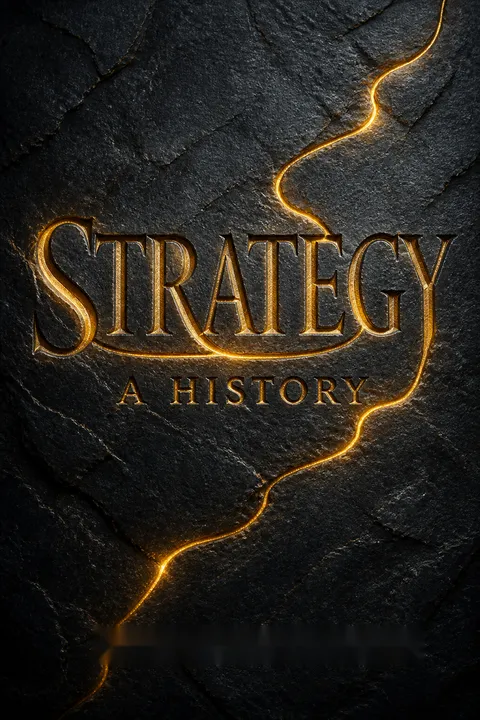
Strategy: A History is a comprehensive exploration of strategic thought across military, political, and business domains. Readers praise Freedman's erudition and breadth of coverage, though some find the book's length and density challenging. Many appreciate the historical context provided, but note that concrete strategic advice is limited. The book is seen as valuable for those deeply interested in strategy, offering insights into its limitations and the importance of adaptability. Some criticize the Western-centric focus and occasional lack of synthesis.
People Also Read


Glossary
mētis
adaptive practical intelligenceA Greek term for practical intelligence that combines foresight, close attention, adaptability, and an understanding of how others think. In strategic settings, mētis can include deception and indirection, but it is broader than trickery. It is a way of judging changing situations and choosing effective action when no fixed formula is reliable.
remarkable trinity
war's interacting forcesClausewitz's model of war as an interaction among three forces: the violence and emotion of the people, chance and probability in military action, and political reason. None fully controls the others. The model explains why war can serve policy yet still become unpredictable, emotionally charged, and difficult to limit.
friction
war's everyday obstaclesClausewitz's term for the small problems that accumulate during military action, including delay, confusion, faulty information, miscommunication, and chance. A plan may appear straightforward, but these obstacles lower performance and make intended results harder to achieve. Friction is not an exception to war; it is a defining feature of its practice.
strategy of exhaustion
wearing down resistanceA form of strategy that seeks political results by gradually weakening an opponent's willingness or ability to continue, rather than destroying its army in one decisive battle. It can involve raids, blockades, territorial pressure, or inconclusive engagements. It is not bloodless, and it can become a costly contest of endurance.
OODA loop
observe, orient, decide, actJohn Boyd's model of a repeating decision cycle: observe conditions, orient by interpreting them, decide what to do, and act. Action changes the environment, so the cycle begins again. Boyd argued that responding and adapting faster than an opponent can disrupt the opponent's understanding and preserve one's own initiative.
hegemony
rule through accepted ideasGramsci's term for a form of dominance sustained through ideas and everyday assumptions that make an existing order seem natural or broadly acceptable. It does not eliminate coercion, but it can reduce the need to use force constantly. Challengers therefore seek to change common understandings as well as formal political institutions.
bounded rationality
decision under cognitive limitsHerbert Simon's account of how people make decisions with limited time, information, and mental capacity. Rather than calculate every possible option and select an ideal solution, they often stop when they find an option that is satisfactory. The concept explains why real decisions differ from models of perfect optimization.
System 1 and System 2
intuition and deliberationA dual-process model of thought. System 1 refers to fast, largely automatic judgments shaped by experience and learned patterns. System 2 refers to slower, more deliberate reasoning that can compare alternatives and test assumptions. The processes interact: deliberate thought can correct intuition, but can also rationalize an intuitive preference.
strategic scripts
future-oriented action storiesFreedman's way of describing strategy as a plausible account of how action in the present might move a situation toward a desirable next state. A script helps participants understand what they are trying to do and why, while anticipating reactions from others. Unlike a fixed plan, it must remain open to revision as circumstances change.
FAQ
What's Strategy: A History about?
- Comprehensive exploration: The book examines the evolution of strategic thought across military, political, and business contexts, tracing its origins from ancient times to modern practices.
- Interplay of theory and practice: It highlights the relationship between strategic theory and real-world applications, showing how ideas have shaped actions and vice versa.
- Diverse sources: Freedman draws on historical texts, military campaigns, and philosophical reflections, featuring figures like Sun Tzu, Machiavelli, and Clausewitz.
Why should I read Strategy: A History?
- Rich historical context: The book offers a thorough historical perspective on strategy, connecting past events to contemporary challenges.
- Insightful analysis: Freedman delves into key strategic concepts, providing a deeper understanding relevant to both military and non-military applications.
- Applicability across fields: Insights can be applied to military, political, and business strategies, encouraging critical thinking about strategy in everyday life.
What are the key takeaways of Strategy: A History?
- Fluid and adaptable strategy: Strategy is a dynamic process that evolves based on circumstances and interactions, crucial for success.
- Understanding the enemy: Knowing the opponent's strengths, weaknesses, and intentions is vital for formulating effective strategies.
- Role of chance: The impact of chance and unpredictability in strategy underscores the need for flexibility and resilience.
What are the best quotes from Strategy: A History and what do they mean?
- “Everyone has a plan ’till they get punched in the mouth.”: Emphasizes the unpredictability of real-world situations and the need for adaptable strategies.
- “War is not an exercise of the will directed at inanimate matter.”: Highlights the complexity of war, where human emotions and reactions play a significant role.
- “The best—indeed the only—strategy was to obey God and then do as he told you.”: Reflects the idea that successful strategy often involves aligning with a higher purpose or moral framework.
How does Strategy: A History define strategy?
- Broad definition: Strategy is the art of planning and directing operations, encompassing military, political, and social dimensions.
- Means and ends: It involves the interrelation of strategic objectives and the methods used to achieve them.
- Dynamic nature: Strategy is fluid, evolving in response to changing circumstances and challenges.
What is the significance of Clausewitz's trinity in Strategy: A History?
- Three elements of war: Clausewitz’s trinity consists of primordial violence, chance, and policy, shaping the nature of war.
- Influence on military strategy: It emphasizes the need for a balance between these elements for effective strategic planning.
- Limits of strategy: The trinity illustrates that strategy must consider political objectives and human behavior's unpredictability.
How does Strategy: A History address the concept of the indirect approach?
- Definition: The indirect approach uses cunning and deception to achieve objectives, avoiding direct confrontation.
- Historical examples: Freedman provides examples from Sun Tzu and Liddell Hart, demonstrating its effectiveness in various conflicts.
- Modern relevance: The approach remains relevant today, especially in asymmetric warfare and complex geopolitical situations.
What role does deception play in strategy according to Strategy: A History?
- Critical element: Deception allows weaker parties to outmaneuver stronger opponents, evident in military and political contexts.
- Psychological impact: It can undermine the enemy's confidence and disrupt decision-making processes.
- Ethical considerations: The book explores the moral implications of using deception, encouraging reflection on strategic choices.
How does Strategy: A History connect strategy to politics?
- War as politics: Clausewitz’s dictum that “war is politics by other means” highlights the intrinsic link between military strategy and political objectives.
- Political context: Political considerations shape strategic decisions, emphasizing alignment with broader goals.
- Coalition dynamics: Alliances and coalitions significantly impact military effectiveness, vital for strategists to understand.
What is the significance of the "Red Queen effect" in Strategy: A History?
- Continuous competition: Companies must constantly improve to maintain their market position, reflecting intense industry competition.
- Diminishing returns: Focus on operational effectiveness may lead to marginal gains, necessitating new markets or innovations.
- Strategic implications: Encourages businesses to create unique value propositions and consider "blue ocean" strategies.
How does Strategy: A History address the concept of nonviolence?
- Strategic choice: Figures like Gandhi used nonviolence to achieve political goals, highlighting its potential effectiveness.
- Moral dimensions: Nonviolence shapes public perception and moral authority, gaining sympathy and support.
- Challenges: Its effectiveness depends on opponents' willingness to engage in dialogue rather than repression.
What critiques does Strategy: A History offer about traditional strategic thought?
- Limitations of classical theories: Traditional frameworks may not account for real-world complexities, advocating for flexibility.
- Overemphasis on military solutions: Highlights the importance of political, social, and economic strategies.
- Interdisciplinary perspectives: Calls for incorporating insights from various disciplines to enrich strategic thinking.
Download PDF
Download EPUB
.epub digital book format is ideal for reading ebooks on phones, tablets, and e-readers.








