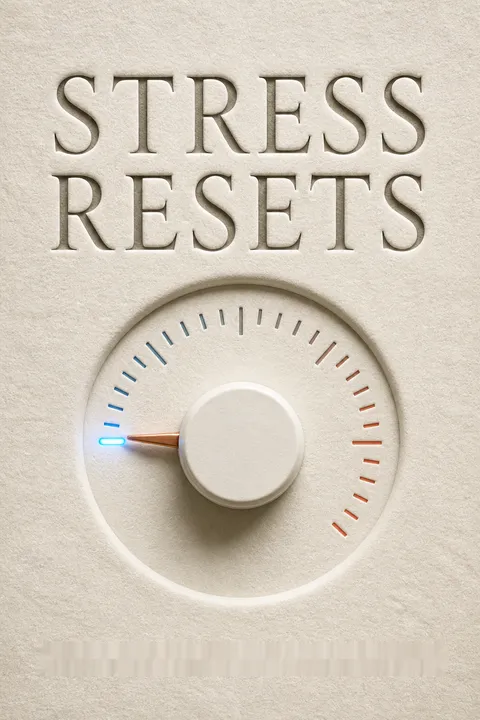


Key Takeaways
Interrupt the spiral before your reaction multiplies the original stress
Stress has two parts. A difficult event matters, but so does the meaning assigned to it and the response that follows. Stress can intensify when a person feels threatened and believes they lack the resources to cope. The event may be real; the added spiral is still something to work with.
Small reactions compound. One morning, the author's husband dropped milk, cut his hand while cleaning it up, and then had a minor car accident while still fuming. The mishaps were ordinary; staying caught in the agitation helped the morning snowball. The practical move is to pause before acting, notice what is happening, and choose one useful next step instead of adding rumination, avoidance, or an impulsive response.
The book's most useful distinction is between acknowledging a genuine hardship and adding avoidable distress on top of it. That distinction resists both extremes: treating stress as entirely a mindset problem, or assuming reactions have no influence. A pause cannot remove job insecurity, illness, or injustice, but it may prevent a painful situation from also producing a regretted message, missed obligation, or escalating argument. The advice is strongest when the focus stays on that modest, meaningful goal, rather than implying people can control the size of every stress response.
Treat stress arousal as fuel when the challenge matters
Try a different interpretation. The book introduces a stress mindset: seeing stress as potentially useful rather than automatically harmful. Laurie, anxious about starting a remote job, judged her tension as proof she could not cope. Reframing it as energy for a valued challenge helped her return to hiking, book club, and volunteer work.
Aim for mobilization, not forced calm. In performance studies discussed in the book, participants who described their nerves as excitement often performed better than those trying to calm themselves. Students taught to reinterpret bodily arousal also improved on academic measures. This is not a command to celebrate every stressor. The approach is most apt when the challenge matters and the body is gearing up to meet it, not when a situation calls for safety, rest, or practical change.
This reframing is persuasive because it changes the question from “How do I erase this feeling?” to “What might this energy help me do?” That shift can reduce the extra strain of policing normal nerves. It also preserves agency without demanding that people feel cheerful. The boundary matters: reinterpreting arousal cannot make an exploitative job safe or an impossible workload reasonable. The book's own examples work best when reframing accompanies concrete action, such as Laurie asking her manager for clarity, rather than replacing problem-solving.
Map the emotional chain before choosing what happens next
Use the ARC map. ARC stands for Antecedent, Response, and Consequences. The antecedent is what prompts an emotion; the response includes thoughts, body sensations, and actions; consequences include both immediate and longer-term results. Mapping those stages can reveal more than one point where a reaction can change.
Separate feeling from self-judgment. Melanie felt angry that parenting demands were falling unevenly on her, then judged herself for feeling angry. That secondary shame and fear obscured the useful signal: she needed more support. She could instead name the anger, notice what triggered it, and ask her husband for a specific break before reaching the point of snapping. The emotion itself is not a verdict on character; it may be information about needs, boundaries, or danger.
ARC turns a vague complaint, “I overreact,” into a sequence that can be examined. That is a practical advantage: a person may not control the initial feeling, but could prepare for a recurring trigger, interrupt a thought spiral, or repair a consequence. The distinction between primary emotion and judgment about emotion is especially valuable because shame often shifts attention away from the original need. Still, emotions are signals, not infallible instructions. Their meaning becomes clearer when feelings are considered alongside facts and context.
Act toward the life you want while your feelings catch up
Choose opposite action. This skill means taking a behavior that differs from the impulse an emotion creates, when that impulse would undermine longer-term aims. It is not pretending to feel fine. Melanie felt anxious about work but wanted to be present with her toddler. She set aside her phone and played with him for fifteen minutes; acting on her intention made the moment more enjoyable and the anxiety less dominant.
Behavior can change mood. Behavioral activation, a structured approach of scheduling meaningful, enjoyable, or accomplishing activities, is used to treat depression. The book describes a major trial in which it compared favorably with medication, including for severe depression. The useful test is not “Do I feel ready?” but “Will this action serve me after this feeling passes?”
The key insight is that mood need not be the gatekeeper for action. Waiting to feel confident, energetic, or unafraid can make a person's life increasingly dependent on conditions that may not arrive on schedule. Small actions create chances to experience competence and connection, which can challenge bleak predictions through lived evidence. The caveat is equally important: acting opposite is not a reason to ignore exhaustion, illness, or legitimate boundaries. Its purpose is to loosen emotion's automatic command, not to demand relentless productivity.
Trade mental replay for a next step, a pause, or real processing
Recognize rumination. Rumination is repetitive, passive thinking about problems or feelings that does not digest them into useful action. Max believed constant analysis kept him responsible and motivated. A planned schedule showed him he worked better when he focused on the task at hand, and that rumination often fed anxiety and procrastination instead.
Change the mental task. Replace unanswerable “why” loops with “how” questions that lead to an action. Other options include stepping back from the thought, postponing worry to a set time, writing about a difficult experience, or taking a brief absorbing break. Expressive writing studies described in the book found lasting reductions in depressive symptoms among people prone to rumination. The point is not to distract from every painful feeling; it is to stop rehearsing the same thought when it is no longer helping.
The section makes an important distinction between reflection and repetition. Reflection produces a decision, a clearer account, or emotional contact; rumination can feel busy while leaving the problem untouched. A useful personal test is whether thinking is generating new information or merely renewing distress. The proposed alternatives are deliberately varied because the same person may need planning, emotional expression, or a short attentional break at different times. This flexibility is more realistic than prescribing mindfulness as the universal answer, especially since Max initially found meditation difficult.
Use a brief reset to recover choice when stress peaks
Resets are short interventions. The book groups immediate tools into mind, body, and behavior approaches. Mind tools include naming an emotion, checking whether a thought is useful, or pausing with STOP: slow down, step back, observe, and proceed mindfully. Body tools include paced breathing, progressive muscle relaxation, or a short burst of movement. A walk, music, or a moment of self-soothing touch can shift attention and arousal too.
Match the tool to the moment. These practices are not meant to erase distress or solve every underlying problem. Their job is to create enough space to make a wiser choice. A five-minute breathing practice may suit racing thoughts; movement may suit restless energy. Try several options when calm, then keep the ones that work. Physical techniques, particularly cold-water exercises, may not be appropriate for everyone.
The recipe-book format fits the reality that stress is not one uniform state. Some people need to settle their bodies before they can think; others benefit more from movement or a concrete task. The most transferable principle is to practice a few tools before an emergency, so remembering them does not depend on peak distress. A reset also has a realistic ceiling: temporary relief can support problem-solving, but it does not substitute for medical attention, therapy, or changes to circumstances that keep producing harm.
Question fast relief that trains you to escape discomfort
Relief can reinforce reliance. Cameron used prescribed Klonopin for anxiety, then increased his use and also relied on cannabis to unwind. The author explains that a substance can become negatively reinforcing: it feels rewarding because it removes an unpleasant state, making escape more likely next time. That can crowd out learning other ways to handle anxiety and may bring tolerance, withdrawal, or other harms.
Keep treatment decisions clinical. The book distinguishes routine reliance on benzodiazepines from carefully supervised psychiatric medication use, and notes that cannabis may have medical uses but is not established here as an anxiety treatment. Cameron eventually worked with clinicians to taper and sought peer support. He reported sharper memory and better awareness of how anxiety sometimes helped him act. Anyone considering changing prescribed medication or substance use should consult an appropriate health professional.
This account is strongest when read as a warning about coping becoming narrow, not as a blanket verdict on medication or every person's cannabis use. Fast relief can teach the mind that ordinary distress is intolerable without the substance, while the underlying trigger remains. At the same time, medication can be appropriate and useful, and dependence or withdrawal requires informed care rather than a test of character. Cameron's story illustrates a path involving a prescriber, therapy, and peer support, not a do-it-yourself abrupt stop.
Build your days around values, not only symptom relief
Values guide behavior. A goal is an outcome one hopes to reach; a value is a quality one can practice along the way, such as attentiveness or generosity. Gary, a retired man living with pain and health anxiety, used a “miracle question” to picture what daily life might look like if his main complaints eased. The answers pointed toward being a more thoughtful husband, parent, and grandparent, even without guaranteed pain relief.
Make the direction visible. Gary identified values in health, relationships, work, and leisure, then chose actions such as morning coffee with his wife, helping seniors with technology, and reconnecting with old friends. The book also describes Deon, who maintained sobriety for six months by going to a bookstore daily to read. These examples show how modest routines can serve a larger direction.
Values-based action is a useful counterweight to the fantasy that life starts after symptoms disappear. Gary's pain did not have to vanish before he could be attentive, and Deon's routine gave structure to a difficult period. This approach can help keep one problem from occupying the whole identity. It should not be mistaken for a demand to find a silver lining in suffering: meaning is most credible when it coexists with acknowledging pain and addressing the practical conditions that can be changed.
Treat sleep, movement, attention, and connection as daily stress buffers
Buffers are preventive habits. Unlike a reset used in an intense moment, a stress buffer is a repeated practice that makes daily life more nourishing and supports recovery. The book highlights regular exercise, consistent sleep and wake times, and paced breathing. It also recommends planning pleasurable activities instead of postponing all enjoyment until work is finished.
Protect attention and connection. Setting times to check messages can reduce the sense of being continually on call. A brief conversation with a familiar person, a curious question, or a small helpful act can strengthen connection and redirect attention from private distress. These habits are not glamorous, but they make it easier to cope when a new stressor appears. Start with one or two that fit real constraints, track whether they help, and adjust rather than turning self-care into another perfection test.
The buffer idea expands stress management beyond emergency techniques. Sleep, movement, social ties, and attention are not decorative extras; they shape the conditions under which coping is possible. The book's advice to experiment and track outcomes is valuable because generic routines can become burdensome when imposed without regard to work, disability, caregiving, or money. A modest habit that fits a person's actual life is more useful than an idealized wellness schedule that quietly becomes another source of failure.
Approach feared situations in steps instead of shrinking your life
Avoidance brings short relief. It can also strengthen the belief that a feared task or sensation is unmanageable. Exposure means approaching what one avoids in a gradual, planned way, while learning that discomfort can be tolerated and that feared outcomes are not certain. Cameron faced his fear of flying by learning about turbulence and taking shorter flights before attempting longer ones.
Practice uncertainty too. Excessive research, reassurance-seeking, and perfectionism can function as safety behaviors, actions intended to prevent feared outcomes but often keeping uncertainty alive. A small experiment might mean sending a routine message without asking several people to review it, or starting a task for ten minutes before deciding it is impossible. The goal is not to feel fearless. It is to recover choices that avoidance has been taking away.
Gradual approach is more than a bravery slogan: it replaces imagined predictions with direct experience. The useful measure of success is willingness to do a meaningful activity while discomfort is present, rather than waiting for anxiety to reach zero. That distinction makes the approach less punitive and more practical. Care is needed when a fear signals genuine danger or when exposure could overwhelm someone; structured support can matter. The book's emphasis on small steps helps avoid confusing therapeutic practice with reckless self-testing.
Analysis
Stress Resets is best understood as a practical field guide built around one central proposition: distress is shaped not only by what happens, but by how people interpret, replay, resist, and respond to it. Its three-part structure moves from understanding those patterns, to brief interventions for acute moments, to habits that make coping more available. The case histories give abstract skills human scale. Laurie illustrates reinterpretation, Melanie shows how emotion can point to an unmet need, Max exposes rumination's false promise of productivity, Cameron's experience complicates the appeal of chemical escape, and Gary demonstrates values-based living amid persistent pain.
The book's most coherent contribution is its insistence that acceptance and change are partners. Acceptance means facing the current feeling or circumstance without adding a struggle against its existence. Change means choosing behavior that better serves the life one wants. This avoids the common trap of making calmness the entry fee for action. The varied resets also acknowledge that people differ: a breathing exercise may help one person, while movement, music, writing, or contact with another person suits someone else.
The broad menu is both strength and limitation. Readers get options, but a long catalog can itself feel like another task. The most sensible use is selective: choose a few tools, test them in ordinary situations, and record what actually helps. Research findings support the book's confidence, though brief experiments and associations do not guarantee the same effect for every person or context. Reframing stress cannot resolve unsafe conditions, unequal burdens, poverty, illness, or structural injustice. The book is most convincing when its tools create room for action without pretending that every source of stress is individually solvable. It presents self-help as useful practice, not a replacement for professional treatment or systemic change.
People Also Read







Glossary
Stress reset
Brief coping practiceA short, evidence-informed exercise intended to reduce the intensity of a stressful moment and help someone regain enough perspective to choose a useful response. Resets may work through attention, thought, body sensations, or behavior. They offer temporary support, not a cure for ongoing problems or a substitute for professional care.
Stress buffer
Resilience-building habitA repeated practice that supports well-being and makes coping more available over time. Examples include exercise, regular sleep routines, meaningful activities, and social connection. Unlike a reset, which is designed for an intense moment, a buffer is preventive and helps build a life with more sources of restoration.
Stress mindset
Belief about stressA person's broad view of whether stress is inherently harmful or can sometimes be useful. A more flexible mindset treats bodily arousal as potentially mobilizing when facing a meaningful challenge. It does not mean that all stress is beneficial or that harmful circumstances should be accepted without change.
ARC of Our Emotions
Emotional sequence mapA framework for examining an emotional episode through three parts: Antecedent, the event or condition that prompts it; Response, including thoughts, physical sensations, and behaviors; and Consequences, including short- and long-term effects. Mapping the sequence helps identify points where preparation or a different response could alter the outcome.
Rumination
Repetitive unproductive thinkingRepeatedly turning over concerns, events, or feelings without moving toward a useful decision or fuller emotional processing. Rumination can feel responsible or problem-solving, yet often prolongs distress and interferes with action, attention, and sleep. It differs from deliberate reflection, which can produce new understanding or a concrete next step.
Opposite action
Act against an unhelpful impulseA skill from dialectical behavior therapy in which a person identifies an emotion and its behavioral urge, then chooses a different action when following the urge would be unhelpful in the long term. The aim is not to fake an emotion, but to behave in line with one's intentions while allowing the feeling to be present.
Psychological flexibility
Adaptable, values-led copingThe capacity to notice present experience, remain open to difficult thoughts and feelings, and take action guided by personal values. In the book's account, flexibility counters rigid avoidance and automatic reactions. It allows people to adjust their behavior to circumstances rather than requiring discomfort to disappear first.
Radical acceptance
Wholehearted acknowledgment of realityA dialectical behavior therapy skill of recognizing and allowing the facts of the present moment, including distressing emotions or physical sensations, without denying them or continuing to fight their existence. Acceptance does not mean approval, resignation, or refusing to change what can be changed. It reduces the extra suffering created by resistance.
Urge surfing
Observe cravings without obeyingA mindfulness-based approach to cravings in which a person notices an urge, its thoughts and bodily sensations, and its intensity without automatically acting on it. The urge is treated as a changing experience that can rise and recede. The method is used in coping with substance use and other habits.
Interoceptive exposure
Practice feared body sensationsA therapeutic method that deliberately and safely recreates physical sensations associated with anxiety, such as dizziness or a racing heart. By experiencing sensations without interpreting them as proof of danger, a person can learn that they are temporary and become less likely to avoid situations that might trigger them. It may require professional guidance.
Behavioral activation
Schedule meaningful activitiesAn evidence-based approach to depression that increases engagement in activities connected to pleasure, accomplishment, or personal goals. It challenges the pattern of waiting for motivation before acting. By changing behavior and creating opportunities for rewarding experience, a person may improve mood and weaken avoidance.
Wise mind
Integrated decision-making stateA dialectical behavior therapy concept describing a perspective that brings together emotional experience, reason, and intuition. It is contrasted with relying only on intense emotion or only on detached logic. Practices such as pausing, breathing, and checking whether an action is wise are intended to help access this balanced perspective.
TIPP
Crisis body-regulation skillsA dialectical behavior therapy acronym for Temperature, Intense exercise, Progressive muscle relaxation, and Paced breathing. These body-based skills are used to influence intense physical arousal during a crisis. The book discusses cold-water stimulation, movement, muscle release, and slower breathing as components, while noting that physical exercises may not suit everyone.
DEAR MAN
Structured assertive communicationA dialectical behavior therapy method for making a request or refusing one. The letters cue the speaker to Describe the situation, Express feelings, Assert a request, Reinforce its value, stay Mindful, Appear confident, and Negotiate when appropriate. The structure helps people communicate needs clearly without becoming passive or needlessly confrontational.
Download PDF
Download EPUB
.epub digital book format is ideal for reading ebooks on phones, tablets, and e-readers.








