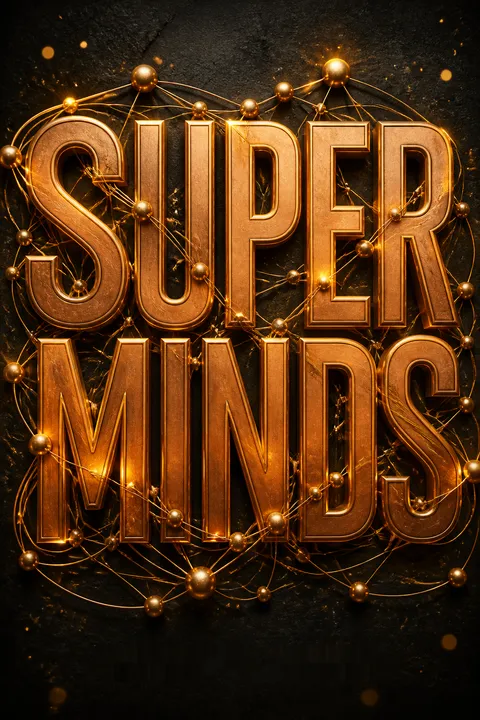


Key Takeaways
Build intelligence by connecting minds, not waiting for lone geniuses
A theorem, together. In 2009, mathematician Tim Gowers invited people online to help prove a difficult theorem. Within months, 39 people had made substantive contributions across more than 1,500 comments. Their work became a mathematical paper credited to the group name D. H. J. Polymath. The achievement was not simply many people working at once. Their ideas were connected, refined, and combined toward a shared problem.
A broader definition. Malone calls a group acting together in ways that seem intelligent a supermind. Its members need not share motives or even cooperate directly: competitors tackling the same challenge can also form one. The key is that their actions connect toward a goal an observer can identify. Human progress, from farming to modern industry, depends on these collective problem-solving systems.
The Polymath story shifts attention from the celebrated individual to the conditions that let useful contributions meet. This resembles distributed cognition: a group can store and develop knowledge across people, tools, and communication practices rather than inside one exceptional mind. The reframing is valuable, but it also raises a practical question: who decides which group goal counts as intelligent? A market can allocate resources effectively for buyers while excluding people without purchasing power. Collective capability is real, but judging it always requires scrutiny of whose objectives it serves.
Design teams for attentive participation, not just impressive résumés
A measurable group ability. Researchers tested 192 groups containing 699 people on tasks ranging from brainstorming to negotiation and execution. Their performance revealed a collective-intelligence factor that explained about 45 percent of the variation across tasks. It also predicted performance on unfamiliar challenges better than the average or highest individual intelligence in a group.
Interaction makes a difference. Groups tended to score higher when members were socially perceptive and conversation was not dominated by one or two voices. Groups with a middle level of cognitive-style diversity also outperformed groups that were highly uniform or sharply divided. The reported association between women’s representation and group scores was largely explained by social perceptiveness, so it is not evidence that gender alone causes stronger teamwork.
The useful design lesson is to treat participation patterns as part of a team’s capability, not as meeting etiquette. A group that hears more of its members can draw on knowledge that status hierarchies might otherwise suppress. Still, the findings do not make a universal recipe for every team: the studies involved particular tasks and relatively small groups. Equal airtime can also become a ritual rather than useful exchange. The deeper target is not identical speaking time, but a process in which relevant information can surface and influence the work.
Use computers to strengthen groups before expecting machines to replace them
Connection before autonomy. Malone argues that computers’ near-term importance lies less in humanlike artificial intelligence than in connecting people and information at scale. Most computer use already supports communication, from shared documents to online communities. Such tools can make a human group more capable without making the machine broadly intelligent.
Machines can take different roles. A computer may be a tool directed by a person, an assistant that takes initiative, a peer acting alongside people, or a manager that assigns and coordinates work. CrowdForge, for example, organized online workers to outline, research, and write encyclopedia-style articles. Its software divided the work and assembled the pieces. The result illustrates a human-computer group doing a task through coordination, not through a single superhuman machine.
This perspective avoids the misleading choice between human workers and autonomous machines. Many systems already distribute intelligence across people, software, and procedures, even when users experience them as one product. The role distinction also helps identify where accountability belongs: a tool follows instructions, while a manager-like system shapes what other people do. The main caution is that better coordination does not automatically mean better outcomes. A system can efficiently organize people around a narrow or harmful objective, so its goals and oversight matter as much as its technical performance.
Match the decision system to the problem, not your ideology
Five ways groups decide. A hierarchy gives authority to designated decision makers. A democracy uses votes. A market coordinates voluntary trades. A community relies on shared norms and informal consensus. An ecosystem has no overall agreement mechanism, so power and survival shape outcomes. Real institutions often combine these forms.
Each has a different job. Markets can coordinate huge numbers of detailed choices through prices, but they ignore costs that prices omit, such as pollution. Hierarchies can coordinate interdependent work and enforce rules, but concentrated authority may serve leaders more than members. Democracies can represent broad preferences, though voting takes time and can produce poor decisions when voters lack useful information. Communities can sustain trust and cooperation, but consensus becomes costly as groups grow.
The framework is strongest as a diagnostic tool, not a ranking of political ideals. It asks what a decision requires: speed, detailed coordination, broad legitimacy, local trust, or enforcement. That prevents a common category error, such as expecting a market to protect people affected by costs that buyers and sellers do not bear. Institutional design often works best in combinations, with one form compensating for another’s blind spots. Yet the categories simplify messy reality: a company may be hierarchical in one decision, democratic in another, and dependent on community norms throughout.
Expand the search, but protect diversity and independent judgment
More minds find more possibilities. Climate CoLab grew from a few dozen participants to more than 100,000, who developed over 2,000 proposals. Some useful ideas came from outside expected expert circles. In another example, an online game called Foldit let players explore protein structures; its participants solved a scientific enzyme puzzle that had resisted researchers for years.
Crowds need good conditions. Large groups can supply more labor, specialized knowledge, and unusual skills. But the wisdom-of-crowds effect depends on judgments that are sufficiently independent. When people see and copy one another’s guesses, they can become more confident while becoming less accurate. The median can also resist a few extreme guesses better than the average. Bigger groups create potential; the way their contributions are gathered determines whether that potential is realized.
Crowdsourcing works especially well when a problem can be clearly framed, contributions can be compared, and people with different approaches can participate. Foldit shows that a community can uncover ability that formal credentials or job titles may not reveal. But open participation is not automatically inclusive: access, incentives, problem framing, and evaluation still shape who contributes and whose work counts. Independence matters too. Online connection can expose people to more expertise while also making their judgments converge prematurely. Good systems create channels for exchange without erasing useful disagreement.
Break work apart only when coordination costs stay manageable
Reorganize the work. Malone identifies three ways to redesign group work: divide tasks differently, let people choose or be matched to tasks differently, and coordinate dependencies differently. Hyperspecialization means splitting information work into small tasks that can be completed by specialists around the world. Topcoder, for example, runs online contests for software-development tasks and has drawn on a community of more than one million developers.
Keep the pieces connected. Tasks may depend on another person’s output, compete for shared resources, or need to fit together. A travel-planning system tested with online workers tracked constraints such as travel time and the required number of activities, then flagged gaps automatically. Climate CoLab’s contest webs similarly let people develop separate proposals and combine them into larger plans. Decomposition helps only when integration is designed too.
The central organizational insight is that technology changes not only how quickly people communicate, but also which divisions of labor are economically practical. Smaller tasks can open participation to specialists who would never join a conventional team. The danger is fragmentation: when work is sliced too finely, contributors may lose context, bargaining power, or a sense of ownership. A system should therefore measure the cost of coordination alongside the output of each task. The best design preserves enough shared context for contributors to understand how their piece affects the whole.
Give groups shared systems for sensing, remembering, and learning
Intelligence needs a full cycle. A capable group must sense its surroundings, remember useful information, generate possible actions, choose among them, and learn from results. In Brazil, doctors comparing reports of unusual newborn symptoms helped connect a health crisis to the Zika virus. The signal became meaningful through information gathered across people and places. By contrast, Kodak had an early digital-camera invention but failed to respond effectively to the shift in its business environment.
Make experience reusable. Shared records can help groups retrieve cases no individual has seen, while learning loops use records of actions and outcomes to improve future work. For example, a medical diagnosis platform lets clinicians seek colleagues’ judgments on cases and builds a store of accumulated cases. Computers can identify patterns or handle routine steps, while people review ambiguous situations and contribute judgment.
This cycle connects information management to organizational adaptability. A group may possess crucial facts and still fail to act if it cannot combine them, retrieve them when needed, or revise its assumptions. Kodak illustrates that sensing is not merely collecting data; institutions must be willing to interpret inconvenient signals. The same logic makes permanent records powerful but risky. What gets recorded, classified, and treated as evidence can bias future decisions. A learning system needs feedback about outcomes, but it also needs people able to question whether its measures capture what actually matters.
Price climate damage so markets can solve the details
The missing cost. Climate change illustrates why no single type of supermind can solve every part of a problem. Community norms can encourage lower-emission choices, and governments can set regulations, but neither easily manages every detailed trade-off across an economy. Markets are good at coordinating dispersed choices, yet they fail when the price of a product omits the harm caused by its emissions.
Combine institutional strengths. A carbon tax or emissions-trading system makes emitters face more of the cost their choices impose on others. Markets can then help find lower-cost ways to cut emissions. Climate CoLab adds another layer: people can submit proposals, combine them into larger plans, and assess them together. Global cooperation remains difficult because countries’ actions affect one another and voluntary targets may not add up to adequate results.
The important move is to distinguish choosing a social goal from coordinating the many actions needed to pursue it. A government can establish a rule that brings neglected costs into view, while markets help distribute adjustments among firms and consumers. This is a general design principle for problems with widespread spillovers. Still, putting a price on harm requires judgment about how much harm costs, who should pay, and how burdens are distributed. Efficient adjustment is not the same as fair adjustment, and political legitimacy cannot be replaced by a clever price mechanism.
Pair automation with human strengths and enforceable safeguards
Jobs change unevenly. The book cites an estimate that about half of paid work activities could be automated with then-current technology, while only about 5 percent of occupations could be fully automated. People may remain valuable for general judgment, interpersonal work, and tasks in unpredictable settings. But new jobs do not automatically help workers whose old jobs disappear, so retraining, worker associations, and public support may matter during transitions.
Control requires institutions. Advanced AI risks are not solved by assuming machines will share human motives. Malone emphasizes legal responsibility for automated systems, international rules for cross-border harms, and human oversight of goals and critical decisions. His argument is measured rather than alarmist: preparation can improve ordinary automated systems now, even if human-level AI remains far off.
The chapter’s strongest contribution is to treat automation as a problem of institutional adaptation, not only machine capability. Markets can create new work, but historical adaptation does not guarantee that displaced workers will have the skills, location, or time to access it. The same distinction applies to AI safety: technical safeguards matter, but so do liability, enforcement, and decisions about who controls a system. Keeping a human formally in the loop is insufficient if that person lacks authority, context, or time to challenge the machine.
Make the global mind wiser by choosing better collective goals
A useful lens, not a brain in the sky. Malone calls the combined intelligence of people, computers, and other systems on Earth the global mind. The term highlights how decisions in governments, markets, businesses, and communities affect one another. His discussion of consciousness is more speculative: he considers whether groups meet some definitions of awareness and integrated information, and reports that a measure inspired by neuroscience rose in Internet interaction data from 2008 to 2014. That does not establish that the Internet has subjective experience.
Intelligence is not wisdom. A system can become more capable at achieving its goals without choosing goals worth pursuing. Malone links wisdom to considering broad human welfare and purposes beyond individual advantage. The practical implication is that building more powerful connections is not enough; people must also deliberate about what those connections should help accomplish.
The global-mind idea is most persuasive as a scale of analysis. It makes visible outcomes that no individual intended, such as the combined effects of markets, governments, and technologies. The claim that such a system might be conscious is much less settled, because coordinated behavior and integrated information do not by themselves demonstrate felt experience. That uncertainty need not weaken the organizational insight. It does sharpen the ethical question: whether or not a collective has experiences, its decisions can profoundly affect those who do. Wisdom therefore requires accountability to real people and consequences.
Analysis
The book’s central move is to treat intelligence as an organizational property. That perspective is powerful because it explains why human achievement cannot be reduced to individual talent: knowledge is divided, actions are coordinated, and outcomes emerge from systems that no member controls alone. The Polymath project makes this intuitive, while research on group performance gives the idea empirical footing. Malone’s most useful practical claim follows: design the connections among people and machines, rather than treating AI as a contest to replace people.
The framework also makes institutional diversity legible. Markets, hierarchies, democracies, communities, and ecosystems solve different coordination problems, and their combinations can outperform any one form alone. The comparison is productive as a first map, though its ratings depend on assumptions about benefit, cost, and fairness. A market’s voluntary trades may benefit participants while excluding nonparticipants affected by pollution. A democracy can claim legitimacy while making poorly informed choices. Intelligence is therefore not a neutral score until the evaluator specifies whose goals count.
The book is most optimistic about the effects of scale and connectivity. Its examples show how networked groups can find unusual expertise, coordinate distributed work, and remember more than any individual can. Yet connectivity can also spread error, concentrate control, and obscure responsibility. The same systems that amplify expertise can amplify social influence or optimize narrow measures at human expense. More data and more participants are not substitutes for careful task design, trustworthy institutions, and routes for dissent.
The ending distinction between intelligence and wisdom is essential. A supermind can become extraordinarily effective at pursuing an inherited goal without examining whether that goal is desirable. The book’s lasting challenge is therefore both technical and political: build systems that combine human judgment with computational reach, while giving affected people meaningful influence over objectives, evidence, and accountability. Collective intelligence expands what society can do. Collective wisdom determines what it should do.
Review Summary
Superminds receives mixed reviews, with an average rating of 3.56/5. Readers appreciate its exploration of collective intelligence and human-computer interactions, finding some concepts thought-provoking. However, many criticize it for lacking originality, practical applications, and clear arguments. Some find it too broad or outdated, while others praise its insights on group decision-making and AI integration. The book's structure and writing style are points of contention, with some finding it engaging and others considering it repetitive or poorly written.
People Also Read








Glossary
Supermind
connected intelligent groupA group of individuals whose connected actions appear intelligent relative to some goal. Members can include people, computers, and resources they control. A supermind may cooperate internally, compete toward a shared problem, or coordinate through indirect signals. The term describes a useful way to analyze groups such as companies, markets, communities, and governments.
Collective intelligence
group problem-solving abilityThe ability of a group to act effectively through connected contributions from its members. It can refer to effectiveness on a particular task or to broader performance across different kinds of tasks. Research described in the book finds that groups vary in this capacity, and that group performance cannot be predicted from individual intelligence alone.
Specialized intelligence
effectiveness at specific goalsThe ability to achieve particular goals effectively in a given environment. This form of intelligence is task-specific: a group or machine can be highly capable at one activity without being adaptable across many activities. It is useful for assessing whether a system performs a defined job well.
General intelligence
adaptability across many goalsThe ability to perform effectively across a broad range of goals and environments. For a group, it means more than succeeding at one familiar task; it includes versatility and the capacity to learn or adapt when circumstances change. Malone distinguishes it from specialized intelligence, which concerns success at particular tasks.
Liquid democracy
delegated, reversible votingA voting system in which people can vote directly or delegate their voting authority to another person, often for particular topics. Delegates may pass authority onward, and voters can reclaim or redirect their votes. Online systems make this flexible form of representation easier to manage than conventional representative democracy.
Prediction market
market-based probability estimatesA market in which participants buy and sell claims tied to future events. Prices reflect the collective estimate of how likely an event is, while financial or other rewards encourage accurate judgments. The book describes experiments in which human participants and computer programs traded together and produced more accurate predictions than either group alone.
Hyperspecialization
division of information workThe division of information-based work into small tasks that can be performed by people with narrowly focused skills. Online platforms can match these workers to tasks across geographic boundaries. The approach may improve speed, cost, and access to expertise, but it also creates risks of fragmented work, weak worker bargaining power, and loss of context.
Contest webs
linked idea-development contestsA structure for large-scale problem solving in which people compete to develop proposals for related subproblems, then combine selected proposals into more comprehensive plans. Climate CoLab used this approach to connect specialized climate proposals with national and global strategies. The design supports parallel exploration while allowing useful components to be reused.
Cyber-human learning loop
continuous human-machine improvementA process in which people and computers jointly perform work, record relevant inputs and outcomes, and use that information to improve future performance. Computers may initially assist people, then take on routine actions as evidence accumulates. The approach emphasizes ongoing adaptation rather than a one-time effort to automate an entire job.
Evolutionary utilitarianism
selection toward broad benefitMalone’s label for the proposed tendency of ecosystems containing human groups to favor superminds that attract and retain more people by providing benefits people value. Over time, such groups may become more influential than alternatives. This is a descriptive argument about social evolution, not a guarantee that outcomes are fair or that every person benefits.
Integrated information theory
consciousness through integrated informationA theory associated with neuroscientist Giulio Tononi that treats consciousness as related to the amount of information a system generates through interactions among its parts. Malone discusses applying a measure inspired by this theory to group communication patterns. The approach is scientifically contested and does not by itself prove that a group has subjective experience.
FAQ
What's Superminds about?
- Collective Intelligence Focus: Superminds by Thomas W. Malone explores how groups of people and computers can solve problems more effectively than individuals. It examines various forms of collective intelligence, such as hierarchies, communities, markets, and democracies.
- Role of Technology: The book discusses how advancements in information technology enhance collective intelligence, allowing humans and computers to collaborate in unprecedented ways.
- Future Implications: Malone explores how these superminds can address global challenges like climate change and economic inequality by leveraging collective intelligence.
Why should I read Superminds?
- Understanding Modern Collaboration: The book provides insights into effective group collaboration in the digital age, highlighting the importance of collective intelligence in business and governance.
- Future-Proofing Knowledge: It prepares readers for future changes in work and collaboration, emphasizing the need to adapt to new forms involving both humans and machines.
- Practical Applications: Malone offers practical examples and case studies, demonstrating how collective intelligence can lead to innovative solutions for complex problems.
What are the key takeaways of Superminds?
- Definition of Superminds: A supermind is a group of individuals acting together intelligently, emphasizing collaboration and shared goals in achieving collective intelligence.
- Types of Superminds: The book categorizes superminds into hierarchies, democracies, markets, and communities, each with strengths and weaknesses in decision-making.
- Impact of Technology: Information technology significantly enhances superminds' capabilities, allowing smarter decision-making and more effective collaboration.
What are the best quotes from Superminds and what do they mean?
- "Supermind is a powerful combination of many individual minds.": This quote highlights the strength of collective intelligence, suggesting that collaboration can lead to outcomes surpassing individual efforts.
- "The intelligence of human groups—not individual humans—led to human success.": It underscores the importance of collective intelligence in achieving progress and solving complex problems.
- "Hyperconnectivity will allow humans and computers to work together.": This emphasizes the future potential of technology in enhancing collective intelligence, suggesting unprecedented problem-solving abilities.
How does Superminds define "collective intelligence"?
- Broad Definition: Collective intelligence is the shared or group intelligence emerging from collaboration and competition among individuals.
- Importance of Group Dynamics: It emphasizes that collective intelligence is not just the sum of individual intelligences but a unique property arising from effective collaboration.
- Measurement of Collective Intelligence: Malone discusses research showing that collective intelligence can be measured similarly to individual intelligence, indicating some groups are inherently smarter.
How can superminds make smarter decisions according to Superminds?
- Hierarchical Decision-Making: Hierarchies streamline decision-making by having authority figures make choices, leading to efficient outcomes but potentially lacking lower-level input.
- Democratic Participation: Democracies allow broader participation through voting, leading to more representative outcomes, depending on voters' knowledge and engagement.
- Market Mechanisms: Markets facilitate decision-making through mutual agreements, allowing efficient resource allocation and optimal outcomes under the right conditions.
What role do computers play in enhancing superminds in Superminds?
- Tools and Assistants: Computers enhance human capabilities by facilitating communication and collaboration, automating routine tasks, and allowing focus on complex decision-making.
- Peer Collaboration: In some cases, computers act as peers, participating in decision-making processes alongside humans, leading to more informed and accurate outcomes.
- Managerial Functions: Computers can take on managerial roles, coordinating tasks and optimizing workflows, increasing efficiency and effectiveness in achieving group goals.
What is the concept of "hyperspecialization" in Superminds?
- Definition of Hyperspecialization: It refers to individuals focusing on highly specialized tasks leveraging their unique skills, enhancing job satisfaction and productivity.
- Impact on the Workforce: Hyperspecialization leads to a more flexible and dynamic workforce, allowing individuals to choose tasks aligning with their interests and expertise.
- Global Collaboration: Hyperspecialized workers can collaborate globally, taking advantage of economies of scale, enabling groups to tackle complex problems more effectively.
How does Superminds address the issue of climate change?
- Collective Action for Solutions: Malone emphasizes the importance of collective intelligence in addressing climate change, suggesting superminds can develop innovative solutions.
- Climate CoLab Example: The book discusses the Climate CoLab project, which crowdsources ideas for climate action, exemplifying how diverse input leads to effective strategies.
- Role of Technology: Technology facilitates collaboration and data sharing among stakeholders working on climate change, helping implement solutions more effectively.
How does Superminds envision the future of work?
- Shift Towards Collaboration: Malone predicts increased collaboration between humans and machines, redefining job roles through the combination of human creativity and machine efficiency.
- Emergence of New Job Types: New job categories will emerge, particularly in areas requiring interpersonal skills and creativity, with the gig economy offering flexible opportunities.
- Focus on Lifelong Learning: Continuous learning and adaptation are crucial, with individuals needing to develop new skills to thrive in an ever-changing job landscape.
What is the significance of "self-selection" in task assignment within superminds?
- Empowerment of Workers: Self-selection allows individuals to choose tasks aligning with their skills and interests, leading to higher motivation and productivity.
- Increased Engagement: Autonomy in task selection leads to more engaged and satisfied workers, resulting in better outcomes for individuals and organizations.
- Examples of Self-Selection: Platforms like Topcoder and InnoCentive demonstrate the effectiveness of self-selection in harnessing collective intelligence.
How does Superminds suggest we can improve decision-making in superminds?
- Leveraging Technology: Using information technology enhances communication and collaboration within superminds, leading to more informed decision-making and better outcomes.
- Encouraging Participation: Involving more individuals in decision-making processes generates diverse ideas and solutions, achievable through crowdsourcing and online platforms.
- Creating Hybrid Systems: Combining human and machine intelligence leads to smarter decision-making, allowing superminds to tackle complex problems more effectively.
Download PDF
Download EPUB
.epub digital book format is ideal for reading ebooks on phones, tablets, and e-readers.








