

Key Takeaways
Understand thought as nonstop analogy, not occasional flashes of genius
The mind maps constantly. Hofstadter and Sander use analogy broadly: a new perception is linked to a mental structure built from earlier experience. A toddler first knows one specific person as Mommy, then recognizes other caregivers as similar, gradually building a more general concept of mother. That ordinary learning process, they argue, is the same basic operation that enables sophisticated thought.
Galileo used familiar Earth-Moon patterns to interpret tiny points moving around Jupiter as moons. His insight expanded what the word moon could mean. From recognizing a cup to imagining moons around another planet, thought repeatedly uses the past to make the present intelligible. Categorization and analogy, in this account, are two views of that continuous linking process.
The unifying claim is powerful because it makes ordinary perception cognitively important, rather than reserving analogy for celebrated breakthroughs. It also offers a useful test: ask what prior experience makes a new thing recognizable. The theory is most informative when it identifies that experience and the inference it licenses. If every act of recognition is labeled analogy after the fact, however, the claim risks becoming difficult to distinguish from a general theory of learning or perception.
Treat categories as evolving neighborhoods, not boxes with fixed borders
Membership depends on context. Everyday categories have central cases and uncertain edges. A spider may be called an insect in a frightening bedroom, although the same person will correctly identify it as an arachnid on a biology test. A chair can become a stool when someone needs to stand on it. The object has not changed; the useful way of grouping it has.
Language also makes some distinctions feel natural that other languages handle differently. English uses time for the hour, duration, and number of occasions; French commonly separates these into different words. Such differences do not make one language confused. They show that words package experience in culturally learned ways, and that the apparent borders of a concept are neither universal nor perfectly sharp.
This view explains why ordinary language is flexible without being random: context selects which features matter. It also matters beyond vocabulary. Legal definitions, medical diagnoses, and public policy often require crisp boundaries, even when everyday concepts are fuzzy. The practical lesson is not to abandon definitions, but to notice when a useful working boundary is being mistaken for a natural, universal one.
Shift abstraction levels to spot an essence, then check what got lost
Abstraction changes the view. The authors define generalizing abstraction as moving from a narrower category to a broader one that includes it. The word coffee illustrates the shift: in a café it may mean espresso, after a meal it may include tea, and in an invitation to meet it may mean a social visit regardless of what anyone drinks.
The category shadow stretches similarly. It begins with darkness caused by blocked light, then extends to a patch beneath a tree where snow did not land, or to a dry region beyond mountains that block rain. Each extension preserves a relation while changing the materials and scale. Abstraction reveals shared structure, but it also discards detail, sometimes detail that matters.
Abstraction works like compression: it makes distant cases comparable by preserving a few features and dropping others. That is why it supports both insight and error. A broad label can reveal a pattern across very different events, but the same label can erase the causal differences that determine what happens next. A strong analysis therefore asks two questions: what relation survived the abstraction, and what information disappeared?
Question the analogy steering your judgment before it becomes your evidence
First impressions import history. When a small plane hit a Manhattan building in 2006, many people immediately recalled the September 11 attacks. The analogy encouraged suspicions of terrorism before the details were known, even though the aircraft was a small private plane, the damage was limited, and the deaths were confined to those aboard. The Dow Jones average briefly fell as the event was interpreted through that earlier catastrophe.
The authors call this a form of manipulation because analogies arrive uninvited and organize what seems relevant. A familiar case can make a new event feel understood before it has been examined. The same mechanism can help people respond quickly, but it can also crowd out competing interpretations and make resemblance feel like proof.
An analogy can be treated as a provisional prior: it guides attention and expectation before all the evidence is available. That is a strength when speed matters, but a liability when a vivid precedent overwhelms important differences. A useful discipline is to state both sides of the comparison: what matches, and what does not. The mismatch is not an inconvenience to hide; it is often the best clue to whether the analogy should be trusted.
When stuck, change the category of the problem, not just its details
Reframe the obstacle. At a picnic, Jillian realized she had forgotten a corkscrew. She stopped treating the task as pulling out a cork and saw the broader goal: gaining access to the wine. Once the goal was reframed, pushing the cork into the bottle became a workable option. The shift did not change the bottle; it changed which actions seemed relevant.
The candle problem makes the same point. People are asked to attach a candle to a wall using a box of tacks. A full box is easily seen as a container, but an empty one can be reclassified as a stand for the candle. Creative solutions often emerge when an object or goal is seen under a more useful category, rather than when someone simply tries harder within the first framing.
This is closely related to functional fixedness: an object's familiar purpose can hide other uses. The examples suggest a practical move: identify the goal separately from the means currently attached to it. Yet reframing is not a magic formula. A new category is useful only if it respects physical and social constraints; otherwise, it creates a clever-sounding solution that cannot work.
Build expertise by organizing concepts at multiple levels, not hoarding facts
Expertise is structured knowledge. Knowing many dog breeds or wine labels is only part of expertise. A knowledgeable person also organizes examples into useful relations and moves between specific and general categories. A wine expert may know a particular bottle directly, but can also make an informed estimate from its region, vintage, or producer when that exact bottle is unfamiliar.
Quadrilaterals show why this organization matters. Mathematically, every square is a rectangle and a rhombus, but many students resist these inclusions and invent extra rules to keep the categories separate. The authors report that only a small percentage of participants showed the more expert-like hierarchy. Expertise involves seeing when a specific object is also a member of a broader category, and when that broader view helps.
The account treats expertise as an organized network that supports inference, not merely a larger store of facts. This helps explain why experts can reason about unfamiliar cases without pretending to know every detail. It also cautions against assuming that one hierarchy is always best: hunters, veterinarians, and dog-show organizers may classify dogs differently because they have different goals. Expertise is partly knowing which map fits the task.
Use scientific analogies to generate hypotheses, then test the mismatch
A resemblance can open a theory. In 1905, Einstein compared the energy distribution in a blackbody to the distribution of kinetic energy in an ideal gas. A mathematical similarity suggested a physical one: perhaps light energy came in discrete packets, much as a gas consists of separate molecules. The proposal challenged the accepted wave picture of light and met strong resistance. Experiments on the photoelectric effect and, later, Compton scattering helped establish the particle-like behavior of light.
The analogy did not prove the theory. It made a new possibility visible and gave researchers consequences to examine. Einstein's later understanding of E = mc2 also deepened over time: an initial claim about energy carried by radiation became a broader account of energy associated with mass. The conceptual leap mattered, but evidence had to do the testing.
Scientific analogies are productive because they transfer a working structure into a domain where the answer is unknown. Their danger is equally clear: features that travel well can arrive with assumptions that do not. The best use of an analogy is therefore neither blind trust nor immediate dismissal. It is to specify what the mapping predicts, identify where the domains differ, and design tests that could expose a bad fit.
Teach with familiar analogies, but show precisely where they stop working
A helpful model can become a trap. Many students understand multiplication as repeated addition. This works well for three groups of four, but becomes awkward when multiplying by a fraction or when the result is smaller than the starting quantity. Division is often understood as sharing, which makes it hard to imagine a division whose answer is larger than the number being divided. In one study described by the authors, only 44 percent of middle-school students recognized a fuel-cost problem involving 0.26 of a gallon as multiplication.
The familiar models are not useless; they provide an accessible first foothold. Trouble begins when learners treat a model as the whole concept. Teaching should make the analogy explicit, use it where it fits, and then introduce cases that require a more general account.
The educational implication is not to replace intuition with formalism, but to connect them deliberately. An analogy can lower the entry cost of a concept, while a carefully chosen counterexample reveals its limits. This also changes how errors are interpreted: a student may be reasoning coherently from a narrow model rather than failing to think. Instruction can build conceptual flexibility by comparing several models, not merely correcting answers.
Translate the conceptual effect, not the literal wording
Meaning crosses cultures unevenly. A literal translation of an idiom may preserve its words and lose its point. English speakers use sour grapes for someone who dismisses a goal after failing to reach it; French has a related image of grapes being too green, but it is not used with the same familiarity. French also has esprit d'escalier, the perfect reply that occurs only after leaving the conversation, for which English has no equally standard phrase.
The authors' book was developed in French and English together. Their aim was not always to preserve the same surface examples, but to create passages that performed comparable work for each readership. That can require replacing a subway scene, idiom, or joke with a different cultural image that carries the same conceptual relation.
Translation makes visible a problem that monolingual speakers can overlook: languages do not divide experience into identical pieces. Preserving an image is sometimes right, but preserving its communicative function may matter more. Still, there is no single guaranteed measure of equivalent effect. A translator must judge which associations are central for the audience, while accepting that some shades of meaning cannot be carried intact.
Analysis
The book's central achievement is to shift analogy from an occasional rhetorical flourish to a general account of how minds make experience usable. Its strongest examples move across scale: a child extending the concept of mother, a speaker retrieving a proverb, a driver interpreting a new car, and Einstein extending a physical model. The continuity is compelling because each case involves selecting prior structure to interpret novelty. The account also usefully makes categories dynamic, contextual, and culturally acquired rather than fixed labels attached to objects.
Its boldest claim, however, is also its hardest to delimit. If every act of recognition is an analogy between a new mental representation and an old one, then analogy-making risks becoming synonymous with cognition itself. That synthesis is fruitful as a perspective, but it may obscure distinctions among perceptual classification, memory retrieval, relational mapping, and deliberate model-building. Those processes may share mechanisms without being interchangeable for every explanatory purpose.
The book is especially persuasive when it shows what a chosen analogy makes visible and what it hides. The 9/11 association frames a plane crash; sharing makes division intuitive but narrow; Einstein's comparison generates a testable hypothesis. This suggests a practical standard: assess an analogy by its inferences and failure points, not by how vivid or elegant it feels. The account of expertise also sharpens the thesis: experienced thinkers do not simply possess more analogies, they have learned which dimensions matter in a domain.
The educational argument follows naturally. Students need familiar models, but also cases that force revision. Formal rules alone cannot replace intuitive structure, while intuition alone cannot guarantee generality. The book is therefore most valuable not as a claim that all thought is literally one process, but as a sustained reminder that understanding depends on selective comparison, and that every comparison deserves scrutiny.
Review Summary
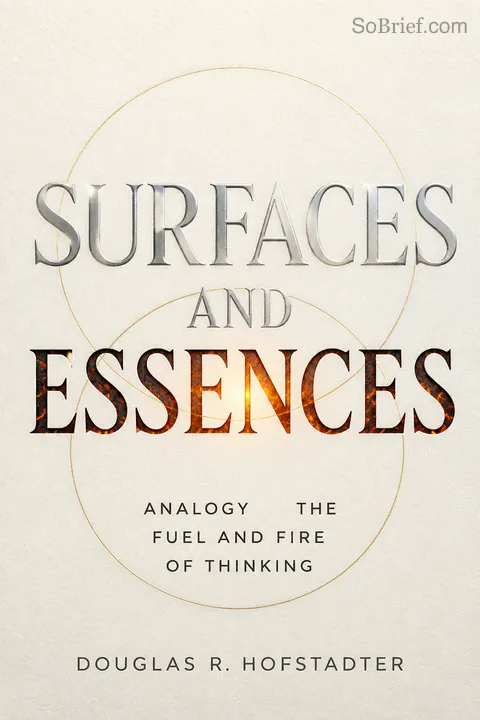
Surfaces and Essences: Analogy as the Fuel and Fire of Thinking receives mixed reviews. Some praise its insightful exploration of analogy in human cognition, while others criticize its length and repetitiveness. Readers appreciate the book's examination of language, categorization, and scientific thinking, particularly the chapter on Einstein's thought processes. However, many find the writing style tedious and the examples excessive. Some reviewers suggest the book could have been more concise while still conveying its core ideas about the role of analogy in human thought and intelligence.
People Also Read








Glossary
analogy-making
Mapping new to rememberedThe authors' broad term for linking a newly perceived object, action, or situation to a mental structure formed from earlier experience. The link can support recognition, inference, memory retrieval, explanation, or discovery. It includes ordinary acts such as recognizing a cup as a cup, not only deliberate comparisons between distant subjects.
categorization
Linking an instance to a conceptThe tentative, context-sensitive act of connecting something encountered to a mental category. In this book, categories are not fixed boxes with sharp borders; their membership can be central, marginal, or dependent on the current task. The authors argue that categorization and analogy-making describe the same basic linking process from different perspectives.
naïve analogy
Familiar model for the unfamiliarAn automatic analogy through which a person interprets a new concept using familiar knowledge, often without noticing the transfer. The model can make learning easier, but it may also narrow understanding. For example, treating division as sharing works for distributing objects but makes it difficult to imagine division producing a larger answer.
ad-hoc categories
Goal-built categoriesTemporary categories assembled to serve a particular goal, rather than retrieved as established concepts. A parent planning a gift for a child may group together a book, shoes, a game, or an outing because each is a possible present. The items need not resemble one another; their shared role in the current task unites them.
marking
One word, nested meaningsA linguistic pattern in which one word names both a broad category and a narrower subcategory. Context determines which sense is intended. The broad, unmarked sense may include cases excluded by the narrower, marked sense. The book uses examples such as man, which can refer broadly to humans or narrowly to males.
frame blend
Merged mental scenariosA mental construction that combines elements from different situations or conceptual frames into one imagined scene. The blend can make an explanation vivid or produce humor, but it can also confuse interpretation. Describing an old event as having happened right here, while pointing to a present location, blends the remembered scene with the current one.
caricature analogy
Exaggerated explanatory comparisonA deliberately invented comparison that transfers the central structure of a situation into a different, often more vivid setting. Speakers use it to explain, persuade, or express strong reactions. The new scene may exaggerate the original situation's absurdity, but it works only if listeners can recognize the relation shared by the two cases.
banalogy
Unnoticed everyday analogyThe authors' term for a commonplace analogy so ordinary that speakers and listeners rarely notice it as one. A reply such as me too links another person's action or experience to one's own, even when the details differ. These small comparisons show how analogy supports routine communication, not only insight or invention.
conceptual space
Map of mental conceptsThe authors' model of concepts as overlapping, fuzzy regions rather than discrete boxes. Languages cover central regions of shared human experience similarly, but their vocabularies diverge toward less common or culturally specific concepts. A language may have one compact expression where another needs several words or lacks a standard phrase.
FAQ
What's Surfaces and Essences: Analogy as the Fuel and Fire of Thinking about?
- Core Thesis: The book argues that analogy is the fundamental mechanism of human thought, shaping how we form concepts and understand the world.
- Role of Analogy: It explores how analogies are not just linguistic tools but are central to cognition, influencing how we categorize and interpret experiences.
- Interconnected Concepts: Hofstadter illustrates how analogies connect various domains, such as language, science, and everyday life, to enhance our understanding.
Why should I read Surfaces and Essences?
- Insight into Cognition: The book offers a deep dive into how analogies shape human thought, challenging traditional views of cognition.
- Interdisciplinary Appeal: It connects ideas from psychology, linguistics, and philosophy, making it relevant for a wide audience interested in cognitive science.
- Engaging Examples: Hofstadter uses relatable anecdotes and examples to make complex concepts accessible and enjoyable to read.
What are the key takeaways of Surfaces and Essences?
- Analogy's Central Role: The book posits that analogy is at the heart of all thinking, influencing how we categorize and understand the world.
- Conceptual Fluidity: Concepts are dynamic and evolve through experiences, rather than being fixed definitions, allowing for a richer understanding of language and thought.
- Cognitive Flexibility: It emphasizes the importance of cognitive flexibility, showing how we can shift between categories and perspectives effortlessly.
What are the best quotes from Surfaces and Essences and what do they mean?
- "Analogy is the fuel and fire of thinking.": This quote encapsulates the book's main thesis, emphasizing that analogy is essential for forming concepts and understanding the world.
- "Categories are not drawers into which clear-cut items are automatically sorted.": This highlights the complexity of categorization, suggesting that our mental categories are fluid and influenced by context and experience.
- "The essence of genius is the ability to see connections where others see none.": This reflects the idea that creative thinking involves recognizing relationships between seemingly unrelated concepts.
How do the authors define analogy in Surfaces and Essences?
- Cognitive Process: Analogy is defined as a cognitive process that connects different concepts based on perceived similarities, fundamental to how we think and categorize experiences.
- Relational Mapping: It involves mapping relationships from one domain to another, allowing for deeper insights and understanding.
- Everyday Examples: The authors provide examples of how we use analogy in daily life, illustrating its deep integration into our cognitive processes.
How does Surfaces and Essences relate to artificial intelligence?
- Human vs. Machine Cognition: Hofstadter discusses the limitations of AI in recognizing and understanding analogies, highlighting the unique aspects of human thought.
- Challenges in AI: Current AI systems struggle with tasks requiring deep understanding and analogy-making, which are natural for humans.
- Future Implications: While AI may evolve, Hofstadter emphasizes that human-like understanding remains a distant goal, underscoring the complexity of human cognition.
What role does language play in Surfaces and Essences?
- Language as a Tool: Language is portrayed as crucial for expressing and communicating concepts formed through analogy, shaping how we categorize experiences.
- Cultural Variability: Different languages may categorize concepts differently, affecting how speakers perceive the world, highlighting the interplay between language and thought.
- Idiomatic Expressions: The book discusses idiomatic expressions as examples of how language encapsulates complex categories, often relying on analogies.
How do the authors address the limitations of traditional views on categorization in Surfaces and Essences?
- Critique of Rigid Definitions: The authors critique the classical view that categories have precise definitions and boundaries, arguing for a more fluid understanding.
- Emphasis on Context: They stress that context plays a significant role in how we categorize experiences, leading to a more nuanced understanding.
- Dynamic Nature of Concepts: Concepts are presented as dynamic entities that evolve over time through experiences and analogies, encouraging a reconsideration of fixed categories.
How does Hofstadter illustrate the concept of abstraction in Surfaces and Essences?
- Levels of Abstraction: Categories can exist at different levels of abstraction, with broader categories encompassing narrower ones.
- Examples of Abstraction: Hofstadter uses examples like "coffee" to show how its meaning can shift based on context, illustrating the fluidity of categorization.
- Cognitive Adaptation: Navigating these levels of abstraction is a key aspect of human cognition, allowing for adaptability in thought and language.
What is the significance of categories in Surfaces and Essences?
- Mental Structures: Categories help organize and make sense of experiences, formed through a series of analogies and evolving over time.
- Fluid Boundaries: Categories have fluid boundaries, allowing for flexibility in understanding and interpretation.
- Cultural Influence: Categories are influenced by cultural context, meaning different cultures may categorize experiences differently, highlighting the subjective nature of categorization.
How do the authors connect analogy and categorization in Surfaces and Essences?
- Interconnected Processes: Analogy and categorization are two sides of the same cognitive coin, essential for understanding and interpreting experiences.
- Fluidity of Concepts: Concepts evolve through a continuous process of analogy-making and categorization, highlighting the dynamic nature of human thought.
- Practical Implications: Understanding this relationship can enhance cognitive flexibility and creativity, encouraging readers to apply these insights in their own thinking.
How does Surfaces and Essences relate to education and learning?
- Role of Analogies in Learning: Analogies are crucial for understanding new concepts, helping students relate unfamiliar ideas to familiar ones.
- Persistence of Naïve Analogies: Naïve analogies often persist into adulthood, influencing understanding of complex subjects, potentially leading to misconceptions.
- Teaching Strategies: Educators should be aware of the analogies students use and work to refine their understanding, enhancing teaching effectiveness and promoting deeper learning.
About the Author
Other books by Douglas R. Hofstadter



Download PDF
Download EPUB
.epub digital book format is ideal for reading ebooks on phones, tablets, and e-readers.








